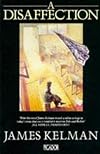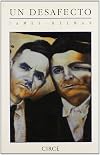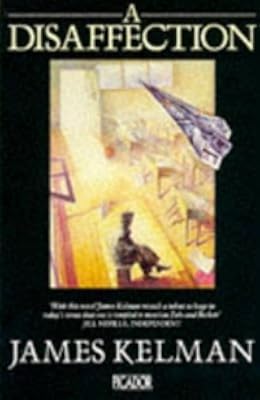
A Disaffection
by James Kelman
On This Page
Description
Patrick Doyle is a twenty-nine-year-old teacher in an ordinary comprehensive school. Isolated, frustrated and increasingly bitter at the system he is employed to maintain, he begins his rebellion, fuelled by drink and his passionate, unrequited love for a fellow teacher.Tags
Recommendations
















Member Reviews
This is my final book from the 1989 Booker shortlist and perhaps the hardest to assess. Kelman is an uncompromising writer with a very striking style, and I suspect that I might have enjoyed this one more if [b:How Late it Was, How Late|89208|How Late it Was, How Late|James Kelman|https://images.gr-assets.com/books/1358745713s/89208.jpg|1193963] was not still fresh in the mind.
This time we are in the head of Patrick Doyle, a 29 year old Glaswegian teacher in a sort of early mid life crisis in which he rebels against what he sees as the futile conformity of the educational system and his part in the perpetuation of a system and society he feels fundamentally opposed to. He is also seeking personal fulfilment, pursuing a married fellow show more teacher who wants to help him but does not requite his feelings, dealing with family issues and pursuing a strange dream in which he sees some electrical pipes he has found as musical instruments that offer some form of escape.
The whole book covers less than a week in his life, and very little is actually resolved, but the whole amounts to a compelling vision, if a very bleak one. show less
This time we are in the head of Patrick Doyle, a 29 year old Glaswegian teacher in a sort of early mid life crisis in which he rebels against what he sees as the futile conformity of the educational system and his part in the perpetuation of a system and society he feels fundamentally opposed to. He is also seeking personal fulfilment, pursuing a married fellow show more teacher who wants to help him but does not requite his feelings, dealing with family issues and pursuing a strange dream in which he sees some electrical pipes he has found as musical instruments that offer some form of escape.
The whole book covers less than a week in his life, and very little is actually resolved, but the whole amounts to a compelling vision, if a very bleak one. show less
There are a number of ways to write a book review but by and large I stick to the simple, selfish formula: I write reviews in a straightforward way that I would like to read. I like to read reviews that allow me to make up my own mind about whether what's reviewed is for me or not. Mostly that suits me: I have no axe to grind - I'm just telling the reader what I thought of a book.
This time though I have an axe - I really want you to read this book - I want to share it with you - this is a great book, not just a good book but a great book. This book demonstrates what the new novel can be - should be. Kelman is a true successor to Joyce and Beckett: he is the British Sorrentino but whereas it is difficult to find Sorrentino's influence show more flowing through American literature Kelman's legacy is set already with writers like Agnes Owens, Roddy Doyle and Irving Welsh.
I could bore you with a list of writers who influenced Kelman directly or indirectly but that would be pointless, simply accept that Kelman did not arrive at his style from nowhere, a broad wealth of British experimentation with the novel preceded his breakthrough.
Kelman uses dialect (Glaswegian) and vernacular throughout his prose and not just in the dialogue which is possibly difficult for anybody who has never heard a Scots accent but for those who have it is a simple matter to read tricky bits out loud to understand. HIs eye and his ear are nearly 20/20 and pitch perfect and, although there is little in the way of plot there is such a wealth of insight and nuance that one sometimes has to consciously draw breath and take pause to digest.
He has one ploy that I particularly enjoy and that is to have his protagonist form and partly answer a question (usually about himself or his trajectory) and then leave the reader to complete the response for himself or herself - in this way Kelman draws the reader into the very soul of the protagonist and by the end of this wonderful novel you have a very good understanding of the very nature of disaffection.
Kelman is very good and this is a fine example of the modern novel - I urge you to read it. show less
This time though I have an axe - I really want you to read this book - I want to share it with you - this is a great book, not just a good book but a great book. This book demonstrates what the new novel can be - should be. Kelman is a true successor to Joyce and Beckett: he is the British Sorrentino but whereas it is difficult to find Sorrentino's influence show more flowing through American literature Kelman's legacy is set already with writers like Agnes Owens, Roddy Doyle and Irving Welsh.
I could bore you with a list of writers who influenced Kelman directly or indirectly but that would be pointless, simply accept that Kelman did not arrive at his style from nowhere, a broad wealth of British experimentation with the novel preceded his breakthrough.
Kelman uses dialect (Glaswegian) and vernacular throughout his prose and not just in the dialogue which is possibly difficult for anybody who has never heard a Scots accent but for those who have it is a simple matter to read tricky bits out loud to understand. HIs eye and his ear are nearly 20/20 and pitch perfect and, although there is little in the way of plot there is such a wealth of insight and nuance that one sometimes has to consciously draw breath and take pause to digest.
He has one ploy that I particularly enjoy and that is to have his protagonist form and partly answer a question (usually about himself or his trajectory) and then leave the reader to complete the response for himself or herself - in this way Kelman draws the reader into the very soul of the protagonist and by the end of this wonderful novel you have a very good understanding of the very nature of disaffection.
Kelman is very good and this is a fine example of the modern novel - I urge you to read it. show less
Alternately funny and depressing, this snapshot of the life of a disillusioned Glasgow teacher is beautifully crafted in the language of that city. Patrick, the central character is lonely and frustrated and as the novel progresses the bitterness that is growing inside him threatens to take him over. I would highly recommend this book - but not if you want to be cheered up!
At about 80 pages in I was ready to give up on this book, but in the end I'm really glad I didn't. Many people struggle with Kelman's language, in particular his use of authentic Glasgow dialect. I found the writing technically brilliant and easy to read (perhaps being a Scot helps), but being placed in the interior monologue of a troubled, bitter, confused, lonely twenty something was a place I really didn't want to be, and that's what I struggled with in reading the novel. However, the more I read, the more I recognized what Patrick Doyle, the 'hero' felt about class and politics in late eighties Scotland, and the struggles of an individual to find his place in society.
La novela de Kelman refleja las experiencias vividas en Glasgow, su ciudad natal. Con un lenguaje sincero que no hace concesiones a convencionalismos y unas observaciones perspicaces de las vidas de personas sencillas, Kelman ha sido aclamado como la voz de la clase obrera del oeste de Escocia, alienada, oprimida e ignorante.
Jan 25, 2009Spanish
Ratings
Members
- Recently Added By
Lists

Booker Prize
491 works; 62 members

Man Booker Prize Longlist 1989
6 works; 2 members

Booker Prize Shortlist: Titles Not Yet Read
161 works; 4 members

living room bookshelf
150 works; 1 member
Author Information

40+ Works 3,808 Members
Awards and Honors
Common Knowledge
- Original publication date
- 1989
- People/Characters
- Patrick Doyle
- Important places
- Glasgow, Scotland, UK
- First words
- Patrick Doyle was a teacher.
Classifications
Statistics
- Members
- 355
- Popularity
- 88,647
- Reviews
- 5
- Rating
- (3.64)
- Languages
- English, Spanish
- Media
- Paper, Ebook
- ISBNs
- 7
- ASINs
- 3