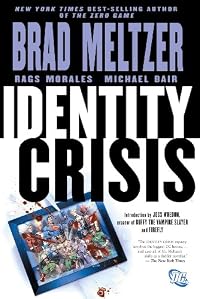
Identity Crisis
by Brad Meltzer, Michael Bair (Illustrator), Rags Morales (Illustrator)
DC Comics Crisis (3), Identity Crisis (Collections and Selections — 1-7), Superman TPBs Post-Crisis Continuity (Identity Crisis 1-7)
On This Page
Description
Novelist Brad Meltzer's #1 NEW YORK TIMES bestselling miniseries that rocked the DC Universe and influenced new storylines for years to come. When Sue Dibny, wife of the Elongated Man, is murdered in her own home, the superhero community is devastated. They come together in mourning, hold their loved ones closer, and immediately begin a worldwide search to find her killer. But a handful of heroes think they already know who murdered Sue Dibny. Years ago, to protect Sue and others like her show more from super-villains, Green Arrow, Hawkman, Black Canary, the Atom and Zatanna crossed a line. Now, their long-buried secret will break the superhero community apart. show lessTags
Recommendations






Member Reviews
I had honestly forgotten I'd already read this years ago (Really, over a decade ago? Wow...) until I came to Goodreads to add it. Luckily, I had also forgotten the plot so it was like reading it for the first time again. This really is a fantastic plotline about how superhero secret identities are meant to protect the heroes' loved ones. So when someone starts attacking and threatening them, the DC heroes declare war to find the perpetrator.
Reading this again with a different eye, I still loved the story but found parts of it very problematic. For one, it focused almost exclusively on male superheroes - no women heroes had their family members targeted. Given who the murderer was, it sort of made sense, but still seemed very skewed. It show more never really showed a women hero worrying about a loved one, as if that protective instinct was only reserved for men, though there were two panels showing Dinah and Zatanna standing at their fathers' graves. Meltzer could very well have had a brief scene of Barbara calling her dad; instead, we get a flashback of her getting shot by the Joker.
It's hard to reconcile a really powerful storyline with the paternalistic undertone. The story is supposed to make the reader feel uncomfortable, though I'm not sure this is a facet that the author had intended. While Dinah and Zatanna had major parts to play in the plot, they were never a POV character - and it was an odd choice to make Ollie Queen one, I thought.
A good -- if problematic -- read. show less
Reading this again with a different eye, I still loved the story but found parts of it very problematic. For one, it focused almost exclusively on male superheroes - no women heroes had their family members targeted. Given who the murderer was, it sort of made sense, but still seemed very skewed. It show more never really showed a women hero worrying about a loved one, as if that protective instinct was only reserved for men, though there were two panels showing Dinah and Zatanna standing at their fathers' graves. Meltzer could very well have had a brief scene of Barbara calling her dad; instead, we get a flashback of her getting shot by the Joker.
It's hard to reconcile a really powerful storyline with the paternalistic undertone. The story is supposed to make the reader feel uncomfortable, though I'm not sure this is a facet that the author had intended. While Dinah and Zatanna had major parts to play in the plot, they were never a POV character - and it was an odd choice to make Ollie Queen one, I thought.
A good -- if problematic -- read. show less
One of my very favourite graphic novels, and perhaps my very favourite super hero team-up or event book of all time. Meltzer's ability to quickly get me inside the heads of the myriad of characters -- both ones I was familiar with from before and the many I was not -- and to feel their emotions and think their thoughts is quite impressive. Especially considering how often the narrative hops back and forth between different viewpoints. Morales' artwork is fantastic -- pretty, exciting and most importantly, deeply emotional when it needs to be. Which is often, in this story.
I first bought this comic on a whim, needing something to read on a 4 hour boat ride. I'm not ashamed to say I teared up several times there in my seat, reading this. show more It's not often a Justice League comic makes you cry, let alone multiple times, but this one did. I've re-read it twice since then, and while the emotional impact is of course somewhat muted upon revisiting, my eyes got distinctly moist at several points even during the third read-through. It's that effective.
"Identity Crisis" is a murder mystery, a conspiracy thriller, a character drama, and a super hero action adventure, all rolled into one, and even upon finishing it, it's tough to know which it is more. What it most definitely is, is a loving dive into DC's many fantastic characters, and -- almost incidentally -- tribute to the Silver Age comics that somehow simultaneously makes the darker, modern incarnations all the more compellingly flawed and conflicted. And what it is most of all is a story about love, and grief, and relationships. And if you know the names of more than five DC characters (which you do. You know you do. Even if you've only ever seen one of the movies, you know the names of three characters from "Superman" alone.), I think you'd enjoy reading this. show less
I first bought this comic on a whim, needing something to read on a 4 hour boat ride. I'm not ashamed to say I teared up several times there in my seat, reading this. show more It's not often a Justice League comic makes you cry, let alone multiple times, but this one did. I've re-read it twice since then, and while the emotional impact is of course somewhat muted upon revisiting, my eyes got distinctly moist at several points even during the third read-through. It's that effective.
"Identity Crisis" is a murder mystery, a conspiracy thriller, a character drama, and a super hero action adventure, all rolled into one, and even upon finishing it, it's tough to know which it is more. What it most definitely is, is a loving dive into DC's many fantastic characters, and -- almost incidentally -- tribute to the Silver Age comics that somehow simultaneously makes the darker, modern incarnations all the more compellingly flawed and conflicted. And what it is most of all is a story about love, and grief, and relationships. And if you know the names of more than five DC characters (which you do. You know you do. Even if you've only ever seen one of the movies, you know the names of three characters from "Superman" alone.), I think you'd enjoy reading this. show less
Brad Meltzer is apparently a famous (or at least best-selling) thriller novelist. He made his comics debut with Green Arrow: The Archer's Quest, which I found fairly good, but there was one real reason I was looking forward to this book: Elongated Man. (Well, sort of.)
Anyone who has the misfortune of discussing comic books with me for a sustained period of time will rapidly learn that one of two ongoings I own a complete run of is Justice League Europe and then proceed to roll their eyes and stop talking to me. But the truth is that JLE introduced me to many of DC's second-string characters... and I love second-string characters, which is probably why Nite Owl is my favorite Watchman. Ralph Dibny, the Elongated Man, has a fairly good show more run in JLE: he's treated decently by Keith Giffen and his various collaborators, he really comes into his own when Gerard Jones takes over the title; his role in the Red Winter storyline is excellent. (Someday, I'll pick up the miniseries Elongated Man: Europe '92, his only-ever title, which was penned by Jones.) But how can you not love him? He's goofy, he's got a fabulous wife, his nose twitched when he smells a mystery, and he doesn't even bother with that secret identity malarkey.
Which is where the trouble begins. Because, as is probably well known by this point, but I shall warn you that there are some SPOILERS AHEAD, this is the book where Sue Dibny dies. How can this happen? All too easily, unfortunately, as the Dibnys are well known to the public. This is why I was sort of looking forward to the book: I love Ralph and Sue, and I knew that their marriage ending like this would be terrible. But I also knew that if it did, a good writer could make something really good out of it.
Meltzer turns out to be a very good writer indeed. The first chapter is nothing short of amazing, even when you know what's coming. It jumps back and forth between "Now" as various heroes hear the news about Sue and a countdown to the moment of death as Ralph goes on patrol with a Justice League newbie, telling her about himself... and Sue. The moment where Ralph finds out what happened is devastating, thanks in a large part to Rags Morales's brilliant artwork, which uses Ralph's stretching ability to great emotional effect: when he finds Sue's body, his face contorts in unreal agony. And when the funeral comes, he literally cannot hold himself together. It's tragic to watch: this normally witty, talkative man doesn't know what to say and can't even compose himself. And why would he be able to? He's lost the love of his life. In a medium and genre where death can often be portrayed all too casually, it really drives home what's happened.
The emotional effect is definitely Meltzer's strong point, and the story is replete with gripping, real moments, from small ones like Clark visiting his parents to big ones like Tim Drake dealing with his father learning of his identity as Robin. This latter one initially seems small, but the importance of this relationship to the book grows gradually as it progresses, eventually culminating in a rather intense sequence involving Batman, Robin, and Captain Boomerang, which I found more than gripping. A lot of the book is about family, as you might have guessed from reading this review so far: husbands and wives, fathers and sons, mentors and mentees. It works well.
Of course, it isn't all high emotional drama; we also get attempts to unravel the mystery of who killed Sue Dibny. But, not quite: while most of the Justice League, the Justice Society, and the rest of Earth's heroes round up suspects, a group within the Justice League thinks they know who did it: Doctor Light. This is where a lot of the drama of the book is centered, and it's also home to what's possibly an even more controversial event than the murder of Sue: the rape of Sue. The book reveals that during the JLA's "satellite era" (the 1970s), Dr. Light broke onto the satellite and raped Sue. Whoa. This is followed by still more revelations: a secret cabal within the Justice League (Green Arrow, Hawkman, Zatanna, the Atom, Black Canary, the Flash, and Green Lantern) regularly mind-wiped villains who learned too much about the JLA, and they not only erased Dr. Light's memories, but rewrote his personality to stop it from ever happening again. And then another revelation, possibly not as big, but one with long-term repercussions. I'll keep this one quiet at least. It's a lot to take in, as Meltzer reworks a lot of old continuity and casts it into a considerably distant light. But, I (admittedly someone who's never read any 1970's JLA comics) think it works. There's darkness for darkness's sake, but this is darkness that explores the nuances of what it means to be a hero, and what it means to be the loved one of a hero. There are lines to tread, and the heroes here crossed them: and they knew it. I think at times it doesn't quite work within their established characters (as someone who's been reading a lot of Green Arrow of late, I don't entirely buy his complicity, or the way it would affect his relationship with Hawkman), but it works well enough-- and it certainly works for this story.
Interestingly enough (and as pointed out by Eric Burns in his articles on Identity Crisis), the rape of Sue turns out to be a red herring, because Dr. Light isn't behind it at all. But we still get an interesting tale of the supervillain community as well, as they band together (for money, of course) to protect Dr. Light, who is naturally enraged once he figures out what happened to him so long ago. I like the stuff with the villain, especially the new Calculator, and now I finally get what was up with Merlyn after my complaining about Green Arrow: Heading into the Light. He's still kinda lame, though. The sequences where all the villains chill out together are good fun. However, Deathstroke the Terminator, the world's dumbest-named and dumbest-costumed supervillain shows up here, somehow managing to incapacitate half of the Justice League in a highly contrived action sequence where they all take turns attacking him for some reason. This dude couldn't take out Gangbuster, much less Green Arrow or the Flash.
Is it all sunshine? No. Maybe my biggest problem is that though I like the eventual revelation of the actual killer (it's twisted, but it makes sense and works well with the themes of the story), it's one of those stories where as soon as the mystery is solved, the killer is revealed by their own self anyway, rendering all the deduction redundant. So what's the point then? And I can take the point about the portrayal of women here: Sue Dibny is pretty much the ultimate victim, but that's ameliorated by this being once chapter in her very long history. And though the portrayal of Jean Loring might also have its problems, there's enough other female characters here to show that it's not as two-dimensional as it's sometimes made out to be. There's also some side stories I don't get: why was Firestorm even in this?
I've already mentioned the art, but it's worth mentioning again: this is one of those rare comics where it wouldn't work half so well with another artist at the controls. This stuff is intense when it needs to be intense, emotional when it needs to be emotional, action-packed when it needs to be action-packed. Quality artwork all around, pencils, inks, and colors alike. (On the other hand, the original series covers are included between chapters here... and they're by can-only-draw-one-body-type-for-each-sex Michael Turner. Thank God they didn't end up on the cover of the collected edition.)
The title of the story is Identity Crisis, but despite that, it's not about protecting secret identities, it's not some story that could only apply to superheroes. It's about personal identities: who we are and what we stand for and what we're willing to do. And most of all, how our identities derive from those around us, lovers, parents, friends, enemies, and spouses alike. Which is why that final panel of Ralph Dibny, like so many others in this book, just hits you in the gut.
DC Comics Crises: « Previous in sequence | Next in sequence » show less
Anyone who has the misfortune of discussing comic books with me for a sustained period of time will rapidly learn that one of two ongoings I own a complete run of is Justice League Europe and then proceed to roll their eyes and stop talking to me. But the truth is that JLE introduced me to many of DC's second-string characters... and I love second-string characters, which is probably why Nite Owl is my favorite Watchman. Ralph Dibny, the Elongated Man, has a fairly good show more run in JLE: he's treated decently by Keith Giffen and his various collaborators, he really comes into his own when Gerard Jones takes over the title; his role in the Red Winter storyline is excellent. (Someday, I'll pick up the miniseries Elongated Man: Europe '92, his only-ever title, which was penned by Jones.) But how can you not love him? He's goofy, he's got a fabulous wife, his nose twitched when he smells a mystery, and he doesn't even bother with that secret identity malarkey.
Which is where the trouble begins. Because, as is probably well known by this point, but I shall warn you that there are some SPOILERS AHEAD, this is the book where Sue Dibny dies. How can this happen? All too easily, unfortunately, as the Dibnys are well known to the public. This is why I was sort of looking forward to the book: I love Ralph and Sue, and I knew that their marriage ending like this would be terrible. But I also knew that if it did, a good writer could make something really good out of it.
Meltzer turns out to be a very good writer indeed. The first chapter is nothing short of amazing, even when you know what's coming. It jumps back and forth between "Now" as various heroes hear the news about Sue and a countdown to the moment of death as Ralph goes on patrol with a Justice League newbie, telling her about himself... and Sue. The moment where Ralph finds out what happened is devastating, thanks in a large part to Rags Morales's brilliant artwork, which uses Ralph's stretching ability to great emotional effect: when he finds Sue's body, his face contorts in unreal agony. And when the funeral comes, he literally cannot hold himself together. It's tragic to watch: this normally witty, talkative man doesn't know what to say and can't even compose himself. And why would he be able to? He's lost the love of his life. In a medium and genre where death can often be portrayed all too casually, it really drives home what's happened.
The emotional effect is definitely Meltzer's strong point, and the story is replete with gripping, real moments, from small ones like Clark visiting his parents to big ones like Tim Drake dealing with his father learning of his identity as Robin. This latter one initially seems small, but the importance of this relationship to the book grows gradually as it progresses, eventually culminating in a rather intense sequence involving Batman, Robin, and Captain Boomerang, which I found more than gripping. A lot of the book is about family, as you might have guessed from reading this review so far: husbands and wives, fathers and sons, mentors and mentees. It works well.
Of course, it isn't all high emotional drama; we also get attempts to unravel the mystery of who killed Sue Dibny. But, not quite: while most of the Justice League, the Justice Society, and the rest of Earth's heroes round up suspects, a group within the Justice League thinks they know who did it: Doctor Light. This is where a lot of the drama of the book is centered, and it's also home to what's possibly an even more controversial event than the murder of Sue: the rape of Sue. The book reveals that during the JLA's "satellite era" (the 1970s), Dr. Light broke onto the satellite and raped Sue. Whoa. This is followed by still more revelations: a secret cabal within the Justice League (Green Arrow, Hawkman, Zatanna, the Atom, Black Canary, the Flash, and Green Lantern) regularly mind-wiped villains who learned too much about the JLA, and they not only erased Dr. Light's memories, but rewrote his personality to stop it from ever happening again. And then another revelation, possibly not as big, but one with long-term repercussions. I'll keep this one quiet at least. It's a lot to take in, as Meltzer reworks a lot of old continuity and casts it into a considerably distant light. But, I (admittedly someone who's never read any 1970's JLA comics) think it works. There's darkness for darkness's sake, but this is darkness that explores the nuances of what it means to be a hero, and what it means to be the loved one of a hero. There are lines to tread, and the heroes here crossed them: and they knew it. I think at times it doesn't quite work within their established characters (as someone who's been reading a lot of Green Arrow of late, I don't entirely buy his complicity, or the way it would affect his relationship with Hawkman), but it works well enough-- and it certainly works for this story.
Interestingly enough (and as pointed out by Eric Burns in his articles on Identity Crisis), the rape of Sue turns out to be a red herring, because Dr. Light isn't behind it at all. But we still get an interesting tale of the supervillain community as well, as they band together (for money, of course) to protect Dr. Light, who is naturally enraged once he figures out what happened to him so long ago. I like the stuff with the villain, especially the new Calculator, and now I finally get what was up with Merlyn after my complaining about Green Arrow: Heading into the Light. He's still kinda lame, though. The sequences where all the villains chill out together are good fun. However, Deathstroke the Terminator, the world's dumbest-named and dumbest-costumed supervillain shows up here, somehow managing to incapacitate half of the Justice League in a highly contrived action sequence where they all take turns attacking him for some reason. This dude couldn't take out Gangbuster, much less Green Arrow or the Flash.
Is it all sunshine? No. Maybe my biggest problem is that though I like the eventual revelation of the actual killer (it's twisted, but it makes sense and works well with the themes of the story), it's one of those stories where as soon as the mystery is solved, the killer is revealed by their own self anyway, rendering all the deduction redundant. So what's the point then? And I can take the point about the portrayal of women here: Sue Dibny is pretty much the ultimate victim, but that's ameliorated by this being once chapter in her very long history. And though the portrayal of Jean Loring might also have its problems, there's enough other female characters here to show that it's not as two-dimensional as it's sometimes made out to be. There's also some side stories I don't get: why was Firestorm even in this?
I've already mentioned the art, but it's worth mentioning again: this is one of those rare comics where it wouldn't work half so well with another artist at the controls. This stuff is intense when it needs to be intense, emotional when it needs to be emotional, action-packed when it needs to be action-packed. Quality artwork all around, pencils, inks, and colors alike. (On the other hand, the original series covers are included between chapters here... and they're by can-only-draw-one-body-type-for-each-sex Michael Turner. Thank God they didn't end up on the cover of the collected edition.)
The title of the story is Identity Crisis, but despite that, it's not about protecting secret identities, it's not some story that could only apply to superheroes. It's about personal identities: who we are and what we stand for and what we're willing to do. And most of all, how our identities derive from those around us, lovers, parents, friends, enemies, and spouses alike. Which is why that final panel of Ralph Dibny, like so many others in this book, just hits you in the gut.
DC Comics Crises: « Previous in sequence | Next in sequence » show less
Superbly written, brilliantly drawn, and well-scripted. Interview snippets of key scenes included in the back was worth the read for more insight into the construction of the series.
The plot of Identity Crisis is that Sue Dibny, the Elongated Man's wife, is murdered. Pretty much every DC hero then tries to solve the mystery of her murder, which generally involves questioning every DC villain.
Like any mystery, it's full of twists and turns, shocking revelations that make little sense, and a great deal of past dirt is dug up. In particular, it becomes clear that a subset of JLA members have been secretly doing something the rest of the JLA would not approve of. This revelation applies retroactively, reframing tons of past events in the DC universe. Really, that's the name of the game here, lots of stuff keeps getting dug up and retcons all kinds of stuff in DC, generally by infusing it with darkness and sex.
The idea show more is interesting if a little over the top in it's "make everything dark and gritty!" approach. But it's a good mystery, with some kind of crazed attacker figuring out the family members of hereos and attacking them in their homes, stakes raising, and lots of sweeping character arcs. All in all, it's decent and engaging.
Now, I have to mention, the way women are treated in this miniseries is appalling. The entire thing is, obviously, a Women in the Fridge trope but the book goes way beyond it. Women are raped, and constantly discussed in terms of men protecting them. The main problem, as worded by a character in the book is that "people are attacking our wives!". Really? Not just "spouses"? No female heroes are worried about their husbands being attacked, it's all men. This kind of thing is surprising from a company that produces an icon of feminism, Wonder Woman. In fact, the Amazonian's role is embarrassing. She appears on the cover of one of the issues, but when she actually shows up she has exactly one line, spoken with her out of frame, and after Oliver Queen's narrator comments on her "rack". The other female heroes offer occasional, half-hearted "I can take care of myself" protestation, but pretty much every woman is pathetic, weak, frail, and in need of a man's protection. Even fearless star reporter Lois Lane becomes a frightened little girl and asks Superman to stay home and protect her. This treatment of women continues through the entire book, culminating in the last issue with the grand finale of misogyny in a twist that I won't spoil. I know this kind of commentary comes off as super-sensitive, but I found myself constantly distracted by how crapped-on women were in this book, it was extremely off-putting. show less
Like any mystery, it's full of twists and turns, shocking revelations that make little sense, and a great deal of past dirt is dug up. In particular, it becomes clear that a subset of JLA members have been secretly doing something the rest of the JLA would not approve of. This revelation applies retroactively, reframing tons of past events in the DC universe. Really, that's the name of the game here, lots of stuff keeps getting dug up and retcons all kinds of stuff in DC, generally by infusing it with darkness and sex.
The idea show more is interesting if a little over the top in it's "make everything dark and gritty!" approach. But it's a good mystery, with some kind of crazed attacker figuring out the family members of hereos and attacking them in their homes, stakes raising, and lots of sweeping character arcs. All in all, it's decent and engaging.
Now, I have to mention, the way women are treated in this miniseries is appalling. The entire thing is, obviously, a Women in the Fridge trope but the book goes way beyond it. Women are raped, and constantly discussed in terms of men protecting them. The main problem, as worded by a character in the book is that "people are attacking our wives!". Really? Not just "spouses"? No female heroes are worried about their husbands being attacked, it's all men. This kind of thing is surprising from a company that produces an icon of feminism, Wonder Woman. In fact, the Amazonian's role is embarrassing. She appears on the cover of one of the issues, but when she actually shows up she has exactly one line, spoken with her out of frame, and after Oliver Queen's narrator comments on her "rack". The other female heroes offer occasional, half-hearted "I can take care of myself" protestation, but pretty much every woman is pathetic, weak, frail, and in need of a man's protection. Even fearless star reporter Lois Lane becomes a frightened little girl and asks Superman to stay home and protect her. This treatment of women continues through the entire book, culminating in the last issue with the grand finale of misogyny in a twist that I won't spoil. I know this kind of commentary comes off as super-sensitive, but I found myself constantly distracted by how crapped-on women were in this book, it was extremely off-putting. show less
IDENTITY CRISIS is a book that I read simply because I got sick of running into spoilers while attempting to read about it on the Internet. Now that I've read it, I see why there's so much spoilerific content out there - it's a work that's difficult to talk about without giving away significant chunks of the plot. Suffice to say, then, that this is a graphic novel in which a minor, but not unknown, character in the DC Universe loses their life in the first chapter. This is an event that should not have much emotional heft to it, but the creators of said graphic novel do such a wonderful and efficient job of making you emotionally invested in said character that it indeed does. The remainder of the story concerns the unraveling of the show more mystery behind said character's death, and this is also played out with great skill. The only major caveat I would give to the prospective reader is that this work may be a little too "inside-baseball" for someone who is new to the DC Universe - I have been reading DC comics on and off for more than 40 years and there are a lot of references that I just didn't get.
A final note: one of the most enjoyable aspects of this edition are the many extras (creator commentaries and the like) in the back of the book. If you (like me) are as fascinated by the creative process that goes into a work like this as you are the work itself, make sure you don't skip this part. show less
A final note: one of the most enjoyable aspects of this edition are the many extras (creator commentaries and the like) in the back of the book. If you (like me) are as fascinated by the creative process that goes into a work like this as you are the work itself, make sure you don't skip this part. show less
A truly moving and imaginative work, not really a Justice League story per se, but most of the past and present members are featured, including some mixed baddies from the Silver Age. The main plot centers around the killing of Sue Dibny, wife of Ralph Dibny (the Elongated Man), and a beloved honorary member of the JLA. See, Ralph Dibny had been "out" for years, his identity no longer a secret. The JLA, reeling from the loss, soon learns that whoever killed Sue has targeted other JLA members' loved ones. This is a fascinating story in itself, as it brings up all the various sacrifices and conflicts in leading a double life, as most of the heroes do. But Meltzer and Morales have made their considerable talents a synergy, as we see in the show more afterwords exploring the genesis of the book. We also see the emotions that drive these characters as I have rarely seen, and some intriguing moral dilemmas are introduced as well. For example, if a villain learns your identity, is it acceptable to manipulate his memories to protect your loved ones? There are one or two "throw-in" scenes that don't seem essential to the storyline, but nevertheless work quite well (Captain Boomerang's day of playing "catch" with his son, for example). The final revelation of the killer is a tremendous shock, but in retrospect it might have been more effective to lay some more groundwork for the killer's motivations. Still, that would have run the risk of tipping off the reader. There are also a couple of other established characters besides Sue Dibny who meet their ends. A fine story, well-complemented by Morales' emotive artwork. It was fascinating to see the interplay between the two creators in the afterwords. show less
Members
- Recently Added By
Lists

Books Read By artturnerjr - 2014
34 works; 1 member

Blue Pyramid 1,276 Best Books of All Time
1,248 works; 32 members

Books Read in 2021
5,361 works; 114 members

Books Read in 2009
464 works; 11 members
Author Information

185+ Works 36,572 Members
Brad Meltzer was born on April 1, 1970 and grew up in Brooklyn, NY. He graduated from the University of Michigan and Columbia Law School. His first published title was called The Tenth Justice. His other works include Dead Even, The First Counsel, The Millionaires, The Book of Fate, The Zero Game, The Inner Circle and The Fifth Assassin. He is the show more Eisner Award-winning author of the critically acclaimed comic book, Justice League of America. He also wrote the non-fiction books, Heroes for My Son and Heroes for My Daughter. He has written speeches for former President Clinton's National Service Program and played himself as an extra in Woody Allen's film, Celebrity. In 2013, his title History Decoded: The 10 Greatest Conspiracies of All Time. In 2014 his titles, I Am Abraham Lincoln, I Am Amelia Earhart and I am Rosa Parks made The New York Times Best Seller List. In 2016, Meltzer's title's The House of Secrets, I Am George Washington, and I Am Jane Goodall made the New York Times Bestseller list. (Bowker Author Biography) show less

Some Editions
Awards and Honors
Series

DC Comics Crisis
6 works (3)

Identity Crisis
7 works (Collections and Selections — 1-7)

Superman TPBs Post-Crisis Continuity
146 works (Identity Crisis 1-7)
Belongs to Publisher Series
DC Comics Graphic Novel Collection (Special 5)
Work Relationships
Common Knowledge
- Canonical title
- Identity Crisis
- Original title
- Identity Crisis
- Original publication date
- 2005
- People/Characters
- Batman (Bruce Wayne); Elongated Man (Ralph Dibny); Wonder Woman (Diana); Black Canary (Dinah Drake Lance); Atom (Ray Palmer); Robin (Timothy Drake) (show all 26); Jean Loring; Green Arrow (Oliver Queen); Green Lantern (Kyle Rayner); Lois Lane; Firestorm (Ronald Raymond | Martin Stein); Doctor Mid-Nite (Pieter Anton Cross); Mister Terrific (Michael Holt); Jack Drake; Captain Boomerang (George "Digger" Harkness); Captain Boomerang Jr. (Owen Mercer); Green Arrow (Connor Hawke); Superman (Clark Kent | Kal-El); Kyle Rayner (Green Lantern); Flash (Barry Allen, Wally West); Barry Allen (The Flash); Wally West (The Flash); Sue Dibny; Connor Hawke; Owen Mercer; Red Tornado
- Important places
- Gotham City, New Jersey, USA; Metropolis, USA (Metropolis, New York, USA); Opal City; Justice League Satellite; Valhalla Cemetery, Metropolis, New York, USA
- Important events
- Murder of Sue Dibny
- Dedication
- For Ben Rubin, my Poppy, who used to make up the best Batman stories just because he knew I loved hearing them. -Brad Meltzer
Dedicated to Ralph, Flerida and Lisa. To Kyra, Lorraine, Devon, Isabel and Gwendolen. For friends, and a family's love and support; in the end that is what this story is about. And to the naysayers because this book speaks of... (show all) perseverance as well. Dad, chapter five is for us. I love you all. -Rags Morales - First words
- Opal City. Thirty minutes to now. Ralph Dibny and Lorrainne Reilly. Co-workers.
- Quotations
- She doesn't get annoyed often...But when she does, it reminds me of one thing...there are some things more potent than Kryptonite.
People aren't stupid, Wally. They believe what they want to believe. And hear what they want to hear. - Last words
- (Click to show. Warning: May contain spoilers.)Ralph and Sue Dibny. Husband and wife.
Classifications
- Genres
- Graphic Novels & Comics, Teen
- DDC/MDS
- 741.50973 — Arts & recreation Drawing & decorative arts Drawing and drawings Comic books, graphic novels, fotonovelas, cartoons, caricatures, comic strips Cartoons, Caricatures, Comics History North America
- LCC
- PN6727 .M45 .I34 — Language and Literature Literature (General) Literature (General) Collections of general literature Comic books, strips, etc.
- BISAC
Statistics
- Members
- 1,122
- Popularity
- 22,418
- Reviews
- 38
- Rating
- (3.79)
- Languages
- 5 — English, French, German, Portuguese, Spanish
- Media
- Paper, Ebook
- ISBNs
- 21
- ASINs
- 2
