Marks of Identity
by Juan Goytisolo
On This Page
Description
A Spanish exile returns from Paris to his family home in Barcelona. The first volume of Goytisolo's great trilogy which includes Count Julian and Juan the Landless, Marks of Identity is a revealing reflection on exile. Goytisolo comes to the conclusion that every man carries his own exile about with him, wherever he lives. The narrator (Goytisolo) rejects Spain itself and searches instead for poetry, the word without history' Marks of Identity is a shocking and influential work, and an show more affirmation of the ability of the individual to survive the political tyrannies of our time. show lessTags
Recommendations
























Member Reviews
Señas de identidad was the first of Goytisolo's books to break with realism (he later disowned the eight novels that preceded it). He deploys just about every modernist trick in the book: multi-page sentences; a narrator who switches freely between first, second and third persons; unpredictable scene-changes (the one I had to read three times before it made sense was when we switched from a piazza in Venice to a voodoo ceremony in Cuba in mid-sentence); inserted texts and documents; polyphony; language-switching (the book is written in Castilian, but he expects the reader to be able to negotiate quite lengthy passages of French and the occasional bit of Catalan dialogue; in the last chapter there are as many as five languages going on show more at once), etc., etc.
The multiple-voices thing is one of the most characteristic elements of the book, and Goytisolo builds it up gently from classic "now"/"then" alternation of the opening chapters to (apparently) unconnected narratives interleaved first paragraph-by-paragraph, then sentence-by-sentence, and ultimately moves on to multiple voices within the same sentence, so that the last chapter becomes as complicated to unpick as the final ensemble of a Mozart opera.
So there's a lot of virtuoso showing-off going on (and a few cheap tricks, like the way he gets the book to end on the words INSERT COIN in several different languages), but it isn't just about technique: Goytisolo wants to take the focus away from his disenchanted narrator, the exiled photographer Álvaro, and generalise his jaundiced view of the "menopausal society" of Francoist Spain into a much broader picture. Spain, as he sees it, is irredeemably damaged by centuries of (Catholic, feudal, monarchist) social control and exploitation. What money there is has been made on the backs of slaves (inter alia by Álvaro's family, who, like Goytisolo's, owned plantations in Cuba). The Civil War has left terrible scars on both sides, and Spain is being damaged further by rural poverty and emigration (we forget it now, but about two million Spanish workers migrated elsewhere in Europe in the 50s and 60s), whilst the recent opening up of the tourist trade is merely leaving scars on the landscape and putting money into a handful of greedy pockets. And the Spanish exiles in Paris are too damaged and divided to organise anything (they can't even manage to stage an orgy in an artist's studio...).
A fantastic, subtle, complicated and powerful book that it isn't possible to do justice to on a first reading... show less
The multiple-voices thing is one of the most characteristic elements of the book, and Goytisolo builds it up gently from classic "now"/"then" alternation of the opening chapters to (apparently) unconnected narratives interleaved first paragraph-by-paragraph, then sentence-by-sentence, and ultimately moves on to multiple voices within the same sentence, so that the last chapter becomes as complicated to unpick as the final ensemble of a Mozart opera.
So there's a lot of virtuoso showing-off going on (and a few cheap tricks, like the way he gets the book to end on the words INSERT COIN in several different languages), but it isn't just about technique: Goytisolo wants to take the focus away from his disenchanted narrator, the exiled photographer Álvaro, and generalise his jaundiced view of the "menopausal society" of Francoist Spain into a much broader picture. Spain, as he sees it, is irredeemably damaged by centuries of (Catholic, feudal, monarchist) social control and exploitation. What money there is has been made on the backs of slaves (inter alia by Álvaro's family, who, like Goytisolo's, owned plantations in Cuba). The Civil War has left terrible scars on both sides, and Spain is being damaged further by rural poverty and emigration (we forget it now, but about two million Spanish workers migrated elsewhere in Europe in the 50s and 60s), whilst the recent opening up of the tourist trade is merely leaving scars on the landscape and putting money into a handful of greedy pockets. And the Spanish exiles in Paris are too damaged and divided to organise anything (they can't even manage to stage an orgy in an artist's studio...).
A fantastic, subtle, complicated and powerful book that it isn't possible to do justice to on a first reading... show less
This started out brilliantly: shattered memories of a pampered childhood in pre-civil war and civil-war Spain, and the early years of Franco, recalled by a man who, we later learn, will go on to rebel, emigrate, and obsess about Spain. But the longer it goes the less point there seems to be, and this for a number of very good and interesting reasons.
What makes the start so interesting and affecting is the way Goytisolo combines large scale history with individual experience. The fact that the experiences are those of a child makes it even more moving; the scene of young Alvaro and his Nanny dressed all in white trying to get to a church, which is burning down, so they can say prayers/quite possibly martyr themselves, is amazing.
But as show more the book goes on, the tension between history and character goes a bit slack. There are sections which are very obviously 'history' (Alvaro remembers interviewing the poor and the peasants; the book reproduces their stories, which aren't at all interesting or affecting), and sections which are very obviously 'character' (Alvaro hang out in Paris trying to get laid; this is slightly more interesting than the peasants' biographies). By the end, there's very little tension at all, the divergent styles are more irritating than interesting, and I didn't much care what happened to either Alvaro or Spain.
Goytisolo is clearly tremendously talented, and I'm fairly sure he recognized these problems, and that's what makes the book's flaws so instructive: it's just that hard to write a novel that combines the individual and the historical without being cheesy or cliched about it.
I'd also like to know how good/bad this translation is. There's some definite weirdness (e.g., repetition of the word 'anodynic,' when 'anodyne' would have done perfectly well; people always say 'Halt!' rather than, I don't know, 'Stop!'), and the language isn't at all attractive. Is his Spanish attractive enough to pull a reader through the more tedious bits and the later 'experimental' sections? I hope so. show less
What makes the start so interesting and affecting is the way Goytisolo combines large scale history with individual experience. The fact that the experiences are those of a child makes it even more moving; the scene of young Alvaro and his Nanny dressed all in white trying to get to a church, which is burning down, so they can say prayers/quite possibly martyr themselves, is amazing.
But as show more the book goes on, the tension between history and character goes a bit slack. There are sections which are very obviously 'history' (Alvaro remembers interviewing the poor and the peasants; the book reproduces their stories, which aren't at all interesting or affecting), and sections which are very obviously 'character' (Alvaro hang out in Paris trying to get laid; this is slightly more interesting than the peasants' biographies). By the end, there's very little tension at all, the divergent styles are more irritating than interesting, and I didn't much care what happened to either Alvaro or Spain.
Goytisolo is clearly tremendously talented, and I'm fairly sure he recognized these problems, and that's what makes the book's flaws so instructive: it's just that hard to write a novel that combines the individual and the historical without being cheesy or cliched about it.
I'd also like to know how good/bad this translation is. There's some definite weirdness (e.g., repetition of the word 'anodynic,' when 'anodyne' would have done perfectly well; people always say 'Halt!' rather than, I don't know, 'Stop!'), and the language isn't at all attractive. Is his Spanish attractive enough to pull a reader through the more tedious bits and the later 'experimental' sections? I hope so. show less
"Marks of Identity" is not an easy work in many respects. Let's start with the plot. In the traditional sense, there isn't one. Yet there is most definitely a story. The fabric of the story is the Spanish Civil War and the impact of its brutality on both those who stayed and those who left. The story is presented not chronologically but through personal stories of pain and the struggle to hope.
Goytisolo's style is both powerful and complex. The glue that holds the work together is the beauty of his prose. The simplest scenes and events are driven into our memory by the simple yet powerful flow of his words.
Not an inspiring story nor an easy read but one that is, nonetheless, an important and memorable portrait of Spain in the early show more 20th century. show less
Goytisolo's style is both powerful and complex. The glue that holds the work together is the beauty of his prose. The simplest scenes and events are driven into our memory by the simple yet powerful flow of his words.
Not an inspiring story nor an easy read but one that is, nonetheless, an important and memorable portrait of Spain in the early show more 20th century. show less
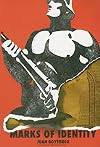
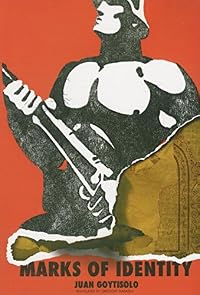
Now the 1001 Books list has its critics. But quite honestly, it’s books like Marks of Identity that reinforce my commitment to it. I’ve never heard of the title or the author and check out that front cover in the photo. Frankly, on the strength of a photo of a stuffed rabbit, some straw, a bit of rusty corrugated iron and a blue torso, I would never have picked this up. I did so simply because it was on the list.
Boy, I’m glad I did pick it up though. Goytisolo’s novel is the first one that has moved me with its writing in so many ways for a long time.
The ’story’ takes place while Alvaro Mendiola drinks in the night air in his apartment in Cuban exile. From beginning to end, this event must last no more than a couple of hours show more at the most. But as he drinks, Alvaro starts to recall his life from his childhood to his student days, to the Spanish Civil War and afterwards with self-imposed exile to Paris and, eventually, Cuba.
But these flashbacks are amazing. For each one, Goytisolo adopts some remarkable styles of writing. I was never sure what was coming next. Some of his sentences stretch on for pages and pages. But they’re not tough to read. I never had morbid fear as I turned a page like I have had with some books that just seem to go on and on and on. I was engaged throughout.
Goytisolo’s depiction of the messy war is very moving and intimate. He uses some great prose to conjure up vivid images and metaphors which reinforce this. And there’s a large cast of characters who play his associates and friends, his enemies and, above all, his lover who appears from time to time always with a tinge of melancholy.
This novel, as all good ones should, opened up a world to me and engaged me in it. Highly recommended. show less
Boy, I’m glad I did pick it up though. Goytisolo’s novel is the first one that has moved me with its writing in so many ways for a long time.
The ’story’ takes place while Alvaro Mendiola drinks in the night air in his apartment in Cuban exile. From beginning to end, this event must last no more than a couple of hours show more at the most. But as he drinks, Alvaro starts to recall his life from his childhood to his student days, to the Spanish Civil War and afterwards with self-imposed exile to Paris and, eventually, Cuba.
But these flashbacks are amazing. For each one, Goytisolo adopts some remarkable styles of writing. I was never sure what was coming next. Some of his sentences stretch on for pages and pages. But they’re not tough to read. I never had morbid fear as I turned a page like I have had with some books that just seem to go on and on and on. I was engaged throughout.
Goytisolo’s depiction of the messy war is very moving and intimate. He uses some great prose to conjure up vivid images and metaphors which reinforce this. And there’s a large cast of characters who play his associates and friends, his enemies and, above all, his lover who appears from time to time always with a tinge of melancholy.
This novel, as all good ones should, opened up a world to me and engaged me in it. Highly recommended. show less
A child during the civil war, Alvaro returns to Spain after ten years exile, mostly in Paris, disillusioned and alienated. The Spain he returns to is at peace but is overlain by a blanket of fascist repression that is ignored by the rest of Europe. The novelist is especially scathing about the effects of tourism on Spanish culture, the ignorance of most Europeans about Spain, and the self-regard of Spanish exiles. The story is told in a diffuse fashion with several different storylines that never quite converge, often told in the second person.
Una de les millors novel·les de Goytisolo.
Feb 10, 2024Catalan
Libreria Ramses. Lugar: Estanteria 4 (Arriba/Abajo) -
Posicion:Parte Derecha - 24 (Dcha a Izda)
Posicion:Parte Derecha - 24 (Dcha a Izda)
Apr 21, 2026Spanish
Members
- Recently Added By
Published Reviews
ThingScore 100
In one of his strongest novels, Marks of Identity, deftly translated by Gregory Rabassa and recently reissued by Dalkey Archive Press, Goytisolo follows the wanderings of several characters whose lives are irrevocably altered by the Franco regime. His iconoclastic impulse shapes the novel at every level.
added by paradoxosalpha
Lists

Las 100 Mejores Novelas en Castellano del Siglo XX
105 works; 13 members

My TBR
371 works; 3 members
Las cien mejores novelas del siglo XX en lengua española
117 works; 1 member
Author Information

134+ Works 2,850 Members
Juan Goytisolo Gay was born in Barcelona, Spain on January 5, 1931. He studied law at the University of Madrid and the University of Barcelona, but did not earn a degree. His first novel, The Young Assassins, was published in 1954. He wrote Children of Chaos and performed six months of military service before moving to Paris in 1956. He found work show more as a reader for Gallimard, one of France's premier publishing houses, and continued to write. His novels include Fiestas, Island of Women, Marks of Identity, Count Julian, Juan the Landless, Makbara, Landscapes after the Battle, The Marx Family Saga, A Cock-Eyed Comedy, State of Siege, and Exiled from Almost Everywhere. He also wrote two political travelogues entitled Countryside of Níjar and La Chanca and two memoirs entitled Forbidden Territory and Realms of Strife. He died on June 4, 2017 at the age of 86. (Bowker Author Biography) show less
Some Editions
Awards and Honors
Notable Lists
Series
Belongs to Publisher Series
Common Knowledge
- Canonical title
- Marks of Identity
- Original title
- Señas de identidad
- Original publication date
- 1966 (original Spanish) (original Spanish); 1969 (English: Rabassa) (English: Rabassa)
- People/Characters
- Alvaro Mendiola
- First words
- "Established in Paris comfortably established in Paris with more years of residence in France than in Spain with more French habits than Spanish ones including even the classic one of living with the daughter of a well-known ... (show all)exile a regular resident of the Ville Lumiere and an episodic visitor to his homeland in order to bear Parisian witness to aspects of Spanish life that might serve to epater le bourgeois an expert in that vast European geography that is traditionally hostile to our values and also present in his intineraries the well-known hand of the great bearded saint of that ex-paradise of a Caribbean island transformed today by work and the grace of Reds semi-Reds and useful idiots into a silent and lugubrious floating concentration camp evading the realities of the moment with an easy comfortable and advantageous nonconformity showing himself with prudent niceties and calculated tactics in all the social circles of the Boeotian world beyond El Ferol in order to gain for us the forgiveness and pardon.... [this 'sentence' goes on for over two pages]
- Last words
- (Click to show. Warning: May contain spoilers.)GELDSTUCK EINWARFEN
- Blurbers*
- Lehut, Bernard; Berton, Benjamin
*Some information comes from Common Knowledge in other languages. Click "Edit" for more information.
Classifications
Statistics
- Members
- 483
- Popularity
- 62,516
- Reviews
- 8
- Rating
- (3.88)
- Languages
- 5 — Dutch, English, French, German, Spanish
- Media
- Paper, Ebook
- ISBNs
- 26
- ASINs
- 9