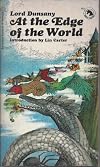
At the Edge of the World
by Lord Dunsany
On This Page
Tags
Recommendations












Member Reviews
https://fromtheheartofeurope.eu/at-the-edge-of-the-world-by-lord-dunsany/
This is a selection of his short fiction assembled in 1970 by Lin Carter, as part of his ongoing efforts to cash in on the success of The Lord of the Rings, with some interesting biographical detail of how and when each set of stories was written.
If you’ve read one Dunsany story, to be honest, you’ve read them all. The descriptions are good and the use of language very effective. But nothing very much happens; there are few surprises or moments of tension, and no memorable characters or grand themes beyond exalted whimsy. That was my prejudice before reading the collection, and I’m sorry to say that it was confirmed.
Dunsany was clearly an influence on both show more H.P. Lovecraft and J.R.R. Tolkien, and thus on all of their successors, but I think that both were better writers. Dunsany evokes your sensawunda, and makes you feel that there is a magical world just around the corner, out of sight; but both Lovecraft and Tolkien did the same and added a lot more depth and structure to their respective mythologies. With Dunsany, you feel that he is just telling you another story; Lovecraft and Tolkien take you into the depths of their detailed imaginary worlds. Lovecraft also adds horror, and Tolkien moral courage, to give extra dimensionality to the narrative.
Don’t get me wrong, Dunsany is a good writer, but he paved the way for better. (See also, “Lord Dunsany: The Geography of the Gods”, by Vernon Hyles, in More Real Than Reality: The Fantastic in Irish Literature and the Arts, edited by Donald E. Morse and Csilla Bertha.) show less
This is a selection of his short fiction assembled in 1970 by Lin Carter, as part of his ongoing efforts to cash in on the success of The Lord of the Rings, with some interesting biographical detail of how and when each set of stories was written.
If you’ve read one Dunsany story, to be honest, you’ve read them all. The descriptions are good and the use of language very effective. But nothing very much happens; there are few surprises or moments of tension, and no memorable characters or grand themes beyond exalted whimsy. That was my prejudice before reading the collection, and I’m sorry to say that it was confirmed.
Dunsany was clearly an influence on both show more H.P. Lovecraft and J.R.R. Tolkien, and thus on all of their successors, but I think that both were better writers. Dunsany evokes your sensawunda, and makes you feel that there is a magical world just around the corner, out of sight; but both Lovecraft and Tolkien did the same and added a lot more depth and structure to their respective mythologies. With Dunsany, you feel that he is just telling you another story; Lovecraft and Tolkien take you into the depths of their detailed imaginary worlds. Lovecraft also adds horror, and Tolkien moral courage, to give extra dimensionality to the narrative.
Don’t get me wrong, Dunsany is a good writer, but he paved the way for better. (See also, “Lord Dunsany: The Geography of the Gods”, by Vernon Hyles, in More Real Than Reality: The Fantastic in Irish Literature and the Arts, edited by Donald E. Morse and Csilla Bertha.) show less
Ratings
Members
- Recently Added By
Lists

Ballantine Adult Fantasy Series
85 works; 8 members
Author Information

391+ Works 10,073 Members
Though during his lifetime the Irish nobleman Lord Edward John Moreton Drax Plunkett, the 18th Baron Dunsany, was perhaps regarded as a minor talent, his somber short fantasies and novels had a significant impact on the development of fantasy and horror fiction. In real life, Dunsany was as interesting and versatile as anyone about whom he wrote. show more He was an African big-game hunter, a soldier in both the Boer War and World War I, and was wounded in the 1916 Irish Easter Rebellion. He was also the national chess champion of Ireland. Dunsany's first short story collection, The Gods of Pegana, was published in 1905 and was soon followed by other fantasy anthologies, including Time and the Gods (1906) and The Sword of Welleran and Other Stories (1908), among others. These stories are distinguished by their elegant, fairy tale settings and Dunsany's unique, macabre sense of humor. Dunsany's novels, such as The King of Elfland's Daughter (1924) and The Charwoman's Shadow (1926), are considered fantasy classics. Although Dunsany wrote prodigiously and with great versatility throughout his life, many regard his early, highly stylized short fiction to be his best work, and his most important. (Bowker Author Biography) show less
All Editions
Some Editions
Series
Belongs to Publisher Series
Work Relationships
Common Knowledge
- Canonical title
- At the Edge of the World
- Original publication date
- 1970-03
- Epigraph
- Come with me, ladies and
gentlemen who are in any wise
weary of London: come with me:
and those that tire at all
of the world we know:
for we have new worlds herr.
--Preface to Thebook of Wonder - First words
- The pomp of crowning was ended, the rejoicing had died away, and Khanazar, the new King, sat in the seat of the Kings of Averon to do his work upon the destinies of men.
Introduction: This book contains thirty of the finest stories written by the man many connoisseurs--including myself--consider the greatest fantasy writer of all time. - Last words
- (Click to show. Warning: May contain spoilers.)Afterword: We cannot add to the weight of the world by an ounce, we can only bring to it fancies; and whether they are expressed in towers by architects, or carve in jade by craftsmen in China, or written on paper by poets, it seems to me that they are the only wealth by which Earth can increase its store.
- Blurbers
- Lovecraft, H. P.; Yeats, William Butler; Cabell, James Branch; de Camp L. Sprague
Classifications
Statistics
- Members
- 269
- Popularity
- 120,224
- Reviews
- 1
- Rating
- (4.11)
- Languages
- English, German, Spanish, Swedish
- Media
- Paper
- ISBNs
- 4
- ASINs
- 7