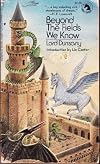
Beyond the Fields We Know
by Lord Dunsany
On This Page
Description
Beyond the fields we know, in the Lands of Dream, lies the Valley of the Yann where the mighty river of that name, rising in the Hills of Hap, idleing its way by massive dream-evoking amethyst cliffs, orchid-laden forests, and ancient mysterious cities, comes to the Gates of Yann and passes to the sea.Tags
Recommendations














Member Reviews
I love Dunsany's style, though some might say he stole it directly from scripture. None of the individual stories or vignettes blew me away, but as a whole they create a world that must really exist in some other dimension.
This mass-market paperback is one of Lin Carter's editions of Lord Dunsany's fantasies issued by Ballantine in the early 1970s. It contains all of Gods of Pegāna and the better part of Time and the Gods, along with the play King Argimenes and the Unknown Warrior, and a selection of poems and later stories. The Pegāna stories that make up the first part of the book represent one of Dunsany's chief literary innovations. In Pegāna, he created a cosmology and mythology out of whole cloth to support a narrative universe, setting a precedent emulated by later writers like Tolkien and Lovecraft. Dunsany adopted the narrative styles of myth and high legend, often with surprisingly irreverent effects. In addition to Pegāna's gods, this show more collection includes the hilarious later story of "Chu-Bu and Sheemish," which makes light of divine jealousies.
The thing that really stands out for me in Dunsany's works is the language. I had to read this purple piece from "The Sword of Welleran" about four times just for the pleasure of it: "Then night came up, huge and holy, out of waste marshes to the eastwards and low lands and the sea; and the angels that watched over all men through the day closed their eyes and slept, and the angels that watched over all men through the night woke and ruffled their deep blue feathers and stood up and watched." Also, I thought it was interesting in that same story that the nameless narrator and sometimes eyewitness of the story "I, the dreamer that sit before my fire asleep" -- was asleep while telling it. Many of Dunsany's stories are imbued with the flavor of dream and dream-vision to an extent that had perhaps at that time been rivaled in modern literature only by the fantasies of George MacDonald.
Carter's introduction is chiefly biographical, while his afterword is sort of philological. Expanding on his claim that Dunsany was the first to base invented proper nouns in literary fantasy on Hebrew models -- or more precisely the Anglicized Hebrew names of the KJV Bible -- Carter traces the direct and indirect influence of Dunsany through those verbal sounds. (The broadest indirect path goes through Lovecraft.) He instances Clark Ashton Smith, Tolkien, Leiber, and many another author as coiners of names on the pattern laid down by Dunsany.
In editing these books, Carter earned the praise of Ursula LeGuin for saving "us all from a lifetime of pawing through the shelves of used bookstores somewhere behind several dusty cartons between 'Occult' and 'Children's' in hopes of finding, perhaps, the battered and half-mythical odd volume of Dunsany" (The Language of the Night, 84). These days, much Dunsany is in print again, but Carter's mass-market editions are still enchanting, and now themselves worth pawing through the shelves of used bookstores to obtain. show less
The thing that really stands out for me in Dunsany's works is the language. I had to read this purple piece from "The Sword of Welleran" about four times just for the pleasure of it: "Then night came up, huge and holy, out of waste marshes to the eastwards and low lands and the sea; and the angels that watched over all men through the day closed their eyes and slept, and the angels that watched over all men through the night woke and ruffled their deep blue feathers and stood up and watched." Also, I thought it was interesting in that same story that the nameless narrator and sometimes eyewitness of the story "I, the dreamer that sit before my fire asleep" -- was asleep while telling it. Many of Dunsany's stories are imbued with the flavor of dream and dream-vision to an extent that had perhaps at that time been rivaled in modern literature only by the fantasies of George MacDonald.
Carter's introduction is chiefly biographical, while his afterword is sort of philological. Expanding on his claim that Dunsany was the first to base invented proper nouns in literary fantasy on Hebrew models -- or more precisely the Anglicized Hebrew names of the KJV Bible -- Carter traces the direct and indirect influence of Dunsany through those verbal sounds. (The broadest indirect path goes through Lovecraft.) He instances Clark Ashton Smith, Tolkien, Leiber, and many another author as coiners of names on the pattern laid down by Dunsany.
In editing these books, Carter earned the praise of Ursula LeGuin for saving "us all from a lifetime of pawing through the shelves of used bookstores somewhere behind several dusty cartons between 'Occult' and 'Children's' in hopes of finding, perhaps, the battered and half-mythical odd volume of Dunsany" (The Language of the Night, 84). These days, much Dunsany is in print again, but Carter's mass-market editions are still enchanting, and now themselves worth pawing through the shelves of used bookstores to obtain. show less
Ratings
Members
- Recently Added By
Lists

Ballantine Adult Fantasy Series
85 works; 8 members
Author Information

391+ Works 10,090 Members
Though during his lifetime the Irish nobleman Lord Edward John Moreton Drax Plunkett, the 18th Baron Dunsany, was perhaps regarded as a minor talent, his somber short fantasies and novels had a significant impact on the development of fantasy and horror fiction. In real life, Dunsany was as interesting and versatile as anyone about whom he wrote. show more He was an African big-game hunter, a soldier in both the Boer War and World War I, and was wounded in the 1916 Irish Easter Rebellion. He was also the national chess champion of Ireland. Dunsany's first short story collection, The Gods of Pegana, was published in 1905 and was soon followed by other fantasy anthologies, including Time and the Gods (1906) and The Sword of Welleran and Other Stories (1908), among others. These stories are distinguished by their elegant, fairy tale settings and Dunsany's unique, macabre sense of humor. Dunsany's novels, such as The King of Elfland's Daughter (1924) and The Charwoman's Shadow (1926), are considered fantasy classics. Although Dunsany wrote prodigiously and with great versatility throughout his life, many regard his early, highly stylized short fiction to be his best work, and his most important. (Bowker Author Biography) show less
All Editions
Some Editions
Series
Belongs to Publisher Series
Work Relationships
Contains
The Sayings of Kib (Sender of Life in All the Worlds) [short story] by Edward J. M. D. Plunkett 18th baron Dunsany
The Sayings of Slid (Whose Soul Is in the Sea) [short story] by Edward J. M. D. Plunkett 18th baron Dunsany
The Sayings of Limpang-Tung (The God of Mirth and of Melodious Minstrels) [short story] by Edward J. M. D. Plunkett 18th baron Dunsany
Of Yoharneth-Lahai (The God of Little Dreams and Fancies) [short story] by Edward J. M. D. Plunkett 18th baron Dunsany
Of Roon, the God of Going, and the Thousand Home Gods [short story] by Edward J. M. D. Plunkett 18th baron Dunsany
Of Dorozhand (Whose Eyes Regard the End) [short story] by Edward J. M. D. Plunkett 18th baron Dunsany
Of the Calamity that Befel Yūn-Ilāra by the Sea, and of the Building of the Tower of the Ending of Days [short story] by Edward J. M. D. Plunkett 18th baron Dunsany
Common Knowledge
- Canonical title
- Beyond the Fields We Know
- Original title
- Beyond the Fields We Know
- Original publication date
- 1972-05
- People/Characters
- MANA-YOOD-SUSHAI; Welleran
- Quotations
- Then night came up, huge and holy, out of waste marshes to the eastwards and low lands and the sea; and the angels that watched over all men through the day closed their eyes and slept, and the angels that watched over all me... (show all)n through the night woke and ruffled their deep blue feathers and stood up and watched.
Classifications
Statistics
- Members
- 191
- Popularity
- 172,094
- Reviews
- 2
- Rating
- (4.13)
- Languages
- English
- Media
- Paper, Ebook
- ISBNs
- 3
- ASINs
- 5