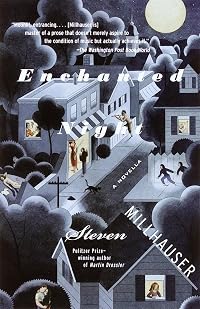
Enchanted Night: A Novella
by Steven Millhauser
On This Page
Description
From the Pulitzer Prize-winning author of Martin Dressler comes a stunningly original new book set in a Connecticut town over one incredible summer night. The delicious cast of characters includes a band of teenage girls who break into homes and simply leave notes reading "We Are Your Daughters," a young woman who meets a phantom lover on the tree swing in her back yard, a beautiful mannequin who steps down from her department store window, and all the dolls "no longer believed in," left show more abandoned in the attic, who magically come to life. With each new book, Steven Millhauser radically stretches not only the limits of fiction but also of his seemingly limitless abilities. Enchanted Night is a remarkable piece of fiction, a compact tale of loneliness and desire that is as hypnotic and rich as the language Millhauser uses to weave it. show lessTags
Recommendations






















Member Reviews
I just read Martin Dressler, and I loved it, so when I saw this novella sitting unloved in the share corner of our Master's Studio, I scooped it up. (It's not stealing from my students if I return it on Monday, right?) This is not the equal of Martin Dressler, not really close, but there is still a lot of good here. Millhauser once again uses a fairytale-like style to tell a modern story. This one leans a good deal more into magical realism than MD, and though I rarely groove on magical realism, I thought he did it well. This is atmospheric and poetic, and there is also a very dark undercurrent. A good deal of this addresses the dangers girls and women face when they try to define themselves, and men see them only as ways to meet their show more (sometimes, but not always, repulsive) needs or wants. show less
"[A] prose that doesn't merely aspire to the condition of music but actually achieves it", says the blurb on the cover. Personally I never hear music when reading prose but if this novella were music it would be a fancifully composed tone poem. Aaron Copeland maybe, applying his recognizable Americanism. Or Debussy might be a better choice: an impressionistic tone poem of a summer night under a bright moon on a town on the edge of the woods (and thus, on the edge of a certain primeval wildness, which the right auteur can masterfully bring out).
Here's a sentence from this novella, page 101:
I imagine Millhauser as working in a distinctly American brand of magical-realism, which has a sharp focus on the materialistic things around us. He's a bit of a cataloger. For instance:
For me this is an interesting enough little piece, though fairly insubstantial. I liked most of the writing,
Here's a sentence from this novella, page 101:
In attics streaked by moonlight, the dolls begin to dance.I think the reader can usefully use that sentence to gauge his or her likely enjoyment of show more this novella. Sound interesting? Read this. Sound off-putting? Give this a skip.
I imagine Millhauser as working in a distinctly American brand of magical-realism, which has a sharp focus on the materialistic things around us. He's a bit of a cataloger. For instance:
Through a pair of open curtains, moonlight enters the living room. The moonlight glistens on Laura's silver-speckled raspberry barrette lying on the mahogany piano bench, on the glass-covered black-and-white photograph, taken by her father, of a pile of lobster pots beside an overturned rowboat on the coast of Maine, on the blue porcelain statuette of a Chinaman standing on the coffee table, on a bronze key attached to a cowhide keycase resting on the arm of the reading chair beside the lamp table. Anyone sitting on the couch, head turned toward the screened window with the parted curtains, would see a basketball net over the garage door across the street, a roof with a black TV antenna against the dark blue sky, and a nearly full moon, white with blue shadows, divided into two uneven pieces by a single black antenna arm cutting across the bottom about a third of the way up."That's the entire chapter titled "Living Room and Moonlight", page 99. Things get bent toward magical ends: here, on other pages, is a storefront mannequin stepping out to stroll along the street with her admirer. And, of course, the dolls, dancing and acting in the town's attics.
For me this is an interesting enough little piece, though fairly insubstantial. I liked most of the writing,
"So down in the valley, valley so low, I'm working my way up an inch at a time and meanwhile on top of old Smokey all covered with snow I've got my hand under her blouse and I'm feeling her up through her bra which has these fancy lacy edges, man."but there is the occasional clunker.
The two-story frame houses sit looking at the steep thruway embankment like drugged-out ladies in an old-age home trying to remember what lies on the other side.show less
It's a hot summer night in Connecticut, and the moon is unusually bright, and everything is magic. Millhauser takes it from there, writing about how this magic affects everyone from a 14-year-old girl who sneaks out of the house with nothing but a half a roll of Lifesavers in her pocket to a middle-aged man who has been writing the Great American Novel while living at home with his mother for almost all of his life. Pan plays his flute, a mannequin discovers the joy of holding hands, and a girl gang is more surprised than surprising. The only word for this novella is charming. It is like a dream itself; you almost don't read it, it almost floats directly into your mind, and yet the lovely language, each word chosen deliberately, show more registers with precision. I want to experience this night. show less
The contrast between Millhauser's previous excellent novel, Martin Dressler, and his latest novella, Enchanted Night, is similar to the difference between a businesslike day and a very magical night. The entertaining cast of characters is large and varied: a naked girl on the grass, a gang of boys hidden in the town library, a storefront mannequin walking hand-in-hand with her longtime admirer, and a group of girls having tea with a woman after having broken into her house. Many other characters are moving about on this truly enchanted and very active night. Millhauser won the Pulitzer Prize for Martin Dressler, and now he's written something very magical about a hot summer night in Connecticut. Enchanted Night is a fine example of what show more special heights a short work of fiction can reach - it's a magical novella.
(5/01) show less
(5/01) show less
This was an experimental collection of fragments (shorts?) that have certain leitmotifs and hypnotic repetitions.
They all seemed to explore one night in a town from multiple perspectives. At times, it was hard to follow but if read fast enough, it all seemed like one hallucinatory dream.
They all seemed to explore one night in a town from multiple perspectives. At times, it was hard to follow but if read fast enough, it all seemed like one hallucinatory dream.
In short pieces of prose and arguably some poetry, Millhauser tells the story of one enchanted night in a smallish town in Connecticut sometime in the 1950s (or possibly the 60s?). All manner of activity abounds during the wee hours - some magical, some not. The story is all about desire and longing and the less glamorous 'want' and 'need'(imo). Some of it is whimsical and quite enjoyable and yet I did not enjoy the story as much as I expected to. The reader is watching the happenings of this enchanted night from some distance and it is that distance that I felt acutely. And looking back on it, with rare exception, it seemed the women in the story were objects, enchanted in a way so as to please the men of the story. The manikin comes show more to life to fulfill the longing in the man who gazes at her in the window. A young woman sheds her clothing privately in the moonlight but watched secretly through the bushes by a man. Still, there are a fair number of laudatory blurbs on the back of the book, so perhaps the story would enchant me more at another time. show less
This strange little book contains a string of vignettes about one night in a small town. Each short chapter gives the reader a new perspective. We hear from a 39-year-old man, the head of a teenage gang of girls, the field insects, a mannequin, and more. We meander through the town with no real goal, just admiring the night and meeting a few people along the way.
BOTTOM LINE: The writing was beautiful at times, but the novella didn’t leave any lasting impression for me.
“The world, filled to the brim with stillness, suddenly overflows.”
BOTTOM LINE: The writing was beautiful at times, but the novella didn’t leave any lasting impression for me.
“The world, filled to the brim with stillness, suddenly overflows.”
Members
- Recently Added By
Author Information

45+ Works 5,679 Members
Awards and Honors
Awards
Classifications
Statistics
- Members
- 318
- Popularity
- 100,289
- Reviews
- 10
- Rating
- (3.64)
- Languages
- English, French
- Media
- Paper, Audiobook, Ebook
- ISBNs
- 13
- ASINs
- 2