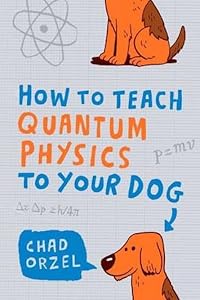
How to Teach Quantum Physics to Your Dog
by Chad Orzel
On This Page
Description
Who better to teach the magic of quantum physics than a talking dog? Sit down with Orzel and his dog Emmy as the author explains the laws of physics.Tags
Recommendations





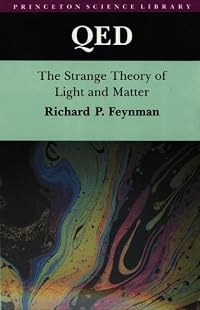
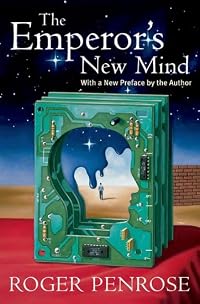
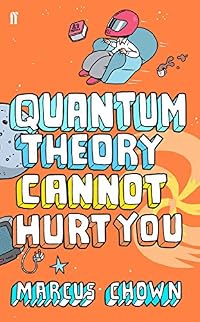
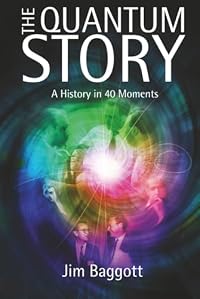





Member Reviews
Quantum physics may still remain an unsolved mystery to me, for the most part, but I feel I understand some of its quirky aspects better now. I've read a few books for laymen on this subject, and the sad fact is that it may be simply so counter-intuitive that it my brain won't accept it. My 'that don't make sense' filter seems to kick in. When I read such books, I keep stopping to question the findings and ask, "How could that be?" (Unfortunately, my math skills are inadequate to help me overcome this.) Still, somehow I feel there must be some underlying order in the universe, but, then again, perhaps not.
In any event, this book is a (supposedly) imagined conversation between a physics professor and his dog. I found it quite show more entertaining. Things I especially liked were the one Terry Pratchett reference (and footnotes)and the last chapter, which is about the charlatans and other profiteers who misuse the language of quantum physics to promote bogus things like free energy and magic healing. If you're fascinated by quantum and what it means, pick up this book. I can't say you'll understand quantum electrodynamics when you're done reading it, but you will be entertained and perhaps more knowledgeably confused, and, most importantly, less likely to be taken in by hucksters misusing the terms to sell quantum snake oil. show less
In any event, this book is a (supposedly) imagined conversation between a physics professor and his dog. I found it quite show more entertaining. Things I especially liked were the one Terry Pratchett reference (and footnotes)and the last chapter, which is about the charlatans and other profiteers who misuse the language of quantum physics to promote bogus things like free energy and magic healing. If you're fascinated by quantum and what it means, pick up this book. I can't say you'll understand quantum electrodynamics when you're done reading it, but you will be entertained and perhaps more knowledgeably confused, and, most importantly, less likely to be taken in by hucksters misusing the terms to sell quantum snake oil. show less
If dog treats appeared out of empty space in the middle of a kitchen, a human would freak out, but a dog would take it in stride [... dogs] always expect treats to appear at any moment, for no obvious reason. [...] If you can look at the world the way a dog does, as an endless source of surprise and wonder, then quantum mechanics will seem a lot more approachable.
Chad Orzel enlists his German shepherd, Emmy, to provide that perspective in How to Teach Physics to Your Dog. Each chapter opens with Emmy voicing some problem (usually related to improving her chances of nabbing a squirrel or bunnie or treat) that gives Chad a jumping-off point into physics concepts like particle-wave duality, uncertainty, measurement, teleportation. It’s a show more cute device but it’s also effective -- alternating between theory and man-dog conversation both lightens the content and applies it to the everyday.
I endured a year of classical physics in college but came to this book after having developed an adulthood interest in quantum physics. I came away much more aware of the concepts involved, but only slightly more in command of them. (Maybe that’s the way with physics, little by little?) But to be clear: this is a physics book and Orzel writes for a pop-sci physics audience: “Most people wouldn’t know a wavefunction if they tripped over one, but almost everyone has heard of the uncertainty principle…” If that’s not you, or if you’re not interested in photons, probability, and polarization, this is not the book for you. If that is you, enjoy! -- Orzel’s approach is positive and curious, and Emmy is just plain fun.
(Review based on a copy of the book provided by the publisher.) show less
Chad Orzel enlists his German shepherd, Emmy, to provide that perspective in How to Teach Physics to Your Dog. Each chapter opens with Emmy voicing some problem (usually related to improving her chances of nabbing a squirrel or bunnie or treat) that gives Chad a jumping-off point into physics concepts like particle-wave duality, uncertainty, measurement, teleportation. It’s a show more cute device but it’s also effective -- alternating between theory and man-dog conversation both lightens the content and applies it to the everyday.
I endured a year of classical physics in college but came to this book after having developed an adulthood interest in quantum physics. I came away much more aware of the concepts involved, but only slightly more in command of them. (Maybe that’s the way with physics, little by little?) But to be clear: this is a physics book and Orzel writes for a pop-sci physics audience: “Most people wouldn’t know a wavefunction if they tripped over one, but almost everyone has heard of the uncertainty principle…” If that’s not you, or if you’re not interested in photons, probability, and polarization, this is not the book for you. If that is you, enjoy! -- Orzel’s approach is positive and curious, and Emmy is just plain fun.
(Review based on a copy of the book provided by the publisher.) show less
Well, it certainly has a unique selling point.
A quixotic quest, you would think: rendering the world of quantum physics understandable for the layman - approached quixotically: by fabricating a dialogue between the author, a physics professor, and his rabbit-chasing, treat-loving Alsatian dog.
There is something oddly Socratic about Orzal's interlocutions with Emmy the Alsatian. Only in the Dialogues, no-one says "that sounds ridiculous, Socrates". Emmy has no such qualms.
As a conceptual device it works as well as it can be expected to, though at times both Chad and Emmy expect too much of their readers. That is one smart dog.
Over the years I've read plenty of popular science treatments of quantum physics (more than your average bear, I show more dare say, but of course that's not to say I necessarily understood them), and I still found my eyes glazing over at some of the depth to which Orzal was obliged (or at any rate inclined) to descend in expounding quantum theory. Emmy stays with him throughout, and eggs him on.
I have always harboured suspicions about the scientific inviolability claimed of this sort of physics. Real, falsifiable empirical evidence seems in short supply (often being suspiciously forbidden by the very terms of the theory, or at least buried under many sedimentary layers of mathematical assumption) and quantum effects have a habit of conveniently being unobservable in any dimension meaningful to everyday life. Or vanishing (er, I mean, collapsing the wave function) when you try to measure them.
Which, to this old sceptic, gives them a religious sort of disposition - true by definition; true because smart men learned in arcane lore say so. (I should say I'm not alone in this view: properly credentialised physicists like Peter Woit and Lee Smolin have also expressed it).
That said, Orzal is no (ahem) dogmatist (indeed, trying to de-mystify the scriptures as he does makes him more like a sort of Lutheran reformer), and I think is prepared to admit of some missing links in the overall theory (I couldn't work out whether quantum entanglement, which is "non local", falsifies relativity or not).
Then again, the only practical upshot I could derive of all this colossally brain-contorting discipline is the possibility of "quantum computing" - apparently faster and cheaper than boring old silicon.
Orzal's main objective, finally arrived at in the closing chapter, is to debunk phoney new age baloney which purports to trade on quantum underpinnings - quantum healing, and that kind of thing. This is done effectively, but at some cost: by underlining the singular uselessness of quantum theory in every day volumes, velocities and quantities. Whenever it would come in handy (often, when chasing squirrels, as Emmy astutely observes), by its own theory, quantum effects would be unobservably minuscule.
Which makes this old goat wonder why we bother digging up the Swiss countryside and dropping trillions of dollars of supercooled electromagnets into it just to find another unobservable subatomic particle. Surely we can figure out whether quantum computing works by trying to building a quantum computer?
In the final analysis, and as other reviewers have said, I put this book down having a better general understanding of the gist of a number of really quite difficult concepts - enough to keep my end of the conversation up if sat next to a physicist at dinner - even if the details and implications below that remain entirely murky - and so in that regard, it is a tough job imaginatively and successfully done.
And, now matter how cute the device seems, you can't help but like the irrepressible Emmy, even if she does understand Schrodinger's indeterminacy better than I do. show less
A quixotic quest, you would think: rendering the world of quantum physics understandable for the layman - approached quixotically: by fabricating a dialogue between the author, a physics professor, and his rabbit-chasing, treat-loving Alsatian dog.
There is something oddly Socratic about Orzal's interlocutions with Emmy the Alsatian. Only in the Dialogues, no-one says "that sounds ridiculous, Socrates". Emmy has no such qualms.
As a conceptual device it works as well as it can be expected to, though at times both Chad and Emmy expect too much of their readers. That is one smart dog.
Over the years I've read plenty of popular science treatments of quantum physics (more than your average bear, I show more dare say, but of course that's not to say I necessarily understood them), and I still found my eyes glazing over at some of the depth to which Orzal was obliged (or at any rate inclined) to descend in expounding quantum theory. Emmy stays with him throughout, and eggs him on.
I have always harboured suspicions about the scientific inviolability claimed of this sort of physics. Real, falsifiable empirical evidence seems in short supply (often being suspiciously forbidden by the very terms of the theory, or at least buried under many sedimentary layers of mathematical assumption) and quantum effects have a habit of conveniently being unobservable in any dimension meaningful to everyday life. Or vanishing (er, I mean, collapsing the wave function) when you try to measure them.
Which, to this old sceptic, gives them a religious sort of disposition - true by definition; true because smart men learned in arcane lore say so. (I should say I'm not alone in this view: properly credentialised physicists like Peter Woit and Lee Smolin have also expressed it).
That said, Orzal is no (ahem) dogmatist (indeed, trying to de-mystify the scriptures as he does makes him more like a sort of Lutheran reformer), and I think is prepared to admit of some missing links in the overall theory (I couldn't work out whether quantum entanglement, which is "non local", falsifies relativity or not).
Then again, the only practical upshot I could derive of all this colossally brain-contorting discipline is the possibility of "quantum computing" - apparently faster and cheaper than boring old silicon.
Orzal's main objective, finally arrived at in the closing chapter, is to debunk phoney new age baloney which purports to trade on quantum underpinnings - quantum healing, and that kind of thing. This is done effectively, but at some cost: by underlining the singular uselessness of quantum theory in every day volumes, velocities and quantities. Whenever it would come in handy (often, when chasing squirrels, as Emmy astutely observes), by its own theory, quantum effects would be unobservably minuscule.
Which makes this old goat wonder why we bother digging up the Swiss countryside and dropping trillions of dollars of supercooled electromagnets into it just to find another unobservable subatomic particle. Surely we can figure out whether quantum computing works by trying to building a quantum computer?
In the final analysis, and as other reviewers have said, I put this book down having a better general understanding of the gist of a number of really quite difficult concepts - enough to keep my end of the conversation up if sat next to a physicist at dinner - even if the details and implications below that remain entirely murky - and so in that regard, it is a tough job imaginatively and successfully done.
And, now matter how cute the device seems, you can't help but like the irrepressible Emmy, even if she does understand Schrodinger's indeterminacy better than I do. show less
I've read two or three books on quantum physics and this is the best: explains things clearly in plain English (although the later explanations of entanglement and teleportation are a bit tangled up) and, most importantly, is very fun--especially for dog lovers!
The best explanation I've found of quantum physics' basic principles for a lay lay lay person. You can infer from the title that this book does not belong on a doctoral candidate's Works Cited page. If, however, you've found yourself unable to recall the major foundations of quantum physics no matter how many cute animated YouTube videos you've watched, you'll have no trouble after reading this. A humorous midpoint between a tome and a For Dummies, and a quick read.
The best explanation I've found of quantum physics' basic principles for a lay lay lay person. You can infer from the title that this book does not belong on a doctoral candidate's Works Cited page. If, however, you've found yourself unable to recall the major foundations of quantum physics no matter how many cute animated YouTube videos you've watched, you'll have no trouble after reading this. A humorous midpoint between a tome and a For Dummies, and a quick read.
The best explanation I've found of quantum physics' basic principles for a lay lay lay person. You can infer from the title that this book does not belong on a doctoral candidate's Works Cited page. If, however, you've found yourself unable to recall the major foundations of quantum physics no matter how many cute animated YouTube videos you've watched, you'll have no trouble after reading this. A humorous midpoint between a tome and a For Dummies, and a quick read.
Members
- Recently Added By
Published Reviews
ThingScore 100
It is extremely well-written, combining a scientist's rigor and accuracy with a natural raconteur's storytelling skill.
added by lampbane
Lists

In Our Time books
4,934 works; 2 members
Author Information

7 Works 1,036 Members
Chad Orzel was born and raised in central New York and received a degree in physics from Williams College and his Ph.D. in chemical physics from the University of Maryland. He is now a professor in the Department of Physics and Astronomy at Union College in Schenectady, New York. He lives near campus with his wife, Kate; their daughter; and, of show more course, Emmy, the Queen of Niskayuna. show less
Awards and Honors
Awards
Common Knowledge
- Original publication date
- 2010-12-07; 2012
- People/Characters
- Emmy
- Dedication
- To Kate, whose laugh started the whole thing
- First words
- The Mohawk-Hudson Humane Society has set up a little path through the woods near their facility outside Troy, so you can take a walk with a dog you're thinking of adopting.
- Last words
- (Click to show. Warning: May contain spoilers.)"If we see evil squirrels, you can bite them." "Ooooh!"
- Disambiguation notice
- How to Teach Physics to Your Dog has been issued as How to Teach Quantum Physics to Your Dog in the UK by Oneworld Publications.
Classifications
Statistics
- Members
- 581
- Popularity
- 50,417
- Reviews
- 14
- Rating
- (3.76)
- Languages
- 8 — Dutch, English, German, Italian, Polish, Portuguese, Spanish, Turkish
- Media
- Paper, Ebook
- ISBNs
- 17
- ASINs
- 7