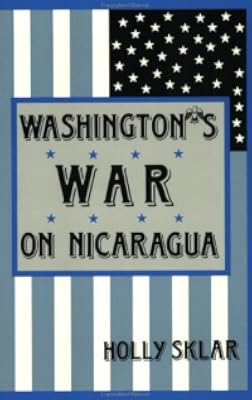
Washington's War on Nicaragua
by Holly Sklar
On This Page
Description
An account of U.S. policy from the Sandinista revolution through the Iran-contra scandal and beyond. Sklar shows how the White House sabotaged peace negoatiations and sustained the deadly contra war despite public opposition, with secret U.S. special forces and an auxiliary arm of dictators, drug smugglers and death squad godfathers, and illuminates an alternative policy rooted in law and democracy.Tags
Recommendations















Member Recommendations
Members
- Recently Added By
Author Information
10+ Works 489 Members
Common Knowledge
- Original publication date
- 1988
- People/Characters
- Charlie Wilson; Anastasio Somoza Debayle; Elliot Abrams; William J. Casey; Richard Secord; Albert Hakim (show all 23); John Poindexter; Oliver North; Robert Owen; Clair George; Duane Clarridge; Theodore Shackley; Thomas Clines; Edwin Wilson; Felix Rodriguez; Luis Posada Carriles; Felipe Vidal; Rafael "Chi Chi" Quintero; John Singlaub; John Hull; Tom Posey; Jack Terrell; William D. Stewart
- Important places
- Nicaragua; Grenada (US invasion)
- Important events
- Cold War; Salvadoran Civil War; murder (ABC News reporter William D. Stewart | US missionaries in El Salvador); Nicaraguan Revolution; assassination (Archbishop Óscar Romero); Contra War (show all 11); invasion (Grenada by USA); United States presidential election (1980 | 1984); Nicaraguan elections (1984); La Penca Bombing; Iran-Contra Affair
- Epigraph
- By their very nature, covert activities, or special activities, are a lie. There's great deceit - deception - practiced in th conduct of covert operations. They are at essence a lie.
Oliver North, Iran-Contra Hea... (show all)rings, July 7, 1987. - First words
- General Smedley Butler led American marines into Nicaragua eight years before the Russian revolution of 1917.
- Quotations
- "The idea is to slowly demonize the Sandinista government (in) order to turn it into a real enemy and threat in the minds of the American people, thereby eroding their resistance to U.S. support for the contras and, perhaps, ... (show all)to a future U.S. military intervention in the region." - Anonymous U.S. government official
Reagan's reflections on Argentina were no aberration. He gave the account of events in Chile: "Allende was a Marxist and took Chile down the road to socialism... Journalists who have made an honest effort to talk with the Chi... (show all)lean man-in-the-street report that there would have been a people's revolt if the military overthrow of the Allende regime had not taken place." General Pinochet "promised to restore democratic rule also and to allow elections. True, they haven't taken place as yet, but there is reason to believe that if and when they do the general might just be the favourite candidate if he chooses to run." Reagan doesn't tell us why the Chilean people gave Allende's party even more support in the 1973 mid-term congressional elections, the last elections before Chilean democracy was crushed by the military in a U.S.-backed coup.
The official spin-controllers know they have the advantage. As George Bush's press secretary, Peter Teeley, told reporters following the 1984 vice-presidential debate: "You can say anything you want in a debate, and 80 millio... (show all)n people hear it. If reporters then document that a candidate spoke untruthfully, so what? Maybe 200 people read it, or 2,000 or 20,000."
As a United Fruit Company public relations specialist said of their success in using the press to create a favorable climate of opinion for the CIA-orchestrated Guatemalan coup of 1954: "It is difficult to make a convincing... (show all) case for manipulation of the press when the victims proved so eager for the experience." - Blurbers
- LeoGrande, William M.
Classifications
- Genres
- Nonfiction, Politics and Government, History, General Nonfiction
- DDC/MDS
- 327.7307285 — Society, government, & culture Political science International Relations: Spies North America United States U.S.-North American Relations
- LCC
- E183.8 .N5 .S55 — History of the United States United States History Diplomatic history. Foreign and general relations. Relations with individual countries
- BISAC
Statistics
- Members
- 49
- Popularity
- 614,073
- Languages
- English
- Media
- Paper
- ISBNs
- 4