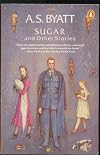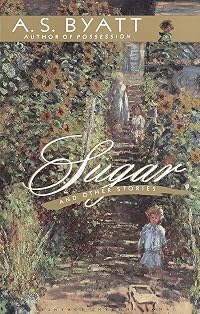
Sugar and Other Stories
by A. S. Byatt
On This Page
Description
A.S. Byatt's short fictions, collected in paperback for the first time, explore the fragile ties between generations, the dizzying abyss of loss and the elaborate memories we construct against it, resulting in a book that compels us to inhabit other lives and returns us to our own with new knowledge, compassion, and a sense of wonder..
Tags
Recommendations




















Member Recommendations

KayCliff Both "The Birds of the Air" and A S Byatt's short story, `The July Ghost', are fictional accounts of bereavement and grief following the death of a young son, that really happened in the woman authors' lives.

KayCliff The genesis of "The Children's Book" can be seen in the short story, "The Changeling".

KayCliff The story "Precipice-encurled" refers to "The Aspern Papers"
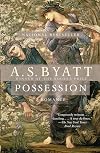
KayCliff The story, "Precipice-encurled" can be seen as a sort of paradigm of 'Possession'.
Member Reviews
Byatt's first published collection of short stories, which appeared in between the novels Still life and Possession, contains eleven stories, mostly written for The New Yorker or Encounter. The subjects advance in a suspiciously logical sequence through the book: women's education, mother-daughter relationships, ghosts, accusations of witchcraft, writers and mortality. The opening story, "Racine and the Tablecloth", has a younger version of Frederica (called Emily here) at boarding school in York and locked in a struggle with a small-minded headmistress who thinks academic achievement is no excuse for refusing to engage with the community life of the school, in a kind of inverted Miss Jean Brodie set-up.
"Precipice-encurled" is show more particularly interesting in the light of what is to come in that it's historical fiction about Robert Browning — we meet him and his sister in Venice a couple of years after Elizabeth's death, planning a visit to friends in their holiday retreat in the Apennines, and sketching out a poem about Descartes.
The autobiographical title-story also ties a lot of threads together: the narrator talks about her memories of her (paternal) grandparents, who ran a sweet factory in Conisbrough, and reflects on how much creative fiction goes into family memories: her firsthand memories are conditioned by the way her mother "improved" the facts to turn them into family anecdotes, and she herself adds her professional writer's instinct to turn events into stories. She also talks about her father's death and his passion for Van Gogh (tying into Still Life, of course) and about her passion for Norse mythology and Ragnarök, which she traces back to a book her mother had used "as a crib" whilst doing compulsory Old Norse and Icelandic for her English degree, and which she read as a young child. And that, of course, links into several of her later novels, including Possession. show less
"Precipice-encurled" is show more particularly interesting in the light of what is to come in that it's historical fiction about Robert Browning — we meet him and his sister in Venice a couple of years after Elizabeth's death, planning a visit to friends in their holiday retreat in the Apennines, and sketching out a poem about Descartes.
The autobiographical title-story also ties a lot of threads together: the narrator talks about her memories of her (paternal) grandparents, who ran a sweet factory in Conisbrough, and reflects on how much creative fiction goes into family memories: her firsthand memories are conditioned by the way her mother "improved" the facts to turn them into family anecdotes, and she herself adds her professional writer's instinct to turn events into stories. She also talks about her father's death and his passion for Van Gogh (tying into Still Life, of course) and about her passion for Norse mythology and Ragnarök, which she traces back to a book her mother had used "as a crib" whilst doing compulsory Old Norse and Icelandic for her English degree, and which she read as a young child. And that, of course, links into several of her later novels, including Possession. show less
It is always a little sad to reach the point where there is no more fiction to read by a favourite writer - let's hope she still has more to come. This was Byatt's first collection of stories, the last book she published before [b:Possession|41219|Possession|A.S. Byatt|https://images.gr-assets.com/books/1391124124s/41219.jpg|2246190], and although it lacks the thematic unity of most of her later story collections, it still contains some fine writing. There are some recurring themes - death (two of the stories involve ghosts) and how real life inspires the writing process.
The first story Racine and the Tablecloth is a moving tale of a clever girl who is bullied at school and feels antagonised by her teacher. Like some of the other show more stories here this one is a little elliptical.
For me the least convincing piece was The Dried Witch, a rather macabre story set in a primitive village, which is interesting because its style presages some of her later fairy stories.
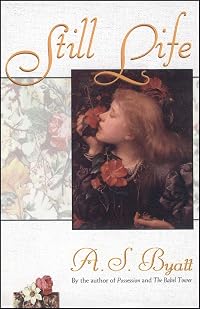
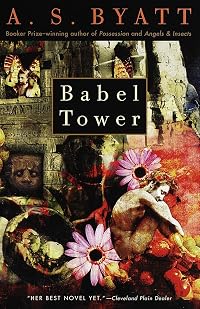
On the Day that E.M. Forster Died is a story of a writer that must be at least partly autobiographical - she has a number of disparate ideas for her next novel and while sitting in the British Library she sees that they would be more powerful as part of a single larger work, and feels that the shadow cast by Forster has been lifted - those who have read the Frederica quartet ([b:The Virgin in the Garden|86888|The Virgin in the Garden|A.S. Byatt|https://images.gr-assets.com/books/1399401834s/86888.jpg|245459], [b:Still Life|91519|Still Life|A.S. Byatt|https://images.gr-assets.com/books/1348286107s/91519.jpg|1794016], [b:Babel Tower|91688|Babel Tower|A.S. Byatt|https://images.gr-assets.com/books/1193064878s/91688.jpg|1063051] and [b:A Whistling Woman|68123|A Whistling Woman|A.S. Byatt|https://images.gr-assets.com/books/1389037506s/68123.jpg|1374506]) might recognise this description. For me this quartet and [b:Possession|41219|Possession|A.S. Byatt|https://images.gr-assets.com/books/1391124124s/41219.jpg|2246190] are Byatt's most complex and rewarding works. The story then moves off on a tangent to a decidedly odd encounter with an old acquaintance who tries to involve her in a bizarre conspiracy.
The penultimate story Precipice Uncurled is a curious story of a talented young painter falling in love with a friend of Robert Browning, and his death in a fall from a mountain in the Apennines where he is trying to capture the light. I suspect my ignorance led me to miss some of the resonances and context for this one, but it is interesting because it was probably written when she was already thinking about Possession.
The final story Sugar gives the collection its title. Sugar is about family history and the way stories are filtered and changed by the teller - the narrator compares her parents' conflicting memories of her grandfather, the owner of a boiled sweet factory, and the stories of her aunts and uncles.
As always with Byatt there are plenty of ideas here and this is a rewarding read, but perhaps not the best starting point for someone new to her work. show less
The first story Racine and the Tablecloth is a moving tale of a clever girl who is bullied at school and feels antagonised by her teacher. Like some of the other show more stories here this one is a little elliptical.
For me the least convincing piece was The Dried Witch, a rather macabre story set in a primitive village, which is interesting because its style presages some of her later fairy stories.
On the Day that E.M. Forster Died is a story of a writer that must be at least partly autobiographical - she has a number of disparate ideas for her next novel and while sitting in the British Library she sees that they would be more powerful as part of a single larger work, and feels that the shadow cast by Forster has been lifted - those who have read the Frederica quartet ([b:The Virgin in the Garden|86888|The Virgin in the Garden|A.S. Byatt|https://images.gr-assets.com/books/1399401834s/86888.jpg|245459], [b:Still Life|91519|Still Life|A.S. Byatt|https://images.gr-assets.com/books/1348286107s/91519.jpg|1794016], [b:Babel Tower|91688|Babel Tower|A.S. Byatt|https://images.gr-assets.com/books/1193064878s/91688.jpg|1063051] and [b:A Whistling Woman|68123|A Whistling Woman|A.S. Byatt|https://images.gr-assets.com/books/1389037506s/68123.jpg|1374506]) might recognise this description. For me this quartet and [b:Possession|41219|Possession|A.S. Byatt|https://images.gr-assets.com/books/1391124124s/41219.jpg|2246190] are Byatt's most complex and rewarding works. The story then moves off on a tangent to a decidedly odd encounter with an old acquaintance who tries to involve her in a bizarre conspiracy.
The penultimate story Precipice Uncurled is a curious story of a talented young painter falling in love with a friend of Robert Browning, and his death in a fall from a mountain in the Apennines where he is trying to capture the light. I suspect my ignorance led me to miss some of the resonances and context for this one, but it is interesting because it was probably written when she was already thinking about Possession.
The final story Sugar gives the collection its title. Sugar is about family history and the way stories are filtered and changed by the teller - the narrator compares her parents' conflicting memories of her grandfather, the owner of a boiled sweet factory, and the stories of her aunts and uncles.
As always with Byatt there are plenty of ideas here and this is a rewarding read, but perhaps not the best starting point for someone new to her work. show less
Che scriva complessi ed esaltanti romanzi vittoriani, che scriva delicati racconti, la Byatt è una scrittrice che rasenta la perfezione.
Nell'uso del linguaggio, dove ogni parola è non solo al suo posto, ma assolutamente necessaria; nella delicata complessità delle trame, perfettamente equilibrate, vere, commoventi; nella descrizione dei personaggi che sono a tutto tondo anche nei racconti più brevi.
Una splendida lettura.
Nell'uso del linguaggio, dove ogni parola è non solo al suo posto, ma assolutamente necessaria; nella delicata complessità delle trame, perfettamente equilibrate, vere, commoventi; nella descrizione dei personaggi che sono a tutto tondo anche nei racconti più brevi.
Una splendida lettura.
I was first turned on to Byatt by a lovely woman who loved English fiction due to the time she spent abroad. Though A. S. Byatt is acclaimed for her novels like Possession, I find her short stories much more readable and engaging. This is my favorite of her collections.
https://nwhyte.livejournal.com/3616386.html
Stories from early in Byatt's career; I have previously read Possession, which I loved, and Babel Tower, which I did not. Two of these are ghost stories, most of them demonstrate a talent still coming together. I particularly liked the first one, “Racine and the Tablecloth”, about feminist liberation through boarding-school essays, and the last two, “Precipice-Encurled”, an exploration of Robert Browning à la Possession, and the clearly autobiographical “Sugar”. All very digestible.
Stories from early in Byatt's career; I have previously read Possession, which I loved, and Babel Tower, which I did not. Two of these are ghost stories, most of them demonstrate a talent still coming together. I particularly liked the first one, “Racine and the Tablecloth”, about feminist liberation through boarding-school essays, and the last two, “Precipice-Encurled”, an exploration of Robert Browning à la Possession, and the clearly autobiographical “Sugar”. All very digestible.
Themes seem to run from story to story. The first two are both about differences between generations (women's); 2-4 about death and survival, and attitude to ancestors, which links with former generations in 1; No 5, `The dried witch', ends with her death and survival. Also theme of woman ageing, which carries on through 7, 9, 10 (Juliana). Then 6 and 7 are about literature and language. The heroine of 6 is a lecturer in lit; of 7 is a writer, with treatment again of the theme of death. The heroine of 8 is another woman writer, now introducing the theme of fear - or carrying it on from the end of previous story. Fear (woman's) is main theme of next story, 9. Sudden death, literature (and art), and one generation investigating an earlier show more one, in 10.
Then the last one, 11, which gives the collection its title, and from which
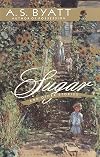
the cover pictures derive. It chiefly reverts to theme of family history, inter-generational relations, development. show less
Then the last one, 11, which gives the collection its title, and from which
the cover pictures derive. It chiefly reverts to theme of family history, inter-generational relations, development. show less
sette racconti bellissimi, in cui le storie fanno da padrone e le parole sono evocative.
Members
- Recently Added By
Author Information

83+ Works 38,254 Members
A.S. Byatt was born on August 24, 1936 in Sheffield, England. She received a B.A. from Newnham College, Cambridge in 1957, did graduate study at Bryn Mawr College from 1957-58, and attended Somerville College, Oxford from 1958-59. She was a staff member in the extra-mural department at the University of London from 1962-71. From 1968-69, she was show more also a part-time lecturer in the liberal studies department of the Central School of Art and Design, London. She was a lecturer at University College from 1972-80 and then senior lecturer from 1981-83. She became a full-time writer in 1983. Her works include The Biographer's Tale, The Virgin in the Garden, Babel Tower, A Whistling Woman, and The Children's Book. She also wrote numerous collections of short stories including Sugar and Other Stories, The Matisse Stories, The Djinn in the Nightingale's Eye, Elementals, and Little Black Book of Stories. Byatt received the English Speaking Union fellowship in 1957-58, the Fellow of the Royal Society of Literature in 1983, the Silver Pen Award for Still Life, and the Booker Prize for Possession: A Romance in 1990. (Bowker Author Biography) show less
Some Editions
Work Relationships
Is contained in
Common Knowledge
- Original publication date
- 1987
- First words
- When was it clear that Martha Crichton-Walker was the antagonist?
- Quotations
- Brian had died in his sleep ... The house was quieter without Brian, and this was good as well as lonely. His retirement, so brief, had been clutter and potter and constant small collisions of will and table-space and living-... (show all)space.
She sends him quires of hand-made Venetian paper which he distributes to artists and poets of his acquaintance.
Dear dead women, the scholar thinks, peering into the traces on the hooded green plane of the microfilm reader, or perhaps turning over browned packets of polite notes ... He has read her essay ... he now knows her, has piece... (show all)d her together. ... This scholar believes ... that his subject is the hidden heroine of a love story ... He adduces a poem ... The scholar's story combs the facts this way. He scrutinizes the microfilm, the yellowing letters, for little bright nuggets and filaments of fact to add to his mosaic.
Classifications
Statistics
- Members
- 528
- Popularity
- 56,567
- Reviews
- 9
- Rating
- (3.69)
- Languages
- English, French, German, Italian
- Media
- Paper, Ebook
- ISBNs
- 12
- ASINs
- 5