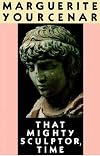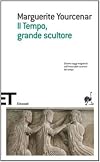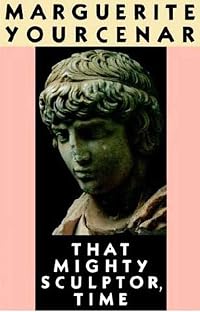
That Mighty Sculptor, Time
by Marguerite Yourcenar
On This Page
Description
This posthumously published collection of essays takes up such diverse subjects as the poet Oppian, Tantrism, the feasts of the Christian year, Durer, the Japanese studies of Ivan Morris, the erotic mysticism of the Gita-Govinda, the eternal spirit of Andalusia, and Bede's Ecclesiastical History. The title esay consider's time's transforming effect on arrt, meditating on the erosion of a statue and the resulting production of a new, sublime work of art.Tags
Recommendations

























Member Reviews
Marguerite Yourcenar, as always, writes magnificently regardless of the subject. In this posthumous collection of essays, tributes, and fragments she delves into quite the range. From Japanese uprisings and heroes; to the effects of time and elements on art, particularly sculptures; to animal cruelty; to the origins of Christianity in England; to the crucial elements of the historical novel in her works, and other subjects. It's always illuminating and entertaining reading her work, especially when it deals with the historical.
One of the fascinating bits from this collection was her abandoned project of the three Elizabeths of Central Europe. Three women who share a name: Saint Elizabeth, who abandons her noble station to serve the show more sick and poor; Elizabeth Báthory, infamous serial killer and (suspected) witch, and Empress Elizabeth, beautiful, narcissistic, youth-obsessed, and later assassinated, royal. Yourcenar aimed to create a work linking all three women, each separated from the other by three centuries but all sharing their Hungarian connection. A project she abandoned and which I wish had been realized and completed, but the essay on this abandoned project, while a tease of what could have been, was wonderful compensation.
Some of my favourite quotes from Sistine, pieces where Marguerite as Michaelangelo contemplates on life, love, death, and grief:
"Oh, I know that all that is only an illusion like the rest, and there is no future. Man, who invented time, then invented eternity for contrast; but the negation of time is as vain as time itself. There is no past or future, only a series of successive presents, a road perpetually destroyed and continued, upon which we all go forward."
"No one possesses anyone (even sinners cannot achieve that), and since art is the only true possession, it is less a matter of possessing than of re-creating a person."
"We love because we are not able to endure being alone. For the same reason, we fear death."
"This, we begin to fear that our renunciation has been a sin against ourselves, and our desire, lacking an outlet, takes on the monstrous aspect of everything that has never existed. Of all man's regrets, perhaps the cruelest is that for the unachieved."
This review has grown longer than intended. But I must finish it with this beautiful fragment from the Written in a Garden pieces:
"Your body, composed three-quarters of water plus a few terrestrial minerals, a small handful. And this great flame within you, whose nature you do not comprehend. And within your lungs, captured and recaptured continuously within the thoracic cage, air, that lovely stranger without whom you cannot live." show less
One of the fascinating bits from this collection was her abandoned project of the three Elizabeths of Central Europe. Three women who share a name: Saint Elizabeth, who abandons her noble station to serve the show more sick and poor; Elizabeth Báthory, infamous serial killer and (suspected) witch, and Empress Elizabeth, beautiful, narcissistic, youth-obsessed, and later assassinated, royal. Yourcenar aimed to create a work linking all three women, each separated from the other by three centuries but all sharing their Hungarian connection. A project she abandoned and which I wish had been realized and completed, but the essay on this abandoned project, while a tease of what could have been, was wonderful compensation.
Some of my favourite quotes from Sistine, pieces where Marguerite as Michaelangelo contemplates on life, love, death, and grief:
"Oh, I know that all that is only an illusion like the rest, and there is no future. Man, who invented time, then invented eternity for contrast; but the negation of time is as vain as time itself. There is no past or future, only a series of successive presents, a road perpetually destroyed and continued, upon which we all go forward."
"No one possesses anyone (even sinners cannot achieve that), and since art is the only true possession, it is less a matter of possessing than of re-creating a person."
"We love because we are not able to endure being alone. For the same reason, we fear death."
"This, we begin to fear that our renunciation has been a sin against ourselves, and our desire, lacking an outlet, takes on the monstrous aspect of everything that has never existed. Of all man's regrets, perhaps the cruelest is that for the unachieved."
This review has grown longer than intended. But I must finish it with this beautiful fragment from the Written in a Garden pieces:
"Your body, composed three-quarters of water plus a few terrestrial minerals, a small handful. And this great flame within you, whose nature you do not comprehend. And within your lungs, captured and recaptured continuously within the thoracic cage, air, that lovely stranger without whom you cannot live." show less
Il tempo è un grande scultore, lascia i suoi segni sulla pietra e sulla pittura, così come sull'animo umano, e soprattutto sul linguaggio.
Alcuni dei saggi che compongono la raccolta assomigliano a racconti, altri sono vere e proprie invettive.
I più belli, a parer mio, sono gli studi sul linguaggio che compongono la prima parte del libro, in particolare il lungo brano intitolato "Tono e linguaggio nel romanzo storico", una dettagliata e appassionata analisi del testo da parte dell'autore che lo ha scritto, e, nello stesso tempo, una precisa indicazione per chi vuole scrivere.
Alcuni dei saggi che compongono la raccolta assomigliano a racconti, altri sono vere e proprie invettive.
I più belli, a parer mio, sono gli studi sul linguaggio che compongono la prima parte del libro, in particolare il lungo brano intitolato "Tono e linguaggio nel romanzo storico", una dettagliata e appassionata analisi del testo da parte dell'autore che lo ha scritto, e, nello stesso tempo, una precisa indicazione per chi vuole scrivere.
Per apprezzare questo insieme di articoli e saggi, scritti in epoche diverse - ma sempre con uno stile raffinato ed una gentilezza d'altri tempi - bisognerebbe essere molto colti, conoscitori di arti e poesia, appassionati di storia e letteratura. Solo cosi' se ne potrebbero assaporare a fondo le riflessioni, gli aggettivi, gli indovinati accostamenti. Per chi, di cultura mediocre (come il sottoscritto), si voglia arrischiare a leggere queste meditazioni, si rende necessaria una non comune sensibilità e grande curiosità.
In assenza di queste, rimane soltanto il senso della lontananza da una erudizione così profonda.
In assenza di queste, rimane soltanto il senso della lontananza da una erudizione così profonda.
Crônicas
Brevi saggi di una grande autrice sul tema dell'inesorabile flusso del tempo: "Tutto scorre. L'anima che assiste, immobile, al passare delle gioie, delle tristezze e delle morti, di cui è fatta la vita, ha ricevuto "la grande lezione delle cose che passano".
Aug 23, 2017Italian
verzameling van diverse reeds gepubliceerde essays rond diverse onderwerpen.
Oct 13, 2010Dutch
Ratings
Members
- Recently Added By
Author Information

110+ Works 14,677 Members
A French novelist, playwright, and essayist born in Belgium, Marguerite Yourcenar was a resident of the United States for many years, living in isolation on a small island off the coast of Maine. Educated at home by wealthy and cultured parents, she had a strong humanistic background, translating the ancient Greek poet Pindar and the poems of the show more modern Greek Constantine Cavafy. She has translated American Negro spirituals and works of Virginia Woolf (see Vol. 1) and Henry James (see Vol. 1). Her novels include Alexis (1929) and Coup de Grace (1939). A collection of poems, Fires, was published in 1936. Yourcenar is particularly known for Hadrian's Memoirs (1951), a philosophical meditation in the form of a fictional autobiography of the second-century Roman emperor. In Germaine Bree's judgment, "With great erudition and great psychological insight, Marguerite Yourcenar constructed a body of work that is a meditation on the destiny of mankind." In 1981, she became the first woman ever elected to the French Academy. (Bowker Author Biography) show less
Common Knowledge
- Canonical title
- That Mighty Sculptor, Time
- Original title
- Le Temps, ce grand sculpteur
- Original publication date
- 1983
Classifications
Statistics
- Members
- 261
- Popularity
- 124,822
- Reviews
- 6
- Rating
- (3.78)
- Languages
- 7 — Catalan, Dutch, English, French, Italian, Portuguese, Spanish
- Media
- Paper, Ebook
- ISBNs
- 20
- ASINs
- 2