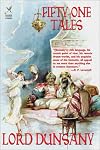
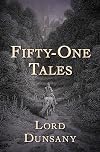
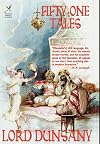
Fifty-One Tales
by Lord Dunsany
On This Page
Description
Looking for a cornucopia of classic fantasy tales? Dip into The Food of Death: Fifty-One Tales from genre pioneer Lord Dunsany. The short stories collected in this career-spanning compendium range from fables with a mythic bent to action-adventure tales set in alternate universes—all from the pen of a brilliant early figure in the field who is credited as a major influence on Tolkien and Lovecraft. Fantasy fans won't be disappointed..
Tags
Recommendations











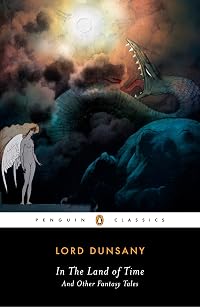










Member Reviews
You sometimes read that the late Victorian/Edwardian periods were marked by cultural lassitude and a general feeling of exhaustion, but "Fifty-One Tales" might be the best example I've actually seen of this culture-wide ennui. In Lord Dunsay's mini-stories, industrialism foretells the ruination of mankind, nature is in retreat, the old gods are in hiding, and the modern world looks generally bleak. In some ways, Dunsany has most of the prejudices that you'd expect an Anglo-Irish Lord of his era to have. A lot of people, most notably W. B. Yeats, played with classical and natural themes at about this place and time, but Dunsany's has none of Yeats' vigor: he comes off as merely defeated and melancholy, while Yeats seemed to draw real show more power from the literary and mythological past.
Which isn't to say that "Fifty-One Tales" is a necessarily terrible book. It's amazing to realize that somebody out there was writing microfictions -- or flash fictions, or twitter novels or whatever you'd like to call them -- one hundred years ago. Dunsany's stories are compact and often feel complete, which considering that some of them aren't longer than a few paragraphs, is something of an achievement. And Dunsany can write, after a fashion, even if his style will probably come off as too perfect and excessively ornamented to many modern readers. Still, every once in a while he hits the mark, thereby keeping things somewhere above the Mendoza line. And I'm sure that a lot of fantasy and Victoriana fans will find a lot of this stuff positively charming. But, unsurprisingly, these tales lack any trace the engagement with the physical body or with a particular individual consciousness that tends to characterize Modernist writing.. I enjoyed this one mostly as a historical curiosity. show less
Which isn't to say that "Fifty-One Tales" is a necessarily terrible book. It's amazing to realize that somebody out there was writing microfictions -- or flash fictions, or twitter novels or whatever you'd like to call them -- one hundred years ago. Dunsany's stories are compact and often feel complete, which considering that some of them aren't longer than a few paragraphs, is something of an achievement. And Dunsany can write, after a fashion, even if his style will probably come off as too perfect and excessively ornamented to many modern readers. Still, every once in a while he hits the mark, thereby keeping things somewhere above the Mendoza line. And I'm sure that a lot of fantasy and Victoriana fans will find a lot of this stuff positively charming. But, unsurprisingly, these tales lack any trace the engagement with the physical body or with a particular individual consciousness that tends to characterize Modernist writing.. I enjoyed this one mostly as a historical curiosity. show less
One or two-page tales, usually piquant, written in high style, often twists on myths or fables, sometimes silly, sometimes exquisitely philosophical. Sometimes Dunsany describes London or the Irish countryside in a mythic context. "And the sound of the river was like a mighty sigh that Grief had in the beginning sighed among her sisters, and that could not die like the echoes of human sorrow failing on earthly hills, but was as old as time and the pain in Charon's arms." That is from a tale titled Charon, which imagines Charon ferrying the last living soul across the great river. From such a sentence, I can see why he hung out with Yeats and was an inspiration for LeGuin.
Flash from a hundred years ago. Fairly quick read, since most of these fit on a page each. Lot of what most people would classify as either parables or homilies. There's a still a touch of Dunsanian dreaminess in them.
A facsimile of a collection originally published in 1915. I suppose these would be called "short shorts" today - there are a few that are one or two paragraphs long, and none longer than a few pages.
Most are fables or parables. Quite a few involve Death, as well as other anthropomorphized seasons and elements and such. Another major theme is Man and Technology vs. Nature. The standout for me was a twist on the Tortoise and Hare story. And there are others that clearly stand as influences on writers such as Lovecraft and Clark Ashton Smith.
I'm not sure how this compares to the rest of his oeuvre, just because the stories are so short. But there are certainly some good stories in here, and I think it makes for a nice diversion (shouldn't show more take you more than an hour or two to read this). show less
Most are fables or parables. Quite a few involve Death, as well as other anthropomorphized seasons and elements and such. Another major theme is Man and Technology vs. Nature. The standout for me was a twist on the Tortoise and Hare story. And there are others that clearly stand as influences on writers such as Lovecraft and Clark Ashton Smith.
I'm not sure how this compares to the rest of his oeuvre, just because the stories are so short. But there are certainly some good stories in here, and I think it makes for a nice diversion (shouldn't show more take you more than an hour or two to read this). show less
Fifty-One Tales is a collection of fantasy short stories by Irish writer Lord Dunsany, considered a major influence on the work of J. R. R. Tolkien, H. P. Lovecraft, Ursula K. Le Guin and others. This collection of tales was fun to read. You get many tales from The Assignation, Charon, The Death of Pan, The Worm and the Angel, Roses, The Song of the Blackbird, and The Messengers. All of these by Lord Dunsany are great little reads that can be comical or thought provoking. The are derived from mythology and truth. You get it all in these tales from ghosts to kings, angels and dreams, gods and men. Some are quite short and will take mere minutes to read, but give it a go and read them all because in the end you will be glad you did.
Ratings
Members
- Recently Added By
Author Information

391+ Works 10,070 Members
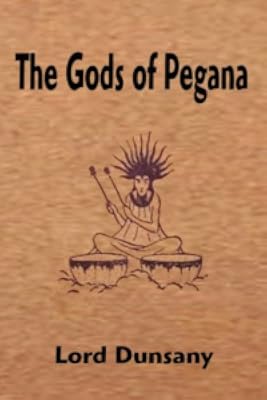
Though during his lifetime the Irish nobleman Lord Edward John Moreton Drax Plunkett, the 18th Baron Dunsany, was perhaps regarded as a minor talent, his somber short fantasies and novels had a significant impact on the development of fantasy and horror fiction. In real life, Dunsany was as interesting and versatile as anyone about whom he wrote. show more He was an African big-game hunter, a soldier in both the Boer War and World War I, and was wounded in the 1916 Irish Easter Rebellion. He was also the national chess champion of Ireland. Dunsany's first short story collection, The Gods of Pegana, was published in 1905 and was soon followed by other fantasy anthologies, including Time and the Gods (1906) and The Sword of Welleran and Other Stories (1908), among others. These stories are distinguished by their elegant, fairy tale settings and Dunsany's unique, macabre sense of humor. Dunsany's novels, such as The King of Elfland's Daughter (1924) and The Charwoman's Shadow (1926), are considered fantasy classics. Although Dunsany wrote prodigiously and with great versatility throughout his life, many regard his early, highly stylized short fiction to be his best work, and his most important. (Bowker Author Biography) show less
Some Editions
Series
Belongs to Publisher Series
Work Relationships
Is contained in
Lord Dunsany Super Pack: The Gods of Pegana; Time and the Gods; The Sword of Welleran and Other Stories; A Dreamers Tales; The Book of Wonder; Fifty-One... by Lord Dunsany
Common Knowledge
- Canonical title
- Fifty-One Tales
- Alternate titles
- The Food of Death
- Original publication date
- 1915 (UK and US) (UK and US)
- First words
- Fame singing in the highways, and trifling as she sang, with sordid adventurers, passed the poet by.
- Last words
- (Click to show. Warning: May contain spoilers.)But at evening as he stole out of the forest, and slipped like a shadow softly along the hills, Pan saw the tomb and laughed.
- Disambiguation notice
- Also published as "The Food of Death".
Note that the UK and US editions differ:- The UK edition includes the story 'The Poet Speaks With Earth' and omits the story 'The Mist'
- The US edition in... (show all)cludes the story 'The Mist' and omits the story 'The Poet Speaks with Earth'
Classifications
Statistics
- Members
- 373
- Popularity
- 83,650
- Reviews
- 6
- Rating
- (3.88)
- Languages
- English, Japanese
- Media
- Paper, Audiobook, Ebook
- ISBNs
- 42
- ASINs
- 24