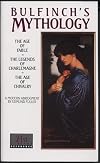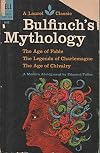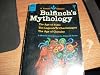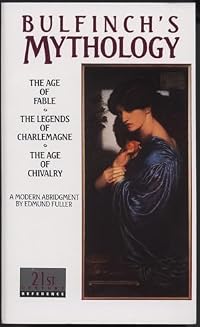
Bulfinch's Mythology (A Modern Abridgement by Edmund Fuller)
by Thomas Bulfinch, Edmund Fuller (abridged by)
On This Page
Description
Contains myths of Greece and Rome, Egypt, the Far East, and Germany, also legends of King Arthur and Charlemagne.Tags
Recommendations




















Member Reviews
This 1967 version of Thomas Bulfinch's textbooks on mythology (finished in 1863) is a chronicle of myths that have influenced Western civilization and literature for hundreds of years. It is divided into three sections: The Age of Fable, The Age of Chivalry, and The Legends of Charlemagne.
The Age of Fable takes up more than half of the book and is a great look at the myths of Greece, Rome, Scandinavia, and the British Isles. The vast majority of this section (33 out of 40 chapters) is spent on the myths of Greece and Rome. Fuller chooses to follow Bulfinch in naming the characters of the myths in their Roman names, rather than the Greek names, although translations are given. Stories included in this section include the creation of the show more world, Hercules, The Iliad, The Oddesy, and the Anead, as well as many Norse myths, the druids of Europe, and Beowulf. This section is easy to follow and gives insight into any myth you'd want to read about (or take inspiration from for your games, particularly from Mythic Odysseys of Theros).
The second section, The Age of Chivalry, revolves around the stories of King Arthur and the Knights of the Round Table. This section is where the "Abridgement" in the title starts to rear its ugly head. While not as bad as in the following section, this is where the fact that this book was originally a textbook comes out in the storytelling. Unlike the former section, where there were stories like the Iliad but quickly move on to other characters, this section is more or less about the same group of people throughout. This means that while we have these characters for a longer amount of time, we still do not get very much elaboration on their character traits outside of being told that they love people or are virtuous knights. Because we are with these characters for longer, I would expect more elaboration on them. This section also summarises Le Morte d’Arthur (1485), by Sir Thomas Malory, which is also located in the recommended reading of Appendix D of the 5e Dungeon Master's Guide (2014).
In my opinion, the last section, The Legends of Charlemagne, was the hardest to get through, even though it was only around fifty pages. Maybe this is due to the fact that it is around half the length of The Age of Chivalry, or due to the fact that Charlemagne was an actual historical figure, but this section dragged along quite a bit. It was also, especially in chapters four and five, very insistent on a mentality of "us Christians versus those Muslims," which while understandable for the time, was not exactly the most palatable depiction for me, as I am not a Christian.
All in all, this is a great reference book, but I would stick to using it as just that and not reading it cover-to-cover like I did. show less
The Age of Fable takes up more than half of the book and is a great look at the myths of Greece, Rome, Scandinavia, and the British Isles. The vast majority of this section (33 out of 40 chapters) is spent on the myths of Greece and Rome. Fuller chooses to follow Bulfinch in naming the characters of the myths in their Roman names, rather than the Greek names, although translations are given. Stories included in this section include the creation of the show more world, Hercules, The Iliad, The Oddesy, and the Anead, as well as many Norse myths, the druids of Europe, and Beowulf. This section is easy to follow and gives insight into any myth you'd want to read about (or take inspiration from for your games, particularly from Mythic Odysseys of Theros).
The second section, The Age of Chivalry, revolves around the stories of King Arthur and the Knights of the Round Table. This section is where the "Abridgement" in the title starts to rear its ugly head. While not as bad as in the following section, this is where the fact that this book was originally a textbook comes out in the storytelling. Unlike the former section, where there were stories like the Iliad but quickly move on to other characters, this section is more or less about the same group of people throughout. This means that while we have these characters for a longer amount of time, we still do not get very much elaboration on their character traits outside of being told that they love people or are virtuous knights. Because we are with these characters for longer, I would expect more elaboration on them. This section also summarises Le Morte d’Arthur (1485), by Sir Thomas Malory, which is also located in the recommended reading of Appendix D of the 5e Dungeon Master's Guide (2014).
In my opinion, the last section, The Legends of Charlemagne, was the hardest to get through, even though it was only around fifty pages. Maybe this is due to the fact that it is around half the length of The Age of Chivalry, or due to the fact that Charlemagne was an actual historical figure, but this section dragged along quite a bit. It was also, especially in chapters four and five, very insistent on a mentality of "us Christians versus those Muslims," which while understandable for the time, was not exactly the most palatable depiction for me, as I am not a Christian.
All in all, this is a great reference book, but I would stick to using it as just that and not reading it cover-to-cover like I did. show less
I read the abridged version. I discovered that I have the hardcover full editions of both the [Bulfinch's Mythology] and [The Age of Fable]. The main differences are in "The Age of Fable". A complete section of the Welsh stories has been cut out of the abridged edition. So far, those comprise more stories of Arthur and his Knights. I haven't done a close study of the original mythology, but the man who did the abridgement said that the only thing he left out of it was some of the Victorian poetry which Bulfinch had used to show how modern folks have used the tales. He left in poetry from the more famous poets.
I enjoyed reading this tremendously. It connected many dots for me of classical readings I have done from Dante to Tolkien, and show more in many less famous readings as well.
I am going through my hardcover full editions and reading the bits which were missing from the abridgement. I probably won't keep the paperback, since I have the full editions, but I would recommend it to anyone who wanted a reference and didn't want to take up so much room on their shelves. show less
I enjoyed reading this tremendously. It connected many dots for me of classical readings I have done from Dante to Tolkien, and show more in many less famous readings as well.
I am going through my hardcover full editions and reading the bits which were missing from the abridgement. I probably won't keep the paperback, since I have the full editions, but I would recommend it to anyone who wanted a reference and didn't want to take up so much room on their shelves. show less
I was having trouble analyzing British poetry in English senior year, but I picked up an illusion here and there to what little I knew of Greek and Roman mythology. So I got myself a used copy of this book, and I was amazed at how mythology is the key to understanding so much literature! I fell in love.
The author was a well-educated and underemployed bank clerk in Boston who used his spare time to research classical mythology. Thomas Bulfinch was born in 1796, one of three sons of the great Unitarian architect. But unlike his two successful brothers, Thomas only failed in several businesses. At age 41, taking a modest clerical job, he began to write what became the definitive and important series of works on mythology, fables and legends. To this day, Bulfinch supersedes in quality and readership much of the scholastic materials written by academicians.
This three-volume collection presents Bulfinch's studies first published in one combined volume in 1881: The Age of Fable presents the Greek and Roman myths of the classical period. show more The Age of Chivalry is a retelling of the legends of King Arthur, Robin Hood, and sundry British/Celtic folk tales. The third part, the Legends of Charlemagne, recounts tales drawn from France, Germany, and Africa. show less
This three-volume collection presents Bulfinch's studies first published in one combined volume in 1881: The Age of Fable presents the Greek and Roman myths of the classical period. show more The Age of Chivalry is a retelling of the legends of King Arthur, Robin Hood, and sundry British/Celtic folk tales. The third part, the Legends of Charlemagne, recounts tales drawn from France, Germany, and Africa. show less
Ratings
Members
- Recently Added By
Author Information

54+ Works 14,611 Members

Work Relationships
Is an abridged version of
Common Knowledge
- Canonical title
- Bulfinch's Mythology (A Modern Abridgement by Edmund Fuller) (A Modern Abridgement by Edmund Fuller)
- Alternate titles
- Mythology: a modern abridgment
- Original publication date
- 1967-08
Classifications
Statistics
- Members
- 789
- Popularity
- 35,105
- Reviews
- 5
- Rating
- (3.86)
- Languages
- English
- Media
- Paper
- ISBNs
- 1
- ASINs
- 18