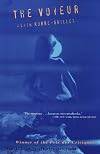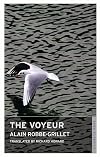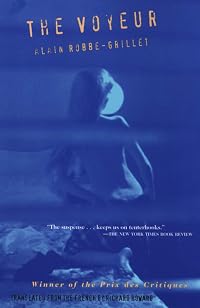
The Voyeur
by Alain Robbe-Grillet
On This Page
Description
Mathias, a timorous, ineffectual traveling salesman, returns to the island of his birth after a long absence. Two days later, a thirteen-year-old girl is found drowned and mutilated. With eerie precision, Robbe-Grillet puts us at the scene of the crime and takes us inside Mathias's mind, artfully enlisting us as detective hot on the trail of a homocidal maniac. A triumphant display of the techniques of the "new novel," The Voyeur achieves the impossible feat of keeping us utterlyengrossed in show more the mystery of the child's murder while systematically raising doubts about whether it really occurred. show lessTags
Recommendations








































Member Recommendations
by ateolf
Member Reviews
A deceptive book. First the title, then the cover and blurbs on the back lead you to think it's a mystery, that it contains a plot, or even meaningful characters. The back cover claims it is an expression of literature as art. But nouveau roman is a vague category. It can take many forms. I was reminded of Beckett, who's work, in my mind, ranged from atrocious to miraculously good. Robbe-Grillet's purpose in this novel seemed to be to experiment with detail, not to entertain, enlighten, or innovate. Hyper-attention to detail is fine in small doses. Yet, this becomes a catalogue of things normally subtracted from a good book.
If you're interested in this book (I can't think of any reason to read it unless you plan to live more than one show more lifetime) skip the first 110 pages. Or, better yet, skip to the last 20 pages. Nothing of consequence could be said to happen for 99% of the book, which is the reason for my rating. The main character wanders around a small island town not selling watches. The dialogue is mostly of the sales pitch variety. Having done sales myself, I didn't need to read about someone doing it. Especially with such lack of skill, clearly pre-judging his customers, and failing so miserably. But add to this a stifling, rococo hoard of environmental details - he spends pages describing chair legs, frilly curtains, rug patterns, carpet stains, gleaming windowpanes, puddles of mud on the side of the road, clouds in the shape of turds, and hundreds of other silly observations. With existential horror, I found myself reading it, being bored, and questioning my own sanity. show less
If you're interested in this book (I can't think of any reason to read it unless you plan to live more than one show more lifetime) skip the first 110 pages. Or, better yet, skip to the last 20 pages. Nothing of consequence could be said to happen for 99% of the book, which is the reason for my rating. The main character wanders around a small island town not selling watches. The dialogue is mostly of the sales pitch variety. Having done sales myself, I didn't need to read about someone doing it. Especially with such lack of skill, clearly pre-judging his customers, and failing so miserably. But add to this a stifling, rococo hoard of environmental details - he spends pages describing chair legs, frilly curtains, rug patterns, carpet stains, gleaming windowpanes, puddles of mud on the side of the road, clouds in the shape of turds, and hundreds of other silly observations. With existential horror, I found myself reading it, being bored, and questioning my own sanity. show less
Robbe-Grillet crafts a sort of narrative puzzle here, details revealed and suspicions raised and resolved as the story retreads itself and at the same time moves forward. The focus is on objects and on time, instead of direct characterization and plot. I can see the justifications for this, an effort to reinvent the dimensions of the novel and how narrative is constructed. However, I don't empathize with Mathias or the townspeople or, more surprisingly, the dead girl. I find no room to empathize with them because Robbe-Grillet makes them feel more like chess pieces then like people. I can understand his motivation, but characterization and empathy are vital elements to a successful narrative in my opinion. As for this story, we figure show more out how it unfolds, but not so much why any of it happens. show less
Robbe-Grillet's ability to deconstruct time in a story never ceases to amaze me. Upon first reading of the Voyeur, you're thrown by the repetition of the lead character's thoughts. But as the author weaves you back through the ever more familiar scenarios, subtle changes and shifts start to reveal the truth that the character is hiding. One of the more brilliant reinventions of what a novel can be.
Line of grey water. Iron rings submerge in waves. Series of lines, connecting, network of curves, angles. Shortcut to the cottages, all the same, one-story, single window. Only four miles long. Keep to schedule. Knock on wooden door, knock again with ring. Enter, first door on the right. New oilcloth on table. Press the clasps. Open the suitcase, remove the cardboard strips. Waterproof, shockproof.
Figure eight of cord, greasy. String collection, the cupboard not locked, empty. Chromium-plated bicycle. Ride into yellow light. Sun glints on fenders. Chain noisy, chain quiet, fix the chain, fix the chain, the chain is fine. How much time. How to account, the memorandum book, the suitcase, lay book in the cover. Figure eight around island. show more Series of lines. Half-smoked cigarettes. The parapet, a timorous face. Violet, Violet...little Jacqueline...grey sweater, just a rag.
Close-fitting black dress. Delicate skin. Nape of neck exposed, tip of a vertebra, thin black cloth, wrists behind back, kneeling. Remove the cardboard strips. Face of watch. The time, the time...it spreads, retracts. Path along the fields. Grey gull perched on a post. All afternoon, drawing. A single window. Draw it all day. Light only reaches so far. The table below the window. Beyond the light, into the corners, the shadows, come forward. Four panes of window. Finger to her mouth. Spider crabs. Laughing. The steamer, the sheep disturbed. Too close to the edge.
Iron rings, submerge, waves cover rust marks. Another glass of absinthe. Gumdrops. The suitcase, angles, copper rivets. Press the clasps. Remove the protective paper, the cardboard strips. Close the loop of an eight. show less
Surréalisme français
May 22, 2006French
Ratings
Members
- Recently Added By
Lists

Harold Bloom - The Western Canon: D. The Chaotic Age
833 works; 24 members
Author Information

59+ Works 5,359 Members
Writer and filmmaker Alain Robbe-Grillet was born in Brest, France in 1922. Robbe-Grillet's first novel, The Erasers (1953) is considered to be one of the first books of the nouveau roman, or new novel, in which external reality is more important than character or plot. His other works included The Voyeur (1955), Jealousy (1957) and Djinn (1981). show more He worked in the film industry as a writer, actor and director. He died at the age of 85 on February 18, 2008. (Bowker Author Biography) show less
Some Editions
Awards and Honors
Awards
Series
Belongs to Publisher Series
Common Knowledge
- Canonical title*
- Le Voyeur
- Original title
- Le Voyeur
- Alternate titles*
- Соглядатай
- Original publication date
- 1958
- Original language*
- Français
*Some information comes from Common Knowledge in other languages. Click "Edit" for more information.
Classifications
Statistics
- Members
- 663
- Popularity
- 43,459
- Reviews
- 5
- Rating
- (3.77)
- Languages
- 8 — English, French, German, Italian, Japanese, Serbian, Spanish, Swedish
- Media
- Paper, Ebook
- ISBNs
- 22
- ASINs
- 21