On This Page
Description
Hurtled back through time more than two hundred years to 1743 Scotland, Claire Randall finds herself caught in the midst of an unfamiliar world torn apart by violence, pestilence, and revolution and haunted by her growing feelings for a young soldier, James Fraser..
Tags
Recommendations




Member Reviews
Gabaldon really knows how to weave together a complex story. There are so many twists and turns (Mostly POV’s), it felt like I was on a literary rollercoaster. The American Revolution is in full swing, and our favorite time-traveling couple is right in the thick of it. It's like watching a historical drama and a soap opera all rolled into one.
Now, I have to admit, keeping track of all the characters and plotlines was a bit of a challenge at times. It’s like trying to remember everyone’s name at a family reunion, but instead of your third cousin twice removed,
Claire and Jamie are as dynamic and lovable as ever. Their chemistry is off the charts, and their unwavering love gives me all the feels. Plus, Ian, Brianna, Roger, and the whole gang are back and dealing with their own drama, making the book a rich tapestry of interwoven stories.
One of my favorite things about Gabaldon’s writing is her ability to blend humor with drama. There were moments I found myself laughing out loud—like Claire’s sass or Jamie’s dry wit—right before being hit with some intense, heart-pounding action. It's a perfect balance that keeps the story engaging and emotionally satisfying.
These books are LONG. Like, "get comfy, you’re gonna be here a while" long. But honestly, by the time I reached the end, I was already missing the characters and ready for more.
MOBY is emotional, thrilling, and full of the rich historical detail we all love. So, grab a cup of tea (or maybe something stronger) and dive in!
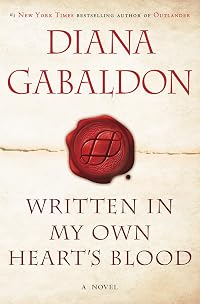
Written In My Own Heart’s Blood - Gabaldon
audio performance by Davina Porter
5 stars
I feel vindicated. The past two books in the series did not impress me, but it was worth suffering through them, and waiting it out for this one. Most of the dangling threads are tied up, or at least, somewhat untangled. Story lines are converging once more, and there is a mostly positive outlook for my favorite characters. Although violated characters are still dealing with the consequences of previous violence,there were no rapes, that I recall, in this 848 page tome. There is, in true Gabaldon form, a lot of sex; reunion sex, wedding night sex, before battle sex, brothel sex, third trimester pregnancy sex, and lots of humorous conversation about show more sex. I’m happy that her characters are happy, but sometimes I wish she would give them a bit more privacy.
There were quite a few laugh out loud moments in this book, including the impromptu bachelorette beer drinking party that Claire has with Rachel and Dotty (one of those conversations about sex). I laughed at Jaime Fraser under the care and scrutiny of Prudence and Patience and at Ian’s encounter with Mrs. Sylvie and the Wurms (in the presence of his wife). Gabaldon wrote another wonderful, ridiculous wedding, and two graveside scenes that made me cry. There are some old characters like Hal Grey, the Duke of Pardloe, who are getting more of the action, and some wonderful new characters like Jane and Fanny.
It’s too bad that I liked this one so much. I was beginning to lose interest in this series. Now I’m very unhappy about waiting 4 or 5 years for the next one.
show less
audio performance by Davina Porter
5 stars
I feel vindicated. The past two books in the series did not impress me, but it was worth suffering through them, and waiting it out for this one. Most of the dangling threads are tied up, or at least, somewhat untangled. Story lines are converging once more, and there is a mostly positive outlook for my favorite characters. Although violated characters are still dealing with the consequences of previous violence,there were no rapes, that I recall, in this 848 page tome. There is, in true Gabaldon form, a lot of sex; reunion sex, wedding night sex, before battle sex, brothel sex, third trimester pregnancy sex, and lots of humorous conversation about show more sex. I’m happy that her characters are happy, but sometimes I wish she would give them a bit more privacy.
There were quite a few laugh out loud moments in this book, including the impromptu bachelorette beer drinking party that Claire has with Rachel and Dotty (one of those conversations about sex). I laughed at Jaime Fraser under the care and scrutiny of Prudence and Patience and at Ian’s encounter with Mrs. Sylvie and the Wurms (in the presence of his wife). Gabaldon wrote another wonderful, ridiculous wedding, and two graveside scenes that made me cry. There are some old characters like Hal Grey, the Duke of Pardloe, who are getting more of the action, and some wonderful new characters like Jane and Fanny.
It’s too bad that I liked this one so much. I was beginning to lose interest in this series. Now I’m very unhappy about waiting 4 or 5 years for the next one.
show less
WARNING: What follows are my opinions and my opinions only in which I freely discuss plot points from the previous seven books. If you are a huge fan of the series, what I have to say may not be something you will want to read. Continue at your own risk.
Written in My Own Heart’s Blood is not the end of the Outlander series. You cannot imagine how much this fact angers and saddens me. Claire and Jamie are not old but they are old enough to be put to rest. They’ve had their tumultuous life, and it is time to let them grow old together in peace. This would be the best thing Ms. Gabaldon could do for these beloved characters.
The rest of the cast can go do their own thing too; I just do not want to hear about it anymore. William is a show more spoiled brat. Bree and Roger do not improve over time. Lord John’s purpose remains nebulous, as it appears as if he is a convenient character to use when someone in the Fraser family needs something. While Rachel and Ian make a tremendously cute couple, I don’t need to see every intimate moment of their lives.
This shift to other characters beyond Claire and Jamie is a true indication that this series has run its course. The series has always been about Claire and Jamie, and if they no longer have enough of a story to fill a novel without all of the extraneous character subplots, then their story is done. It is a shame that Ms. Gabaldon does not feel the same way because she does the entire series, and her characters, a disservice.
As for Written in My Own Heart’s Blood, it remains the clunky chunkster for which Ms. Gabaldon is famous. The entire story is essentially a repeat of previous plot lines, with the added benefit of plot holes the size of supermassive black holes. Claire faces a life-threatening injury. Jamie expresses his undying love. Jamie gets seasick. Claire saves lives with radical (for the time) surgical procedures. They face several military battles together. They try to get away from politics and war but keep getting involved with important historical figures. There are marriages, births, scandals, fires, and fleeing. Yes, it sounds like the plot to every previous book in the series.
There is also more time travel through stones. At this point in time, the stones and the ability to move through time has become nothing but a plot contrivance. Don’t know what to do with certain characters? Send them through the stones! This time, Roger is the one to go through the stones, and what follows is so ridiculous it is embarrassing. There is nothing gained by his presence in the 18th century again other than it is the only way to explain his inclusion in the novel. Of course, this means Bree must go to Roger’s rescue…again…even as she faces her own dangers - which is the only reason she enters the novel. Thankfully, there is not a huge swath of the novel devoted to their inexplicable storyline, but there is just enough to make you hate reading the book.
I’ve stated before and I will continue to repeat that Ms. Gabaldon is not a good writer. Her descriptive paragraphs are awkward and disruptive. She spends too much time lingering over descriptions of things that do not deserve the attention, almost as if she prides herself on her openness by discussing in detail such matters as rectal and vaginal surgery. This time around, there is an unhealthy attention to anal sex, with characters mentioning it in some context in almost every scene, whether it pertains to the scene or not. Then, there are her awful comparisons of female anatomy to seafood. Seriously, female body parts should never be compared to oysters, fresh-caught trout or anything like it. It is an appalling comparative in my opinion, and one that removes any sexiness from any scene.
As much as I struggled listening to the story, as much as I cannot stand Bree and Roger or any of the other subplots, I continue to read the series and find pleasure in Claire and Jamie, at least when I do not have to read about their bedroom antics. They have mellowed into a great example of a strong marriage. Their relationship is built on trust, love, mutual respect, and, above all, friendship. The scenes where they discuss the day’s activities or make plans for their family remain my favorite scenes of the book because they are so normal and realistic – unlike pretty much every other scene in the novel. It is a pleasure to watch them interact as thoroughly as a long happily-married couple does with the little crises that make up an ordinary daily life. They don’t need the constant drama and involvement in major historical events to be interesting or lovable. They just need each other.
Davina Porter, as always, saves this story from utter wretchedness. Her performance is as steady and reliable as always. It is a true pleasure to listen to her narrate the story, even if the words she must speak are horribly repetitive and clunky. She is the only reason I can get through the major holes in the series and the eye-rolling events in the individual stories. I may not like the books, but I do like her performances and will continue to stick with the audiobook format as long as the series continues.
I am thoroughly disappointed that Ms. Gabaldon is extending the series by yet one more book. There is little to no original stories anymore, and long-time readers will find no surprises in Written in My Own Heart’s Blood. It is actually an entertaining little game to predict in advance how the story will unfold and confirm whether you are right. There was so much ridiculousness within Roger and Bree’s subplot that readers will feel disgust that they are actually reading that drivel. The first two novels in the series are so good that it is almost disgraceful to see what Jamie and Claire and the rest of the Fraser clan are doing in Written in My Own Heart’s Blood. It is time to end the series once and for all. Let them all live in peace. Besides, we now have the TV series to keep our interest and remind us how and why we fell in love with the series in the first place. show less
Written in My Own Heart’s Blood is not the end of the Outlander series. You cannot imagine how much this fact angers and saddens me. Claire and Jamie are not old but they are old enough to be put to rest. They’ve had their tumultuous life, and it is time to let them grow old together in peace. This would be the best thing Ms. Gabaldon could do for these beloved characters.
The rest of the cast can go do their own thing too; I just do not want to hear about it anymore. William is a show more spoiled brat. Bree and Roger do not improve over time. Lord John’s purpose remains nebulous, as it appears as if he is a convenient character to use when someone in the Fraser family needs something. While Rachel and Ian make a tremendously cute couple, I don’t need to see every intimate moment of their lives.
This shift to other characters beyond Claire and Jamie is a true indication that this series has run its course. The series has always been about Claire and Jamie, and if they no longer have enough of a story to fill a novel without all of the extraneous character subplots, then their story is done. It is a shame that Ms. Gabaldon does not feel the same way because she does the entire series, and her characters, a disservice.
As for Written in My Own Heart’s Blood, it remains the clunky chunkster for which Ms. Gabaldon is famous. The entire story is essentially a repeat of previous plot lines, with the added benefit of plot holes the size of supermassive black holes. Claire faces a life-threatening injury. Jamie expresses his undying love. Jamie gets seasick. Claire saves lives with radical (for the time) surgical procedures. They face several military battles together. They try to get away from politics and war but keep getting involved with important historical figures. There are marriages, births, scandals, fires, and fleeing. Yes, it sounds like the plot to every previous book in the series.
There is also more time travel through stones. At this point in time, the stones and the ability to move through time has become nothing but a plot contrivance. Don’t know what to do with certain characters? Send them through the stones! This time, Roger is the one to go through the stones, and what follows is so ridiculous it is embarrassing. There is nothing gained by his presence in the 18th century again other than it is the only way to explain his inclusion in the novel. Of course, this means Bree must go to Roger’s rescue…again…even as she faces her own dangers - which is the only reason she enters the novel. Thankfully, there is not a huge swath of the novel devoted to their inexplicable storyline, but there is just enough to make you hate reading the book.
I’ve stated before and I will continue to repeat that Ms. Gabaldon is not a good writer. Her descriptive paragraphs are awkward and disruptive. She spends too much time lingering over descriptions of things that do not deserve the attention, almost as if she prides herself on her openness by discussing in detail such matters as rectal and vaginal surgery. This time around, there is an unhealthy attention to anal sex, with characters mentioning it in some context in almost every scene, whether it pertains to the scene or not. Then, there are her awful comparisons of female anatomy to seafood. Seriously, female body parts should never be compared to oysters, fresh-caught trout or anything like it. It is an appalling comparative in my opinion, and one that removes any sexiness from any scene.
As much as I struggled listening to the story, as much as I cannot stand Bree and Roger or any of the other subplots, I continue to read the series and find pleasure in Claire and Jamie, at least when I do not have to read about their bedroom antics. They have mellowed into a great example of a strong marriage. Their relationship is built on trust, love, mutual respect, and, above all, friendship. The scenes where they discuss the day’s activities or make plans for their family remain my favorite scenes of the book because they are so normal and realistic – unlike pretty much every other scene in the novel. It is a pleasure to watch them interact as thoroughly as a long happily-married couple does with the little crises that make up an ordinary daily life. They don’t need the constant drama and involvement in major historical events to be interesting or lovable. They just need each other.
Davina Porter, as always, saves this story from utter wretchedness. Her performance is as steady and reliable as always. It is a true pleasure to listen to her narrate the story, even if the words she must speak are horribly repetitive and clunky. She is the only reason I can get through the major holes in the series and the eye-rolling events in the individual stories. I may not like the books, but I do like her performances and will continue to stick with the audiobook format as long as the series continues.
I am thoroughly disappointed that Ms. Gabaldon is extending the series by yet one more book. There is little to no original stories anymore, and long-time readers will find no surprises in Written in My Own Heart’s Blood. It is actually an entertaining little game to predict in advance how the story will unfold and confirm whether you are right. There was so much ridiculousness within Roger and Bree’s subplot that readers will feel disgust that they are actually reading that drivel. The first two novels in the series are so good that it is almost disgraceful to see what Jamie and Claire and the rest of the Fraser clan are doing in Written in My Own Heart’s Blood. It is time to end the series once and for all. Let them all live in peace. Besides, we now have the TV series to keep our interest and remind us how and why we fell in love with the series in the first place. show less
Summary: Claire Fraser, believing Jamie lost at sea, had married Lord John in order to keep herself from being arrested for sedition. When Jamie turns up at Lord John's Philadelphia home, then, the reunion was a bit tumultuous. And from there, things only begin to get more hectic, for in 1778, being the wife (or former wife) of a British Lord in Philadelphia is not particularly safe, particularly when the British Army retreats from the city, and General Washington's troops pursue them close behind. Nor are Claire and Jamie's family safe from the war - Jamie's illegitimate son William has finally learned who his true father is, to his horror, and as a member of the British army, may wind up shooting at his own family across a show more battlefield. Jamie's nephew, Young Ian, is in love with a Quaker, despite his violent past, and current activity on behalf of the American troops. And even Jamie and Claire's daughter and grandchildren are not safe, despite being 200 years in the future. For they're being hunted by someone who wants the secrets of their time traveling, someone who has kidnapped young Jem, and lured Roger into the past. But the past Roger winds up is not the past he's familiar with, and while he finds a Fraser at Lallybroch, that Fraser is Brian, Jamie's father. Roger won't return to the present without his son… but how can he be sure that Jem even traveled to the same time?
Review: I loved this book. I always love the Outlander books. And the reason for that is probably 90-95% down to how much I love the characters. After eight fatty-fat novels, they feel like family, and even though the novels' plots tend to meander, I never mind, since reading about them is just like spending time with old friends. As the series progresses and the main characters age (Jamie is in his late 50s in this book; Claire in her early 60s), more and more of the focus is shifting to the next generation. And this is okay with me: I love Jamie and Clare (and Lord John) as much as I ever did, and they have some fantastic scenes, but I love the next generation almost as much (well, Young Ian and Brianna, at any rate. I'm warming to William, but Roger is still a little self-righteously pious for me.) Gabaldon keeps the story moving along at a quick pace, even given its size, switching between the viewpoints of the various characters. And they all have moments, lines, scenes, that were just wonderful. I cried a couple of times, had my heart melt at a few others (Jamie helping Ian to put on his war paint - gods, that scene was amazingly touching), laughed more than once, almost squirmed out of my seat at one point. (There's eyeball surgery. In 1778. I don't deal well with eye violence. Ick! Not cool, Gabaldon.)
I keep referring to "the story", but when it comes to these books, particularly the later books in the series, that's a bit of a misnomer. This book isn't so much a story with a beginning, middle, and end; it's a slice of these people's lives. Again, because I love the characters so much, I don't mind, but it does make the pacing a little weird. Most of the first half of the book is given over to events leading up to, during, and immediately after the Battle of Monmouth, which would seem like a cohesive story arc own its own. But then the book keeps going for another 300 pages. It's a little wrong-footing, and it takes a bit of adjustment to not having a strong (or really any) narrative driving the story, and even though this is something that can and has driven me bonkers in other books, Gabaldon's got enough writerly voodoo that it doesn't bother me here. Briana and Roger's storyline(s) also have more of complete arc in this book - Roger's stuck in the past, Brianna and the kids are in danger in the present, and neither of them knows when (or if) their family will ever be back together again. There was also a nice tie-in with Roger's story to the short story "A Leaf on the Wind of All Hallows" from Songs of Love and Death - it's not necessary for understanding this book, but it built on it nicely.
So, all in all, I really enjoyed this book. It took me quite a while to read it (sorry, everyone after me on the wait list at the library, for keeping it a week past the due date!), but I so much enjoy sharing these character's lives that it's worth reading slowly enough to savor. 4.5 out of 5 stars.
Recommendation: If you need a cohesive plot running through a book, and don't do well with character-driven fiction, then this is not the book (or series, really) for you. But if you've read the rest of the series (and maybe the Lord John series… and the short stories…) already, then this installment will be a welcome return. But if you've read all of the other books already, then you don't need me to tell you that. show less
Review: I loved this book. I always love the Outlander books. And the reason for that is probably 90-95% down to how much I love the characters. After eight fatty-fat novels, they feel like family, and even though the novels' plots tend to meander, I never mind, since reading about them is just like spending time with old friends. As the series progresses and the main characters age (Jamie is in his late 50s in this book; Claire in her early 60s), more and more of the focus is shifting to the next generation. And this is okay with me: I love Jamie and Clare (and Lord John) as much as I ever did, and they have some fantastic scenes, but I love the next generation almost as much (well, Young Ian and Brianna, at any rate. I'm warming to William, but Roger is still a little self-righteously pious for me.) Gabaldon keeps the story moving along at a quick pace, even given its size, switching between the viewpoints of the various characters. And they all have moments, lines, scenes, that were just wonderful. I cried a couple of times, had my heart melt at a few others (Jamie helping Ian to put on his war paint - gods, that scene was amazingly touching), laughed more than once, almost squirmed out of my seat at one point. (There's eyeball surgery. In 1778. I don't deal well with eye violence. Ick! Not cool, Gabaldon.)
I keep referring to "the story", but when it comes to these books, particularly the later books in the series, that's a bit of a misnomer. This book isn't so much a story with a beginning, middle, and end; it's a slice of these people's lives. Again, because I love the characters so much, I don't mind, but it does make the pacing a little weird. Most of the first half of the book is given over to events leading up to, during, and immediately after the Battle of Monmouth, which would seem like a cohesive story arc own its own. But then the book keeps going for another 300 pages. It's a little wrong-footing, and it takes a bit of adjustment to not having a strong (or really any) narrative driving the story, and even though this is something that can and has driven me bonkers in other books, Gabaldon's got enough writerly voodoo that it doesn't bother me here. Briana and Roger's storyline(s) also have more of complete arc in this book - Roger's stuck in the past, Brianna and the kids are in danger in the present, and neither of them knows when (or if) their family will ever be back together again. There was also a nice tie-in with Roger's story to the short story "A Leaf on the Wind of All Hallows" from Songs of Love and Death - it's not necessary for understanding this book, but it built on it nicely.
So, all in all, I really enjoyed this book. It took me quite a while to read it (sorry, everyone after me on the wait list at the library, for keeping it a week past the due date!), but I so much enjoy sharing these character's lives that it's worth reading slowly enough to savor. 4.5 out of 5 stars.
Recommendation: If you need a cohesive plot running through a book, and don't do well with character-driven fiction, then this is not the book (or series, really) for you. But if you've read the rest of the series (and maybe the Lord John series… and the short stories…) already, then this installment will be a welcome return. But if you've read all of the other books already, then you don't need me to tell you that. show less
Although I’ve tried in my previous reviews, I’m not sure there are adequate words to express what a huge fan I am of the entire Outlander series and all the characters in it, but once again, I will try with this review of Written in My Own Heart’s Blood. For the last few books, the focus has expanded from Jamie and Claire to include a number of other characters’ perspectives, such as Brianna and Roger, Ian, Lord John, William, Rachel and Denny (although I don’t think he had any of his own POV scenes), Dottie, and even occasionally, the odd other POV like Jemmy and Germain. No matter who’s “telling the story,” I love them all and can’t get enough of them. It’s what makes these books so darn enjoyable for me. As a show more writer myself, I never fail to be astounded by how well Diana Gabaldon wrangles all these characters and weaves each of their individual narratives together into a cohesive whole. Then of course, there’s the heart-stopping romance, and we get a number of romantic pairings in this volume that definitely held my interest and kept me reading. I’m always eager to see what happens next, which is why I simply couldn’t put this or any other book of the series down.
Jamie and Claire may not be the only characters whose stories are being told anymore, but they’re definitely still the heart and soul of the series, and all the other characters and events still revolve around them. This book begins with a continuation of their reunion after Jamie was presumed dead and lost at sea but then “miraculously” reappeared. They haven’t even properly reunited yet before Jamie and John (who married Claire in his absence to protect her) end up in a fight outside of town, and then Jamie finds himself conscripted into the Continental army at the behest of George Washington himself. It takes quite a few chapters before things finally get sorted out for Jamie and Claire to really come back together, and from there, they take part in yet another major Revolutionary War operation, the Battle of Monmouth. From there, they spend some time back in Philadelphia, before heading for Savannah, and at the very end of the book, finally returning home to Fraser’s Ridge. Through it all, it’s obvious that this couple are still madly in love with one another even after all the many years they’ve been together and even after weathering through all sorts of separations and challenges. They face a number of new complications in this book, including a life-threatening injury, but their love overcomes each and every one. I adore these two and never tire of seeing more of their lives together.
As with the previous book of the series, Lord John has become a major player with his narrative woven into the Outlander books instead of having his own separate stories. During his personal conflict with Jamie at the beginning of the book, he says exactly the wrong thing, so that when they’re accosted by Continental soldiers, Jamie is angry enough to leave John to his own devices. This leads to John, whose brother Hal has reactivated his military commission, being taken as a prisoner of war. From there, he ping-pongs back and forth between escaping and being a prisoner, but he can’t quite get away from the Rebels. This leads him back to Jamie and Claire, as well as a brief and unwelcome reunion with his step-brother and former lover, Percy, but eventually he does find his way back to the British army and Hal. He also investigates a mysterious officer named Richardson who might be a spy or maybe even a double-agent, and helps Hal and William search for Hal’s son, Benjamin’s widow and her child, whom they’ve never met and aren’t even certain exist. He must also deal with some difficulties in his relationship with William over not revealing the truth of William’s birth. It would be impossible not to love John for his honorable nature and the way he always tries to do the right thing. It was revealed that Richardson has certain knowledge about John that could be very damaging, so I’ll be sitting on pins and needles wondering what might happen to him in the next book.
William, Jamie’s illegitimate son and John’s adopted son, is an important player as well. At the end of the previous book, he finally discovered his true parentage and he spends this entire book dealing with that fall-out. He’s left emotionally adrift and trying to figure out exactly who he really is and find something about himself that’s real. In the midst of this reckoning, he meets Jane, a young prostitute who offers him a bit of comfort. Because of his status as a prisoner of war, he can’t fight in the battle or carry weapons, so he’s assigned to relocating Loyalists who must leave Philadelphia and head for New York in the wake of the Continental Army taking over the city. On the way there, he encounters Jane again, along with her younger sister, Fanny, and becomes their protector. I thought perhaps Jane might become a love interest for William, but things didn’t go exactly the way I thought they might. However, through it all, William exhibits the kindness, care, and honor that he’s apparently inherited from both of his fathers.
Young Ian is beside himself to discover that he didn’t actually lose both Jamie and his mother, Jenny, after all. He follows Jamie into the battle as a Mohawk scout, and as usual, gets himself into a bit of trouble. On the romantic front, Rachel made it clear at the end of the previous book that she’d chosen Ian, and although William is a bit put out at first, her mind is more than made up. However, there are still complications to overcome, in that Ian isn’t a Quaker and has no real interest in converting since fighting is in his blood. There’s also the little problem of Rachel and her brother, Denzel, having both been read out of their Quaker meeting because of Denny’s calling to be a surgeon with the Continental Army. Denny continues to be an incredible doctor for that era and is more than willing to learn from Claire, also saving her life at one point. He has his own issues to overcome in his relationship with Dottie, because although she has converted to the Quaker faith, like Ian and Rachel, they have no meeting where they can marry. However, I can say that there are happy endings all the way around for these two couples that made my hopeless romantic’s heart soar.
Meanwhile, Brianna, Roger, Jem, and Mandy are all inhabiting their own timelines. At the end of the previous book, Jem had been kidnapped. Thinking that the kidnappers – who were in search of the cursed Jacobite gold of which only Jem and Jamie know the location – had taken Jem back through the stones to find it, Roger, along with his ancestor, Buck – who himself had accidentally traveled to the future – go back in time, looking for Jem. Little do they know, though, that Jem never left 1980, so their search for him is fruitless. But they do meet a number of other characters, including a surprising one, when they land in a time just a few years before the one Claire first traveled back to. Unfortunately, though, this leaves Bree alone in 1980 to fend off the kidnappers, save Jem, and figure out a way to keep her kids safe from these ne’er-do-wells, which ends up with her taking drastic actions.
There is so much that happens in Written in My Own Heart’s Blood that it never feels like an 800+ page tome. The plot moves along at a steady pace, with all the characters involved at various points. In addition to everything I talked about above, Fergus and Marsali suffer through a double tragedy, but have happy news as well, while Jenny once again, becomes a main supporting player and we begin to get reacquainted with the residents of Fraser’s Ridge. There are a couple of very sad deaths that brought tears to my eyes. As usual, the history is deftly woven into the narrative with many real historical figures as characters as well. I always feel like I’m getting an entertaining history lesson whenever I pick up one of these books. This volume doesn’t end on quite as big of a cliffhanger as the last one, but there is enough left open to tantalize the reader into the next book, which unfortunately isn’t yet available. I’ve seen Ms. Gabaldon’s posts mentioning that it’s in the final stages, so in the meantime, I’ll be delving into the second Outlandish Companion, while eagerly waiting for Go Tell the Bees That I Am Gone to be released, hopefully sometime yet this year (2020). show less
Jamie and Claire may not be the only characters whose stories are being told anymore, but they’re definitely still the heart and soul of the series, and all the other characters and events still revolve around them. This book begins with a continuation of their reunion after Jamie was presumed dead and lost at sea but then “miraculously” reappeared. They haven’t even properly reunited yet before Jamie and John (who married Claire in his absence to protect her) end up in a fight outside of town, and then Jamie finds himself conscripted into the Continental army at the behest of George Washington himself. It takes quite a few chapters before things finally get sorted out for Jamie and Claire to really come back together, and from there, they take part in yet another major Revolutionary War operation, the Battle of Monmouth. From there, they spend some time back in Philadelphia, before heading for Savannah, and at the very end of the book, finally returning home to Fraser’s Ridge. Through it all, it’s obvious that this couple are still madly in love with one another even after all the many years they’ve been together and even after weathering through all sorts of separations and challenges. They face a number of new complications in this book, including a life-threatening injury, but their love overcomes each and every one. I adore these two and never tire of seeing more of their lives together.
As with the previous book of the series, Lord John has become a major player with his narrative woven into the Outlander books instead of having his own separate stories. During his personal conflict with Jamie at the beginning of the book, he says exactly the wrong thing, so that when they’re accosted by Continental soldiers, Jamie is angry enough to leave John to his own devices. This leads to John, whose brother Hal has reactivated his military commission, being taken as a prisoner of war. From there, he ping-pongs back and forth between escaping and being a prisoner, but he can’t quite get away from the Rebels. This leads him back to Jamie and Claire, as well as a brief and unwelcome reunion with his step-brother and former lover, Percy, but eventually he does find his way back to the British army and Hal. He also investigates a mysterious officer named Richardson who might be a spy or maybe even a double-agent, and helps Hal and William search for Hal’s son, Benjamin’s widow and her child, whom they’ve never met and aren’t even certain exist. He must also deal with some difficulties in his relationship with William over not revealing the truth of William’s birth. It would be impossible not to love John for his honorable nature and the way he always tries to do the right thing. It was revealed that Richardson has certain knowledge about John that could be very damaging, so I’ll be sitting on pins and needles wondering what might happen to him in the next book.
William, Jamie’s illegitimate son and John’s adopted son, is an important player as well. At the end of the previous book, he finally discovered his true parentage and he spends this entire book dealing with that fall-out. He’s left emotionally adrift and trying to figure out exactly who he really is and find something about himself that’s real. In the midst of this reckoning, he meets Jane, a young prostitute who offers him a bit of comfort. Because of his status as a prisoner of war, he can’t fight in the battle or carry weapons, so he’s assigned to relocating Loyalists who must leave Philadelphia and head for New York in the wake of the Continental Army taking over the city. On the way there, he encounters Jane again, along with her younger sister, Fanny, and becomes their protector. I thought perhaps Jane might become a love interest for William, but things didn’t go exactly the way I thought they might. However, through it all, William exhibits the kindness, care, and honor that he’s apparently inherited from both of his fathers.
Young Ian is beside himself to discover that he didn’t actually lose both Jamie and his mother, Jenny, after all. He follows Jamie into the battle as a Mohawk scout, and as usual, gets himself into a bit of trouble. On the romantic front, Rachel made it clear at the end of the previous book that she’d chosen Ian, and although William is a bit put out at first, her mind is more than made up. However, there are still complications to overcome, in that Ian isn’t a Quaker and has no real interest in converting since fighting is in his blood. There’s also the little problem of Rachel and her brother, Denzel, having both been read out of their Quaker meeting because of Denny’s calling to be a surgeon with the Continental Army. Denny continues to be an incredible doctor for that era and is more than willing to learn from Claire, also saving her life at one point. He has his own issues to overcome in his relationship with Dottie, because although she has converted to the Quaker faith, like Ian and Rachel, they have no meeting where they can marry. However, I can say that there are happy endings all the way around for these two couples that made my hopeless romantic’s heart soar.
Meanwhile, Brianna, Roger, Jem, and Mandy are all inhabiting their own timelines. At the end of the previous book, Jem had been kidnapped. Thinking that the kidnappers – who were in search of the cursed Jacobite gold of which only Jem and Jamie know the location – had taken Jem back through the stones to find it, Roger, along with his ancestor, Buck – who himself had accidentally traveled to the future – go back in time, looking for Jem. Little do they know, though, that Jem never left 1980, so their search for him is fruitless. But they do meet a number of other characters, including a surprising one, when they land in a time just a few years before the one Claire first traveled back to. Unfortunately, though, this leaves Bree alone in 1980 to fend off the kidnappers, save Jem, and figure out a way to keep her kids safe from these ne’er-do-wells, which ends up with her taking drastic actions.
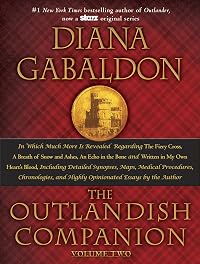
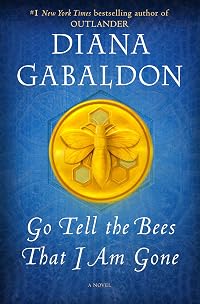
There is so much that happens in Written in My Own Heart’s Blood that it never feels like an 800+ page tome. The plot moves along at a steady pace, with all the characters involved at various points. In addition to everything I talked about above, Fergus and Marsali suffer through a double tragedy, but have happy news as well, while Jenny once again, becomes a main supporting player and we begin to get reacquainted with the residents of Fraser’s Ridge. There are a couple of very sad deaths that brought tears to my eyes. As usual, the history is deftly woven into the narrative with many real historical figures as characters as well. I always feel like I’m getting an entertaining history lesson whenever I pick up one of these books. This volume doesn’t end on quite as big of a cliffhanger as the last one, but there is enough left open to tantalize the reader into the next book, which unfortunately isn’t yet available. I’ve seen Ms. Gabaldon’s posts mentioning that it’s in the final stages, so in the meantime, I’ll be delving into the second Outlandish Companion, while eagerly waiting for Go Tell the Bees That I Am Gone to be released, hopefully sometime yet this year (2020). show less
Where to begin? Having waited five years since the previous book in the Outlander series, I was admittedly lost during the first 20-30 pages. The story lines slowly came trickling back into memory -- and they are many! Smack dab in the middle of the American Revolution, Jamie Fraser has just returned to Philadelphia to find that, thinking him drowned during a voyage from Scotland, his wife Claire had married Lord John Grey (for her own protection, of course, but very soap-opera-like, that). Before the three can resolve their personal issues, the war tugs them in various directions. Meanwhile, back(?) in 1980, Brianna is on the hunt for her kidnapped son while her husband Roger, also searching, somehow ends up in 1739 and discovers show more something he didn't think he was looking for.
Diana Gabaldon is a genius storyteller. The depth and breadth of her characters and the detail surrounding their lives, never ceases to leave me in awe. I don't know how she keeps it all straight in her head -- I gave up trying to keep track of the numerous peripheral military characters and to which faction they belonged, and thankfully it in no way detracted from the story. The delicate scenes in which Jamie confronts the unusual circumstances surrounding John and Claire's marriage were exceptionally memorable. I wonder again at this conclusion of this book, as I have with the others, will John ever find happiness? I'm not sure I can wait another five years to learn what happens next. show less
Diana Gabaldon is a genius storyteller. The depth and breadth of her characters and the detail surrounding their lives, never ceases to leave me in awe. I don't know how she keeps it all straight in her head -- I gave up trying to keep track of the numerous peripheral military characters and to which faction they belonged, and thankfully it in no way detracted from the story. The delicate scenes in which Jamie confronts the unusual circumstances surrounding John and Claire's marriage were exceptionally memorable. I wonder again at this conclusion of this book, as I have with the others, will John ever find happiness? I'm not sure I can wait another five years to learn what happens next. show less
At over 800 pages, it should come as no surprise that this is a sprawling novel, but the immense cast of characters, shifts in time, and countless subplots are either masterfully intricate -- or an unwieldy mess -- depending on your taste.
I liked the book very much, but that may be because shortly after beginning to read, I switched to the audio book version (at 38 disks, you have to make a serious commitment to the story -- but it's worth it). The narrated version felt like an old-time radio serial, and I mean that in the best of ways. This isn't a book you'd want to speed read in any case, and listening to the complex plot read by a narrator who cares about character, you realize just how big-hearted this book is.
I liked the book very much, but that may be because shortly after beginning to read, I switched to the audio book version (at 38 disks, you have to make a serious commitment to the story -- but it's worth it). The narrated version felt like an old-time radio serial, and I mean that in the best of ways. This isn't a book you'd want to speed read in any case, and listening to the complex plot read by a narrator who cares about character, you realize just how big-hearted this book is.
 This review was written for LibraryThing Early Reviewers.
Members
- Recently Added By
Lists

Historical Fiction
889 works; 91 members

NPRs your picks: top 100 Sci-Fi/Fantasy books
297 works; 80 members

Top Five Books of 2014
1,064 works; 398 members

Top Five Books of 2017
757 works; 231 members
Top Five Books of 2018
802 works; 265 members
Top Five Books of 2016
795 works; 229 members

2016 Book Club Choices
52 works; 7 members

KayStJ's to-read list
1,616 works; 11 members

The Re-Reads
12 works; 1 member

Books - Gabaldon, Diana: Outlander
22 works; 1 member
Author Information

95+ Works 126,047 Members
Diana Gabaldon was born in Flagstaff, Arizona on January 11, 1952. She has a B.S. in zoology, a M.S. in marine biology, and a Ph.D. in quantitative behavioral ecology. She has worked as a university professor and has written freelance for various magazines and companies such as Walt Disney. She writes the Outlander series, which was adapted into a show more television series. (Bowker Author Biography) show less

Diana Gabaldon is a LibraryThing Author, an author who lists their personal library on LibraryThing.
Some Editions
Awards and Honors
Awards
Series

Work Relationships
Is contained in
Contains
Has as a reference guide/companion
Common Knowledge
- Canonical title
- Written in My Own Heart's Blood
- Original publication date
- 2014-06-10
- People/Characters
- James "Jamie" Alexander Malcolm MacKenzie Fraser; Claire Beauchamp Randall Fraser; Lord John Grey; William Ransom, Earl of Ellesmere; Jenny Murray; Ian Murray "Young Ian" (show all 52); Rachel Hunter; Denzell Hunter; Hal Grey, Duke of Pardloe; Roger MacKenzie Wakefield; Brianna Randall MacKenzie; Jeremiah "Jem" MacKenzie; Amanda MacKenzie; Marsali Jane MacKimmie Joyce; Henri-Christian Fraser; Fergus Claudel Fraser; Germain Fraser; Geneva Dunsany; Isobel Dunsany; George Washington; Dan Morgan; Jethro Woodbine; Henry Clinton; William Buccleigh MacKenzie; Dougal MacKenzie; Dorothea Grey; Jane Pocock; Rob Cameron; Frances Pocock; Percy Wainwright; Ezekial Richardson; Mrs. Figg; Mortimer Figg; Hector McEwan; Brian Fraser; Watson Smith; Benjamin Grey; Henry Grey; Charles Lee; Benedict Arnold; Ben Tarleton; Joseph Abernathy; Geillis Duncan; Fiona Buchan; Jonathan "Jack" Wolverton Randall; Lionel Menzies; Tench Bledsoe; Colenso Baragwanath; Denys Randall-Isaacs; Gilbert du Motier, Marquis de Lafayette; Amaranthus Cowden Grey; Jeremiah MacKenzie
- Important places
- Philadelphia, Pennsylvania, USA; Boston, Massachusetts, USA; Savannah, Georgia, USA; Charleston, South Carolina, USA; Fraser's Ridge, North Carolina, USA; Scotland, UK (show all 7); Monmouth County, New Jersey, USA
- Important events
- Battle of Monmouth Courthouse
- Dedication
- This book is dedicated to ALL of the people (besides me) who worked like fiends to produce it for you. Especially to
Jennifer Hershey (editor, U.S.)
Bill Massey (editor, U.K.)
Kathleen Lord (... (show all)aka "Hercules" -- copy editor)
Barbara Schnell (translator and trench-buddy, Germany)
Catherine MacGregor, Catherine-Ann MacPhee, and Adhamh O Broin (Gaelic experts)
Virginia Norey (aka "Book Goddess" -- designer)
Kelly Chian, Maggie Hart Benjamin Dreyer, Lisa Feuer, and the rest of the Random House Production Team
and
Beatrice Lampe und Petra Zimmermann in Munchen - First words
- In the light of eternity, time casts no shadow.
- Last words
- (Click to show. Warning: May contain spoilers.)Then I was flying down the hill, with Jamie just before me, arms flung wide, the two of us flying together on that same wind.
- Publisher's editor
- Hershey, Jennifer [US]; Massey, Bill [UK]
- Original language
- English
- Disambiguation notice
- The French translations of the Outlander series have been split in different ways by different publishers. Also, the same titles have been used for different splits. You can find information about the splits here: ... (show all)tp://fr.wikipedia.org/wiki/Le_Chardon_et_le_Tartan." rel="nofollow" target="_new">http://fr.wikipedia.org/wiki/Le_Chard... Please do not combine French translations with each other or with other language versions without checking that the content is the same. Thank you.
Classifications
- Genres
- Romance, Fiction and Literature, Historical Fiction, Science Fiction, Fantasy, General Fiction
- DDC/MDS
- 813.54 — Literature & rhetoric American literature in English American fiction in English 1900-1999 1945-1999
- LCC
- PS3557 .A22 .W85 — Language and Literature American literature American literature Individual authors 1961-
- BISAC
Statistics
- Members
- 4,850
- Popularity
- 2,924
- Reviews
- 133
- Rating
- (4.41)
- Languages
- 9 — Czech, English, Finnish, French, German, Italian, Polish, Spanish, Portuguese (Portugal)
- Media
- Paper, Audiobook, Ebook
- ISBNs
- 52
- UPCs
- 1
- ASINs
- 26
