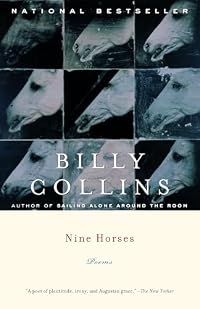
Nine Horses: Poems
by Billy Collins
On This Page
Description
Poems by the Poet Laureate of the United States.Tags
Recommendations


Member Reviews
In Nine Horses, renown poet Billy Collins explores the little things we all experience in life, using an effective blend of conversational clarity and surprising turn-of-phrase to examine the everyday world—traveling, reading, domestic occurrences, memory—with a gentle sense of humor and wonder. The poems focus on ordinary experiences (a train ride, a day at the beach, a birthday gift, a walk in the woods), but often move into reflections on larger issues, such as time, mortality, and identity. The author invites the reader to see how small things carry hidden meanings, how language both reveals and conceals, and how we live our lives almost unknowingly.
Throughout the volume, you get the definite sense of the poet as an show more observer—and sometimes as both narrator and participant—moving through snapshots of life with wit, elegiac sentiments, and a deft twist of metaphor. There is also a recurring tension between what is present and what is absent: the tangible world we touch and the mystery behind it that we do not see. In that regard, the entire book feels less like a linear march from beginning to end and more like a collection of meditations on staying still long enough to notice and remember all the little moments that end up being so important.
I really should confess that I do not ordinarily read a lot of poetry and that this is the first collection of Collins’ work that I have encountered. (Thanks, by the way, to my book club for suggesting this as a departure from our usual literary fare.) So, I was probably more surprised than I should have been at the cadence and style the author chose to capture his thoughts in each of these poems. Also, I was not expecting how funny many of them were. While each of the more than four dozen entries in the volume merits attention, I did have my favorites, including “Royal Aristocrat”, “Love”, “Creatures”, “Study in Orange and White”, “Litany”, “To My Patron”, and “Balsa”. Nine Horses certainly will not be my last foray into Collins’ comforting and engaging world. show less
Throughout the volume, you get the definite sense of the poet as an show more observer—and sometimes as both narrator and participant—moving through snapshots of life with wit, elegiac sentiments, and a deft twist of metaphor. There is also a recurring tension between what is present and what is absent: the tangible world we touch and the mystery behind it that we do not see. In that regard, the entire book feels less like a linear march from beginning to end and more like a collection of meditations on staying still long enough to notice and remember all the little moments that end up being so important.
I really should confess that I do not ordinarily read a lot of poetry and that this is the first collection of Collins’ work that I have encountered. (Thanks, by the way, to my book club for suggesting this as a departure from our usual literary fare.) So, I was probably more surprised than I should have been at the cadence and style the author chose to capture his thoughts in each of these poems. Also, I was not expecting how funny many of them were. While each of the more than four dozen entries in the volume merits attention, I did have my favorites, including “Royal Aristocrat”, “Love”, “Creatures”, “Study in Orange and White”, “Litany”, “To My Patron”, and “Balsa”. Nine Horses certainly will not be my last foray into Collins’ comforting and engaging world. show less
After three days of steady, inconsolable rain,
I walk through the rooms of the house
wondering which would be best to die in.
I read very little poetry. Laughably little, embarrassingly little. But [[Billy Collins]] reminds me here, as he always does, that poetry is not sentimental or schlocky or dull. [Nine Horses: Poems] was just like the other books of his that I've read, slowly, a poem or two a day. There are poems about yearning and love and also poems about the weather or what he sees from the window of a train to Albany and sometimes they are all present in the same poem. I'm sorry to be finished with this slender volume.
Before it was over
I took out a pencil and a notepad
and figured out roughly what was left --
a small box of show more Octobers, a handful of Aprils,
little time to waste reading a large novel
on the couch every evening,
a few candles flaming in the corners of the room.
a fishbowl of Mondays, a row of Fridays --
yet I cannot come up with anything
better than to strike a match,
settle in under a light blanket,
and open to the first sentence of Clarissa. show less
I walk through the rooms of the house
wondering which would be best to die in.
I read very little poetry. Laughably little, embarrassingly little. But [[Billy Collins]] reminds me here, as he always does, that poetry is not sentimental or schlocky or dull. [Nine Horses: Poems] was just like the other books of his that I've read, slowly, a poem or two a day. There are poems about yearning and love and also poems about the weather or what he sees from the window of a train to Albany and sometimes they are all present in the same poem. I'm sorry to be finished with this slender volume.
Before it was over
I took out a pencil and a notepad
and figured out roughly what was left --
a small box of show more Octobers, a handful of Aprils,
little time to waste reading a large novel
on the couch every evening,
a few candles flaming in the corners of the room.
a fishbowl of Mondays, a row of Fridays --
yet I cannot come up with anything
better than to strike a match,
settle in under a light blanket,
and open to the first sentence of Clarissa. show less
A mostly enjoyable introduction for me to Billy Collins, one of our more popular contemporary poets. A lot of these poems are about taking a specific moment of his life and slowing things down, turning contemplative, taking it as a stepping off point to consider, well, Life and Mortality. Thus inviting the reader to do similarly, to take a moment away from busyness and distraction to think of more meaningful things. Which is something poetry is really useful for, though it has been shoved to the margins of culture, with most people worrying (not without some cause) that poetry is usually really difficult to understand! Collins seems to be trying to reach more of these potential readers without being utterly simplistic and trite either: show more striving for absolute clarity, eschewing innovation, using easy to follow visual lines, not using words like "eschewing", but also avoiding over earnestness and banality.
It's not a bad trick, though one downside is a lack of really memorable lines and passages, poetic phrasing that makes you think "wow". However there are images that stick out. These include a country mouse that steals a match and while running with it in its mouth behind the house's walls accidentally becomes
It's not a bad trick, though one downside is a lack of really memorable lines and passages, poetic phrasing that makes you think "wow". However there are images that stick out. These include a country mouse that steals a match and while running with it in its mouth behind the house's walls accidentally becomes
suddenly thrust ahead of his time -Another memorable image concerns James Whistler's famous painting of his mother, commonly called "Whistler's Mother", but insensitively titled "Arrangement in Grey and Black No. 1" by Whistler himself:
now a fire-starter, now a torchbearer
in a forgotten ritual, little brown druid
illuminating some ancient night.
but when I strolled along the riverbank,Collins also imagines the injustice if Botticelli had titled The Birth of Venus, "Composition in Blue, Ocher, Green, and Pink", or the absurdity of the reverse - Mark Rothko titling one of his "sandwiches of color", as Collins puts it, "Fishing Boats Leaving Falmouth Harbor at Dawn." Funny stuff! show less
after my museum tour,
I imagined how the woman's heart
could have broken
by being demoted from mother
to mere arrangement, a composition without color.
My son is suffering through poetry in his high school English class. He does not find it easy to see symbolism or to plumb behind metaphor for meaning. He already dislikes the class and this unit finds him struggling terribly. I remember feeling a little at a loss myself when reading poetry despite my general facility with all things English class related. Unlike my boy, I could eventually winkle out a meaning acceptable enough to earn me praise but the work of it left me unwilling to read poetry on my own. And this has stayed the case for twenty some years now. But for some reason, when I saw Billy Collins' collection, Nine Horses, I was drawn to it. And the word "Poems" on the cover did not make me immediately want to run and hide. So show more I brought it home and now I've read it. And I wish that my son could be studying some of the simple, natural, and elegant poems contained in this collection. Yes, because they are accessible but mostly because they are wonderful.
Collins captures the beauty of the natural world and of our place within it. He writes of the stages of life and the everyday. And he presents it all in clear and lovely verse. Sometimes he makes surprising but accurate comparisons, sometimes he pops in a twist on the expected, and sometimes he writes something witty and tongue in cheek, but overall and most of the time the poems are infused with a sense of familiarity and comfort. This is an eloquent and pleasing collection to be sure and I'll have to search out his others to allow myself to slip into the plain and profound beauty of his language and imagery again and again. show less
Collins captures the beauty of the natural world and of our place within it. He writes of the stages of life and the everyday. And he presents it all in clear and lovely verse. Sometimes he makes surprising but accurate comparisons, sometimes he pops in a twist on the expected, and sometimes he writes something witty and tongue in cheek, but overall and most of the time the poems are infused with a sense of familiarity and comfort. This is an eloquent and pleasing collection to be sure and I'll have to search out his others to allow myself to slip into the plain and profound beauty of his language and imagery again and again. show less
I don't normally read poetry but I flipped through this one while I was cataloging it (I admit, it was mostly because of the horses on the cover) and ended up taking it home.
These poems are so deceptively simple yet powerful. Everyday occurences and objects become something magical in the hands of Collins. He both awes me with his skill and gives me hope that maybe I could actually write a decent poem.
I read one of the poems ("Aimless Love") out loud to a friend and actually got chills down my spine, which I don't think has ever happened to me while reading a poem. Collins' poems are spare, no fancy imagery, no overwrought emotions but they distill life into its essence, like holding up a lens that sharpens one's vision of the world.
I show more look forward to reading more of Collins' poems -- and maybe trying to write a few of my own. show less
These poems are so deceptively simple yet powerful. Everyday occurences and objects become something magical in the hands of Collins. He both awes me with his skill and gives me hope that maybe I could actually write a decent poem.
I read one of the poems ("Aimless Love") out loud to a friend and actually got chills down my spine, which I don't think has ever happened to me while reading a poem. Collins' poems are spare, no fancy imagery, no overwrought emotions but they distill life into its essence, like holding up a lens that sharpens one's vision of the world.
I show more look forward to reading more of Collins' poems -- and maybe trying to write a few of my own. show less
"We are busy doing nothing" Collins says of poets and in these poems that is true. A lot of work went into them - the attention to words, phrasing, cadence - and it doesn't result in much. He starts with promising ideas but they don't go anywhere. See "Absence," "Paris," "Trompe L'Oeil," "Albany," "Rooms." Very rarely - "Study in Orange and White" - he has an idea that makes it worth reading the whole poem. But mostly these are poems with no center, "no there there." The work is in four parts and the last two are better. Collins is best when he writes about nearly nothing - "The Great Walter Pater" or "Bermuda." He would have been good on the rewrite of "Last Year at Marienbad." With so many poets with something to say trying to be show more heard it's a shame that he gets so much of the stage for minor statements. show less
I picked up Nine Horses on a whim ( I liked the title, and the reviews here looked promising) and although it's not at all horse-related in the sense the title suggests, I enjoyed it very much. Collins' poems are lyric and accessible at the same time. He muses on every day matters -- 3 AM wakefulness, love and domesticity, or the simple act of watching the scenery click by on a train trip -- and makes them experiences worthy of remembering.
I'm not usually a poetry reader, so this isn't a particularly literary review, but today I've been more watchful for the beauty in the everyday. I'll look for Collins' name in the future if a poetic mood strikes me, and I'm adding Nine Horses to my "books to purchase" list.
I'm not usually a poetry reader, so this isn't a particularly literary review, but today I've been more watchful for the beauty in the everyday. I'll look for Collins' name in the future if a poetic mood strikes me, and I'm adding Nine Horses to my "books to purchase" list.
Members
- Recently Added By
Author Information

42+ Works 12,773 Members
Billy Collins has published six collections of poetry, including Questions About Angels and The Art of Drowning, Picnic, Lightning, his latest, sold more than 25,000 copies in its first year. He teaches at Lehman College of the City University of New York and at Sarah Lawrence College. He was named U.S. Poet Laureate in June 2000. (Bowker Author show more Biography) Billy Collins was born in New York City in 1941. He earned a BA from the College of the Holy Cross, and both an MA and PhD from the University of California-Riverside. Collins conducted summer poetry workshops at University College Galway and is the Poet in Residence at Burren College of Art in Ireland. He is also a professor of English at Lehman College (CUNY). In 1992, Collins was chosen to be the Literary Lion of the New York Public Library. He was named U.S. Poet Laureate in 2001 and held the title until 2003. Collins then served as Poet Laureate for the State of New York from 2004 until 2006. His poetry has appeared in anthologies, textbooks and periodicals including Poetry, The American Poetry Review, The American scholar, Harper's, The Paris Review and The New Yorker. He is the author of six books of poetry including "The Art of Drowning." His poems have also been selected to appear in The Best American Poetry of 1992, 1993 and 1997. His works have won various awards including the Bess Hokin Prize, the Frederick Bock Prize, the Oscar Blumenthal Prize and the Levinson Prize, all awarded by Poetry. He has received fellowships from the New York Foundation for the Arts, the National Endowment for the Arts and the Guggenheim Foundation. His collection of poems entitled Aimless Love made numerous best-seller lists in 2013. (Bowker Author Biography) show less
Awards and Honors
Awards
Distinctions
Common Knowledge
- Original publication date
- 2002
Classifications
Statistics
- Members
- 1,232
- Popularity
- 19,901
- Reviews
- 15
- Rating
- (4.06)
- Languages
- English, German
- Media
- Paper, Ebook
- ISBNs
- 9
- ASINs
- 5