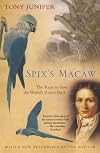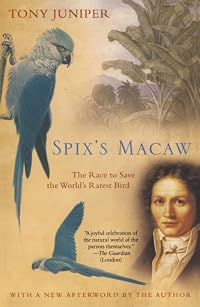
Spix's Macaw: The Race to Save the World's Rarest Bird
by Tony Juniper
On This Page
Description
An environmental parable for our times - the story of a beautiful blue bird meeting its nemesis at the end of the 20th-century. In December 1897 the Reverend F. G. Dutton lamented that 'there are so many calls on a parson's purse, that he cannot always treat himself to expensive parrots.' He was hoping to purchase a Spix's Macaw, a rare and beautiful parrot found in a remote area of Brazil. Today, the parson's search would be in vain. By the turn of the millennium only one survivor, a lone show more male, existed in the wild. Spix's Macaw tells the hearbreaking story of a unique band of brilliant blue birds - who talk, fall in love, and grieve - struggling against the forces of extinction and their own desirability. By the second half of the 20th-century the birds became gram for gram more valuable than heroin; so valuable that they drew up to $40,000 on the black markets. When, in 1990, only one was found to be living in the wild, an emergency international rescue operation was launched and an amnesty declared, allowing private collectors to come forward with their illegal birds, possible mates for the last wild Spix. In a breathtaking display of stoicism and endurance, the loneliest bird in the world had lived without a mate for fourteen years, had outwitted predators and second-guessed the poachers. But would he take to a new companion? Spix's Macaws are like humans - they can't be forced to love. With exquisite detail, this book tells the dramatic story of the rescue operation, and of the humans whose selfishness and greed brought a beautiful species to the brink of extinction. The long, lonely flight of the last Spix's Macaw is both a love story and an environmental parable for our times. show lessTags
Recommendations





















Member Reviews
The Spix's Macaw is one of the rarest birds in the world due to its popularity in the pet trade. Collected nearly to extinction, the last few wild individuals were gathered up to start a breeding program. Filled with corruption, people with "white saviour syndrome" and the desperation of the Brazilian government to gain control of its own species again, this book examines the Spix's macaw and how the greed and selfish mindsets of individuals can threaten species and derail conservation efforts. Since many parrots find themselves in similar situations, these kinds of discussions are important in educating the general public (especially those who want to own a parrot) about the ethical issues surrounding parts of the pet bird trade.
While show more I was aware of the specie's fate I was very interested to get to delve into the details of what happened. Getting to meet some of the key players (some of whom aren't great) and getting to see some of the struggles. I appreciate that he didn't paint the trappers as the evil villains people like these are often painted to be and focussed on the causes and the reasons why this kind of behaviour even occurs in the first place. (I'm not saying they're saints of course and neither is the author, but they definitely aren't the root of the problem either). I am glad to see that there is more order than there were in the early days and that the Brazilian government is no longer being as excluded as they once were (unfortunately a common sentiment - people from third world countries need others to step in and have someone else take over when it comes to endangered species and get minimal input. Although thankfully things are getting better, these kinds of practices still exist in conservation and local communities often don't get enough of a voice).
Since this book was published, some captive-bred individuals have been released into the wild, and seem to be doing better than the last attempt. Although the captive population is definitely growing, giving the species a better chance of survival, only time will tell how successful these efforts have been. show less
While show more I was aware of the specie's fate I was very interested to get to delve into the details of what happened. Getting to meet some of the key players (some of whom aren't great) and getting to see some of the struggles. I appreciate that he didn't paint the trappers as the evil villains people like these are often painted to be and focussed on the causes and the reasons why this kind of behaviour even occurs in the first place. (I'm not saying they're saints of course and neither is the author, but they definitely aren't the root of the problem either). I am glad to see that there is more order than there were in the early days and that the Brazilian government is no longer being as excluded as they once were (unfortunately a common sentiment - people from third world countries need others to step in and have someone else take over when it comes to endangered species and get minimal input. Although thankfully things are getting better, these kinds of practices still exist in conservation and local communities often don't get enough of a voice).
Since this book was published, some captive-bred individuals have been released into the wild, and seem to be doing better than the last attempt. Although the captive population is definitely growing, giving the species a better chance of survival, only time will tell how successful these efforts have been. show less
I came to this book interested about the mother-son smuggling ring I read that was arrested in connection with this and other rare fauna. However, I was really drawn into the book's larger, two-century tale of the discovery, decline and effective extinction of a beautiful and rare creature. It is amazing the detail unearthed on individual birds and individuals heroes and criminals.
A gripping story of greed and the natural world.
Ratings
Members
- Recently Added By
Author Information
17 Works 664 Members
Tony Juniper is a writer, sustainability adviser, and longtime environmentalist. He has published several successful and award-winning books, including the bestseller What Has Nature Ever Done for Us? And Saving Planet Earth. He has worked on efforts to conserve tropical forests for more than thirty years, including with BirdLife International, show more Friends of the Earth, and as an advisor to The Prince's Rainforests Project. He is currently Chair of Natural England, the country's official government conservation agency. show less
Common Knowledge
- Important places
- Brazil
- Dedication
- For my Mother and Father
- First words
- The blue parrot came to rest on a bare sun-bleached branch that stuck out from the bushy crown of a crabby old caraiba tree.
- Last words
- (Click to show. Warning: May contain spoilers.)The fate of the blue parrots still hangs in the balance, as does the future of countless other species whose survival depends on human cooperation, foresight and generosity.
- Blurbers
- Deakin, Roger; Phillips, Adam
Classifications
Statistics
- Members
- 100
- Popularity
- 322,121
- Reviews
- 3
- Rating
- (3.96)
- Languages
- English
- Media
- Paper, Ebook
- ISBNs
- 5
- ASINs
- 1