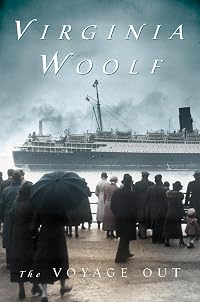
The Voyage Out
by Virginia Woolf
On This Page
Description
The first novel in what would be a remarkable but tragically curtailed creative career, Virginia Woolf's The Voyage Out recounts the tale of Rachel Vinrace's literal and metaphorical journey. En route to South America on one of her father's ships, Rachel undertakes her own voyage of self-discovery as she interacts with a motley crew of passengers, through whom Woolf takes the opportunity to savagely satirize the bourgeois mores of Edwardian England..
Tags
Recommendations









Member Reviews
Virgina Woolf's first novel has a few surprises for me. For starters, it doesn't feel Modernist, but more like a traditional novel. It's full of intellectual elements, and games, with literary titles popping up in more and less serious ways. And it has some kind of spiritual whole to it. The title is a perfect one for such a ground-breaking first novel, and it's plot-relevant. And it has an odd humor to it. And some very dark elements.
We follow the strange Rachel Vinrace, a sheltered 24-year-old woman raised by her aunts who hasn't done a lot of things. She is obsessed with music and a great piano player. But she hasn't had a romantic relationship. She hasn't formulated her ideas. Humanity is still a great curiosity to her. She's very show more open to other people's ideas but responds with uninformed sort-of gut responses that may be original or quirky but don't always seem to make much sense. And when things aren't working for her, she returns to the music. This gives her a sort of counter-to-convention mind.
A novel of characters, we see Rachel through many different eyes. Within the book she will travel via her dad's company ship on the voyage out from London to Brazil, with a small group that gain boarding, including Rachel's aunt and uncle, and notably, briefly but prominently, Richard and Clarissa Dalloway. Then she will stay in fictional Santa Marina, Brazil, near a hotel full of English travelers. Latinos and natives are hidden in the background. This is basically an isolated community of well-to-do English adults - married and single, young and older. And they all have some sort of response to Rachel.
These characters may be intelligent and intellectual, or not, but they are all far more conventional than Rachel. So, in a way, they can't see her. One stunning character is Helen Ambrose, based on Woolf's deceased mother, who is Rachel's aunt and tries to play a mothering role. Another prominent character is Terrence Hewet, an intellectually minded wealthy bachelor with a lifetime income, who is also lazy and charming and writing a book he never actually writes. He will find Rachel irresistible and eventually become engaged to her. But there is a dark humor in the clash between his well-meaning, conventional, if young and idealistic, perspective and Rachel's unconventional mind.
There are several mysterious and dark elements of the book, which plays on the exotic locality either onboard the boat, or in Brazil. Rachel's dreams are eerie and striking. There is a sort of heart-of-darkness moment, which is also an engagement scene laying a gentle critique on the concept of marriage.
There are several feminist elements in here, and mostly they come across as a criticism of marriage. Engagement does not make people happy but instead stresses them out and darkens their outlook! Marriages are typically a mess hidden under the covers of convention. Helen is worldly, but her husband Ridley is lost in his office in his academic literary study, translating the ancient Greek poet, Pindar, famous for his odes to obscure Greek Olympian winners. And I cannot overlook Evelyn Murgatroyd, a young, comically and fiercely independent personality, compared to Napoleon, who welcomes and spurns marriage proposals. The illegitimate daughter of a servant, she storms through the book, placing herself in people's way, demanding understanding, needing affectionate attention. She needs men to propose to her, and she need's to reject them. They're simply too small for her character. Altogether, marriage here seems like a terribly dangerous thing.
The book is playfully literary throughout, giving a strong intellectual undertone. We note Rachel hates Jane Austen and Gibbon. But everyone has something literary going on. Ridley Ambrose's Pindar. St. John Hirst, another bachelor based on Lytton Strachey, is incredibly erudite, and socially awkward, especially with woman. He demands Rachel read Gibbon so he can evaluate her intellect! I do love that he reads [[Swinburne]]'s Sapphics during church. But all the characters, even the less scholarly, have literature on the their mind. Even a member of the ship's crew tells Helen of his love for Shakespeare's [Henry V].
And, since I'm already going on way too long, I want to say something about the pace, especially early on. It's not a fast-moving book. But when we are onboard the ship, floating, going seemingly nowhere, constrained by surrounding water, forcing everyone to interact, however awkwardly, it struck me both how mysterious it is, and how [[William Faulkner]] would play with similar themes. Faulkner's second novel, [Mosquitos], is a boat trip in the Louisiana swamps where the boat goes aground and everyone is stuck. Like this novel, his novel is full of conventional and very literary characters and a very impressionable young woman. His characters are more outrageous, and his heroine way more sexualized, but that pace, still, with confined, forced clashes of interaction, ties into the same elements here. Layering that with the maybe [Heart of Darkness] moment, we might have a little Conrad-Woolf-Faulkner literary train, although it probably only exists in my mind.
It's awkward to try to analyze Woolf as her work is so complex, and there is so much serious stuff out on her. It feels like mistakes might strike sparks and spontaneously combust off the screen. But, under that warning, I found that overall the book makes for and ponders a sort of clash, on different levels, between intellectual and rawer humanity, and in that way provides a gentle critique on conventional English cultural norms. Christianity, academia, unfair finances, sexual attraction and marriage all come under some criticism. And the impossibility of communication, of reaching Rachel, seems to provide another, counter theme. The deeper and surficial minds at play.
2026
https://www.librarything.com/topic/378447#9149888 show less
We follow the strange Rachel Vinrace, a sheltered 24-year-old woman raised by her aunts who hasn't done a lot of things. She is obsessed with music and a great piano player. But she hasn't had a romantic relationship. She hasn't formulated her ideas. Humanity is still a great curiosity to her. She's very show more open to other people's ideas but responds with uninformed sort-of gut responses that may be original or quirky but don't always seem to make much sense. And when things aren't working for her, she returns to the music. This gives her a sort of counter-to-convention mind.
A novel of characters, we see Rachel through many different eyes. Within the book she will travel via her dad's company ship on the voyage out from London to Brazil, with a small group that gain boarding, including Rachel's aunt and uncle, and notably, briefly but prominently, Richard and Clarissa Dalloway. Then she will stay in fictional Santa Marina, Brazil, near a hotel full of English travelers. Latinos and natives are hidden in the background. This is basically an isolated community of well-to-do English adults - married and single, young and older. And they all have some sort of response to Rachel.
These characters may be intelligent and intellectual, or not, but they are all far more conventional than Rachel. So, in a way, they can't see her. One stunning character is Helen Ambrose, based on Woolf's deceased mother, who is Rachel's aunt and tries to play a mothering role. Another prominent character is Terrence Hewet, an intellectually minded wealthy bachelor with a lifetime income, who is also lazy and charming and writing a book he never actually writes. He will find Rachel irresistible and eventually become engaged to her. But there is a dark humor in the clash between his well-meaning, conventional, if young and idealistic, perspective and Rachel's unconventional mind.
There are several mysterious and dark elements of the book, which plays on the exotic locality either onboard the boat, or in Brazil. Rachel's dreams are eerie and striking. There is a sort of heart-of-darkness moment, which is also an engagement scene laying a gentle critique on the concept of marriage.
There are several feminist elements in here, and mostly they come across as a criticism of marriage. Engagement does not make people happy but instead stresses them out and darkens their outlook! Marriages are typically a mess hidden under the covers of convention. Helen is worldly, but her husband Ridley is lost in his office in his academic literary study, translating the ancient Greek poet, Pindar, famous for his odes to obscure Greek Olympian winners. And I cannot overlook Evelyn Murgatroyd, a young, comically and fiercely independent personality, compared to Napoleon, who welcomes and spurns marriage proposals. The illegitimate daughter of a servant, she storms through the book, placing herself in people's way, demanding understanding, needing affectionate attention. She needs men to propose to her, and she need's to reject them. They're simply too small for her character. Altogether, marriage here seems like a terribly dangerous thing.
The book is playfully literary throughout, giving a strong intellectual undertone. We note Rachel hates Jane Austen and Gibbon. But everyone has something literary going on. Ridley Ambrose's Pindar. St. John Hirst, another bachelor based on Lytton Strachey, is incredibly erudite, and socially awkward, especially with woman. He demands Rachel read Gibbon so he can evaluate her intellect! I do love that he reads [[Swinburne]]'s Sapphics during church. But all the characters, even the less scholarly, have literature on the their mind. Even a member of the ship's crew tells Helen of his love for Shakespeare's [Henry V].
And, since I'm already going on way too long, I want to say something about the pace, especially early on. It's not a fast-moving book. But when we are onboard the ship, floating, going seemingly nowhere, constrained by surrounding water, forcing everyone to interact, however awkwardly, it struck me both how mysterious it is, and how [[William Faulkner]] would play with similar themes. Faulkner's second novel, [Mosquitos], is a boat trip in the Louisiana swamps where the boat goes aground and everyone is stuck. Like this novel, his novel is full of conventional and very literary characters and a very impressionable young woman. His characters are more outrageous, and his heroine way more sexualized, but that pace, still, with confined, forced clashes of interaction, ties into the same elements here. Layering that with the maybe [Heart of Darkness] moment, we might have a little Conrad-Woolf-Faulkner literary train, although it probably only exists in my mind.
It's awkward to try to analyze Woolf as her work is so complex, and there is so much serious stuff out on her. It feels like mistakes might strike sparks and spontaneously combust off the screen. But, under that warning, I found that overall the book makes for and ponders a sort of clash, on different levels, between intellectual and rawer humanity, and in that way provides a gentle critique on conventional English cultural norms. Christianity, academia, unfair finances, sexual attraction and marriage all come under some criticism. And the impossibility of communication, of reaching Rachel, seems to provide another, counter theme. The deeper and surficial minds at play.
2026
https://www.librarything.com/topic/378447#9149888 show less
I love Virginia Woolf so much that I have invented a book club where we will read all her books, in chronological order. Just read these sentences and tell me you don't want to read everything this woman has written:
"And now the room was dim and quiet, and beautiful silent people passed through it, to whom you could go and say anything you liked. She felt herself amazingly secure as she sat in her arm-chair, and able to review not only the night of the dance, but the entire past, tenderly and humorously, as if she had been turning in a fog for a long time, and could now see exactly where she had turned. For the methods by which she had reached her present position, seemed to her very strange, and the strangest thing about them was that show more she had not known where they were leading her. That was the strange thing, that one did not know where one was going, or what one wanted, and followed blindly, suffering so much in secret, always unprepared and amazed and knowing nothing; but one thing led to another and by degrees something had formed itself out of nothing, and so one reached at last this calm, this quiet, this certainty, and it was this process that people called living." (p. 354)
The Voyage Out is first on the list, and it's one I hadn't read before. Telling the story of a married couple and their 24-year-old niece who take a boat from England to South America (with Mr. and Mrs. Dalloway!) for a holiday and there meet a hotel full of English folk. Various relationships start and stop and some exciting things happen, but most of the action is observational and interior. The central section of the book in particular had a Women in Love quality to me (with much less sex and frantic melodrama), but that faded a bit as the story moved to focus on Rachel, the niece, and Terence, who has fallen in love with her. This is Woolf's first novel and was heavily revised and edited before its release -- a reconstruction of the original manuscript has been published as Melymbrosia (the original title) and I'm keen to read that one and see a more radical view of these fascinating characters.
Novel #1 did not disappoint! show less
"And now the room was dim and quiet, and beautiful silent people passed through it, to whom you could go and say anything you liked. She felt herself amazingly secure as she sat in her arm-chair, and able to review not only the night of the dance, but the entire past, tenderly and humorously, as if she had been turning in a fog for a long time, and could now see exactly where she had turned. For the methods by which she had reached her present position, seemed to her very strange, and the strangest thing about them was that show more she had not known where they were leading her. That was the strange thing, that one did not know where one was going, or what one wanted, and followed blindly, suffering so much in secret, always unprepared and amazed and knowing nothing; but one thing led to another and by degrees something had formed itself out of nothing, and so one reached at last this calm, this quiet, this certainty, and it was this process that people called living." (p. 354)
The Voyage Out is first on the list, and it's one I hadn't read before. Telling the story of a married couple and their 24-year-old niece who take a boat from England to South America (with Mr. and Mrs. Dalloway!) for a holiday and there meet a hotel full of English folk. Various relationships start and stop and some exciting things happen, but most of the action is observational and interior. The central section of the book in particular had a Women in Love quality to me (with much less sex and frantic melodrama), but that faded a bit as the story moved to focus on Rachel, the niece, and Terence, who has fallen in love with her. This is Woolf's first novel and was heavily revised and edited before its release -- a reconstruction of the original manuscript has been published as Melymbrosia (the original title) and I'm keen to read that one and see a more radical view of these fascinating characters.
Novel #1 did not disappoint! show less
It's nearly impossible not to compare this to her later novels, but the elements I enjoy in some of Virginia Woolf's fiction writing are already there: her ability to capture the trains of thought of various characters; her ability to conjure the spiritual from the tangible; and her ability (shared with Forster) to render her characters with an affectionate air despite their faults. The real standout for me here is the near disregard for South America as an actual place rather than a mere backdrop to Woolf's drama. My copy includes a back cover blurb from Forster, who refers to the book's "scene" as "a South America not found on any map." I am not sure whether to credit Woolf for capturing the colonialist point of view of the British show more traveler of this time or to assume she shares the same failing. But I am also still thinking about the title - the various voyages at work here and the various ways of interpreting the word "out." show less
Rachel Vinrace is a character whose life in England is structured by Victorian ideas of the proper development of young women. Her outer life is restricted by her maiden aunts, and her inner life is kept in check by self-discipline in her piano playing and the restraint imposed on her imagination in the kind of literature she is allowed to read.
Rachel has an opportunity to take a voyage out of her bonds on a cruise to South America. She begins to loosen her self restrictions as she studies the artificial and real motives of her fellow travelers. While on her father's ship, Rachel's liberation is as slow and determined as her piano playing, staying with the composition but engaging in a few private improvisations.
While staying at a show more hotel in South America, the pace of Rachel's development accelerates. As she accompanies other brave souls on a short guided trip into the wilds of the jungle, Rachel's insight races. But she has no meaningful starting point or signposts to guide her in self exploration. Her emotions become increasingly intense and her behavior more erratic as she falls in love with a fellow passenger. Rachel's ideas take flight with striking visual images and loose emotional associations. A common resolution of her out of control improvisations is the complete peace of immersion in an undersea world, a final reduction of "fever."
Virginia Woolf's first novel is an excellent self portrait of budding bipolar disorder. The author sketches this portrait by producing unexpected and "pretty notes" as Louis Armstrong described his jazz. Woolf ultimately found her own underwater peace suggesting the tremendous toll of manic creativity. show less
Rachel has an opportunity to take a voyage out of her bonds on a cruise to South America. She begins to loosen her self restrictions as she studies the artificial and real motives of her fellow travelers. While on her father's ship, Rachel's liberation is as slow and determined as her piano playing, staying with the composition but engaging in a few private improvisations.
While staying at a show more hotel in South America, the pace of Rachel's development accelerates. As she accompanies other brave souls on a short guided trip into the wilds of the jungle, Rachel's insight races. But she has no meaningful starting point or signposts to guide her in self exploration. Her emotions become increasingly intense and her behavior more erratic as she falls in love with a fellow passenger. Rachel's ideas take flight with striking visual images and loose emotional associations. A common resolution of her out of control improvisations is the complete peace of immersion in an undersea world, a final reduction of "fever."
Virginia Woolf's first novel is an excellent self portrait of budding bipolar disorder. The author sketches this portrait by producing unexpected and "pretty notes" as Louis Armstrong described his jazz. Woolf ultimately found her own underwater peace suggesting the tremendous toll of manic creativity. show less
Not an easy book to review because it sidles out of reach every time you try to grasp its essence or its meaning. The starting point is to understand that this was the first novel of an established 'intellectual' already in her early thirties. It is a book in which she is 'finding her fictional voice'.
This means, of course, that she has not yet found her voice. The tone throughout is a questioning one in an unrealistic setting that dwells on the two classic old concerns of love and death. The novel is ultimately unsatisfactory and yet one that shows undoubted signs of genius.
We can deal with the flaws quickly. The most obvious is that she is still living in that half world between belles lettres and fiction. This is a problem, I show more suspect, for all literary insiders trying to make the move from observer of imagination to deploying imagination.
In fact, she does not do badly at all - far better than the execrable first efforts, for example, of another literary insider Graham Greene - but chatter about 'art', posturing and occasional obscure attempts at prose poetry (abandoned quite quickly) are not modernism and are not fiction.
She also moves less than fluidly between startling realism in expressing emotional states (including the sticky issues of love emerging and dealing with death) and character stereotypes that occasionally merge into the socially satirical.
The book is also uneven. The first section (the actual voyage out) has one tone, the lengthy exposition at the South American destination another and the final love affair and its unfolding yet another.
The first could be a mimicry of Chekhov or Ibsen (and may be deliberate) and the second an old-fashioned novel of manners. She only finds that voice of hers in a sustained manner, in halting stages, towards the end.
There is, however, depth in the book between the shallows. Her skilled observation of people of her class and generation makes even the occasional longeurs tolerable. And when she does get her teeth into emotion and its restraint, you sense that this is a woman with yet more to say.
The book is set in a rather unreal world. It was published in 1915. There is no war and yet there is an empire and politics. The feminism is present but worn lightly and subtly. The locations are so detached from the real as to simulate voyage across the Styx to a purgatory.
There is an element of 'L'enfers, c'est les autres' and 'Huis Clos', anticipating Sartre's world view of two or three decades later. If there is a great theme, it seems to be one of frustration at her nation's and class's inability to be honest about emotion, a frustration common to the sensitive.
It is a very late imperial English novel. The English upper middle classes are easy in their hegemony. They have come to terms with aristocracy as simply eccentric and lovable equals and are beginning their patronising project to 'improve' the lot of the working classes.
These socially well placed and comfortably off, if anxious, people are troubled. They find it difficult to articulate how they are troubled. The book is the starting point for such an articulation as some fit themselves into and become their roles and others chafe for something more.
Some of the characters cannot get out of their stereotyped straitjackets and Woolf is initially unconvincing in presenting us with Rachel, a woman constrained by kindly sheltering and trying to 'find herself' as she experiences new things and sensations.
Later Rachel comes more alive until we feel we might just be getting into the mind of a type - the withdrawn introvert who discovers love but retains enough self possession not to wholly 'believe' in it. Her counterpart St. John Hirst also grows with the book into a tragic and real character.
The perspective constantly shifts. Woolf is quite skilled at the beginning in shifting our own perspective as well as hers although she drops the proto-modernism quite soon to tell a more conventional story. Not knowing other minds is a constant theme.
For example, you would think, at the beginning, that Helen Ambrose, apparently (we are told) modelled on Woolf's sister but who we cannot not believe is expressing something of the author, is the 'main character' but, by the end, she has drifted into a bit part alongside others.
This is one of those books where there is always both a little more to it than first appears and yet somehow it just misses so that you cannot work out entirely whethet the author was a bit too clever for her readers or perhaps not quite clever enough to pull off what ever she was planning.
However, there is some magnificent writing in the book that make the journey worthwhile - a ball at the hotel, the two lovers tentatively trying to communicate on a hillside, a walk through jungle that seems drawn from an English country excusion, a death and people's reactions to death.
Although the book drags a little in the middle, quite a lot happens to an enclosed group of people found first in a ship and then, expanded, in a hotel and a villa. There are characters who take a little time to get used to: Woolf often gives insufficient information to do so clearly or quickly.
In conclusion, a slightly frustrating but worthwhile read that does seem, sometimes despite itself, to get inside the minds of a privileged but troubled class that has enclosed itself in rules to maintain order and yet (at least its younger cohort) is pining for the freedom to be truly honest.
To a reader a century on what might be interesting is the degree to which those rules were socially enforced and the huge stakes involved in making the right marital choice on the basis of emotions that might be transient and the confusion that emerges when great emotions are thwarted.
There are feminist aspects to the novel but they are not laid on with a trowel. The men, though dominant and implicitly sometimes a little misogynistic by today's standards, are as trapped by the situation of their class as any woman. There are no truly bad people here.
This is not an empire or class in decline but one living in inner confusion and holding it together by playing life like a chess game with permitted moves. Woolf simultaneously describes that world dispassionately and registers the beginning of a protest against the loaded rules of the game. show less
This means, of course, that she has not yet found her voice. The tone throughout is a questioning one in an unrealistic setting that dwells on the two classic old concerns of love and death. The novel is ultimately unsatisfactory and yet one that shows undoubted signs of genius.
We can deal with the flaws quickly. The most obvious is that she is still living in that half world between belles lettres and fiction. This is a problem, I show more suspect, for all literary insiders trying to make the move from observer of imagination to deploying imagination.
In fact, she does not do badly at all - far better than the execrable first efforts, for example, of another literary insider Graham Greene - but chatter about 'art', posturing and occasional obscure attempts at prose poetry (abandoned quite quickly) are not modernism and are not fiction.
She also moves less than fluidly between startling realism in expressing emotional states (including the sticky issues of love emerging and dealing with death) and character stereotypes that occasionally merge into the socially satirical.
The book is also uneven. The first section (the actual voyage out) has one tone, the lengthy exposition at the South American destination another and the final love affair and its unfolding yet another.
The first could be a mimicry of Chekhov or Ibsen (and may be deliberate) and the second an old-fashioned novel of manners. She only finds that voice of hers in a sustained manner, in halting stages, towards the end.
There is, however, depth in the book between the shallows. Her skilled observation of people of her class and generation makes even the occasional longeurs tolerable. And when she does get her teeth into emotion and its restraint, you sense that this is a woman with yet more to say.
The book is set in a rather unreal world. It was published in 1915. There is no war and yet there is an empire and politics. The feminism is present but worn lightly and subtly. The locations are so detached from the real as to simulate voyage across the Styx to a purgatory.
There is an element of 'L'enfers, c'est les autres' and 'Huis Clos', anticipating Sartre's world view of two or three decades later. If there is a great theme, it seems to be one of frustration at her nation's and class's inability to be honest about emotion, a frustration common to the sensitive.
It is a very late imperial English novel. The English upper middle classes are easy in their hegemony. They have come to terms with aristocracy as simply eccentric and lovable equals and are beginning their patronising project to 'improve' the lot of the working classes.
These socially well placed and comfortably off, if anxious, people are troubled. They find it difficult to articulate how they are troubled. The book is the starting point for such an articulation as some fit themselves into and become their roles and others chafe for something more.
Some of the characters cannot get out of their stereotyped straitjackets and Woolf is initially unconvincing in presenting us with Rachel, a woman constrained by kindly sheltering and trying to 'find herself' as she experiences new things and sensations.
Later Rachel comes more alive until we feel we might just be getting into the mind of a type - the withdrawn introvert who discovers love but retains enough self possession not to wholly 'believe' in it. Her counterpart St. John Hirst also grows with the book into a tragic and real character.
The perspective constantly shifts. Woolf is quite skilled at the beginning in shifting our own perspective as well as hers although she drops the proto-modernism quite soon to tell a more conventional story. Not knowing other minds is a constant theme.
For example, you would think, at the beginning, that Helen Ambrose, apparently (we are told) modelled on Woolf's sister but who we cannot not believe is expressing something of the author, is the 'main character' but, by the end, she has drifted into a bit part alongside others.
This is one of those books where there is always both a little more to it than first appears and yet somehow it just misses so that you cannot work out entirely whethet the author was a bit too clever for her readers or perhaps not quite clever enough to pull off what ever she was planning.
However, there is some magnificent writing in the book that make the journey worthwhile - a ball at the hotel, the two lovers tentatively trying to communicate on a hillside, a walk through jungle that seems drawn from an English country excusion, a death and people's reactions to death.
Although the book drags a little in the middle, quite a lot happens to an enclosed group of people found first in a ship and then, expanded, in a hotel and a villa. There are characters who take a little time to get used to: Woolf often gives insufficient information to do so clearly or quickly.
In conclusion, a slightly frustrating but worthwhile read that does seem, sometimes despite itself, to get inside the minds of a privileged but troubled class that has enclosed itself in rules to maintain order and yet (at least its younger cohort) is pining for the freedom to be truly honest.
To a reader a century on what might be interesting is the degree to which those rules were socially enforced and the huge stakes involved in making the right marital choice on the basis of emotions that might be transient and the confusion that emerges when great emotions are thwarted.
There are feminist aspects to the novel but they are not laid on with a trowel. The men, though dominant and implicitly sometimes a little misogynistic by today's standards, are as trapped by the situation of their class as any woman. There are no truly bad people here.
This is not an empire or class in decline but one living in inner confusion and holding it together by playing life like a chess game with permitted moves. Woolf simultaneously describes that world dispassionately and registers the beginning of a protest against the loaded rules of the game. show less
“I feel so intensely the delights of shutting oneself up in a little world of one’s own, with pictures and music and everything beautiful”
I have spoken before about my relationship with Virginia Woolf, and my recent determination to read more of her work. I was glad, therefore to be given a chance to read her first novel for Behold the stars read-a-long. It is the one hundred year anniversary of the publication of this novel, something that I am glad is being celebrated. It is always so interesting to see where a great artist started – and Virginia Woolf must surely be that – often reading an author’s work in chronological order can be particularly rewarding.
“one never knows what any one feels. We’re all in the dark. We show more try to find out, but can you imagine anything more ludicrous than one person’s opinion of another person? One goes along thinking one knows; but one really doesn’t know.”
thevoyageout1The Voyage Out was apparently written by Woolf at a time when she herself was quite psychologically vulnerable – I think I would have guessed that from the novel itself – even if I hadn’t read that somewhere else. The themes of the novel are those of self-discovery, sexual awakening, death and femininity. There are voyages of discovery for Rachel – who at the start of the novel is a perhaps surprisingly naive young woman, even for the times in which she was living – and others whom she meets in the course of the novel. The sea voyage itself taking up only a part of the whole novel. One of the aspects I particularly liked in this novel – was the idea of knowing – or not knowing the people around us, how so often we assume things about people, think we know things while all the time we are terribly wrong, like Clarissa Dalloway – a minor character in this novel – who I don’t belive understands her husband as much as she thinks she does.
“That was the strange thing, that one did not know where one was going, or what one wanted, and followed blindly, suffering so much in secret, always unprepared and amazed and knowing nothing; but one thing led to another and by degrees something had formed itself out of nothing, and so one reached at last this calm, this quiet, this certainty, and it was this process that people called living.”
Rachel Vinrace, is a young woman who having been living with her aunts in London, embarks upon a sea voyage, aboard her father’s ship to South America. The ship is primarily a cargo ship, but some special passengers are permitted by arrangement, and it is thus that Rachel finds herself among a slightly mismatched group of fellow travellers. In the company of her beautiful aunt Helen Ambrose and Uncle Ridley, Rachel meets Clarissa and Richard Dalloway – who are both a huge presence on the ship. Clarissa befriends Rachel, while her husband shows himself to be just a little predatory, they eventually leave the ship before its final destination.
The ship finally docks in South America – the exact location seems to be fictional and in a sense it is of no importance where these characters are thrown together – just that they are. In a place very different to home, where the rules aren’t necessarily exactly the same. In a place where those who are still young can contemplate all the future has to offer them now that the Victorian age is behind them, while the older generation can look on, reflecting perhaps on how it was for them. The Ambroses have a Villa for their exclusive use – within sight of a hotel, where a large group of English guests are already in residence. Rachel accompanies her aunt to the hotel, introductions are made, allegiances formed, excited plans for expeditions made. Here romances are inevitably started, – bearing in mind that this is a story written by Virginia Woolf – not Jane Austen, and not all ships make it back to harbour. I am really conscious of not wanting to say too much about this novel, in which in some senses, not much happens, but what does occur, is everything, so I am keeping this review fairly short – maybe Virgina Woolf really just needs to speak for herself, and there are many lovely sections I could quote, simply for the sake of it.
“The morning was hot, and the exercise of reading left her mind contracting and expanding like the main-spring of a clock, and the small noises of midday, which one can ascribe to no definite cause, in a regular rhythm. It was all very real, very big, very impersonal, and after a moment or two she began to raise her first finger and to let it fall on the arm of her chair so as to bring back to herself some consciousness of her own existence. She was next overcome by the unspeakable queerness of the fact that she should be sitting in an arm-chair, in the morning, in the middle of the world. Who were the people moving in the house–moving things from one place to another? And life, what was that? It was only a light passing over the surface and vanishing, as in time she would vanish, though the furniture in the room would remain. Her dissolution became so complete that she could not raise her finger any more, and sat perfectly still, listening and looking always at the same spot. It became stranger and stranger. She was overcome with awe that things should exist at all. . . She forgot that she had any fingers to raise. . . The things that existed were so immense and so desolate. . . She continued to be conscious of these vast masses of substance for a long stretch of time, the clock still ticking in the midst of the universal silence.”
There is both lightness and darkness in this novel – inevitably so, the simple human joy at being young and in love, smiling at one another with nothing needing to be said – Woolf captures that every bit as well as she captures the ageing beauty or the wannabe writer. several of the characters from the hotel – were almost completely faceless for me, I could barely distinguish between Mrs Flushing, Mrs Thornbury and Mrs Elliot – and that fact irritated me a little, though perhaps we aren’t meant to distinguish between them, they are of a type. However Helen, Rachel her young lover Terence, the Dalloways and St John Hirst are beautifully and delicately brought to life in this novel. The Voyage Out is perhaps (I am no expert) Virginia Woolf’s least experimental novel, in structure it is certainly far more conventional than many people perhaps associate with Woolf. I enjoyed it enormously, I was blown away by Orlando quite recently, and so I really think I have found the time in my life when Virginia Woolf is (hopefully) no longer a completely closed book. show less
I have spoken before about my relationship with Virginia Woolf, and my recent determination to read more of her work. I was glad, therefore to be given a chance to read her first novel for Behold the stars read-a-long. It is the one hundred year anniversary of the publication of this novel, something that I am glad is being celebrated. It is always so interesting to see where a great artist started – and Virginia Woolf must surely be that – often reading an author’s work in chronological order can be particularly rewarding.
“one never knows what any one feels. We’re all in the dark. We show more try to find out, but can you imagine anything more ludicrous than one person’s opinion of another person? One goes along thinking one knows; but one really doesn’t know.”
thevoyageout1The Voyage Out was apparently written by Woolf at a time when she herself was quite psychologically vulnerable – I think I would have guessed that from the novel itself – even if I hadn’t read that somewhere else. The themes of the novel are those of self-discovery, sexual awakening, death and femininity. There are voyages of discovery for Rachel – who at the start of the novel is a perhaps surprisingly naive young woman, even for the times in which she was living – and others whom she meets in the course of the novel. The sea voyage itself taking up only a part of the whole novel. One of the aspects I particularly liked in this novel – was the idea of knowing – or not knowing the people around us, how so often we assume things about people, think we know things while all the time we are terribly wrong, like Clarissa Dalloway – a minor character in this novel – who I don’t belive understands her husband as much as she thinks she does.
“That was the strange thing, that one did not know where one was going, or what one wanted, and followed blindly, suffering so much in secret, always unprepared and amazed and knowing nothing; but one thing led to another and by degrees something had formed itself out of nothing, and so one reached at last this calm, this quiet, this certainty, and it was this process that people called living.”
Rachel Vinrace, is a young woman who having been living with her aunts in London, embarks upon a sea voyage, aboard her father’s ship to South America. The ship is primarily a cargo ship, but some special passengers are permitted by arrangement, and it is thus that Rachel finds herself among a slightly mismatched group of fellow travellers. In the company of her beautiful aunt Helen Ambrose and Uncle Ridley, Rachel meets Clarissa and Richard Dalloway – who are both a huge presence on the ship. Clarissa befriends Rachel, while her husband shows himself to be just a little predatory, they eventually leave the ship before its final destination.
The ship finally docks in South America – the exact location seems to be fictional and in a sense it is of no importance where these characters are thrown together – just that they are. In a place very different to home, where the rules aren’t necessarily exactly the same. In a place where those who are still young can contemplate all the future has to offer them now that the Victorian age is behind them, while the older generation can look on, reflecting perhaps on how it was for them. The Ambroses have a Villa for their exclusive use – within sight of a hotel, where a large group of English guests are already in residence. Rachel accompanies her aunt to the hotel, introductions are made, allegiances formed, excited plans for expeditions made. Here romances are inevitably started, – bearing in mind that this is a story written by Virginia Woolf – not Jane Austen, and not all ships make it back to harbour. I am really conscious of not wanting to say too much about this novel, in which in some senses, not much happens, but what does occur, is everything, so I am keeping this review fairly short – maybe Virgina Woolf really just needs to speak for herself, and there are many lovely sections I could quote, simply for the sake of it.
“The morning was hot, and the exercise of reading left her mind contracting and expanding like the main-spring of a clock, and the small noises of midday, which one can ascribe to no definite cause, in a regular rhythm. It was all very real, very big, very impersonal, and after a moment or two she began to raise her first finger and to let it fall on the arm of her chair so as to bring back to herself some consciousness of her own existence. She was next overcome by the unspeakable queerness of the fact that she should be sitting in an arm-chair, in the morning, in the middle of the world. Who were the people moving in the house–moving things from one place to another? And life, what was that? It was only a light passing over the surface and vanishing, as in time she would vanish, though the furniture in the room would remain. Her dissolution became so complete that she could not raise her finger any more, and sat perfectly still, listening and looking always at the same spot. It became stranger and stranger. She was overcome with awe that things should exist at all. . . She forgot that she had any fingers to raise. . . The things that existed were so immense and so desolate. . . She continued to be conscious of these vast masses of substance for a long stretch of time, the clock still ticking in the midst of the universal silence.”
There is both lightness and darkness in this novel – inevitably so, the simple human joy at being young and in love, smiling at one another with nothing needing to be said – Woolf captures that every bit as well as she captures the ageing beauty or the wannabe writer. several of the characters from the hotel – were almost completely faceless for me, I could barely distinguish between Mrs Flushing, Mrs Thornbury and Mrs Elliot – and that fact irritated me a little, though perhaps we aren’t meant to distinguish between them, they are of a type. However Helen, Rachel her young lover Terence, the Dalloways and St John Hirst are beautifully and delicately brought to life in this novel. The Voyage Out is perhaps (I am no expert) Virginia Woolf’s least experimental novel, in structure it is certainly far more conventional than many people perhaps associate with Woolf. I enjoyed it enormously, I was blown away by Orlando quite recently, and so I really think I have found the time in my life when Virginia Woolf is (hopefully) no longer a completely closed book. show less
Not quite what I was expecting — at times it's almost like one of E.M. Forster's "the English abroad" novels. But there are also some very characteristically Woolfish things about it. I loved the cameo appearance by the Dalloways and enjoyed the passages where Woolf suddenly started striding out confidently with something very like her mature style. It was interesting too to watch what were obviously the first sea-trials of the famous shifting-point-of-view narrative technique. So it definitely satisfies the rule that you can't have too much Virginia Woolf.
On the other hand, there are obviously some problems with it. The most glaring one is the accident of history: Woolf had a hard time with her health while she was writing the book show more (from 1910 onwards) and it took her so long to finish it that someone had shot an Archduke in the meantime, and a great deal of what she says about social status, work, death and suffering, religion, the role of women, Russia, etc. is totally and utterly irrelevant to the world of 1915. Or indeed to the post-war world. Anyway, the social satire in the book has been edited down and concealed to such an extent that you almost need a microscope to find it (she does discuss a few topics that might have been considered very daring at the time, had anyone noticed that they were there...). And it does ramble a bit. There are passages, especially in the "South American" part that just seem to duplicate each other, not really advancing either the action or our understanding of the characters. show less
On the other hand, there are obviously some problems with it. The most glaring one is the accident of history: Woolf had a hard time with her health while she was writing the book show more (from 1910 onwards) and it took her so long to finish it that someone had shot an Archduke in the meantime, and a great deal of what she says about social status, work, death and suffering, religion, the role of women, Russia, etc. is totally and utterly irrelevant to the world of 1915. Or indeed to the post-war world. Anyway, the social satire in the book has been edited down and concealed to such an extent that you almost need a microscope to find it (she does discuss a few topics that might have been considered very daring at the time, had anyone noticed that they were there...). And it does ramble a bit. There are passages, especially in the "South American" part that just seem to duplicate each other, not really advancing either the action or our understanding of the characters. show less
Members
- Recently Added By
Published Reviews
ThingScore 58
"The Voyage Out" is Virginia Woolf's first novel, published in 1915, and offers an insightful exploration into the themes of youth, love, and the journey towards self-awareness. The story follows Rachel Vinrace, a young woman who embarks on a sea voyage to South America aboard her father's ship, the Euphrosyne. Throughout the journey and her stay in a fictional South American country, Rachel show more is introduced to a variety of English expatriates and travelers, each contributing to her understanding of the world and herself.
As Rachel navigates through the complexities of adult society, relationships, and her emerging desire for independence and identity, Woolf delves deep into the inner workings of her characters' minds, employing a psychological narrative style that would come to define her later works. The novel addresses themes such as the stifling nature of Edwardian society, the quest for personal freedom, and the complexities of love and marriage, all while showcasing Woolf's burgeoning talent for stream-of-consciousness storytelling. "The Voyage Out" is not just a tale of physical journey but also a profound exploration of the transition from adolescence into adulthood, marking the emergence of Woolf's voice as a significant literary figure in modernist literature. show less
As Rachel navigates through the complexities of adult society, relationships, and her emerging desire for independence and identity, Woolf delves deep into the inner workings of her characters' minds, employing a psychological narrative style that would come to define her later works. The novel addresses themes such as the stifling nature of Edwardian society, the quest for personal freedom, and the complexities of love and marriage, all while showcasing Woolf's burgeoning talent for stream-of-consciousness storytelling. "The Voyage Out" is not just a tale of physical journey but also a profound exploration of the transition from adolescence into adulthood, marking the emergence of Woolf's voice as a significant literary figure in modernist literature. show less
added by Michael_Vannin
The voyage out is een roman als een schip, traag en majestueus golft ze van de bladzijden. Virginia Woolfs eerste is een weldaad. Nu die roman uit 1915 eindelijk als De uitreis in vertaling is verschenen, kunnen we kort zijn over de reden waarom het zo lang duurde: stekeblinde beroepslezers ter plaatse. The New York Times kon het ook niet bekoren. In 1920 poogt de krant de vuistdikke roman show more samen te vatten in vier zinnen en begint daartoe als volgt: ‘Ridley Ambrose, a professor, and his wife, Helen, a woman of the smart London world, are going to the antipodes on a vessel owned by Helen’s brother-in-law, Willoughby Vinrace.’ Een zin die je een beetje doet grinniken als je het boek net hebt uitgelezen. show less
added by Jozefus
So the story maunders on, and the fact that it is crowded with incident, most of it futile, and that the clever talk by every one continues in a confusing cataract in every chapter, does not save it from becoming extremely tedious.
added by Nickelini
Lists

1001 Books You Must Read Before You Die
1,448 works; 1,134 members

Female Author
1,234 works; 67 members

20th Century Literature
1,161 works; 55 members

water on the brain: maritime fiction
74 works; 18 members

Stream of Consciousness
87 works; 8 members

1910s
90 works; 16 members

Woolf ranked
9 works; 3 members

First published in 1915
87 works; 11 members

First Novels
373 works; 17 members

SHOULD Read Books!
354 works; 9 members
Books referenced in A Very Great Profession: The Woman's Novel 1914-39
199 works; 6 members

Books Read in 2019
4,052 works; 110 members
Reading LIst
648 works; 1 member

The "A" List
67 works; 8 members
Talk Discussions
Past Discussions
Group Read, February 2016: The Voyage Out in 1001 Books to read before you die (February 2016)
Woolf: The Voyage Out in Author Theme Reads (February 2009)
Author Information

657+ Works 119,345 Members
Virginia Woolf was born in London, England on January 25, 1882. She was the daughter of the prominent literary critic Leslie Stephen. Her early education was obtained at home through her parents and governesses. After death of her father in 1904, her family moved to Bloomsbury, where they formed the nucleus of the Bloomsbury Group, a circle of show more philosophers, writers, and artists. During her lifetime, she wrote both fiction and non-fiction works. Her novels included Jacob's Room, Mrs. Dalloway, To the Lighthouse, Orlando, and Between the Acts. Her non-fiction books included The Common Reader, A Room of One's Own, Three Guineas, The Captain's Death Bed and Other Essays, and The Death of the Moth and Other Essays. Having had periods of depression throughout her life and fearing a final mental breakdown from which she might not recover, Woolf drowned herself on March 28, 1941 at the age of 59. Her husband published part of her farewell letter to deny that she had taken her life because she could not face the terrible times of war. (Bowker Author Biography) show less
Some Editions
Awards and Honors
Distinctions
Series
Belongs to Publisher Series
Work Relationships
Is contained in
Has the adaptation
Is abridged in
Common Knowledge
- Canonical title
- The Voyage Out
- Original title
- The Voyage Out
- Original publication date
- 1915
- People/Characters
- Rachel Vinrace; Clarissa Dalloway
- Important places
- Atlantic Ocean
- Dedication
- To L. W.
- First words
- As the streets that lead from the Strand to the Embankment are very narrow, it is better not to walk down them arm-in-arm.
- Quotations
- In the streets of London where beauty goes unregarded, eccentricity must pay the penalty.
She looked forward to seeing them as civilised people generally look forward to the first sight of civilised people, as though they were of the nature of an approaching physical discomfort—a tight shoe or a draughty window.
"I have a weakness for people who can't begin."
Each of the ladies, being after the fashion of their sex, highly trained in promoting men's talk without listening to it, could think—about the education of children, about the use of fog sirens in an opera—without betray... (show all)ing herself.
[...], for if Rachel were ever to think, feel, laugh, or express herself, instead of dropping milk from a height as though to see what kind of drops it made, she might be interesting though never exactly pretty.
To feel anything strongly was to create an abyss between oneself and others who feel strongly perhaps but differently. It was far better to play the piano and forget all the rest.
It appeared that nobody ever said a thing they meant, or ever talked of a feeling they felt, but that was what music was for. Reality dwelling in what one saw and felt, but did not talk about, one could accept a system in whi... (show all)ch things went round and round quite satisfactorily to other people, without often troubling to think about it, except as something superficially strange
In Spain he and Mrs. Dalloway had mounted mules, for they wished to understand how the peasants live. Are they ripe for rebellion, for example?
"There's something one knows a gentleman by," said Clarissa, "but one can't say what it is."
"I'd rather die than come in to dinner without changing-- wouldn't you? It matters ever so much more than the soup."
"Oh, I'd forgotten there's a dreadful little thing called Pepper. He's just like his name. He's indescribably insignificant, and rather queer in his temper, poor dear. It's like sitting down to dinner with an ill-conditioned ... (show all)fox-terrier, only one can't comb him out, and sprinkle him with powder, as one would one's dog. It's a pity, sometimes, one can't treat people like dogs!"
As the streets that lead from the Strand to the Embankment are very narrow, it is better not to walk down them arm-in-arm. If you persist, lawyers= clerks will have to make flying leaps into the mud; young lady typists will h... (show all)ave to fidget behind you. ...
The embankment juts out in angles here and there, like pulpits; instead of preachers, however, small boys occupy them, dangling string, dropping pebbles, or launching wads of paper for a cruise. ...
Some one is always looking into the river near Waterloo Bridge; a couple will stand there talking for half an hour on a fine afternoon; most people, walking for pleasure, contemplate for three minutes; when, having compared the occasion with other occasions, or made some sentence, they pass on. Sometimes the flats and churches and hotels of Westminster are like the outlines of Constantinople in a mist; sometimes the river is an opulent purple, sometimes mud-coloured, sometimes sparkling blue like the sea. It is always worth while to look down and see what is happening.
The small, agitated figures decorated with fountain pens, and burdened with dispatch-boxes, had appointments to keep, and drew a weekly salary.
Mrs Dalloway began to write. A pen in her hands became a thing one caressed paper with, and she might have been stroking and tickling a kitten as she wrote. - Last words
- (Click to show. Warning: May contain spoilers.)Across his eyes passed a procession of objects, black and indistinct, the figures of people picking up their books, their cards, their balls of wool, their work-baskets, and passing him one after another on their way to bed.
- Original language
- English UK
Classifications
Statistics
- Members
- 3,012
- Popularity
- 5,933
- Reviews
- 45
- Rating
- (3.72)
- Languages
- 12 — Dutch, English, Finnish, French, German, Hungarian, Italian, Polish, Portuguese, Spanish, Swedish, Turkish
- Media
- Paper, Audiobook, Ebook
- ISBNs
- 219
- UPCs
- 1
- ASINs
- 50