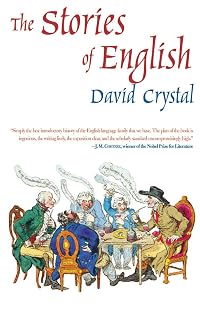
The Stories of English
by David Crystal
On This Page
Description
A history of the English language draws on the diversity of dialects and regional accents around the world, as well as the dialects that appear in a variety of literary classics, to explain the significance of the language.Tags
Recommendations











Member Reviews
David Crystal has audaciously performed a feat I would never have attempted in my wildest dreams. He has traced the evolution of the English language from its earliest beginnings with the arrival of the Anglo-Saxons in Great Britain, through its developing dialects, the influences of Latin and Norman French (not to be confused with Parisian French), and the evolution of Old English. He continues through developments in Middle English and finishes at the dawn of the 21st century with the many different English versions worldwide.
The work is breathtaking in its scope. Is it thorough and well-researched? Absolutely! Is it easy to read? Well, for me, at least, no. No, it’s not.
I’m not a linguist and don’t want to become one. So, I show more skimmed over the bits I didn’t understand. But even so, reading the chapters on Middle English, I found myself mostly lost. What I did get was that during that period of around 300 years, the residents of Britain weren’t language snobs. Sometimes people from different regions had trouble understanding one another, and sometimes they made fun of one another. Still, no one felt one version of English was superior.
That attitude changed from the 16th through the 18th centuries when the inhabitants of London and the surrounding area began to claim ownership of the language, and prescriptivists like Samuel Johnson set out to standardize it. Crystal views this as a tragic situation that was doomed from the start. And rightly so, in his opinion.
Crystal is a descriptivist, not a prescriptivist. He feels languages should evolve naturally with certain basic grammar rules so that we can easily understand one another. But pronunciation guides and picky grammatical rules draw his ire. In particular, he hates the objections to split infinitives and ending sentences with prepositions. Because of this, I found him a pleasure to hang out with. (See what I did there?) I’d recommend this to those curious about our language and those who wish to better understand how languages change and grow. show less
The work is breathtaking in its scope. Is it thorough and well-researched? Absolutely! Is it easy to read? Well, for me, at least, no. No, it’s not.
I’m not a linguist and don’t want to become one. So, I show more skimmed over the bits I didn’t understand. But even so, reading the chapters on Middle English, I found myself mostly lost. What I did get was that during that period of around 300 years, the residents of Britain weren’t language snobs. Sometimes people from different regions had trouble understanding one another, and sometimes they made fun of one another. Still, no one felt one version of English was superior.
That attitude changed from the 16th through the 18th centuries when the inhabitants of London and the surrounding area began to claim ownership of the language, and prescriptivists like Samuel Johnson set out to standardize it. Crystal views this as a tragic situation that was doomed from the start. And rightly so, in his opinion.
Crystal is a descriptivist, not a prescriptivist. He feels languages should evolve naturally with certain basic grammar rules so that we can easily understand one another. But pronunciation guides and picky grammatical rules draw his ire. In particular, he hates the objections to split infinitives and ending sentences with prepositions. Because of this, I found him a pleasure to hang out with. (See what I did there?) I’d recommend this to those curious about our language and those who wish to better understand how languages change and grow. show less
Yet another history of the English language? Yes, but... David Crystal belongs to these linguists passionate and in love with the diversity offered by language, a vision that this book reflects to perfection (e.g. note the 's' in 'stories'...).
His angle is original: he doesn't merely retell Standard English's history, he also reinforces such history by recounting that of the dialects and varieties which grew alongside it, and so helped to shape it. Indeed, he starts by exploring the multitude of dialects which ruled over Great-Britain until at least the 18th century, when one of them (South-East, from the triangle London-Oxford-Cambridge) will be 'selected' to be standardised. He then shows how such variety evolved, imposed itself show more within the whole island first before, then, bursting out into foreign continents following the Empire; all the while still drawing parallels with these other dialects which accompanied it.
The book is more than being intelligently structured. Each chapter focuses on a whole aspect of such language history, all being separated by 'interludes' detailing one of its particular feature. Such read is therefore broken up by little vignettes, completing his arguments as much as they allow food for thoughts.
A constant dialogue between standard and non-standard, it shows that the evolution of a language, its history, is far from being simple and linear, and that behind the passion brought about by the imposing of a standard a fact remains: the richness and beauty of a language lie in its diversity. In fact, David Crystal, brilliant linguist smirking at the constant jeremiads about the supposed 'decline of the English language', puts here his expertise at the service of a great denunciation of prescriptivism.
Instructive, funny at times, entertaining, relevant, here's a goldmine for geeks interested in the English language. I insist on 'geek' because, a massive opus (more than 500 pages!) it deals with the thousand faces of English (standards, Received Pronunciation, regional dialects, sociolects, New Englishes, patois and even creoles and their impact...) in such depth that it's not for the faint hearted! Brilliant. show less
His angle is original: he doesn't merely retell Standard English's history, he also reinforces such history by recounting that of the dialects and varieties which grew alongside it, and so helped to shape it. Indeed, he starts by exploring the multitude of dialects which ruled over Great-Britain until at least the 18th century, when one of them (South-East, from the triangle London-Oxford-Cambridge) will be 'selected' to be standardised. He then shows how such variety evolved, imposed itself show more within the whole island first before, then, bursting out into foreign continents following the Empire; all the while still drawing parallels with these other dialects which accompanied it.
The book is more than being intelligently structured. Each chapter focuses on a whole aspect of such language history, all being separated by 'interludes' detailing one of its particular feature. Such read is therefore broken up by little vignettes, completing his arguments as much as they allow food for thoughts.
A constant dialogue between standard and non-standard, it shows that the evolution of a language, its history, is far from being simple and linear, and that behind the passion brought about by the imposing of a standard a fact remains: the richness and beauty of a language lie in its diversity. In fact, David Crystal, brilliant linguist smirking at the constant jeremiads about the supposed 'decline of the English language', puts here his expertise at the service of a great denunciation of prescriptivism.
Instructive, funny at times, entertaining, relevant, here's a goldmine for geeks interested in the English language. I insist on 'geek' because, a massive opus (more than 500 pages!) it deals with the thousand faces of English (standards, Received Pronunciation, regional dialects, sociolects, New Englishes, patois and even creoles and their impact...) in such depth that it's not for the faint hearted! Brilliant. show less
This is a manifesto for sociolinguistics disguised as a history of the English language, or possibly vice-versa...
In Crystal's view, a language is a form of agreed social behaviour, static neither in time nor in space, varying also according to the purpose for which it is being used at any given moment. Its history is the story of all the millions of people who've used it over the centuries. Unfortunately, only a tiny and unrepresentative proportion of their utterances have made any kind of retrievable mark on the historical record, so when we do historical linguistics we are likely to end up with a model of one particular form of the language, and there's a great temptation to identify Old English uniquely with the language of Beowulf, show more Middle English with the language of Chaucer and Early Modern English with the language of Shakespeare (for example). Crystal goes through the evidence again and shows us how weak that kind of assumption can be - as can the many others we make about language stability, about "correct" forms, about pronunciation, spelling, and grammar, and so on. Pedants watch out!
This is, as you would expect from Crystal, a lively read, never going deep into the sort of dry philological detail you find in something like the Cambridge History, but staying at the sort of level that would appeal to undergraduates and general readers. There wasn't a huge amount that was new to me, but I did get quite a few new insights from Crystal's way of looking at the evidence, so well worth a read, especially if you don't know much about the history of English. show less
In Crystal's view, a language is a form of agreed social behaviour, static neither in time nor in space, varying also according to the purpose for which it is being used at any given moment. Its history is the story of all the millions of people who've used it over the centuries. Unfortunately, only a tiny and unrepresentative proportion of their utterances have made any kind of retrievable mark on the historical record, so when we do historical linguistics we are likely to end up with a model of one particular form of the language, and there's a great temptation to identify Old English uniquely with the language of Beowulf, show more Middle English with the language of Chaucer and Early Modern English with the language of Shakespeare (for example). Crystal goes through the evidence again and shows us how weak that kind of assumption can be - as can the many others we make about language stability, about "correct" forms, about pronunciation, spelling, and grammar, and so on. Pedants watch out!
This is, as you would expect from Crystal, a lively read, never going deep into the sort of dry philological detail you find in something like the Cambridge History, but staying at the sort of level that would appeal to undergraduates and general readers. There wasn't a huge amount that was new to me, but I did get quite a few new insights from Crystal's way of looking at the evidence, so well worth a read, especially if you don't know much about the history of English. show less
"The Stories of English" is a necessary, dense, well-researched volume by an expert who clearly has a true passion for the language and its variations. However, it has some clear advantages and some very clear flaws. (I'm fully aware that it's a bit bathetic of me to dismiss any writing but this most wonderful of linguists, however I adore all of his other books!)
Crystal's mandate is clever and clear: provide a history of the evolution of the English language, with a particular eye to studying "non-standard English" in all its varieties. Changes to the language - be they merely regional slang, or international pidgin dialects - are too often forgotten, due to the fact that they rarely appear in surviving print documents, and Crystal show more wants to lift a light on the subject. We begin with a thorough examination of the growth of Early English, brought together by French, Latin, Anglo, Danish, and so on. Using extensive contemporary texts, Crystal analyses the development of the language, asking such questions as: why do some "loan words" overtake others?; why do some variations remain?; who has the right to decide which language is 'correct'?; and so on, and so forth. Gradually, he moves through Middle English, and into the Modern aspects of the language. Along the way, Crystal continues to provide lengthy excerpts from documents, and finds examples of how the 'non-standard' parts of the language arose, remained, and were treated by those on the 'right side' of English.
There are two particularly notable strengths to the book. The first is Crystal's true passion, which allows him to introduce a variety of texts from centuries ago, and make us feel intrigued by them. The second is his desire to expose the fallacies of those who believe English has exact rules, and should remain within its confines. From the earliest surviving texts, he finds examples of whiners - whether it be those who believe no French or Latin words should be included, or those who are terrified of ending sentences with prepositions - and explains where these mistaken beliefs came from. Crystal doesn't write everything off (he understands, after all, where they come from), but strives to show that strictness for strictness' sake is ridiculous.
However, the book is far from perfect. First of all, despite the claims in the blurb, Crystal's style is often dry and academic. Fair enough, this was never going to be "Gone with the Wind". But particularly in the early chapters, when the subject is six-hundred-year old manuscripts, and the variations of individual letters, it would've been promising to have a slightly more witty tour guide. And, while the first two-thirds of the story are comprehensive, the final third largely covers UK-specific English. There is one fascinating if dry chapter on the development of English throughout the world, but it's quite limited. Again, I understand the need for this, and it actually helps support Crystal's argument that much non-standard English, both on a historical and on a global standpoint, is under-researched, but - to a non-UK reader - things did become a bit specific toward the end.
Crystal has one other adorable but infuriating quirk. He's inclined to make witty - or at least clever - jokes and puns without prior explanation. On several occasions, however, the explanation is so obscure that he's forced to provide an endnote to his explanation of his own witticism. In these cases, he really could've done with just setting up the joke in the main body of the text, as I'd imagine most readers would have had to utilise these endnotes often!
All in all, I'm glad to have read this book. I picked up a lot of fascinating new information, and many of the excerpts were utterly astounding in what they exposed about the lives of our ancestors. At the same time, it never quite found the perfect balance between "popular science" and academia. show less
Crystal's mandate is clever and clear: provide a history of the evolution of the English language, with a particular eye to studying "non-standard English" in all its varieties. Changes to the language - be they merely regional slang, or international pidgin dialects - are too often forgotten, due to the fact that they rarely appear in surviving print documents, and Crystal show more wants to lift a light on the subject. We begin with a thorough examination of the growth of Early English, brought together by French, Latin, Anglo, Danish, and so on. Using extensive contemporary texts, Crystal analyses the development of the language, asking such questions as: why do some "loan words" overtake others?; why do some variations remain?; who has the right to decide which language is 'correct'?; and so on, and so forth. Gradually, he moves through Middle English, and into the Modern aspects of the language. Along the way, Crystal continues to provide lengthy excerpts from documents, and finds examples of how the 'non-standard' parts of the language arose, remained, and were treated by those on the 'right side' of English.
There are two particularly notable strengths to the book. The first is Crystal's true passion, which allows him to introduce a variety of texts from centuries ago, and make us feel intrigued by them. The second is his desire to expose the fallacies of those who believe English has exact rules, and should remain within its confines. From the earliest surviving texts, he finds examples of whiners - whether it be those who believe no French or Latin words should be included, or those who are terrified of ending sentences with prepositions - and explains where these mistaken beliefs came from. Crystal doesn't write everything off (he understands, after all, where they come from), but strives to show that strictness for strictness' sake is ridiculous.
However, the book is far from perfect. First of all, despite the claims in the blurb, Crystal's style is often dry and academic. Fair enough, this was never going to be "Gone with the Wind". But particularly in the early chapters, when the subject is six-hundred-year old manuscripts, and the variations of individual letters, it would've been promising to have a slightly more witty tour guide. And, while the first two-thirds of the story are comprehensive, the final third largely covers UK-specific English. There is one fascinating if dry chapter on the development of English throughout the world, but it's quite limited. Again, I understand the need for this, and it actually helps support Crystal's argument that much non-standard English, both on a historical and on a global standpoint, is under-researched, but - to a non-UK reader - things did become a bit specific toward the end.
Crystal has one other adorable but infuriating quirk. He's inclined to make witty - or at least clever - jokes and puns without prior explanation. On several occasions, however, the explanation is so obscure that he's forced to provide an endnote to his explanation of his own witticism. In these cases, he really could've done with just setting up the joke in the main body of the text, as I'd imagine most readers would have had to utilise these endnotes often!
All in all, I'm glad to have read this book. I picked up a lot of fascinating new information, and many of the excerpts were utterly astounding in what they exposed about the lives of our ancestors. At the same time, it never quite found the perfect balance between "popular science" and academia. show less
A vast info-dump. It reads like the production of a privately-printing seventeenth-century antiquary who has written down many thing that interest him and has had no publishers telling him to remember consumer demographics or to keep it under three hundred pages. Which is not to say that it's a mess, it's not, but arranged chronologically and squeezed in to chapters. But there's a definite sense of spread caused, I think, by the astounding levels of detail. Crystal hates sweeping statements and you'll suddenly realise you're reading about the variant spellings of 'man' in Cotton Aug.ii.64.
Another thing Crystal hates is snobbery. This is a theme that has run through all the books of his that I've read. The thought that one person's show more English is better than another's makes him bilious and he denigrates histories that provide an over-simplified narrative at the expense of regional forms. Having read one or two of those histories I have to agree with him, but those readings being now some time in the past I could have done with something to reorient myself to the timeline. If you're looking for a straight-forward history of English this is not that book. Look, if you're sitting there with your ignorance in one hand and this book in the other then read the book. You'll love it. It's brilliant. If you know literally nothing bout the history of English and you're looking for a heads-up history read one of those, it doesn't matter which one, and then read this. show less
Another thing Crystal hates is snobbery. This is a theme that has run through all the books of his that I've read. The thought that one person's show more English is better than another's makes him bilious and he denigrates histories that provide an over-simplified narrative at the expense of regional forms. Having read one or two of those histories I have to agree with him, but those readings being now some time in the past I could have done with something to reorient myself to the timeline. If you're looking for a straight-forward history of English this is not that book. Look, if you're sitting there with your ignorance in one hand and this book in the other then read the book. You'll love it. It's brilliant. If you know literally nothing bout the history of English and you're looking for a heads-up history read one of those, it doesn't matter which one, and then read this. show less
A good, sometimes tedious look at the origins of the English language, from its earliest beginnings as a language of the Anglo-Saxons to its current dominance of the globe. Takes a look at the Standard and Non-standard forms of English and argues quite convincingly for respect of the Non-standard.
Interesting, but in endless detail, with word lists, interludes, and asides. The author's point of view is that dialect and borrowings from other languages are perfectly normal and healthy for the growth of expressiveness in a language, and he considers English to be the language with the greatest flexibility and vocabulary because of its borrowings. He is against prescriptive grammarians, and insists that the language is what the people speak. The interludes are set off in text boxes, and tell interesting stories about single words or collections of phrases and words. Page 402 has a list of common phrases like "dead as a door nail" that originated with Shakespeare, for instance. My interest faded during old and middle English, and show more picked up again with modern "global" English. The quotations from obscure and well known volumes must have taken years to collect. show less
Members
- Recently Added By
Published Reviews
For David Crystal the English language is an inexhaustible source of fascination, which he communicates to his readers in lively fashion. In The stories of English he celebrates the energy and vitality of nonstandard language.... Crystal makes his position clear in the first few pages, taking issue with those histories of the language that marginalize its non-standard aspects such as regional show more dialects, variations in grammar, spelling, punctuation, and pronunciation. He debunks the persistent myth of ‘purity’ in language: ‘No language has ever been found which displays lexical purity.... But this book is not merely a crusade against prescriptivism; it is full of incidental joys. show less
added by KayCliff
Lists

Non-Fiction Worth Reading
1,025 works; 257 members

Books Read in 2013
1,630 works; 51 members
Author Information

103+ Works 14,169 Members
David Crystal is Honorary Professor of Linguistics at the University of Wales, Bangor.
Common Knowledge
- Original publication date
- 2004
- First words
- In fact, the book has two introductions, because there are two stories to be told.
- Last words
- (Click to show. Warning: May contain spoilers.)In the meantime, I have brought together some of the best displays I know for The Stories of English.
- Blurbers
- Grimes, William; Romano, Carlin; Pinker, Steven; Pullman, Philip; Coetzee, J.M.
Classifications
Statistics
- Members
- 1,393
- Popularity
- 17,093
- Reviews
- 19
- Rating
- (3.87)
- Languages
- English
- Media
- Paper, Ebook
- ISBNs
- 10
- ASINs
- 5