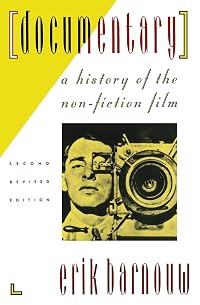
Documentary: A History of the Non-Fiction Film
by Erik Barnouw
On This Page
Description
Now brought completely up to date, the new edition of this classic work on documentary films and film making surveys the history of the genre from 1895 to the present day. With the myriad social upheavals over the past decade, documentaries have enjoyed an international renaissance; here Barnouw considers the medium in the light of an entirely new political and social climate. He examines as well the latest film making technology, and the effects that video cassettes and cable television are show more having on the production of documentaries. And like the previous editions, Documentary is filled with photographs, many of them rare, collected during the author's travels around the world. Covering the full course of the documentary from Louis Lumiere's first effort to recent landmark productions such as Shoah, this book makes the growing importance of a unique blend of art and reality accessible and understandable to all film lovers. show lessTags
Recommendations











Member Reviews
Fascinating and informative read, especially for aspiring documentarians. The only bad thing is that my viewing list is now twice as long.
As a photographer and student in taking documentary course work, this is a really good recourse.
Ratings
Members
- Recently Added By
Lists

Books Cited in Wasteland by W. Scott Poole
120 works; 1 member
Author Information
19+ Works 788 Members
Erik Barnouw, 1908 - 2001 Erik Barnouw was born in 1908 and came from the Netherlands to the United States at the age of 11. He attended Princeton University and after graduating, went on to become a radio writer and a producer. Barnouw began teaching radio writing at Columbia University in 1937. By 1947, he had founded the division of film, radio show more and television in the University's Arts Program. He worked for CBS for one year beginning in 1939, writing and editing, and editing for NBC from 1942 to 1944. He served as chairman of the division he had created at Columbia until 1968, retiring from the University in 1973. He was a member of the Writers Guild of America and served as it's chair from 1957 to 1959. In 1978, Barnouw went to work for the Library of Congress as a film and television expert, and created it's broadcasting and motion picture division, becoming it's first chief. In 1970, he produced a documentary entitled, "Hiroshima-Nagasaki, August, 1945" about the atomic bombs set off there. He was then commissioned to write a complete history of broadcasting by the Oxford University Press, and it was this masterpiece, consisting of three volumes, "A Tower of Babel," "The Golden Web" and "The Image Empire," which named him an expert in the field of broadcasting. Barnouw retired from the Library of Congress in 1978, yet continued to write, publishing his last volume, "Media Lost and Found" in the January before he died. Erik Barnouw died on July 19, 2001 at the age of 93 show less
Classifications
- Genres
- Nonfiction, General Nonfiction, Art & Design, History
- DDC/MDS
- 070.18 — Computer science, information & general works News media, journalism & publishing Documentary media, educational media, news media; journalism; publishing Theory And Instruction Anonymous journals
- LCC
- PN1995.9 .D6 .B37 — Language and Literature Literature (General) Literature (General) Drama Motion pictures
- BISAC
Statistics
- Members
- 300
- Popularity
- 106,846
- Reviews
- 2
- Rating
- (3.53)
- Languages
- English, Spanish
- Media
- Paper
- ISBNs
- 5
- ASINs
- 2