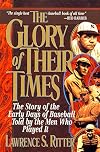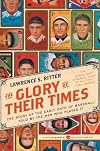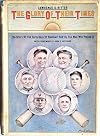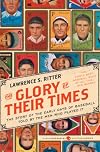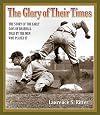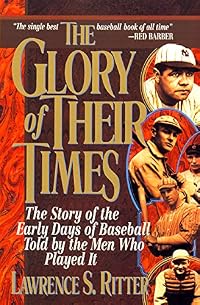
The Glory of Their Times : The Story of Baseball Told By the Men Who Played It
by Lawrence S. Ritter
On This Page
Description
Baseball was different in earlier days-tougher, rawer, more intimate-when giants like Babe Ruth and Ty Cobb ran the bases. In the monumental classic The Glory of Their Times, the golden era of our national pastime comes alive through the vibrant words of those who played and lived the game.Tags
Recommendations













Member Reviews
Anyone who loves baseball and knows how to write wants to write a baseball book. Baseball is the most literary of the sports. It’s long season, the un-timed nature of its games leads inevitably to stories– of past games and past players.
Lawrence S. Ritter was an economics professor at NYU and an editor and writer of economic books and journal articles. When baseball legend Ty Cobb died in 1961, Ritter realized what few others did: with each passing year, more of the early greats of the game would be gone… so would their stories and the stories of the deadball era game.
Between 1962 and 1966, Ritter travelled 75,000 miles to interview players from the early days of baseball, sitting for hours recording their tales with his tape show more recorder. The result, The Glory of Their Times, is the single best book every written about baseball.
The key to the book is the method Ritter used. He turned on the tape recorder and let the players reminisce: tell their stories without prompt or interruption. Only later did he edit. The result is magical.
Men who played just before World War I and after, who played in the first World Series, who played when baseball was truly the national pasttime, who played to escape deadly jobs in mines and slaughterhouses, who were hall-of-fame legends and were teammates and opponents of hall-of-fame legends, tell their stories in a way that can only be called lyrical and literary in the best sense of both those words. You are drawn in and carried along like the best novel, while the dozens of photographs Ritter includes from the men he talked to and other old sources illuminate and delight like the best non-fiction books.
Ritter invented a genre of sports books. Many people have done it since, but no one has done it as well. If I was starting a baseball library from scratch, I would start with this book.
(This review was also published at www.montanawriter.com) show less
Lawrence S. Ritter was an economics professor at NYU and an editor and writer of economic books and journal articles. When baseball legend Ty Cobb died in 1961, Ritter realized what few others did: with each passing year, more of the early greats of the game would be gone… so would their stories and the stories of the deadball era game.
Between 1962 and 1966, Ritter travelled 75,000 miles to interview players from the early days of baseball, sitting for hours recording their tales with his tape show more recorder. The result, The Glory of Their Times, is the single best book every written about baseball.
The key to the book is the method Ritter used. He turned on the tape recorder and let the players reminisce: tell their stories without prompt or interruption. Only later did he edit. The result is magical.
Men who played just before World War I and after, who played in the first World Series, who played when baseball was truly the national pasttime, who played to escape deadly jobs in mines and slaughterhouses, who were hall-of-fame legends and were teammates and opponents of hall-of-fame legends, tell their stories in a way that can only be called lyrical and literary in the best sense of both those words. You are drawn in and carried along like the best novel, while the dozens of photographs Ritter includes from the men he talked to and other old sources illuminate and delight like the best non-fiction books.
Ritter invented a genre of sports books. Many people have done it since, but no one has done it as well. If I was starting a baseball library from scratch, I would start with this book.
(This review was also published at www.montanawriter.com) show less
Jeez, where do I even start with this?
A couple of weeks ago I was overcome with memories of having been a big baseball fan when I was young -- we're talking late 1960s-mid 1970s, the years of the Big Red Machine in Cincinnati, my home town. Strangely, although I tried I couldn't remember where I'd picked up this passion: unlike most things, I don't recall that I got it from my father or my older brother. So ... maybe it was just mine.
Anyhoo, I recalled reading a book (probably one of those Scholastic Book Service things) about baseball, and specifically about the early years and players like Christy Mathewson and Honus Wagner. I decided I wanted to re-familiarize myself with this topic, and so after poking around a bit I got Ritter's show more book from the library.
Oh my. This is really the sh*t. It really really is. This is the sort of book that makes one nostalgic for a time when one wasn't even alive. If you even just *like* baseball, you have to read this one.
NB: Mathewson, Wagner, et al aren't in the Table of Contents (that is, they were not available to be interviewed, having died) but they are very much here -- in both words and pictures. The illustrations are, of course, marvelous.
I'm now trying to find a good book re: the Negro Leagues, because those players are not, alas, included here. show less
A couple of weeks ago I was overcome with memories of having been a big baseball fan when I was young -- we're talking late 1960s-mid 1970s, the years of the Big Red Machine in Cincinnati, my home town. Strangely, although I tried I couldn't remember where I'd picked up this passion: unlike most things, I don't recall that I got it from my father or my older brother. So ... maybe it was just mine.
Anyhoo, I recalled reading a book (probably one of those Scholastic Book Service things) about baseball, and specifically about the early years and players like Christy Mathewson and Honus Wagner. I decided I wanted to re-familiarize myself with this topic, and so after poking around a bit I got Ritter's show more book from the library.
Oh my. This is really the sh*t. It really really is. This is the sort of book that makes one nostalgic for a time when one wasn't even alive. If you even just *like* baseball, you have to read this one.
NB: Mathewson, Wagner, et al aren't in the Table of Contents (that is, they were not available to be interviewed, having died) but they are very much here -- in both words and pictures. The illustrations are, of course, marvelous.
I'm now trying to find a good book re: the Negro Leagues, because those players are not, alas, included here. show less
The late, great evolutionary scientist and baseball fan, Stephen Jay Gould, said of this book: "I could happily reread every summer for the rest of my life that greatest of all baseball books, The Glory of Their Times."
It's a truly wonderful book made up of interviews with old-time baseball players from the early twentieth century. The author tells us that he "traveled 75,000 miles searching for the heroes of a bygone era."
Ritter points out how amazing it is that these old-timers remember so much detail of their playing days. He says, "Many of the people I talked to had to think longer to get the names of all their great-grandchildren straight than they did to run down the batting order of the 1906 Chicago Cubs." As an old-timer myself show more I can empathise with Ritter's comment that "it is not at all unusual as one gets older for the more distant past to be remembered more clearly than what happened three weeks ago..."
I would love to have watched baseball as it was played in those days, when, as Sam Crawford points out in his interview/chapter, most home runs were of the inside-the-park variety.
And Chief Meyers says, "Nowadays, the pitcher wastes so much time out there it's ridiculous - fixing his cap...pulling up his pants...rubbing his chin...They waste an hour or so every day that way. We ALWAYS played a game in less than two hours."
There is a lot of humour in the book, as when Rube Bressler slams the "conference on the mound", which so often happens when a pitcher is in trouble. "The pitcher KNOWS he's in a jam. What can they say to him? They just remind him of it, that's all...All it does is make you even more worried than you already were, which was plenty. There are mighty few pitchers who can survive those conferences on the mound, take it from me."
At the risk of making this review too long, I'm going to end with two poems that are reproduced in this must-buy book: "The old-fashioned pitcher" by George E. Phair and "The old-fashioned batter", which was either also written by Phair or perhaps by Ritter himself. For me these two poems capture the spirit of the book.
How dear to my heart was the old-fashioned hurler
who labored all day on the old village green.
He did not resemble the up-to-date twirler
who pitches four innings and ducks from the scene.
The up-to-date twirler I’m not very strong for;
He has a queer habit of pulling up lame.
And that is the reason I hanker and long for
the pitcher who started and finished the game.
The old-fashioned pitcher,
The iron-armed pitcher,
The stout-hearted pitcher,
Who finished the game.
*****
How dear to my heart was the old-fashioned batter
Who scattered line drives from the spring to the fall.
He did not resemble the up-to-date batter
Who swings from his heels and then misses the ball.
The up-to-date batter I'm not very strong for;
He shatters the ozone with all of his might.
And that is the reason I hanker and long for
Those who doubled to left, and tripled to right.
The old-fashioned batter,
The eagle-eyed batter,
The thinking-man's batter,
Who tripled to right. show less
It's a truly wonderful book made up of interviews with old-time baseball players from the early twentieth century. The author tells us that he "traveled 75,000 miles searching for the heroes of a bygone era."
Ritter points out how amazing it is that these old-timers remember so much detail of their playing days. He says, "Many of the people I talked to had to think longer to get the names of all their great-grandchildren straight than they did to run down the batting order of the 1906 Chicago Cubs." As an old-timer myself show more I can empathise with Ritter's comment that "it is not at all unusual as one gets older for the more distant past to be remembered more clearly than what happened three weeks ago..."
I would love to have watched baseball as it was played in those days, when, as Sam Crawford points out in his interview/chapter, most home runs were of the inside-the-park variety.
And Chief Meyers says, "Nowadays, the pitcher wastes so much time out there it's ridiculous - fixing his cap...pulling up his pants...rubbing his chin...They waste an hour or so every day that way. We ALWAYS played a game in less than two hours."
There is a lot of humour in the book, as when Rube Bressler slams the "conference on the mound", which so often happens when a pitcher is in trouble. "The pitcher KNOWS he's in a jam. What can they say to him? They just remind him of it, that's all...All it does is make you even more worried than you already were, which was plenty. There are mighty few pitchers who can survive those conferences on the mound, take it from me."
At the risk of making this review too long, I'm going to end with two poems that are reproduced in this must-buy book: "The old-fashioned pitcher" by George E. Phair and "The old-fashioned batter", which was either also written by Phair or perhaps by Ritter himself. For me these two poems capture the spirit of the book.
How dear to my heart was the old-fashioned hurler
who labored all day on the old village green.
He did not resemble the up-to-date twirler
who pitches four innings and ducks from the scene.
The up-to-date twirler I’m not very strong for;
He has a queer habit of pulling up lame.
And that is the reason I hanker and long for
the pitcher who started and finished the game.
The old-fashioned pitcher,
The iron-armed pitcher,
The stout-hearted pitcher,
Who finished the game.
*****
How dear to my heart was the old-fashioned batter
Who scattered line drives from the spring to the fall.
He did not resemble the up-to-date batter
Who swings from his heels and then misses the ball.
The up-to-date batter I'm not very strong for;
He shatters the ozone with all of his might.
And that is the reason I hanker and long for
Those who doubled to left, and tripled to right.
The old-fashioned batter,
The eagle-eyed batter,
The thinking-man's batter,
Who tripled to right. show less
Summary: Oral histories by twenty-six former players from the early days of baseball, playing from the 1900’s to the 1940’s.
I’m old enough to remember great baseball players of the 1960’s–Mays, Mantle, Koufax, Mazeroski, Bob Gibson, Hank Aaron. This book reaches back another twenty to sixty years, going back to the early years of major league baseball. Some of the things I learned were that the gloves were smaller, the bats tended to be heavier, the balls deader, and the outfield fences further away. The game was one of strategy and speed and defense rather than power. There were years when a person with ten home runs stood a good chance of being homerun champ. Getting “discovered” wasn’t the result of an intensive show more scouting system. Often, the tip came from a friend, or someone just happened to stop by a semi-pro game and find you.
Lawrence S. Ritter, back in the 1960’s, set out to capture the stories of this time before the players of that generation had passed. Many, like Ruth, Gehrig, and Cobb already had. In this book, he has published oral histories of twenty-six players whose playing years stretch between 1898 to 1947. Many are in the Hall of Fame, some being inducted as a result of their stories appearing in this book.
The narratives cover their growing up years, how they fell in love with the game and made it to the majors, major career events and their afterlife when their playing days were done. One of the things that struck me was how many talked about other great players and managers. For example, Sam Crawford raved about what a great pitcher and fun person was Rube Waddell, about the hitting skills of Wee Willie Keeler, and the greatness of Walter Johnson as a pitcher.
But most noteworthy was the fact that Crawford played beside Ty Cobb in the outfield for thirteen years. He didn’t think he was the greatest overall, arguing instead for Honus Wagner as the best all round player. Cobb was a great hitter, a terror on the base paths, but just an average fielder who could only play outfield. An he was not a nice human being, a fact that several others in the book confirm.
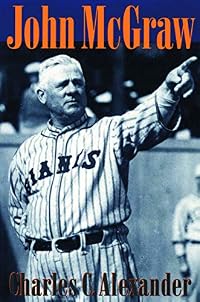
John McGraw (“Mr. McGraw”) comes up in the accounts of many players. He was the manager for the Giants. Rube Marquard, a pitcher who once won 19 straight games (it would be 20 under current rules) loved playing for him. He loved his players, they loved him, but he was a strict disciplinarian.
I remember as a kid and a Cleveland fan hearing from my grandfather about Stanley Coveleski. In 1920, he won three games against the Giants to lead Cleveland to a World Championship. In all, he won 214 games. I also learned he pitched in the days when the spitter was legal, and it was his main pitch!
The book closes out with my other favorite team from my youth, the Pirates and Paul Waner. The most fascinating part of the story is that he and his brother Lloyd played together for many years. Together they had 5600 hits in their careers, more than the three Dimaggio brothers or all five Delahanty brothers.
Ritter did a great job with the interviews. The players were great storytellers. One senses something of what the game was like back then. There’s a lot of “inside baseball” in the book. We see how players translated the mental game into the difference between wins and losses. And not unlike today, the stories capture the ‘brief, shining moment” that is a baseball career. Hank Greenberg’s story makes us wonder, as we did later with Ted Williams, “what if” military service hadn’t interrupted a career in its prime.
There is a debate that runs through the book of how today’s players compare. Players come down on both sides. So much has changed. At the same time, the stories hint at those who would have been great in any era–Mathewson and Johnson as pitchers, Cobb, and Speaker, and Wagner as hitters and fielders, and many more with them. We’ll never know but Ritter certainly captures “the glory of their times,” in these twenty-six histories. Any lover of the game should read this book! show less
I’m old enough to remember great baseball players of the 1960’s–Mays, Mantle, Koufax, Mazeroski, Bob Gibson, Hank Aaron. This book reaches back another twenty to sixty years, going back to the early years of major league baseball. Some of the things I learned were that the gloves were smaller, the bats tended to be heavier, the balls deader, and the outfield fences further away. The game was one of strategy and speed and defense rather than power. There were years when a person with ten home runs stood a good chance of being homerun champ. Getting “discovered” wasn’t the result of an intensive show more scouting system. Often, the tip came from a friend, or someone just happened to stop by a semi-pro game and find you.
Lawrence S. Ritter, back in the 1960’s, set out to capture the stories of this time before the players of that generation had passed. Many, like Ruth, Gehrig, and Cobb already had. In this book, he has published oral histories of twenty-six players whose playing years stretch between 1898 to 1947. Many are in the Hall of Fame, some being inducted as a result of their stories appearing in this book.
The narratives cover their growing up years, how they fell in love with the game and made it to the majors, major career events and their afterlife when their playing days were done. One of the things that struck me was how many talked about other great players and managers. For example, Sam Crawford raved about what a great pitcher and fun person was Rube Waddell, about the hitting skills of Wee Willie Keeler, and the greatness of Walter Johnson as a pitcher.
But most noteworthy was the fact that Crawford played beside Ty Cobb in the outfield for thirteen years. He didn’t think he was the greatest overall, arguing instead for Honus Wagner as the best all round player. Cobb was a great hitter, a terror on the base paths, but just an average fielder who could only play outfield. An he was not a nice human being, a fact that several others in the book confirm.
John McGraw (“Mr. McGraw”) comes up in the accounts of many players. He was the manager for the Giants. Rube Marquard, a pitcher who once won 19 straight games (it would be 20 under current rules) loved playing for him. He loved his players, they loved him, but he was a strict disciplinarian.
I remember as a kid and a Cleveland fan hearing from my grandfather about Stanley Coveleski. In 1920, he won three games against the Giants to lead Cleveland to a World Championship. In all, he won 214 games. I also learned he pitched in the days when the spitter was legal, and it was his main pitch!
The book closes out with my other favorite team from my youth, the Pirates and Paul Waner. The most fascinating part of the story is that he and his brother Lloyd played together for many years. Together they had 5600 hits in their careers, more than the three Dimaggio brothers or all five Delahanty brothers.
Ritter did a great job with the interviews. The players were great storytellers. One senses something of what the game was like back then. There’s a lot of “inside baseball” in the book. We see how players translated the mental game into the difference between wins and losses. And not unlike today, the stories capture the ‘brief, shining moment” that is a baseball career. Hank Greenberg’s story makes us wonder, as we did later with Ted Williams, “what if” military service hadn’t interrupted a career in its prime.
There is a debate that runs through the book of how today’s players compare. Players come down on both sides. So much has changed. At the same time, the stories hint at those who would have been great in any era–Mathewson and Johnson as pitchers, Cobb, and Speaker, and Wagner as hitters and fielders, and many more with them. We’ll never know but Ritter certainly captures “the glory of their times,” in these twenty-six histories. Any lover of the game should read this book! show less
I have given this book two stars. When a book has a 4.3 rating and is generally considered the best baseball book ever published, this deserves an explanation. This book just did not resonate with me. It reads like a raw interview, with no narrative or context. As a historical record, it’s valuable. But the book was published in the 60’s when many of the featured ball players were old men. And the book reads just like that, interviews of old men.
I’m reminded of The Last of the Doughboys. The author of that book set out to interview the few remaining soldiers from the Great War when they were over 100 years old, and some were even over 110. Same concept, but the difference is that book contained narrative. And that made it a much show more better read.
So I’m sorry, I just can’t give this book more stars. Feel free to change my mind if I’m way off base, but it read like an interview that had been tape recorded and transcribed to paper. show less
I’m reminded of The Last of the Doughboys. The author of that book set out to interview the few remaining soldiers from the Great War when they were over 100 years old, and some were even over 110. Same concept, but the difference is that book contained narrative. And that made it a much show more better read.
So I’m sorry, I just can’t give this book more stars. Feel free to change my mind if I’m way off base, but it read like an interview that had been tape recorded and transcribed to paper. show less
This book (and audiobook) contains reminiscences of old-time baseball players. Ritter interviewed them in the early 1960s just after Ty Cobb had died. Featured players include Jimmy Austin, Al Bridwell, Stan Coveleski, Sam Crawford, Goose Goslin, Davy Jones, Tommy Leach, Hans Lobert, Rube Marquard, Jack Meyers, Lefty O’Doul, Fred Snodgrass, Bill Wambsganss, Joe Wood, and more. Only Paul Waner played in the 1940s, the rest played during the 1890s to 1930s.
All these guys are gone now (and have been for many years), and it is just wonderful to listen to them talk about the famous players of the past, and how the game was played. I found a copy of both the paperback and audiobook, so I cross-referenced as I read/listened. There are a few show more differences, I assume due to Ritter’s fact-checking (these are “old guys telling stories,” which are mostly true but reliant on memory). I highly recommend the audiobook, which contains recordings of the actual interviews. If you are at all interested in baseball history, this book is an absolute gem. show less
All these guys are gone now (and have been for many years), and it is just wonderful to listen to them talk about the famous players of the past, and how the game was played. I found a copy of both the paperback and audiobook, so I cross-referenced as I read/listened. There are a few show more differences, I assume due to Ritter’s fact-checking (these are “old guys telling stories,” which are mostly true but reliant on memory). I highly recommend the audiobook, which contains recordings of the actual interviews. If you are at all interested in baseball history, this book is an absolute gem. show less
When they started their careers, professional baseball players were lowly regarded and by the end they’re exploits sold newspapers and had people standing in crowds waiting for details of the game they were playing across the nation. The Glory of Their Times: The Story of the Early Days of Baseball Told by the Men Who Played It by Lawrence S. Ritter is a collection of 26 players telling the story of their careers in their own words from the dawn of 20th Century when baseball became a national obsession.
When originally published Ritter had only interviewed 22 players—four players including a Hall of Famer were added for this enlarged edition—whose careers went just before the turn of the century to mostly the early 1920s with a few show more exceptions. At the time only three players of the group were Hall of Famers and after publication four more were elected, but this collection of “important” and regular players gives this book a wonderful mix as well as the player’s backgrounds. Interestingly Ritter was able to interview several players that were involved in important moments of the time like Merkel’s blunder or Fred Snodgrass’ (featured player) dropped fly in Game 7 of the 1912 World Series, or several Cincinnati players who take exception that they wouldn’t have won the 1919 World Series if the White Sox hadn’t “thrown it”. Of all the 26 players featured in the book, I had only heard of Hall of Famer Hank Greenberg—who was included in the enhanced edition—and didn’t know that much about him so the individual perspectives on how baseball became a major part of the American social-cultural fabric was very interesting.
The Glory of Their Times is a wonderful look into baseball in the first few decades of the 20th Century, Lawrence S. Ritter’s work in transforming a interview transcript into a autobiographical feature that you could imagine the player speaking the words to you was fantastic and made what it is. show less
When originally published Ritter had only interviewed 22 players—four players including a Hall of Famer were added for this enlarged edition—whose careers went just before the turn of the century to mostly the early 1920s with a few show more exceptions. At the time only three players of the group were Hall of Famers and after publication four more were elected, but this collection of “important” and regular players gives this book a wonderful mix as well as the player’s backgrounds. Interestingly Ritter was able to interview several players that were involved in important moments of the time like Merkel’s blunder or Fred Snodgrass’ (featured player) dropped fly in Game 7 of the 1912 World Series, or several Cincinnati players who take exception that they wouldn’t have won the 1919 World Series if the White Sox hadn’t “thrown it”. Of all the 26 players featured in the book, I had only heard of Hall of Famer Hank Greenberg—who was included in the enhanced edition—and didn’t know that much about him so the individual perspectives on how baseball became a major part of the American social-cultural fabric was very interesting.
The Glory of Their Times is a wonderful look into baseball in the first few decades of the 20th Century, Lawrence S. Ritter’s work in transforming a interview transcript into a autobiographical feature that you could imagine the player speaking the words to you was fantastic and made what it is. show less
Members
- Recently Added By
Published Reviews
ThingScore 100
Between 1962 and 1966, Ritter travelled 75,000 miles to interview players from the early days of baseball, sitting for hours recording their tales with his tape recorder. The result, The Glory of Their Times, is the single best book every written about baseball.
The key to the book is the method Ritter used. He turned on the tape recorder and let the players reminisce: tell their stories show more without prompt or interruption. Only later did he edit. The result is magical. show less
The key to the book is the method Ritter used. He turned on the tape recorder and let the players reminisce: tell their stories show more without prompt or interruption. Only later did he edit. The result is magical. show less
added by Broadwater43
Lists

Best Baseball Books
42 works; 20 members
Author Information

14+ Works 1,425 Members
Lawrence s. Ritter (1922-2004) was chairman of the Department of Finance at the Graduate School of Business Administration of New York University. He collaborated with fellow baseball historian Donald Honig on The Image of Their Greatness and The 100 Greatest Baseball Players of All Time but is best known for The Glory of Their Times, one of the show more most famous sports books ever published. show less
Awards and Honors
Awards
Common Knowledge
- Original publication date
- 1966
- First words
- My nickname being what it is, you probably automatically assume I must have been a country boy.
- Last words
- (Click to show. Warning: May contain spoilers.)Somehow...I don't know...it seems like it all happened only yesterday.
Classifications
- Genres
- Sports and Leisure, Nonfiction, General Nonfiction, History, Biography & Memoir
- DDC/MDS
- 796.3570922 — Arts & recreation Recreation, sports, and performing arts Sports Ball sports Ball and stick sports Baseball Biography And History Biography
- LCC
- GV865 .A1 .G56 — Geography, Anthropology and Recreation Recreation. Leisure Recreation. Leisure Sports Ball games: Baseball, football, golf, etc.
- BISAC
Statistics
- Members
- 794
- Popularity
- 34,819
- Reviews
- 20
- Rating
- (4.46)
- Languages
- English, German
- Media
- Paper, Audiobook, Ebook
- ISBNs
- 12
- UPCs
- 2
- ASINs
- 22