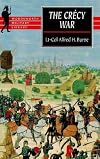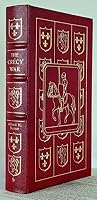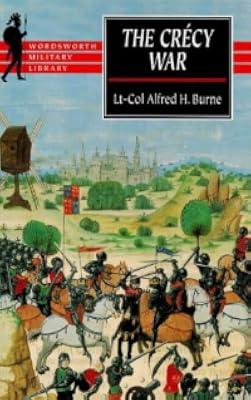
The Crécy war: a military history of the Hundred Years War from 1337 to the Peace of Bretigny, 1360
by Alfred H. Burne
On This Page
Description
Crecy, the Black Princes most famous victory, was the first of two major victories during the first part of the Hundred Years War. This was followed ten years later by his second great success at the Battle of Poitiers. The subsequent Treaty of Bretigny established the rights of the King of England to hold his domains in France without paying homage to the King of France.In this hugely-acclaimed military history Colonel Burne re-establishes the reputation of Edward III as a grand master of show more strategy, whose personal hand lay behind the success of Crecy. He convincingly demonstrates that much of the credit for Crecy and Poitiers should be given to Edward and less to his son, the Black Prince, than is traditionally the case.With his vigorous and exciting style, Colonel Burne has chronicled for the general reader as well as for the military enthusiast, one of the most exceptional wars in which England has ever been engaged. This book firmly restores the Crecy campaign to its rightful place near the pinnacle of British military history.A most important book a work of original research, written by a master of his subject A model of how history should be written, packed with accurate information and common sense.Sir Arthur Bryant in The Sunday Times show lessTags
Recommendations













Member Reviews
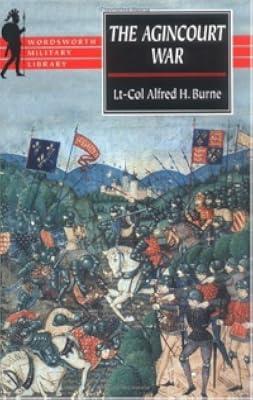
This is a joint review with [a:Alfred H. Burne's|193637|Alfred H. Burne|https://s.gr-assets.com/assets/nophoto/user/m_50x66-82093808bca726cb3249a493fbd3bd0f.png] [b:The Agincourt War|337689|The Agincourt War|Alfred H. Burne|https://d.gr-assets.com/books/1444737814s/337689.jpg|46860288].
The military operations of the Hundred Years War are shrouded with mystery; did Edward III intend a conquest or chevauchée when he embarked on the Crécy campaign? Where was the French army for large chunks of the Agincourt campaign? How many fought in almost any of the battles? Guesswork and conjecture fill many of the gaps, as they must, but some general accounts can be read which give no indication of the extent to which they are presenting, not show more historical fact, but informed hypothesis.
Alfred H. Burne, by contrast, is completely open about this. He fills in the gaps with close study of the primary and secondary sources, an examination of the battlefields in many cases, and his own concept of Inherent Military Probability; essentially just what he, a trained soldier who fought in some of these same fields in World War One, regards as most likely to have happened. These deliberations are documented at length in a number of appendices which can be pretty heavy going. Also, IMP itself has been rather derided. This, however, seems unfair, as all Burne is really doing is flagging up the fact that he is filling in gaps.
These two books remain probably the best history of the military aspect of the conflict between the Plantagenets and Valois from 1337 to 1453. Burne identifies two broad schools of thought on the subject. On the one hand are the British, who see the conduct of Plantagent leaders such as Edward III, Henry V, and Sir John Talbot in very positive terms and that of their Valois opponents correspondingly poorly. On the other is the French school, which is the opposite of all that. Burne is very much of the former and, while the truth probably lies somewhere between the two schools, it probably lies closer to the British and Burne than the French.
There are weaknesses. Burne’s interest is in battles but much of the fighting of the Hundred Years War took the form of sieges or indirect operations. Burne gives the former less weight in the narrative than their frequency deserve, and as regards the latter, his dismissal of Bertrand du Guesclin’s achievements is surely too brusque. Du Guesclin was, simply, one of the most successful commanders of the war on either side and that he was so without fighting too many pitched battles could be seen as being to his credit.
That aside, however, these books remain fascinating and essential reading for anyone with more than a passing interest in the Hundred Years War. show less
The military operations of the Hundred Years War are shrouded with mystery; did Edward III intend a conquest or chevauchée when he embarked on the Crécy campaign? Where was the French army for large chunks of the Agincourt campaign? How many fought in almost any of the battles? Guesswork and conjecture fill many of the gaps, as they must, but some general accounts can be read which give no indication of the extent to which they are presenting, not show more historical fact, but informed hypothesis.
Alfred H. Burne, by contrast, is completely open about this. He fills in the gaps with close study of the primary and secondary sources, an examination of the battlefields in many cases, and his own concept of Inherent Military Probability; essentially just what he, a trained soldier who fought in some of these same fields in World War One, regards as most likely to have happened. These deliberations are documented at length in a number of appendices which can be pretty heavy going. Also, IMP itself has been rather derided. This, however, seems unfair, as all Burne is really doing is flagging up the fact that he is filling in gaps.
These two books remain probably the best history of the military aspect of the conflict between the Plantagenets and Valois from 1337 to 1453. Burne identifies two broad schools of thought on the subject. On the one hand are the British, who see the conduct of Plantagent leaders such as Edward III, Henry V, and Sir John Talbot in very positive terms and that of their Valois opponents correspondingly poorly. On the other is the French school, which is the opposite of all that. Burne is very much of the former and, while the truth probably lies somewhere between the two schools, it probably lies closer to the British and Burne than the French.
There are weaknesses. Burne’s interest is in battles but much of the fighting of the Hundred Years War took the form of sieges or indirect operations. Burne gives the former less weight in the narrative than their frequency deserve, and as regards the latter, his dismissal of Bertrand du Guesclin’s achievements is surely too brusque. Du Guesclin was, simply, one of the most successful commanders of the war on either side and that he was so without fighting too many pitched battles could be seen as being to his credit.
That aside, however, these books remain fascinating and essential reading for anyone with more than a passing interest in the Hundred Years War. show less
Ratings
Members
- Recently Added By
Author Information
15 Works 514 Members
Series
Belongs to Publisher Series
Work Relationships
Is contained in
Common Knowledge
- Canonical title
- The Crécy war: a military history of the Hundred Years War from 1337 to the Peace of Bretigny, 1360
- People/Characters
- Edward III, King of England; Edward, the Black Prince; John Chandos; John II, King of France; Pedro the Cruel, King of Castile; Bertrand du Guesclin (show all 7); Robert Knolles
- Important places
- Normandy, France; Paris, Île-de-France, France; London, England, UK; Crécy-en-Ponthieu, Hauts-de-France, France (Battle of Crécy); Gascony, France; Aquitaine, France (show all 11); Kingdom of Castile; Castile, Spain; Brittany, France; County of Flanders; Flanders, Belgium
- Important events
- Hundred Years' War (1337 | 1453); Reign of Edward III, King of England (1327-01-25 | 1377-06-21); Black Death; Battle of Sluys (1340-06-24); Battle of Crécy (1346-08-26); Siege of Calais (1346-09-04 | 1347-08-03) (show all 7); Battle of Poitiers (1356-09-19)
Classifications
- Genres
- History, Nonfiction, General Nonfiction
- DDC/MDS
- 944.0254 — History & geography History of Europe France and Monaco France Capet and Valois 987-1589 Philip VI 1328-50; John II 1350-64; Charles V 1364-80 ; XIVth Century
- LCC
- DC96 .B87 — History of Europe, Asia, Africa and Oceania France – Andorra – Monaco History of France History By period Early and medieval to 1515 1328-1515 Hundred Years' War, 1339-1453
- BISAC
Statistics
- Members
- 121
- Popularity
- 270,530
- Reviews
- 1
- Rating
- (3.90)
- Languages
- Chinese, English
- Media
- Paper, Ebook
- ISBNs
- 7
- ASINs
- 4