On This Page
Description
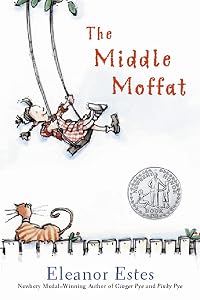
Follows the adventures and misadventures of ten-year-old Jane Moffat living with her widowed mother and three siblings in their new home in Cranbury, Connecticut, in the early twentieth century.Tags
Recommendations


Member Reviews
As usual, Estes does not disappoint.
The Middle Moffat passed the most important test: My kids loved it. Both the 8yo and the 4yo said several times a day, "Read more Moffats, Mommy!" I found myself wondering what my 21st-century children see in these World War I-era books.
I think what makes the Moffat books timeless is the way Estes portrays the children. The books seem very true to the way a child thinks. I really love Jane's perspective, and I enjoyed being in her head. Reading Jane's internal conflict when trying to make decisions really endeared her to me. It's lovely to read a character who is imperfect but trying so hard to do the right thing while receiving conflicting messages (like whether or not to take the last pork chop in a show more home with a maid).
Estes also incorporates some cultural critiques (and gentle ribbing) that help adult readers look at themselves less seriously. I especially loved the chapter where the women of the town hear a talk about Henry David Thoreau and then go through and declutter their homes. That really hit close to home. I had no idea people were decluttering in the early 20th century. And the means by which the organ---but not the piano bench---comes into the Moffat's home highlights the way that some people feel compelled to declutter without really internalizing the reasons for doing so.
The relationship between Jane and the oldest inhabitant of Cranbury was incredibly sweet, the way she cared for him, and he treated her as an equal. I found myself wishing our town would have a parade for every inhabitant who reached the century mark.
There are so many golden moments in this book. The only trouble I had with it is that the chapters are a tad long for a read-aloud. That didn't stop us, though. show less
The Middle Moffat passed the most important test: My kids loved it. Both the 8yo and the 4yo said several times a day, "Read more Moffats, Mommy!" I found myself wondering what my 21st-century children see in these World War I-era books.
I think what makes the Moffat books timeless is the way Estes portrays the children. The books seem very true to the way a child thinks. I really love Jane's perspective, and I enjoyed being in her head. Reading Jane's internal conflict when trying to make decisions really endeared her to me. It's lovely to read a character who is imperfect but trying so hard to do the right thing while receiving conflicting messages (like whether or not to take the last pork chop in a show more home with a maid).
Estes also incorporates some cultural critiques (and gentle ribbing) that help adult readers look at themselves less seriously. I especially loved the chapter where the women of the town hear a talk about Henry David Thoreau and then go through and declutter their homes. That really hit close to home. I had no idea people were decluttering in the early 20th century. And the means by which the organ---but not the piano bench---comes into the Moffat's home highlights the way that some people feel compelled to declutter without really internalizing the reasons for doing so.
The relationship between Jane and the oldest inhabitant of Cranbury was incredibly sweet, the way she cared for him, and he treated her as an equal. I found myself wishing our town would have a parade for every inhabitant who reached the century mark.
There are so many golden moments in this book. The only trouble I had with it is that the chapters are a tad long for a read-aloud. That didn't stop us, though. show less
Who is Jane Moffat, anyway? She isn't the youngest in the family, and she isn't the oldest - she is always just Jane. How boring. So Jane decides to become a figure of mystery . . . the mysterious "Middle Moffat." But being in the middle is a lot harder than it looks.
In between not rescuing stray dogs, and losing and finding best friends, Jane must secretly look after the oldest inhabitant of Cranbury . . . so he can live to be one hundred. Between brushing her hair from her eyes and holding up her stockings, she has to help the girls' basketball team win the championship. And it falls to Jane - the only person in town with enough courage - to stand up to the frightful mechanical wizard, Wallie Bangs.
Jane is so busy keeping Cranbury in show more order that she barely has time to be plain old Jane. Sometimes the middle is the most exciting place of all. . . . show less
In between not rescuing stray dogs, and losing and finding best friends, Jane must secretly look after the oldest inhabitant of Cranbury . . . so he can live to be one hundred. Between brushing her hair from her eyes and holding up her stockings, she has to help the girls' basketball team win the championship. And it falls to Jane - the only person in town with enough courage - to stand up to the frightful mechanical wizard, Wallie Bangs.
Jane is so busy keeping Cranbury in show more order that she barely has time to be plain old Jane. Sometimes the middle is the most exciting place of all. . . . show less
This is the one I read about a dozen times, that encouraged me to read all by Estes and then everything else I could find in the library that was remotely like it. Even today I have that sunny perspective about life, that people are nice and families stick up for each other and girls can get into mischief... Like Cleary, Nesbit, and even Narnia (which btw I still don't see the religion in).
------------
Read again for the GR Newbery club that I host, Jan 2016. Still loving it. Can't believe I never noticed how Mr. Buckle, the oldest inhabitant, blows cotton to the birds for their nests. That might be a good use for pill bottle cotton scraps this spring.... I also appreciate the relevance of the ladies' club, the Browning Society, being on show more the same decluttering kick that many ppl are on now. We're doing it the KonMari way, and they did it because they learned of the teachings of Thoreau, but it's the same idea.
It's just such a sweet story, with enough underlying poignancy to make it richer than a casual reader (which I've been, every other time I've read it) consciously grasps. For example, the fact that the Moffats aren't too proud to accept the hand-me-downs from the ladies is interesting. And when Janey expresses to Mr. Buckle that now that he's made it to 100, he should try for 200... he agrees, and she says, And they might celebrate that birthday in the Yale Bowl. Maybe then I could be a wave." Neither of the friends stop to think about the fact that Janey will be 110 in a hundred years, of course....
I do recommend reading the Moffat books in order if you can - there is some development, the family circumstances and home change as the children grow, etc. And two more books about the family and their kin were recognized by Newbery committees, so we in GR will be reading them later." show less
------------
Read again for the GR Newbery club that I host, Jan 2016. Still loving it. Can't believe I never noticed how Mr. Buckle, the oldest inhabitant, blows cotton to the birds for their nests. That might be a good use for pill bottle cotton scraps this spring.... I also appreciate the relevance of the ladies' club, the Browning Society, being on show more the same decluttering kick that many ppl are on now. We're doing it the KonMari way, and they did it because they learned of the teachings of Thoreau, but it's the same idea.
It's just such a sweet story, with enough underlying poignancy to make it richer than a casual reader (which I've been, every other time I've read it) consciously grasps. For example, the fact that the Moffats aren't too proud to accept the hand-me-downs from the ladies is interesting. And when Janey expresses to Mr. Buckle that now that he's made it to 100, he should try for 200... he agrees, and she says, And they might celebrate that birthday in the Yale Bowl. Maybe then I could be a wave." Neither of the friends stop to think about the fact that Janey will be 110 in a hundred years, of course....
I do recommend reading the Moffat books in order if you can - there is some development, the family circumstances and home change as the children grow, etc. And two more books about the family and their kin were recognized by Newbery committees, so we in GR will be reading them later." show less
Jane is the middle Moffat child and in this charming book she tries to establish her unqiue identity and makes friends with the oldest inhabitant, accidentally joins a basketball team, gives an organ recital, and sees the man in the moon.
Jane is the middle Moffat child and in this charming book she tries to establish her unqiue identity and makes friends with the oldest inhabitant, accidentally joins a basketball team, gives an organ recital, and sees the man in the moon.
"The Middle Moffat" follows the adventures of Janey Moffat, the middle child in a lively family. Set in Cranbury, a fictional town in Connecticut, Janey navigates the challenges and joys of growing up. From exploring hidden places to standing up for what's right, Janey's spirited personality shines through as she finds her place in her family and community. In the classroom, "The Middle Moffat" can be used to explore themes of identity, family dynamics, and community. Teachers can engage students in discussions about character development, plot structure, and historical context, as the story offers a glimpse into life in small-town America during the early 20th century. This book we would be best for ages 10-12.
Not so much a novel as a short story collection, "The Middle Moffat" tells 11 tales focusing on Jane Moffat, who is neither the youngest nor the oldest in the family. These slightly old fashioned stories are light, sweet, and sometimes funny. Estes does a good job portraying the way a child thinks.
Members
- Recently Added By
Lists

Best Newbery Honor Books
257 works; 32 members

Honey For a Child's Heart
1,152 works; 25 members

Newbery Honor Books By Year - I - 1922-1980
199 works; 3 members

Children's Literature 1900 - 1950 in order
413 works; 8 members

Books Read in 2024
4,623 works; 126 members

Recommended Reading List
219 works; 1 member

HMS: Make Your Child a Lover of Books, Ages 7-9
52 works; 2 members
Author Information

30+ Works 22,799 Members
Eleanor Estes was born in West Haven, Connecticut on May 9, 1906. She graduated from the Pratt Institute Library School and worked as a children's librarian in branches of the New York Public Library system. Her first book, The Moffats, was published in 1941. Her other works include The Hundred Dresses and Ginger Pye, which won a John Newbery show more Medal for the most distinguished children's book in 1952. She also wrote a single adult novel entitled The Echoing Green. She died of complications following a stroke on July 15, 1988 at the age of 82. (Bowker Author Biography) show less
Some Editions
Awards and Honors
Awards
Series

Work Relationships
Common Knowledge
- Canonical title
- The Middle Moffat
- Original publication date
- 1942
- People/Characters
- Jane Moffat; Rufus Moffat; Sylvie Moffat; Mama; Mr. Buckle
- Important places
- Cranberry, Connecticut, USA
- Dedication
- To Clarence
- First words
- "This is Jane, the middle Moffat," said Jane, trying to act as though she were Mama, introducing her to one of the ladies she sewed for.
- Last words
- (Click to show. Warning: May contain spoilers.)And slowly the limousine rolled home.
Classifications
- Genres
- Children's Books, Kids, Fiction and Literature
- DDC/MDS
- 813.54 — Literature & rhetoric American literature in English American fiction in English 1900-1999 1945-1999
- LCC
- PZ7 .E749 .M — Language and Literature Fiction and juvenile belles lettres Fiction and juvenile belles lettres Juvenile belles lettres
- BISAC
Statistics
- Members
- 1,769
- Popularity
- 12,420
- Reviews
- 12
- Rating
- (4.16)
- Languages
- 6 — Chinese, Dutch, English, Finnish, Korean, Swedish
- Media
- Paper, Ebook
- ISBNs
- 22
- ASINs
- 8