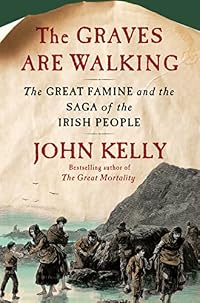
The Graves Are Walking: The Great Famine and the Saga of the Irish People
by John Kelly
On This Page
Description
This compelling new look at one of the worst disasters to strike humankind--the Great Irish Potato Famine--provides fresh material and analysis on the role that nineteenth-century evangelical Protestantism played in shaping British policies and on Britain's attempt to use the famine to reshape Irish society and character.Tags
Recommendations












Member Recommendations
Member Reviews
"By the summer of 1847, newspaper readers in North America and Europe could be forgiven for thinking the only thing the Irish knew how to do any more was die."
That sums up the horrific story of the Irish Potato Famine of 1845-1848ish, a dreadful event that was sadly in need of a new and readable history. That is what John Kelly has delivered -- in spades. He does the world a service by not arguing that the collapsed of the potato crop was artificially manufactured and created by the British with the express purpose of triggering what ended up becoming the equivalent of a genocide of the Irish, nor does he romanticize life in pre-famine Ireland. What he does do is deliver a crisp, well-researched and authoritative history of the show more cataclysm and its consequences.
In Kelly's eyes, the English have a responsibility for the astonishing fatality -- about a million died; another million emigrated -- but it's of a different kind. English policies and especially the commitment to policy ideals rather than the preservation of human life (eg the government determination that no one should interfere with the market's operations by providing free grain or selling below the market price) had an impact that proved devastating. Kelly makes clear that the starting point of their thinking was radically different than what ours might be today, 160 years later: to the English of the 1840s, it was easy to see the famine as a kind of divine judgment, whether on the over-reliance on the potato crop, the antiquated system of barter rather than a modern cash economy, or simply the fact that the Irish were Catholic. To them, the crop failures were a welcome opportunity to reshape Ireland, and the policies that they tried to execute exacerbated the catastrophe.
In the wake of any tragedy of this kind, it's easy to slip into the "but they should have known..." analysis -- 20/20 hindsight. That has been particularly true of the famine, which has played a critical role in the thousand years or so of conflict between England and Ireland, so it's not surprising that Kelly does do a bit of that. (Another example of what I mean by this: it's akin to the comments made about Jews in Germany and Austria in the mid-1930s -- why didn't they leave? Didn't they realize?? Kelly occasionally slips into comments along the lines of "they should have realized...") But the deft marshaling of the complicated facts and the juxtaposition of these against some vivid writing (the only other history of the period I've read was very very dry) and an anecdotal style more than offsets this.
Many of my ancestors are Irish, although Irish protestants, with names like Duke (Kelly quotes a Co. Leitrim physician, John Duke, who was viewed as a savior by some of his Irish Catholic patients and whose grave marker is still decorated with flowers today) and Casement (yes, as in Roger), but most left before the famine, in the 1820s or 1830s, in the aftermath of the failed 1798 rebellion. Most were themselves small farmers or craftsmen, not peasants, but not landowners. I wish that my g-g-g-g-grandfather Francis Duke had left some mention of what he thought of his great-nephew's actions during the famine, and what he thought of the flood of new Irish immigrants to Canada in the years before his death. What is sure is that the Co. Leitrim he left today has a population that is only about 10% of what it was before the famine -- and that for every person now living here, there are at least 7 or 8 members of the Irish diaspora who can trace their roots to Leitrim. That's an example of the impact of this horrifying few years of Irish history, a period that still affects the sense of what it is to be "Irish", and that country's relationship with England.
Kelly has a knack for combining great historical detail and accuracy with narrative detail and vivid writing, making this compelling reading. Recommended: 4.4 stars. show less
That sums up the horrific story of the Irish Potato Famine of 1845-1848ish, a dreadful event that was sadly in need of a new and readable history. That is what John Kelly has delivered -- in spades. He does the world a service by not arguing that the collapsed of the potato crop was artificially manufactured and created by the British with the express purpose of triggering what ended up becoming the equivalent of a genocide of the Irish, nor does he romanticize life in pre-famine Ireland. What he does do is deliver a crisp, well-researched and authoritative history of the show more cataclysm and its consequences.
In Kelly's eyes, the English have a responsibility for the astonishing fatality -- about a million died; another million emigrated -- but it's of a different kind. English policies and especially the commitment to policy ideals rather than the preservation of human life (eg the government determination that no one should interfere with the market's operations by providing free grain or selling below the market price) had an impact that proved devastating. Kelly makes clear that the starting point of their thinking was radically different than what ours might be today, 160 years later: to the English of the 1840s, it was easy to see the famine as a kind of divine judgment, whether on the over-reliance on the potato crop, the antiquated system of barter rather than a modern cash economy, or simply the fact that the Irish were Catholic. To them, the crop failures were a welcome opportunity to reshape Ireland, and the policies that they tried to execute exacerbated the catastrophe.
In the wake of any tragedy of this kind, it's easy to slip into the "but they should have known..." analysis -- 20/20 hindsight. That has been particularly true of the famine, which has played a critical role in the thousand years or so of conflict between England and Ireland, so it's not surprising that Kelly does do a bit of that. (Another example of what I mean by this: it's akin to the comments made about Jews in Germany and Austria in the mid-1930s -- why didn't they leave? Didn't they realize?? Kelly occasionally slips into comments along the lines of "they should have realized...") But the deft marshaling of the complicated facts and the juxtaposition of these against some vivid writing (the only other history of the period I've read was very very dry) and an anecdotal style more than offsets this.
Many of my ancestors are Irish, although Irish protestants, with names like Duke (Kelly quotes a Co. Leitrim physician, John Duke, who was viewed as a savior by some of his Irish Catholic patients and whose grave marker is still decorated with flowers today) and Casement (yes, as in Roger), but most left before the famine, in the 1820s or 1830s, in the aftermath of the failed 1798 rebellion. Most were themselves small farmers or craftsmen, not peasants, but not landowners. I wish that my g-g-g-g-grandfather Francis Duke had left some mention of what he thought of his great-nephew's actions during the famine, and what he thought of the flood of new Irish immigrants to Canada in the years before his death. What is sure is that the Co. Leitrim he left today has a population that is only about 10% of what it was before the famine -- and that for every person now living here, there are at least 7 or 8 members of the Irish diaspora who can trace their roots to Leitrim. That's an example of the impact of this horrifying few years of Irish history, a period that still affects the sense of what it is to be "Irish", and that country's relationship with England.
Kelly has a knack for combining great historical detail and accuracy with narrative detail and vivid writing, making this compelling reading. Recommended: 4.4 stars. show less
This is a very thorough history of the Great Hunger in Ireland, which I will never call the Potato Famine again. A potato blight (throughout Europe) caused the crisis, but the famine was caused by misguided, ideologically driven government policy. Kelly pushes back somewhat against the theory that the famine was a result of a deliberate genocide, but the tale he tells of incompetence and blind ideology is in a way more chilling, because more apt to happen again.
Kelly doesn’t lay down an ideology of his own in the book, but for me it was easy to see disturbing echoes of the 19th century British government in today’s American GOP, with their cynical insistence the “dependence” engendered by any aid to the poor is worse than show more poverty itself. And as I was reading about the incompetence and mean-spiritedness of Sir Charles Trevelyan, who was held in such high esteem in Britain despite the harm he caused, I heard myself muttering “Heckuva job, Trevvie.” show less
Kelly doesn’t lay down an ideology of his own in the book, but for me it was easy to see disturbing echoes of the 19th century British government in today’s American GOP, with their cynical insistence the “dependence” engendered by any aid to the poor is worse than show more poverty itself. And as I was reading about the incompetence and mean-spiritedness of Sir Charles Trevelyan, who was held in such high esteem in Britain despite the harm he caused, I heard myself muttering “Heckuva job, Trevvie.” show less
Joy's review: God, but this book is a slog! Kelly has included every fact he uncovered in his research in this book and done so with out any kind of coherent narrative. The only reason I included the extra 1/2 star is that he did to a lot of research and I learned some interesting things. If only he had an editor to force him to organize this pile of facts into some kind of structure. All of our non-fiction group agrees: Kelly ruined what could have been an excellent book.
This is a history of the famine period in Ireland by Irish-American John Kelly. Between 1845 and 1850, of a population of approx. 8.2 million, some one million died and another million were forced to emigrate. By 1881 the population had fallen to 5.2 million and continued to fall for many more years. This book, based on detailed research involving primary sources, is an involving read but not an easy one. There is a wealth of personal accounts and stories of the impact of the famine across the length and breadth of Ireland, and fitting all this material into a readable volume was I'm sure no easy task, but this I think he has largely succeeded in accomplishing. The author's conclusion that the famine was a genocide in outcome if not in show more intent is one some readers and scholars might take issue with; I think further reading of scholarly works on the famine period is necessary regardless. The recently published Atlas of the Great Irish Famine (Cork UP)is one such work everyone interested in the famine should reference.
See Irish Times review of "The Graves are Walking" at http://www.irishtimes.com/newspaper/features/2012/0925/1224324356401.html show less
See Irish Times review of "The Graves are Walking" at http://www.irishtimes.com/newspaper/features/2012/0925/1224324356401.html show less
I was looking for a relatively short narrative account of the Great Famine to acquire some historical purchase on an event I mostly knew from family folk history. On that scale, this well-written book doesn't disappoint.
Kelly's thesis is that the death of >1 million Irish from hunger and disease was no more a pure Act of God than the destruction of New Orleans in 2005, but was instead a case of a natural crisis exacerbated to catastrophic proportions by political ideology, anti-Irish bigotry, and greed. Specifically, Kelly blames:
1) the greed of Anglo-Irish landlords who responded to the crisis (and increased taxation to support relief efforts) with mass evictions and "emigrant dumping"--i.e. paying the poorest of the poor to emigrate show more to Canada and the U.S. (comparable to one-way bus tickets to CA for the homeless); and
2) short-sighted, parsimonious relief efforts implemented by British civil servants committed to Malthusian and laissez-faire principles, who:
-refused to "artificially" lower the cost of food below market price lest they interfere with the "natural" workings of the market;
-refused to offer robust aid to the starving Irish lest it foster a culture of "dependency" on government;
-rationalized Irish mass death as a tragic but necessary, natural consequence of the failings of the Irish way of life;
-and seized upon the catastrophe as an exciting opportunity to "morally reeducate" a "backward" people and to modernize its agriculture along capitalist lines.
(Kelly's thesis obviously resonates with Naomi Klein's Shock Doctrine about "disaster capitalism.")
Kelly's narrative is especially powerful when it juxtaposes the rationalizations of British capitalists with the unspeakable suffering endured by the victims of famine and government neglect. There are some images here of extreme privation and suffering I will never be able to forget. However, I will point out two problems:
-some of the events he recounts blur the line between history and folk tale (cf. 177, the story of Bridie Sheain which is very powerful, but which is sourced to an "old storyteller" and has the earmarks of legend)
-while I appreciate that the written record probably preserves the perspectives of British observers better than those of illiterate peasants, it bothered me that the narrative individualizes British civil servants while depicting the victims of the famine as an undifferentiated mass. This tends to subtly affirm the Malthusian perspective of the British gov't.
Other, smaller minuses:
-citations are not thorough; when I flipped to the back to find a source of a quotation it was usually quoted second hand from another historian.
-I was able to catch some basic historical errors (e.g. it was John Winthrop, not Jonathan Edwards, who spoke of "a shining city on a hill" [306]) so I suspect there may be others that someone expert on this subject would notice.
On the whole, this is a readable account of a tragic event with lessons for our time, and I recommend it. show less
Kelly's thesis is that the death of >1 million Irish from hunger and disease was no more a pure Act of God than the destruction of New Orleans in 2005, but was instead a case of a natural crisis exacerbated to catastrophic proportions by political ideology, anti-Irish bigotry, and greed. Specifically, Kelly blames:
1) the greed of Anglo-Irish landlords who responded to the crisis (and increased taxation to support relief efforts) with mass evictions and "emigrant dumping"--i.e. paying the poorest of the poor to emigrate show more to Canada and the U.S. (comparable to one-way bus tickets to CA for the homeless); and
2) short-sighted, parsimonious relief efforts implemented by British civil servants committed to Malthusian and laissez-faire principles, who:
-refused to "artificially" lower the cost of food below market price lest they interfere with the "natural" workings of the market;
-refused to offer robust aid to the starving Irish lest it foster a culture of "dependency" on government;
-rationalized Irish mass death as a tragic but necessary, natural consequence of the failings of the Irish way of life;
-and seized upon the catastrophe as an exciting opportunity to "morally reeducate" a "backward" people and to modernize its agriculture along capitalist lines.
(Kelly's thesis obviously resonates with Naomi Klein's Shock Doctrine about "disaster capitalism.")
Kelly's narrative is especially powerful when it juxtaposes the rationalizations of British capitalists with the unspeakable suffering endured by the victims of famine and government neglect. There are some images here of extreme privation and suffering I will never be able to forget. However, I will point out two problems:
-some of the events he recounts blur the line between history and folk tale (cf. 177, the story of Bridie Sheain which is very powerful, but which is sourced to an "old storyteller" and has the earmarks of legend)
-while I appreciate that the written record probably preserves the perspectives of British observers better than those of illiterate peasants, it bothered me that the narrative individualizes British civil servants while depicting the victims of the famine as an undifferentiated mass. This tends to subtly affirm the Malthusian perspective of the British gov't.
Other, smaller minuses:
-citations are not thorough; when I flipped to the back to find a source of a quotation it was usually quoted second hand from another historian.
-I was able to catch some basic historical errors (e.g. it was John Winthrop, not Jonathan Edwards, who spoke of "a shining city on a hill" [306]) so I suspect there may be others that someone expert on this subject would notice.
On the whole, this is a readable account of a tragic event with lessons for our time, and I recommend it. show less
If you are keenly interested in the Irish Potato Famine and its effects on the Irish people, this book is essential. However, there is a very large caveat to anyone who decides to read this book. It is unrelenting, brutal and mind-numbingly depressing -- just as the Famine was to the millions who suffered so horribly in this famine. I can't imagine how Kelly made it through the research and writing without losing his sanity.
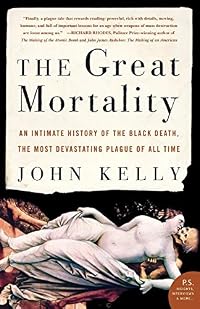
Although I didn't like this as much as Kelly's previous book on the Black Death, The Great Mortality, it was certainly an absorbing read and a sobering one. I hadn't known much about the potato famine before reading this, but it wasn't one of those kind of books where prior knowledge was required to fully understand the text.
The saddest thing of all about the story, I think, is that it wasn't anything evil that doomed the Irish. Contrary to what some people believe, no one was deliberately trying to starve the Irish to death. The British weren't practicing genocide like the Soviets did to Ukraine during the Holodomor. Rather, it was a kind of Hurricane Katrina like situation: the government was trying to help, but it didn't have a clue show more what it was doing and ignorance and self-interest and misplaced priorities prevented any real progress from being made. And so millions died.
Well worth a read for anyone interested in this kind of thing, though I prefer straight-out plagues to famines. show less
The saddest thing of all about the story, I think, is that it wasn't anything evil that doomed the Irish. Contrary to what some people believe, no one was deliberately trying to starve the Irish to death. The British weren't practicing genocide like the Soviets did to Ukraine during the Holodomor. Rather, it was a kind of Hurricane Katrina like situation: the government was trying to help, but it didn't have a clue show more what it was doing and ignorance and self-interest and misplaced priorities prevented any real progress from being made. And so millions died.
Well worth a read for anyone interested in this kind of thing, though I prefer straight-out plagues to famines. show less
Members
- Recently Added By
Published Reviews
ThingScore 75
Kelly intersperses the nitty gritty of the shifting Irish economic situation with horrific glimpses of its human toll ... Recognizing that the British handling of the famine was “parsimonious, short-sighted, grotesquely twisted by religion and ideology” rather than deliberately genocidal is important because while powerful, paranoid, racist madmen like Hitler are relatively rare, our own show more time is replete with men like Trevelyan. ... That version of the story may not be as satisfying dramatically and morally as the one with the evil, homicidal Englishman, but it does do what history does best, which is to show us how not to repeat it. show less
added by lquilter
Author Information

9 Works 2,666 Members
John Kelly specializes in narrative history. He is the author of The Graves Are Walking: The Great Famine and the Saga of the Irish People; The Great Mortality: An Intimate History of the Black Death, the Most Devastating Plague of All Time; Three on the Edge: The Stories of Ordinary American Families in Search of a Medical Miracle; and more. show more Kelly lives in New York City and Sandisfield, Massachusetts. show less
Common Knowledge
- Important events
- Irish Potato Famine (1845 | 1852)
Classifications
Statistics
- Members
- 360
- Popularity
- 87,129
- Reviews
- 14
- Rating
- (3.74)
- Languages
- English
- Media
- Paper, Audiobook, Ebook
- ISBNs
- 13
- ASINs
- 5