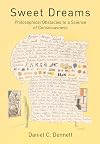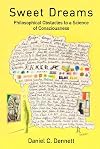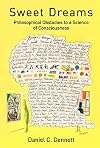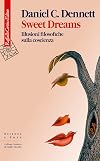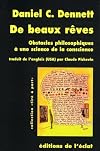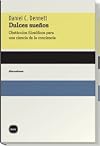
Sweet Dreams: Philosophical Obstacles to a Science of Consciousness
by Daniel C. Dennett
Jean Nicod Lectures (2001)
On This Page
Description
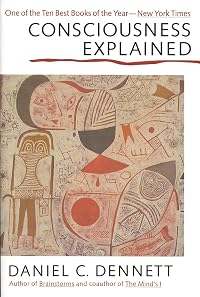
In the years since Daniel Dennett's influential Consciousness Explained was published in 1991, scientific research on consciousness has been a hotly contested battleground of rival theories--"so rambunctious," Dennett observes, "that several people are writing books just about the tumult." With Sweet Dreams, Dennett returns to the subject for "revision and renewal" of his theory of consciousness, taking into account major empirical advances in the field since 1991 as well as recent show more theoretical challenges.In Consciousness Explained, Dennett proposed to replace the ubiquitous but bankrupt Cartesian Theater model (which posits a privileged place in the brain where "it all comes together" for the magic show of consciousness) with the Multiple Drafts Model. Drawing on psychology, cognitive neuroscience, and artificial intelligence, he asserted that human consciousness is essentially the mental software that reorganizes the functional architecture of the brain. In Sweet Dreams, he recasts the Multiple Drafts Model as the "fame in the brain" model, as a background against which to examine the philosophical issues that "continue to bedevil the field."With his usual clarity and brio, Dennett enlivens his arguments with a variety of vivid examples. He isolates the "Zombic Hunch" that distorts much of the theorizing of both philosophers and scientists, and defends heterophenomenology, his "third-person" approach to the science of consciousness, against persistent misinterpretations and objections. The old challenge of Frank Jackson's thought experiment about Mary the color scientist is given a new rebuttal in the form of "RoboMary," while his discussion of a famous card trick, "The Tuned Deck," is designed to show that David Chalmers's Hard Problem is probably just a figment of theorists' misexploited imagination. In the final essay, the "intrinsic" nature of "qualia" is compared with the naively imagined "intrinsic value" of a dollar in "Consciousness--How Much is That in Real Money?" show lessTags
Recommendations






Member Reviews
Essays that are based on Dennett's brilliant "Consciousness Explained" (CE). If you've not read CE, I'd probably suggest not reading this.
Dennett is as prickly and full of insights as ever, but the ground covered is pretty close to CE, so I'm only giving it 3 stars because it lacks novelty.
Dennett is as prickly and full of insights as ever, but the ground covered is pretty close to CE, so I'm only giving it 3 stars because it lacks novelty.
A not-overly-long "revision and renewal" of DCD's view of consciousness. Zombies, qualia, "the hard problem," etc are all (says he) incoherent concepts; heterophenomenology's the thing.
zweert bij het scheermes van ockham, legt duidelijk (maar omslachtig) uit dat iets zich bewust kan zijn van zijn eigen denken, doet lacherig over mensen die daar anders over denken, voert eigenlijk alleen discussie met anderen materialisten, geeft toe (op; 0
It's now available as an ebook on the MIT press portal http://mitpress-ebooks.mit.edu/product/sweet-dreams
Ratings
Members
- Recently Added By
Lists

Falling for Science
56 works; 3 members
Author Information

44+ Works 17,476 Members
Daniel C. Dennett is a University Professor and Austin B. Fletcher Professor of Philosophy at Tufts University and the author of numerous books including Intuition Pumps and Other Tools for Thinking, Breaking the Spell, Darwin's Dangerous Idea, and Consciousness Explained.
Awards and Honors
Awards
Series

Common Knowledge
- Canonical title
- Sweet Dreams: Philosophical Obstacles to a Science of Consciousness
- Original title
- Sweet Dreams: Philosophical Obstacles to a Science of Consciousness
- Original publication date
- 2005
- Original language
- English
Classifications
Statistics
- Members
- 352
- Popularity
- 90,045
- Reviews
- 5
- Rating
- (3.55)
- Languages
- 5 — English, French, German, Italian, Spanish
- Media
- Paper, Ebook
- ISBNs
- 12
- ASINs
- 3