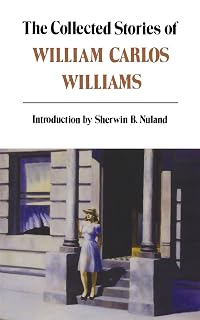
Collected Stories of William Carlos Williams (New Directions Paperbook, Ndp827)
by William Carlos Williams
On This Page
Description
From the Publisher: New Directions has long published poet William Carlos Williams' entire body of short fiction as The Farmers' Daughters (1961). This new edition of The Collected Stories of William Carlos Williams contains all fifty-two stories combining the early collections The Knife of the Times (1932), Life Along the Possaic (1938) with the later collection Make Light of It (1950) and the great long story, "The Farmers' Daughters" (1956). When these stories first appeared, their show more vitality and immediacy shocked many readers, as did the blunt, idiosyncratic speech of Williams' immigrant and working-class characters. But the passage of time has silenced the detractors, and what shines in the best of these stories is the unflinching honesty and deep humanity of Williams' portraits, burnished by the seeming artlessness which only the greatest masters command. show lessTags
Recommendations


Member Reviews
Beautiful stories written with an ear towards capturing the vernacular. Many of these brief tales are plotless dialogues exploring a turn of phrase. WCW was a true radical and I don't think we've yet caught up with him.
Ratings
Members
- Recently Added By
Author Information

Poet, artist, and practicing physician of Rutherford, New Jersey, William Carlos Williams wrote poetry that was experimental in form, ranging from imagism to objectivism, with great originality of idiom and human vitality. Credited with changing and directing American poetry toward a new metric and language, he also wrote a large number of short show more stories and novels. Paterson (1946--58), about the New Jersey city of that name, was his epic and places him with Ezra Pound of the Cantos as one of the great shapers of the long poem in this century. National recognition did not come early, but eventually Williams received many honors, including a vice-presidency of the National Institute of Arts and Letters (1952); the Bollingen Prize (1953); the $5,000 fellowship of the Academy of American Poets; the Loines Award for poetry of the National Institute of Arts and Letters (1948); and the Brandeis Award (1957). Book II of Paterson received the first National Book Award for poetry in 1949. Williams was named consultant in poetry in English to the Library of Congress for 1952--53. Williams's continuously inventive style anchored not only objectivism, the school to which he most properly belongs, but also a long line of subsequent poets as various as Robert Lowell, Frank O'Hara, and Allen Ginsberg. With Stevens, he forms one of the most important sources of a specifically American tradition of modernism. In addition to his earlier honors, Williams received two important awards posthumously, the Pulitzer Prize for Poetry (1963) and the Gold Medal for Poetry from the National Institute of Arts and Letters (1963). (Bowker Author Biography) show less
Some Editions
Classifications
Statistics
- Members
- 77
- Popularity
- 411,825
- Reviews
- 1
- Rating
- (3.88)
- Languages
- English
- Media
- Paper
- ISBNs
- 2