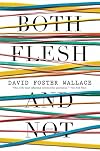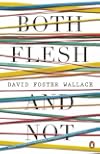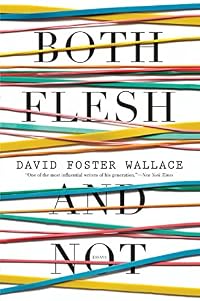
Both Flesh and Not: Essays
by David Foster Wallace 
On This Page
Description
"Both Flesh and Not" gathers fifteen of Wallace's seminal essays, all published in book form for the first time. Never has Wallace's seemingly endless curiosity been more evident than in this compilation of work spanning nearly 20 years of writing. Here, Wallace turns his critical eye with equal enthusiasm toward Roger Federer and Jorge Luis Borges; "Terminator 2" and "The Best of the Prose Poem"; the nature of being a fiction writer and the quandary of defining the essay; the best show more underappreciated novels and the English language's most irksome misused words; and much more. "Both Flesh and Not" restores Wallace's essays as originally written, and it includes a selection from his personal vocabulary list, an assembly of unusual words and definitions. show lessTags
Recommendations




Member Reviews
Maybe it's just me, but the DFW of this book seems more bitter and tendentious than in other works. Maybe that's the price of prophecy. Maybe he was always condescending and I can see it only now. One reason for the bitterness is that many of the entries in the book are reviews, and you better believe that this guy hasn't chosen to review something unless he has a serious bone to pick, a problem that extends beyond the text in question to spar with. This tendency leads to the most surprising and insightful work, and the most unfair. Both of these qualities abound in the prose poem anthology review, and it's infuriating to read. He excoriates the writer of the forward of that anthology as amateurish, proclaims that over 70% of the poems show more were forgettable trash, while deconstructing both the word-limited review genre, and the prose-poem genre. The review is in bullet point form. It's brilliant, but with a nose turned up at an extreme angle.
Deciderization 2007 and Democracy and Commerce at the US open both deal with the overwhelming Total Noise of modern experienced reality. In "deciderization" he finds a metaphor for a contemporary person's reliance on information arbiters (else face circuit overload) in his own duties as editor of Best American Essays, which are to subjectively winnow down an already winnowed pile of essays. In D.A.C. he rummages through this information overload, shows the callous spirit it engenders.
I can't do much by way of explanation of what DFW is all about; you'll have to read him yourself. I'm mostly writing this review for myself. If you must start with this collection, do so, but be warned: be on guard as a reader. And try your best not to skip stuff where it looks like he's spinning his wheels. Being a maximalist has its dangers, and they come out here, but it also has his delights. Ok, you can skip the review of Wittgenstein's Mistress, an avant garde novel about living in a world of atomized logic (I didn't get 90% of it, but maybe you'll fare better)
All told, this isn't his best work (with a few exceptions, especially the federer piece and the "deciderization" essay-- those are required reading). It consists of those pieces that the writer did not get around to collecting in book form during his life. I defy you, however, to find a writer with as strong of a reject pile. show less
Deciderization 2007 and Democracy and Commerce at the US open both deal with the overwhelming Total Noise of modern experienced reality. In "deciderization" he finds a metaphor for a contemporary person's reliance on information arbiters (else face circuit overload) in his own duties as editor of Best American Essays, which are to subjectively winnow down an already winnowed pile of essays. In D.A.C. he rummages through this information overload, shows the callous spirit it engenders.
I can't do much by way of explanation of what DFW is all about; you'll have to read him yourself. I'm mostly writing this review for myself. If you must start with this collection, do so, but be warned: be on guard as a reader. And try your best not to skip stuff where it looks like he's spinning his wheels. Being a maximalist has its dangers, and they come out here, but it also has his delights. Ok, you can skip the review of Wittgenstein's Mistress, an avant garde novel about living in a world of atomized logic (I didn't get 90% of it, but maybe you'll fare better)
All told, this isn't his best work (with a few exceptions, especially the federer piece and the "deciderization" essay-- those are required reading). It consists of those pieces that the writer did not get around to collecting in book form during his life. I defy you, however, to find a writer with as strong of a reject pile. show less
I love DFW's prose. Is this the best DFW collection? No. Had I read some of these pieces before? Yep. Was it still a transcendent reading experience? Absolutely. Bonus points for his decision to take down critic/writer Bruce Bawer with whom I have a personal and philosophical dispute, but it would have been a 5 star read in any event.
Foster Wallace’s last essay collection is, of necessity, weaker than his previous two. Those had the luxury of cherry picking his finest work to the point at which they were published. Both Flesh And Not is therefore left to round up odd pieces and pieces published before his death. This means it’s far less even than its predecessors, things as brief and not particularly revelatory as ‘Mr Cogito’ and ‘Overlooked’ don’t add much insight to either the author or the wider world. But these are only slight works, bagatelles. Instead, when he has the space to dazzle we have the semi-eponymous essay about the beauty of Roger Federer’s tennis, one of his finest works, an essay on the first two Terminator films which explains a show more lot about the state of modern film making (even in the present day) and essays reviewing a Borges biography (which explains Borges’ greatness and the idiocy of much literary biography) and an introductory essay to the Best American Essays of 2007. What these have in common is showing off what made him a great modern essayist – a breadth of knowledge, sly humour and command of the English language few writers can parallel. Not a flawless collection then, but as what flaws there are arise from circumstance and editorial decisions they don’t reflect on the author. Banality there may be in places, but it’s far outweighed by the author’s typical casual brilliance. show less
As ever with DFW's non-fiction, if you're not familiar with or fond of his subject material the essays can be a little overwhelming - but when interests overlap with your own, this is sparkling,
Wallace loved tennis, and his essay here about Roger Federer is the finest piece of tennis-related prose I've ever read. It's also one of the best sport-related pieces ever, on a more general note, and even if you don't like sport you'll find this all rather enthralling.
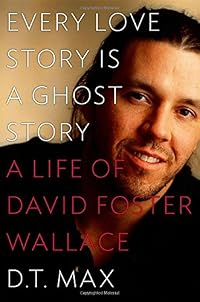
A lot of material has come out since DFWs death, an unfinished novel, this book of essays, a couple of collections of essays talking about Wallace (essentially working to canonize him), the long interview material from Lipsky and the bio by D.T. Max.
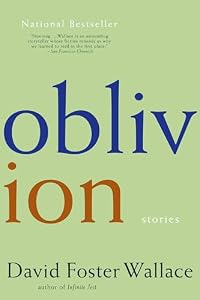
I’d like to think that much of this isn’t specifically a cash-grab or an attempt at canonization but I can’t be sure. Have I bought most of this stuff? Yes I have. Does that make me a sucker, an uber-fan, a fool? I don’t rightly know. I think that maybe I’ve bought all of these books so it feels like he’s still with us, that he didn’t do the bad thing in 2008. I have also found it much easier to read ancillary this stuff than the dwindling works of Wallace’s I’ve not yet show more read (Oblivion, mostly).
This collection here seems rather uneven, at times Wallace’s humor and brilliance is on full display while at others it can kind of feel like scraping the bottom of the barrel. The highlights for me were the title essay, the US Open piece and the piece on Terminator 2. While I really enjoyed 24 Word Notes it seems somewhat absurd that they were pulled from the Oxford American Writer’s Thesaurus for printing here. Overall, I’m going to rate this collection somewhere in the 2.5-3 star range. I wish I could rate it higher, and I wish I wasn't able to see the end of Wallace’s oeuvre on the horizon.
I also kind of wish i didn't just use the word oeuvre. show less
I’d like to think that much of this isn’t specifically a cash-grab or an attempt at canonization but I can’t be sure. Have I bought most of this stuff? Yes I have. Does that make me a sucker, an uber-fan, a fool? I don’t rightly know. I think that maybe I’ve bought all of these books so it feels like he’s still with us, that he didn’t do the bad thing in 2008. I have also found it much easier to read ancillary this stuff than the dwindling works of Wallace’s I’ve not yet show more read (Oblivion, mostly).
This collection here seems rather uneven, at times Wallace’s humor and brilliance is on full display while at others it can kind of feel like scraping the bottom of the barrel. The highlights for me were the title essay, the US Open piece and the piece on Terminator 2. While I really enjoyed 24 Word Notes it seems somewhat absurd that they were pulled from the Oxford American Writer’s Thesaurus for printing here. Overall, I’m going to rate this collection somewhere in the 2.5-3 star range. I wish I could rate it higher, and I wish I wasn't able to see the end of Wallace’s oeuvre on the horizon.
I also kind of wish i didn't just use the word oeuvre. show less
Love the essay on Federer. Foster is a gifted writer. He captures well elements of the beauty of the game of tennis. I especially like his thoughts on what it is to be a creature of flesh, the mystery and the limitations.
Members
- Recently Added By
Author Information

88+ Works 47,599 Members
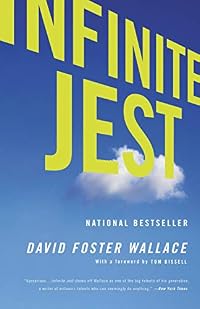
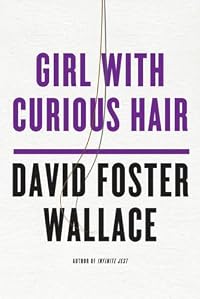
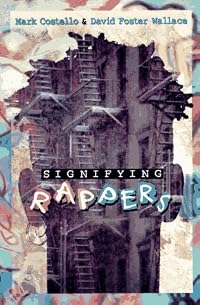
Writer David Foster Wallace was born in Ithaca, New York on February 21, 1962. He received a B.A. from Amherst College in Massachusetts. He was working on his master's degree in creative writing at the University of Arizona when he published his debut novel The Broom of the System (1987). Wallace published his second novel Infinite Jest (1996) show more which introduced a cast of characters that included recovering alcoholics, foreign statesmen, residents of a halfway house, and high-school tennis stars. He spent four years researching and writing this novel. His first collection of short stories was Girl with Curious Hair (1989). He also published a nonfiction work titled Signifying Rappers: Rap and Race in the Urban Present. He committed suicide on September 12, 2008 at the age of 46 after suffering with bouts of depression for 20 years. (Bowker Author Biography) show less
David Foster Wallace has a Legacy Library. Legacy libraries are the personal libraries of famous readers, entered by LibraryThing members from the Legacy Libraries group.
Some Editions
Common Knowledge
- Original publication date
- 2012
Classifications
Statistics
- Members
- 948
- Popularity
- 27,834
- Reviews
- 15
- Rating
- (3.68)
- Languages
- English, Italian, Spanish
- Media
- Paper, Audiobook, Ebook
- ISBNs
- 19
- ASINs
- 8