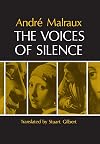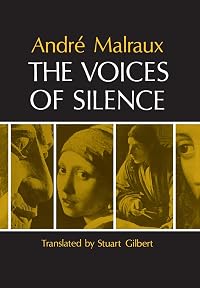
The Voices of Silence
by Andre Malraux
Le musée imaginaire / André Malraux (Collections and Selections — 19 51, 1/1)
On This Page
Description
The description for this book, The Voices of Silence: Man and his Art. (Abridged from The Psychology of Art), will be forthcoming.Tags
Recommendations















Member Reviews
Members
- Recently Added By
Published Reviews
ThingScore 63
A great spokesman for the French intelligence, an inexhaustible provider of formulations, Malraux is not a master of exposition. The consecutive and lucid unrolling of smoothly spun-out ideas is something you will not find in Psychologie de I’Art. Though Malraux tries to disentangle his argument and to make his main points in some logical order, all the painters and all the periods seem to show more be trying to crowd into his pages at once, proposing unexpected comparisons and curious observations. His paragraphs and even his sentences become sometimes so dogged and allusive that one finds them rather hard to follow...
This survey is so exciting, shows such an immense grasp of its subject in its great contours and its concrete detail, that one is swept by it through snags and opacities. You have not only extended studies of the most important schools of art but also picture-by-picture accounts of the careers of certain important painters. show less
This survey is so exciting, shows such an immense grasp of its subject in its great contours and its concrete detail, that one is swept by it through snags and opacities. You have not only extended studies of the most important schools of art but also picture-by-picture accounts of the careers of certain important painters. show less
added by SnootyBaronet
When I read Malraux I know that his observation in matters concerning the visual arts must necessarily be defective. It would be natural to him to suppose that a painter was (like himself) fired by politics, when this painter was, in reality, 'mad about drawing', as was Hokusai, or mad about certain combinations of black and white, as was one of Malraux's favourites, Franz Hals...
Malraux show more analyses very well the art-scene of our time. He groups primitivism (African, Sumerian, etc.), infantilism, the art of the lunatic, as well as that of the Child. He sees the diabolic principle inhering in the grouping. I could not, myself, have dissected with more understanding the major impetus responsible for much of the painting, sculpture, and design in our time. God is dead, Sartre asserts; and so does Malraux. But the latter perceives the Devil brought in by some of the contemporary artists and he applauds the coming back into currency of the diabolic. show less
Malraux show more analyses very well the art-scene of our time. He groups primitivism (African, Sumerian, etc.), infantilism, the art of the lunatic, as well as that of the Child. He sees the diabolic principle inhering in the grouping. I could not, myself, have dissected with more understanding the major impetus responsible for much of the painting, sculpture, and design in our time. God is dead, Sartre asserts; and so does Malraux. But the latter perceives the Devil brought in by some of the contemporary artists and he applauds the coming back into currency of the diabolic. show less
added by SnootyBaronet
Lists

Harold Bloom - The Western Canon: D. The Chaotic Age
833 works; 24 members

Books Referenced by Izetbegovic's Islam Between East and West
233 works; 2 members

Mustich's 1000 Books to Read Before You Die: A Life Changing List
1,001 works; 19 members
Author Information

192+ Works 6,598 Members
Andre (Georges) Malraux, 1901- 1976 French novelist Andre Malraux was born in Paris to a wealthy family. His father was Fernand-Georges Malraux, a stockbroker, and his mother was Berthe (Lamy) Malraux. He attended the Lycee Condorcet and studied oriental languages at the Ecole des Langues Orientales. His parents separated when he was a child, and show more his mother brought him up. His father committed suicide in 1930. Malraux was also considered an adventurer, art historian, and statesman. He was the Minister for Cultural Affairs for eleven years from 1958-1969. He worked as an art editor at Gallimard publishers in Paris. He attended archaeological expeditions in Iran and Afghanistan. At the age of twenty-one, Malraux went to Cambodia with his wife, writer Clara Goldsmidt, where he was imprisoned for taking bas-reliefs from a Khmer temple. In 1925, he went to Saigon and joined the anti-colonial Young Annam League. In World War II, Malraux served in a French tank Unit. He was wounded and captured, but he managed to escape and join the Resistance where he met General Charles de Gaulle. He escaped a second capture in 1944 and received the Medaille de la Resistance, the Croix de Guerre and the British Distinguished Service Order for his service. Malraux's short novel "Le Temps De Mapris" (1935), tells the story of a Communist who's held prisoner in a Nazi concentration camp. In the Spanish Civil War, Malraux fought for the Republicans (1936-1939). He was wounded twice in the effort to stop Franco's advance on Madrid. His novel "L'Espoir" (1937) tells of Republican Spain in combat. This was also adapted for the screen in 1938 and the film was titled Sierrade Teruel. After "L'Espoir", Malraux divorced and had a liaison with Josette Clotis. She died in a railroad accident in 1945. At this time, Malraux broke from communism and began writing non-fiction. In 1948, Malrauxe married Marie-Madeline Lioux, a concert pianist and widow of his half-brother. In 1961, he lost his two sons in an accident. In 1958, when de Gaulle came to power, he was appointed first Minister of Information and then, a year later, Minister of State for Cultural Affairs. In 1967, Malraux's autobiography "Anti-Memoires" was published. In it, Malraux mixed fact with fiction and excerpts from his novels. Later volumes of his personal recollections involved Pablo Picasso, Leopold Sedar Senghor and de Gaulle. In "Felled Oaks" (1971), Malraux tells of his conversations with de Gaulle, his political idol. After leaving politics, Malraux retired to a suburb of Paris and continued to write until his death on November 23, 1976. (Bowker Author Biography) show less
Some Editions
Awards and Honors
Distinctions
Notable Lists
Series

Belongs to Publisher Series
Work Relationships
Common Knowledge
- Canonical title*
- Les Voix du silence
- Original title
- Les Voix du silence
- Original publication date
- 1947-1949 (1e édition originale, Albert Skira, Genève, Suisse) (1e édition originale, Albert Skira, Genève, Suisse); 1951 (1e édition compilée, revue et augmentée, La galerie de la Pléiade, Gallimard) (1e édition compilée, revue et augmentée, La galerie de la Pléiade, Gallimard)
- Original language*
- Français
*Some information comes from Common Knowledge in other languages. Click "Edit" for more information.
Classifications
Statistics
- Members
- 390
- Popularity
- 80,109
- Rating
- (3.79)
- Languages
- English, French, Italian, Portuguese
- Media
- Paper
- ISBNs
- 7
- ASINs
- 17