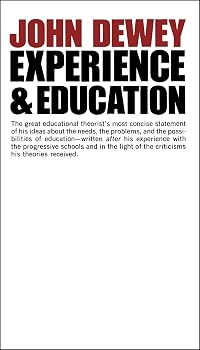
Experience and Education
by John Dewey
On This Page
Description
Experience and Education is the best concise statement on education ever published by John Dewey, the man acknowledged to be the pre-eminent educational theorist of the twentieth century. Written more than two decades after Democracy and Education (Dewey's most comprehensive statement of his position in educational philosophy), this book demonstrates how Dewey reformulated his ideas as a result of his intervening experience with the progressive schools and in the light of the criticisms his show more theories had received. Analyzing both "traditional" and "progressive" education, Dr. Dewey here insists that neither the old nor the new education is adequate and that each is miseducative because neither of them applies the principles of a carefully developed philosophy of experience. Many pages of this volume illustrate Dr. Dewey's ideas for a philosophy of experience and its relation to education. He particularly urges that all teachers and educators looking for a new movement in education should think in terms of the deeped and larger issues of education rather than in terms of some divisive "ism" about education, even such an "ism" as "progressivism." His philosophy, here expressed in its most essential, most readable form, predicates an American educational system that respects all sources of experience, on that offers a true learning situation that is both historical and social, both orderly and dynamic. show lessTags
Recommendations



Member Reviews
This book is a concise statement about the necessity of basing education on the learner's experience and on creating opportunities for learners to reorganize or reimagine their experiences and connect those experiences with others. Learning is not a virtue on its own unless it is guided by educational policy that is, in turn, guided by an appropriate theory of experience. Dewey's thoughts on experience are that it builds over time, and each new experience creates new surface area for building additional experience. Education is about cultivating this experiential learning but also directing it and coordinating with the experiences of others, across situations.
Interesting read in the 21st century. Many of the ideas seem pertinent and show more still, frustratingly, out of reach. There are also important implications here for issues like curriculum design but also for how we understand the role of educators and what it means to hold them accountable for education. show less
Interesting read in the 21st century. Many of the ideas seem pertinent and show more still, frustratingly, out of reach. There are also important implications here for issues like curriculum design but also for how we understand the role of educators and what it means to hold them accountable for education. show less
The popularity of John Dewey, American pragmatist philosopher and education reformer, has largely waned. But during his 90+ years of life, he was one of the most famous public intellectuals alive, teaching at Columbia University. But now he is mostly cited in education circles, perhaps more than he is read, and apart from the Center for Dewey Studies at Southern Illinois University, is largely ignored by the academic philosophy establishment. You won’t find his books at Barnes and Noble very often.
What happened?
I first encountered Dewey after William James, that other famous American pragmatist. Dewey’s book [The Quest for Certainty], his review of the history of philosophy, was not the most lively book but it made good points. show more Pragmatism, the only truly Yankee school of philosophy, stresses the import of thought for action, the practical consequences of philosophical concepts. Rather than the abstract debates over a priori knowledge of metaphysical entities that characterizes Western philosophy, pragmatists called for philosophy to be more like science: more oriented on process, on action. Dewey, who began his career as a Hegelian, extended Peirce’s and James’ thought further. For Dewey, there is no such thing as certainty about entities that exist prior to all experience. Concepts arise from experience and are meaningless unless they bear fruit for experience. This radically recasts or destroys traditional philosophical debates such as free will, the existence of God, and the mind-body problem.
Which brings me to this book. I really enjoyed this book, because Dewey’s points about education are so applicable to my life. Dewey contrasts two modes of education. One, the traditional mode, is based on transmitting static cultural knowledge to largely passive pupils. The “progressive” mode instead seeks to teach not content, but critical thinking; not the knowledge of the past, but the ability to think critically on experiences in the present and future; not information in books but information gained from communities of inquiry and practice. One mode pictures the teacher as a godlike authority, leading the ignorant students to truth, while the other sees the teacher as more of a facilitator. Dewey does not provide examples, but one from my experience will suffice. I spent one year in a high school where science was taught in this “progressive” way. We did lots of fun experiments, but I still can’t tell you some of the basic scientific facts I should have learned, and my preparation for later science courses was subpar.
What’s the rub? Despite his identification with the progressive school of thought, Dewey argues that some moderation is needed. For him, the goal of education is “self-control,” which requires a certain amount of external (teacher) control to inculcate the ability to discipline one’s thoughts and think critically. One of education’s other main goals, the ability to think critically about experience, requires that we at least learn something about the wisdom of the past, insofar as it applies to experiences we will have in the future. So history is not entirely out the window. So education needs to find a middle way between student caprice and teacher control, with a teacher who is not given strict templates of what to teach (standardized testing!) but an ability to adapt content and methods to the students at hand.
One of Dewey’s other main points is that knowledge is not really book-learning, confined to the domain of school then forgotten once the student has moved on from that domain. Knowledge takes place in communities of inquiry. For example, rather than read about archaeological artifacts from the past, students should see the digs, go to the museums, see archaeology at work rather than fossilizing learning. In education systems where learning is done via books and exams – solitary activities – the learning becomes fossilized. One wonders whether online education has made this better or worse.
Dewey died in the 1940s, but his urge to rethink education in a rapidly changing world is more true than ever. For example, he makes the point that those who teach children are older. The knowledge they have needed to make sense of experience may not apply to their students. At my university, the computer science majors aren’t taught Fortran and Pascal; hell, they aren’t taught many software programs at all. Instead they learn theoretical computer science, the principles behind software problem-solving and program design. This ensures that their degree will still be useful in decades to come when even C++ and Java are no longer in vogue.
So I would read this short book. It may be somewhat dated on the debates, but it’s written by a master, the man whom the New York Times deemed “America’s philosopher” on his 90th birthday. It lays out some commonsense but often unrealized or polarized terms for analyzing one’s own schooling. Although philosophy of education gets little attention in philosophy departments now, it is a problem that concerned Plato himself.
(Note: I listened to the audio version on audible. I enjoyed this book, but it was very dense for an audiobook, perhaps too much so. show less
What happened?
I first encountered Dewey after William James, that other famous American pragmatist. Dewey’s book [The Quest for Certainty], his review of the history of philosophy, was not the most lively book but it made good points. show more Pragmatism, the only truly Yankee school of philosophy, stresses the import of thought for action, the practical consequences of philosophical concepts. Rather than the abstract debates over a priori knowledge of metaphysical entities that characterizes Western philosophy, pragmatists called for philosophy to be more like science: more oriented on process, on action. Dewey, who began his career as a Hegelian, extended Peirce’s and James’ thought further. For Dewey, there is no such thing as certainty about entities that exist prior to all experience. Concepts arise from experience and are meaningless unless they bear fruit for experience. This radically recasts or destroys traditional philosophical debates such as free will, the existence of God, and the mind-body problem.
Which brings me to this book. I really enjoyed this book, because Dewey’s points about education are so applicable to my life. Dewey contrasts two modes of education. One, the traditional mode, is based on transmitting static cultural knowledge to largely passive pupils. The “progressive” mode instead seeks to teach not content, but critical thinking; not the knowledge of the past, but the ability to think critically on experiences in the present and future; not information in books but information gained from communities of inquiry and practice. One mode pictures the teacher as a godlike authority, leading the ignorant students to truth, while the other sees the teacher as more of a facilitator. Dewey does not provide examples, but one from my experience will suffice. I spent one year in a high school where science was taught in this “progressive” way. We did lots of fun experiments, but I still can’t tell you some of the basic scientific facts I should have learned, and my preparation for later science courses was subpar.
What’s the rub? Despite his identification with the progressive school of thought, Dewey argues that some moderation is needed. For him, the goal of education is “self-control,” which requires a certain amount of external (teacher) control to inculcate the ability to discipline one’s thoughts and think critically. One of education’s other main goals, the ability to think critically about experience, requires that we at least learn something about the wisdom of the past, insofar as it applies to experiences we will have in the future. So history is not entirely out the window. So education needs to find a middle way between student caprice and teacher control, with a teacher who is not given strict templates of what to teach (standardized testing!) but an ability to adapt content and methods to the students at hand.
One of Dewey’s other main points is that knowledge is not really book-learning, confined to the domain of school then forgotten once the student has moved on from that domain. Knowledge takes place in communities of inquiry. For example, rather than read about archaeological artifacts from the past, students should see the digs, go to the museums, see archaeology at work rather than fossilizing learning. In education systems where learning is done via books and exams – solitary activities – the learning becomes fossilized. One wonders whether online education has made this better or worse.
Dewey died in the 1940s, but his urge to rethink education in a rapidly changing world is more true than ever. For example, he makes the point that those who teach children are older. The knowledge they have needed to make sense of experience may not apply to their students. At my university, the computer science majors aren’t taught Fortran and Pascal; hell, they aren’t taught many software programs at all. Instead they learn theoretical computer science, the principles behind software problem-solving and program design. This ensures that their degree will still be useful in decades to come when even C++ and Java are no longer in vogue.
So I would read this short book. It may be somewhat dated on the debates, but it’s written by a master, the man whom the New York Times deemed “America’s philosopher” on his 90th birthday. It lays out some commonsense but often unrealized or polarized terms for analyzing one’s own schooling. Although philosophy of education gets little attention in philosophy departments now, it is a problem that concerned Plato himself.
(Note: I listened to the audio version on audible. I enjoyed this book, but it was very dense for an audiobook, perhaps too much so. show less
This is a stub.
Incredible.
The gist of the book is that it wants to negotiate meaningful differences between the philosophy of traditional schools on the one hand, and new “progressive” schools on the other. Dewey pushes back against a tendency in progressive schools’ nascent ideologies to position themselves as against the traditional schools; that is, progressive schools see themselves as whatever traditional schools aren’t, and as such apply value to being opposed to something for its own sake. And what Dewey wants to nip this tendency in the bud and explore what aspects of progressive schooling (free exploration, self-starting, teacher-as-facilitator) are valuable, not because of their position opposite some other practice, show more but on their own. He does this by highlighting how experience is the fundament of education, and one only learns and is educated when one’s experience improves both one’s current knowledge, and one’s future ability to learn and use that knowledge, and ideally, for the benefit of the people.
Dewey walks this line between liberal idealist and someone who really does believe that democracy is the best way to access each person’s individual will and apply that will to the collective for the better, because the causal power of the action resultant from a democratic choice is better. It’s reflective of the will of the group. It may not always be the best choice in the end. But it’s not all ends and means; we can’t chunk experience like that. Means are ends are means. Means are today’s ends, and so on.
This is pretty poorly explained, but this does get at what he’s talking about when he talks about education and experience and democracy. I need to learn more, have it be presented in a systematized and direct way, because he is sometimes hard to nail down in summary. But one thing I should be doing more of is summarizing the writers I’m after, and not be scared to get it wrong. show less
Incredible.
The gist of the book is that it wants to negotiate meaningful differences between the philosophy of traditional schools on the one hand, and new “progressive” schools on the other. Dewey pushes back against a tendency in progressive schools’ nascent ideologies to position themselves as against the traditional schools; that is, progressive schools see themselves as whatever traditional schools aren’t, and as such apply value to being opposed to something for its own sake. And what Dewey wants to nip this tendency in the bud and explore what aspects of progressive schooling (free exploration, self-starting, teacher-as-facilitator) are valuable, not because of their position opposite some other practice, show more but on their own. He does this by highlighting how experience is the fundament of education, and one only learns and is educated when one’s experience improves both one’s current knowledge, and one’s future ability to learn and use that knowledge, and ideally, for the benefit of the people.
Dewey walks this line between liberal idealist and someone who really does believe that democracy is the best way to access each person’s individual will and apply that will to the collective for the better, because the causal power of the action resultant from a democratic choice is better. It’s reflective of the will of the group. It may not always be the best choice in the end. But it’s not all ends and means; we can’t chunk experience like that. Means are ends are means. Means are today’s ends, and so on.
This is pretty poorly explained, but this does get at what he’s talking about when he talks about education and experience and democracy. I need to learn more, have it be presented in a systematized and direct way, because he is sometimes hard to nail down in summary. But one thing I should be doing more of is summarizing the writers I’m after, and not be scared to get it wrong. show less
This is a fabulous nutshell of a book that captures the essential of John Dewey's pragmatist take on education. Even though it was written in the 1930s, it offers so much for those of us involved in public education today. Arne Duncan and Barak Obama should read this right away!
Being a younger teacher and rather liberal by nature, I have already learned, experienced, and practiced much of what Dewey had to say in this text. But after reading this text, I better understand much of my more confused and chaotic philosophy.
For me the foundation of the text and the philosophy is the concept that students need to develop knowledge through experience, to have some control over their learning, and to not be subjected to the traditional "teacher as repository of knowledge" form of education. I have always agreed with this, but after teaching for a few years, I found the often-touted alternate of complete student freedom completely impractical. Luckily, in Experience and Education, Dewey continually stresses the show more importance of not fleshing out the progressive philosophy of education in reaction against the traditional. He argues that an educational philosophy needs to build upon itself and its own ideas and not just be a negative of the philosophy which came before. In this light, Dewey has the instructor as a participant and facilitator in the educational process, not as an observer.
Okay so maybe a review of the actual book instead of my thoughts on the ideas within it.... I found the text well organized and the ideas within it easily accessible due to the use of real life analogies. This is not your impractical, overly wordy, impossible to comprehend statement of philosophy. In keeping with his philosophy of education, Dewey uses recognizable experiences of the reader to instruct the reader.
If you are an educator, a student, a parent, or just interested in education, I highly recommend this book. show less
For me the foundation of the text and the philosophy is the concept that students need to develop knowledge through experience, to have some control over their learning, and to not be subjected to the traditional "teacher as repository of knowledge" form of education. I have always agreed with this, but after teaching for a few years, I found the often-touted alternate of complete student freedom completely impractical. Luckily, in Experience and Education, Dewey continually stresses the show more importance of not fleshing out the progressive philosophy of education in reaction against the traditional. He argues that an educational philosophy needs to build upon itself and its own ideas and not just be a negative of the philosophy which came before. In this light, Dewey has the instructor as a participant and facilitator in the educational process, not as an observer.
Okay so maybe a review of the actual book instead of my thoughts on the ideas within it.... I found the text well organized and the ideas within it easily accessible due to the use of real life analogies. This is not your impractical, overly wordy, impossible to comprehend statement of philosophy. In keeping with his philosophy of education, Dewey uses recognizable experiences of the reader to instruct the reader.
If you are an educator, a student, a parent, or just interested in education, I highly recommend this book. show less
John Dewey is one of the most influential philosophers of our time: he has a broad scope of knowledge and depth that becomes the ken of philosophy’s architecture. What we see in Education and Experience is a far ranging longitude where the unfathomable becomes forthright. In education we see that John Dewey extrapolates the importance of self-exploration. Like many more modernized institutions of education we see a more voluble form of stance that allows students to learn in a more elucidating way.
Excellent content, but I found Dewey's writing style heavy going.
Members
- Recently Added By
Lists

1930s
262 works; 5 members

Maybe This Year? Books to Look Forward To
412 works; 9 members

Books Read in 2026
2,055 works; 68 members
Author Information

244+ Works 9,983 Members
John Dewey was born in 1859 in Burlington, Vermont. He founded the Laboratory School at the University of Chicago in 1896 to apply his original theories of learning based on pragmatism and "directed living." This combination of learning with concrete activities and practical experience helped earn him the title, "father of progressive education." show more After leaving Chicago he went to Columbia University as a professor of philosophy from 1904 to 1930, bringing his educational philosophy to the Teachers College there. Dewey was known and consulted internationally for his opinions on a wide variety of social, educational and political issues. His many books on these topics began with Psychology (1887), and include The School and Society (1899), Experience and Nature (1925), and Freedom and Culture (1939).Dewey died of pneumonia in 1952. (Bowker Author Biography) show less
Some Editions
Series
Belongs to Publisher Series
Common Knowledge
- Canonical title
- Experience and Education
- Original publication date
- 1938
- First words
- Mankind likes to think in terms of extreme opposites.
- Quotations
- The only freedom that is of enduring importance is freedom of intelligence, that is to say, freedom of observation and of judgement exercised in behalf of purposes that are intrinsically worth while.
Classifications
Statistics
- Members
- 1,137
- Popularity
- 22,244
- Reviews
- 13
- Rating
- (3.76)
- Languages
- 7 — Danish, Dutch, English, Icelandic, Italian, Portuguese, Spanish
- Media
- Paper, Ebook
- ISBNs
- 13
- ASINs
- 10