Three Parts Dead
by Max Gladstone
Craft Sequence: Publication Order (1), Craft Sequence: Chronological Order (3)
On This Page
Description
"A god has died, and it's up to Tara, first-year associate in the international necromantic firm of Kelethres, Albrecht, and Ao, to bring Him back to life before His city falls apart. Her client is Kos, recently deceased fire god of the city of Alt Coulumb. Without Him, the metropolis's steam generators will shut down, its trains will cease running, and its four million citizens will riot. Tara's job: resurrect Kos before chaos sets in. Her only help: Abelard, a chain-smoking priest of the show more dead god, who's having an understandable crisis of faith. When Tara and Abelard discover that Kos was murdered, they have to make a case in Alt Coulumb's courts--and their quest for the truth endangers their partnership, their lives, and Alt Coulumb's slim hope of survival. Set in a phenomenally built world in which justice is a collective force bestowed on a few, craftsmen fly on lightning bolts, and gargoyles can rule cities, Three Parts Dead introduces readers to an ethical landscape in which the line between right and wrong blurs. "-- show lessTags
Recommendations
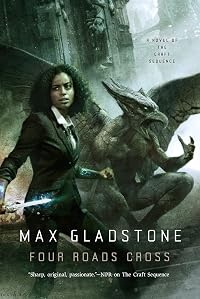
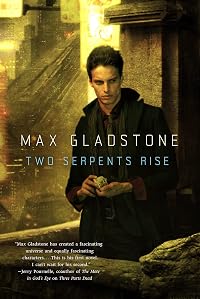



Member Recommendations
Member Reviews
Oh, hell yeah, this rules. Somehow it hit a lot of things I wanted and didn't know I wanted - a noir aesthetic, a great cast of characters, and an amazing set of theological rules that blew me away. (I love a good interpretation of how gods work - it's why [book:Small Gods|20179902] is my favourite Discworld so far.) Once I got past my usual "new book slump," I ate this novel up. Definitely felt written for me - give me more! Four and a half stars.
Gladstone writes vividly imagined, high magic weird fantasy. Think China Mieville in a pinstripe suit instead of a Che Guevara t-shirt. In a world where magic works like the legal system, a god has been murdered and it's up to expelled student and newly minted mage Tara Abernathy to get to the bottom of things before all contracts are due on the New Moon; that is if she survives a deadly duel between her new mentor and her last mentor, both sorcerers well on their way to lichdom, and playing political games three layers deep.
The action positively hurtles along, featuring a supporting cast of a technician-priest, a cop addicted to vampire bites, and gargoyles in love with a dead moon goddess. High level intrigue flows in all directions, show more and Tara is a pleasing combination of decisive and out-of-her-depth, knowing just enough to get into a lot of trouble, and trusting that her wits will get her out. Modern fantasy isn't really my jam, but this is great. show less
The action positively hurtles along, featuring a supporting cast of a technician-priest, a cop addicted to vampire bites, and gargoyles in love with a dead moon goddess. High level intrigue flows in all directions, show more and Tara is a pleasing combination of decisive and out-of-her-depth, knowing just enough to get into a lot of trouble, and trusting that her wits will get her out. Modern fantasy isn't really my jam, but this is great. show less
Tara Abernathy, recent graduate and worker of Craft (basically magic, but with more than a whiff of necromancy), begins working for Elayne Kavarian, who brings her to the city of Alt Coulumb where a God, Kos, has died. She must use all her ingenuity to figure out what really happened, alongside the priest, Abelard, who was there when Kos expired.
The intricate world-building from the rules of magic to the role of divinity in everyday life is the main strength of this book, the first in a series. The pacing stays fast, switching perspectives often between the main players who are in different places investigating the death of Kos, and of a judge, and constantly having the reader guess who they can trust. The characters could be more show more fleshed out, and it was a little on the violent side for me. But the genreblend of fantasy and legal drama worked really well, the ending was satisfying, and I'd be willing to continue the series. show less
The intricate world-building from the rules of magic to the role of divinity in everyday life is the main strength of this book, the first in a series. The pacing stays fast, switching perspectives often between the main players who are in different places investigating the death of Kos, and of a judge, and constantly having the reader guess who they can trust. The characters could be more show more fleshed out, and it was a little on the violent side for me. But the genreblend of fantasy and legal drama worked really well, the ending was satisfying, and I'd be willing to continue the series. show less
It isn’t often that I find a book that hits that fantasy sweet spot. An interesting lead character who rises above gender stereotypes, world-building inventiveness, a storytelling style that keeps me engaged, a clever little mystery, a willingness to poke at authority, and did I mention inventiveness? Three Parts Dead has a few bumps, certainly. But it was one of the better fantasies I’ve read this year, and if you’ve been considering it, I suggest giving it a try. It exceeded my expectations.
No review of mine would be complete without a quick little summary for the memory- impaired. It opens with Abelard, Novice Technician of the god Holy Kas Everburning, who is the unfortunate on temple duty at two-thirty in the morning. His show more world turns upside-down when he discovers Kas’ Everburning Flame has been extinguished during his watch. Somewhat farther away, Tara Abernathy is cast out of the Hidden Schools. Barely recovering from the fall--literally--she makes her way to her parents and a home she hasn’t seen in eight years. She spends her time recooperating at their rural home, but after an attack leaves her village without guards, she uses her necromancer skills to resurrect the guards. Unfortunately, her actions are misinterpreted by the villagers, and Tara experiences a timely rescue from Elayne, partner at a Craft firm of lawyers who essentially negotiate contracts. The firm has a new job–resurrecting Kas–and Elayne wants to give Tara a position, although she isn’t sure if Tara is assistant or associate material. Complications begin when they discover Elayne’s contact in the city has been murdered.
Elayne plays the traditional role of powerful, enigmatic magical mentor (in the Craft), encouraging Tara to take initiative in solving the case while guiding her through the intricacies of working with gods and their followers. Ever since the God Wars forty years ago, both religion and Craft seem to be viewed with suspicion, and although Tara is book-smart, she hasn’t had much experience outside of school. But Elayne is calculating and controlled; there is no doubt she will have examined probabilities and charted several potential paths to the solution. Despite her formality, she isn’t without a sense of humor and comments after she overhears Tara calling her a ‘witch’:
“‘A witch?’ Ms. Kevarian said, bemused. ‘I’d think you’d give me more credit than that, Ms. Abernathy. Riding broomsticks, consorting with unholy powers. Who has the time for such pleasantries anymore? Why, I haven’t been on a date since the late eighties.‘”
Narrative is third-person omniscient: largely focused on Tara, but also stopping by a judge, Abelard the Novice, and Shale the gargoyle, and later, Cat the vampire-addict, and even Elayne. Personally, I’m usually in favor of limited focal points, but it wasn’t frequent or disruptive enough to annoy. Largely focused on Tara with occasional Abelard inclusions, both provide a similarly human and (mostly) naive viewpoint that the reader appreciates as the two learn. The other perspectives don’t necessarily add insight to the plot, although they do humanize other characters and add both dimension to the world-building, and emotional impact.
Speaking of characters, I rather like them, particularly Tara. She is a very satisfactory main character; determined, smart, self-reliant, and confident. Gladstone avoids all my pet peeves of extraneous wardrobe or boyfriend details, or the classic overcompensation of turning Tara into The Plucky Heroine. Female characters are treated very well in this book, meaning that the majority have complex and possibly conflicting motivations. The men, strangely, seem far more straightforward.
“‘I like this way better.’ Cracking the book open, she inhaled the bouquet of its pages. ‘I can smell the paper.’
‘You’re insane,’ Cat said.
‘Knowledge,’ Tara replied, turning a page as quietly as she could manage, ‘is power. I need all the power I can get.'”
World-building is likely going to be the sticking point for many readers. I happen to love Gladstone’s style. I feel fantasy largely has two main storytelling tradition: the describe-every-detail of Tolkien, or the immersion-experience of Andre Norton. Gladstone follows the immersion style of dropping the reader into the world and building comprehension build gradually (his guest post at Fantasy Book Critic is interesting). I couldn’t help but be reminded of two favorites– P.C. Hodgell‘s [b:God Stalk|69169|God Stalk (Kencyrath, #1)|P.C. Hodgell|https://i.gr-assets.com/images/S/compressed.photo.goodreads.com/books/1287523762l/69169._SY75_.jpg|1281031] and Roger Zelazny‘s [b:Lord of Light|13821|Lord of Light|Roger Zelazny|https://i.gr-assets.com/images/S/compressed.photo.goodreads.com/books/1330127327l/13821._SY75_.jpg|1011388], so if you like either of those styles, I’d give this a whirl. There are no lengthy discourses on how magic works, and there is no appendix on the types of Craft (cough, cough, Sanderson), maps or casts of characters. The reader needs to be comfortably with world ambiguity while details build, as well as understanding that Gladstone’s focus is not to describe the city or even the world. He focuses primarily on relationships between the characters, their histories, the gods (and thankfully, I don’t mean in the romantic sense) and problem-solving the god’s death as well as the judge’s. Contributing to the magical ambiguity, Tara’s magic seems interestingly of a ‘dark,’ death-like sort–after all, she makes a couple of revanant guards not long after we meet her.
There’s nothing that reminds me of the absolute subjectivity of a read as a book like this, where reviews from friends range from two to four stars. Like taking care of a puppy that piddles on the rug, I just can’t be irritated at something that is so good. Some readers will be bothered by character stumbles or plot points–I wasn’t. I can’t even tell you what they might be. Although I figured out the murderer, it didn’t really bother me because of the complexity of the motivational plotting. The ending was a little rough in the trope-like confrontation between Evil Individual Ambition and Collective Determination to Restore Order, but since there were a couple of twists I didn’t see coming, I can completely forgive the classic wrap-up. Likewise, while there might have been an eye-roll or two at the classic ‘apprentice-confronts-master’ denouement, I applaud the final determination.
As a side note, Gladstone wrote that he was partially inspired by the U.S. financial crisis in 2007 (on his The Big Idea guest post on Scalzi's blog). I wouldn’t have seen it–I was too struck by the parallels with God Stalk–but it gave me a new level of appreciation as I re-read.
This is seriously creative stuff, classic fantasy storytelling with modern fantasy fusion setting, with a tricky, tricksy ending. Worth reading again, and this is one I’ll be adding to my space-challenged shelves. In hardcover.
Reading again in 2018 as preparation for the final book in the series: still one of the more innovative fantasies I've read this decade. And yes, I did add it to my library. In hardcover. show less
No review of mine would be complete without a quick little summary for the memory- impaired. It opens with Abelard, Novice Technician of the god Holy Kas Everburning, who is the unfortunate on temple duty at two-thirty in the morning. His show more world turns upside-down when he discovers Kas’ Everburning Flame has been extinguished during his watch. Somewhat farther away, Tara Abernathy is cast out of the Hidden Schools. Barely recovering from the fall--literally--she makes her way to her parents and a home she hasn’t seen in eight years. She spends her time recooperating at their rural home, but after an attack leaves her village without guards, she uses her necromancer skills to resurrect the guards. Unfortunately, her actions are misinterpreted by the villagers, and Tara experiences a timely rescue from Elayne, partner at a Craft firm of lawyers who essentially negotiate contracts. The firm has a new job–resurrecting Kas–and Elayne wants to give Tara a position, although she isn’t sure if Tara is assistant or associate material. Complications begin when they discover Elayne’s contact in the city has been murdered.
Elayne plays the traditional role of powerful, enigmatic magical mentor (in the Craft), encouraging Tara to take initiative in solving the case while guiding her through the intricacies of working with gods and their followers. Ever since the God Wars forty years ago, both religion and Craft seem to be viewed with suspicion, and although Tara is book-smart, she hasn’t had much experience outside of school. But Elayne is calculating and controlled; there is no doubt she will have examined probabilities and charted several potential paths to the solution. Despite her formality, she isn’t without a sense of humor and comments after she overhears Tara calling her a ‘witch’:
“‘A witch?’ Ms. Kevarian said, bemused. ‘I’d think you’d give me more credit than that, Ms. Abernathy. Riding broomsticks, consorting with unholy powers. Who has the time for such pleasantries anymore? Why, I haven’t been on a date since the late eighties.‘”
Narrative is third-person omniscient: largely focused on Tara, but also stopping by a judge, Abelard the Novice, and Shale the gargoyle, and later, Cat the vampire-addict, and even Elayne. Personally, I’m usually in favor of limited focal points, but it wasn’t frequent or disruptive enough to annoy. Largely focused on Tara with occasional Abelard inclusions, both provide a similarly human and (mostly) naive viewpoint that the reader appreciates as the two learn. The other perspectives don’t necessarily add insight to the plot, although they do humanize other characters and add both dimension to the world-building, and emotional impact.
Speaking of characters, I rather like them, particularly Tara. She is a very satisfactory main character; determined, smart, self-reliant, and confident. Gladstone avoids all my pet peeves of extraneous wardrobe or boyfriend details, or the classic overcompensation of turning Tara into The Plucky Heroine. Female characters are treated very well in this book, meaning that the majority have complex and possibly conflicting motivations. The men, strangely, seem far more straightforward.
“‘I like this way better.’ Cracking the book open, she inhaled the bouquet of its pages. ‘I can smell the paper.’
‘You’re insane,’ Cat said.
‘Knowledge,’ Tara replied, turning a page as quietly as she could manage, ‘is power. I need all the power I can get.'”
World-building is likely going to be the sticking point for many readers. I happen to love Gladstone’s style. I feel fantasy largely has two main storytelling tradition: the describe-every-detail of Tolkien, or the immersion-experience of Andre Norton. Gladstone follows the immersion style of dropping the reader into the world and building comprehension build gradually (his guest post at Fantasy Book Critic is interesting). I couldn’t help but be reminded of two favorites– P.C. Hodgell‘s [b:God Stalk|69169|God Stalk (Kencyrath, #1)|P.C. Hodgell|https://i.gr-assets.com/images/S/compressed.photo.goodreads.com/books/1287523762l/69169._SY75_.jpg|1281031] and Roger Zelazny‘s [b:Lord of Light|13821|Lord of Light|Roger Zelazny|https://i.gr-assets.com/images/S/compressed.photo.goodreads.com/books/1330127327l/13821._SY75_.jpg|1011388], so if you like either of those styles, I’d give this a whirl. There are no lengthy discourses on how magic works, and there is no appendix on the types of Craft (cough, cough, Sanderson), maps or casts of characters. The reader needs to be comfortably with world ambiguity while details build, as well as understanding that Gladstone’s focus is not to describe the city or even the world. He focuses primarily on relationships between the characters, their histories, the gods (and thankfully, I don’t mean in the romantic sense) and problem-solving the god’s death as well as the judge’s. Contributing to the magical ambiguity, Tara’s magic seems interestingly of a ‘dark,’ death-like sort–after all, she makes a couple of revanant guards not long after we meet her.
There’s nothing that reminds me of the absolute subjectivity of a read as a book like this, where reviews from friends range from two to four stars. Like taking care of a puppy that piddles on the rug, I just can’t be irritated at something that is so good. Some readers will be bothered by character stumbles or plot points–I wasn’t. I can’t even tell you what they might be. Although I figured out the murderer, it didn’t really bother me because of the complexity of the motivational plotting. The ending was a little rough in the trope-like confrontation between Evil Individual Ambition and Collective Determination to Restore Order, but since there were a couple of twists I didn’t see coming, I can completely forgive the classic wrap-up. Likewise, while there might have been an eye-roll or two at the classic ‘apprentice-confronts-master’ denouement, I applaud the final determination.
As a side note, Gladstone wrote that he was partially inspired by the U.S. financial crisis in 2007 (on his The Big Idea guest post on Scalzi's blog). I wouldn’t have seen it–I was too struck by the parallels with God Stalk–but it gave me a new level of appreciation as I re-read.
This is seriously creative stuff, classic fantasy storytelling with modern fantasy fusion setting, with a tricky, tricksy ending. Worth reading again, and this is one I’ll be adding to my space-challenged shelves. In hardcover.
Reading again in 2018 as preparation for the final book in the series: still one of the more innovative fantasies I've read this decade. And yes, I did add it to my library. In hardcover. show less
OMG this really hit the spot. I expected an UF with an interesting premise about the Craft which seemed part witchcraft and part necromancy with something to do with gods, but I didn't expect a sharp exploration of a kind of magic-users who DEFINED and held gods to LAWS. lol
So yeah.
As far as I can tell, it's one part courtroom drama, one part epic necromantic universal magic-struggle, and one part pure awesomeness.
I didn't expect to have the coolness of Gaiman's god-system turned into a crafty legal drama full of nastily powerful peeps pulling loophole tricks to kill immortal gods, but lordy, I had a great time. :)
Easy and fun and very, very compelling. This was pretty much written for me. Just for me. And now I'm giddy. Thanks, Max! :)
So yeah.
As far as I can tell, it's one part courtroom drama, one part epic necromantic universal magic-struggle, and one part pure awesomeness.
I didn't expect to have the coolness of Gaiman's god-system turned into a crafty legal drama full of nastily powerful peeps pulling loophole tricks to kill immortal gods, but lordy, I had a great time. :)
Easy and fun and very, very compelling. This was pretty much written for me. Just for me. And now I'm giddy. Thanks, Max! :)
I received this ARC from Tor via Goodreads.
I have read many advance release copies of books in recent months. A numbers have been stinkers. I confess, I was jaded to get this one, wondering if it would be yet another disappointing.
Oooooh no.
This book blew me away. Not only is it one of the best books I have read this year, I found myself becoming increasingly more distraught as it neared the end. I kept forcing myself to stick my bookmark in so I could pause and savor the pages instead of rushing through.
So what makes this book so incredible?
Three Parts Dead is fresh. It's epic fantasy blended with steampunk blended with the darkness and fast pace of urban fantasy. The characters are brilliant, nuanced, and deeply flawed. The show more world-building is bizarre to the point of being almost too weird, but it doesn't cross that line. Gods die in this world. Tara, the main character, is trained in necromantic law: she utilizes the magic of stone and stars to read the legal agreements of gods. When documents are legally binding, they are bound in magic; I have never come across the like in a fantasy novel.
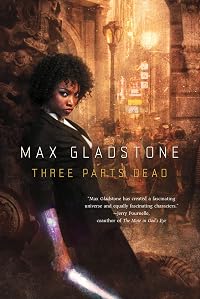
Also, I know I shouldn't judge a book by its cover, but this one is a beaut. Bless you, Tor, for showing Tara as dark-skinned and powerful. No whitewashing here.
As of right now, this book is my absolute top contender for a Nebula nomination next year. show less
I have read many advance release copies of books in recent months. A numbers have been stinkers. I confess, I was jaded to get this one, wondering if it would be yet another disappointing.
Oooooh no.
This book blew me away. Not only is it one of the best books I have read this year, I found myself becoming increasingly more distraught as it neared the end. I kept forcing myself to stick my bookmark in so I could pause and savor the pages instead of rushing through.
So what makes this book so incredible?
Three Parts Dead is fresh. It's epic fantasy blended with steampunk blended with the darkness and fast pace of urban fantasy. The characters are brilliant, nuanced, and deeply flawed. The show more world-building is bizarre to the point of being almost too weird, but it doesn't cross that line. Gods die in this world. Tara, the main character, is trained in necromantic law: she utilizes the magic of stone and stars to read the legal agreements of gods. When documents are legally binding, they are bound in magic; I have never come across the like in a fantasy novel.
Also, I know I shouldn't judge a book by its cover, but this one is a beaut. Bless you, Tor, for showing Tara as dark-skinned and powerful. No whitewashing here.
As of right now, this book is my absolute top contender for a Nebula nomination next year. show less
originally posted at www.csdaley.com
It is really hard to do something completely fresh and original in fantasy for me these days. I have been reading fantasy for a long time. I read a lot of books. So when something jumps out at me as different I tend to take notice. Three Parts Dead is different. While on its surface it is an Urban Fantasy set in a world that looks a little like ours. Underneath it is a mash up of many different genres. By many different genres I am not frakking around. There is a bang up legal procedure that culminates in one of the most interesting court room dramas I have ever read.
I am not even sure I know how to describe this book. The main story revolves around the murder of a god and a young lawyer's search for show more justice. There are gargoyles and vampires and magic (called the craft). The story is gritty and reads like a great mystery novel. The world building is fantastic and the characters pop off the page. I was a little sad to find out that this is a series that will not center around any one character, although I am hopeful that we will see a few of our favorites from book to book.
The writing is smooth and moves at a brisk pace. I like how Gladstone gives us a little bit of the world. Lets our assumptions take hold and then blows it up and goes somewhere surprising. The book had me constantly wondering where it was going next. It is a pretty rare book that does this to me. I don't think I have read a more enjoyable book this last year. When I finished it was everything I could do to delay gratification and not jump into the next book. Three Parts Dead will keep you reading and smiling. You will love the world and how Gladstone peels it back a little at a time. I love that the book ends. Fantasy has become dominated by massive series. It was refreshing to get to the end of the novel and have a conclusion. Gladstone lets his writing and his world draw you into the series. Go buy this book right now and prepare to be entertained. show less
It is really hard to do something completely fresh and original in fantasy for me these days. I have been reading fantasy for a long time. I read a lot of books. So when something jumps out at me as different I tend to take notice. Three Parts Dead is different. While on its surface it is an Urban Fantasy set in a world that looks a little like ours. Underneath it is a mash up of many different genres. By many different genres I am not frakking around. There is a bang up legal procedure that culminates in one of the most interesting court room dramas I have ever read.
I am not even sure I know how to describe this book. The main story revolves around the murder of a god and a young lawyer's search for show more justice. There are gargoyles and vampires and magic (called the craft). The story is gritty and reads like a great mystery novel. The world building is fantastic and the characters pop off the page. I was a little sad to find out that this is a series that will not center around any one character, although I am hopeful that we will see a few of our favorites from book to book.
The writing is smooth and moves at a brisk pace. I like how Gladstone gives us a little bit of the world. Lets our assumptions take hold and then blows it up and goes somewhere surprising. The book had me constantly wondering where it was going next. It is a pretty rare book that does this to me. I don't think I have read a more enjoyable book this last year. When I finished it was everything I could do to delay gratification and not jump into the next book. Three Parts Dead will keep you reading and smiling. You will love the world and how Gladstone peels it back a little at a time. I love that the book ends. Fantasy has become dominated by massive series. It was refreshing to get to the end of the novel and have a conclusion. Gladstone lets his writing and his world draw you into the series. Go buy this book right now and prepare to be entertained. show less
Members
- Recently Added By
Published Reviews
ThingScore 100
contracts define the structure, accessibility, and use of magic, called Craft. The world also includes familiar fantasy elements–from magical boarding schools to vampires to almighty gods–but gives them a fresh take that immediately draws you in.
Gladstone’s world-building involves magical takes on fields that aren’t typically addressed in fantasy—in this case, litigation. Gods, show more rather than being mysterious, unknowable, and omnipotent, have direct relationships with their followers. Their abilities bring happiness and joy to believers, create rain in the desert, cure illnesses—but also fuel metropolitan transit systems, back military operations, and promote trading partnerships with multinational corporations. Like all powerful people, then, the divine are always in need of good legal representation.
That’s where firms like Kelethres, Albrecht, and Ao come in: to negotiate the tangled web of deals that gods enter into. When one of these gods, Kos Everburning of Alt Coulomb, turns up dead, Tara and Ms. Kevarian are on the case. They have to prove that the god didn’t irresponsibly default on his contract, but was murdered, and they have to do it fast, before word of Kos’s death prompts his creditors worldwide to demand restitution, and the people of Alt Coulomb riot over the loss of their god.
Gladstone explained his take on divinity in the world of Three Parts Dead during a recent sit-down interview. “How would a world work in which you actually felt every morning, when you prayed to that god, your furnace would turn on?” he said when we met earlier this month. “That was how you turned your furnace on?” Grounding the metaphysical only highlighted what he felt was most important in the book: “In a world where those contracts are external and not just implied, how would that change the relationship between you and your god?” show less
Gladstone’s world-building involves magical takes on fields that aren’t typically addressed in fantasy—in this case, litigation. Gods, show more rather than being mysterious, unknowable, and omnipotent, have direct relationships with their followers. Their abilities bring happiness and joy to believers, create rain in the desert, cure illnesses—but also fuel metropolitan transit systems, back military operations, and promote trading partnerships with multinational corporations. Like all powerful people, then, the divine are always in need of good legal representation.
That’s where firms like Kelethres, Albrecht, and Ao come in: to negotiate the tangled web of deals that gods enter into. When one of these gods, Kos Everburning of Alt Coulomb, turns up dead, Tara and Ms. Kevarian are on the case. They have to prove that the god didn’t irresponsibly default on his contract, but was murdered, and they have to do it fast, before word of Kos’s death prompts his creditors worldwide to demand restitution, and the people of Alt Coulomb riot over the loss of their god.
Gladstone explained his take on divinity in the world of Three Parts Dead during a recent sit-down interview. “How would a world work in which you actually felt every morning, when you prayed to that god, your furnace would turn on?” he said when we met earlier this month. “That was how you turned your furnace on?” Grounding the metaphysical only highlighted what he felt was most important in the book: “In a world where those contracts are external and not just implied, how would that change the relationship between you and your god?” show less
added by feeling.is.first
Lists

Best Fantasy Novels
821 works; 361 members

Fantasy/Scifi Heroines Without Love Intrests
46 works; 10 members

Diversity in Fantasy and Science Fiction
219 works; 33 members

Female Protagonist
1,056 works; 57 members

Future Green Dragon Group Read Books
80 works; 6 members

Top Five Books of 2014
1,064 works; 398 members

Top Five Books of 2018
802 works; 264 members

Genre Benders: Fantasy + Mystery
108 works; 16 members

infjsarah's wishlist
408 works; 2 members

Books Read in 2015
3,299 works; 126 members

Books Read in 2018
4,360 works; 110 members
Author Information

49+ Works 13,367 Members
Some Editions
Awards and Honors
Series


Work Relationships
Is contained in
Common Knowledge
- Canonical title
- Three Parts Dead
- Original publication date
- 2012-10
- People/Characters
- Tara Abernathy; Elayne Kevarian; Abelard; Catherine Elle; Alexander Denovo; Shale (show all 8); Kos the Everburning; Raz Pelham
- Important places
- Alt Coulomb
- First words
- God wasn't answering tonight.
- Last words
- (Click to show. Warning: May contain spoilers.)"Goodbye, Alexander," she said before she left.
- Blurbers
- Pournelle, Jerry; Vaughn, Carrie; Crowley, John; Morrow, James; Ronald, Margaret; Day, Felicia
- Original language
- English
- Canonical DDC/MDS
- 813.6
- Canonical LCC
- PS3607.L343
Classifications
Statistics
- Members
- 1,596
- Popularity
- 14,262
- Reviews
- 95
- Rating
- (3.91)
- Languages
- English, Hungarian
- Media
- Paper, Audiobook, Ebook
- ISBNs
- 13
- ASINs
- 4