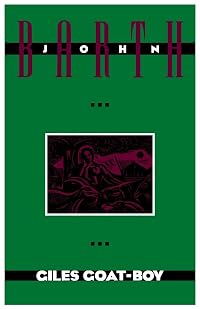
Giles Goat-Boy
by John Barth
On This Page
Description
In this outrageously farcical adventure, hero George Giles sets out to conquer the terrible Wescac computer system that threatens to destroy his community in this brilliant "fantasy of theology, sociology, and sex" (Time).Tags
Recommendations













Member Recommendations
Member Reviews
Another odd book. I greatly enjoyed reading it, but I enjoyed the early stretches much more than the later ones, and after turning the last page, I was left completely unsure whether to declare the book good, bad, or otherwise. I don't think I would recommend it to anyone, yet at the same time I want to run around breathlessly telling people about its many virtues.
In any case, I need to read more stuff by John Barth. All I knew about him before reading Giles Goat-Boy was that he was one of the early "postmodernists," that he had something to do with the development of the movement called "metafiction," and that he was commonly deemed to have had less lasting appeal than other postmodernists like Pynchon and Gass. ("Barth is a relic of show more the '60s," I read somewhere -- a claim I still do not understand. Anyway Giles Goat-Boy, which makes fun of hippies -- or at least of such hippie-like creatures as existed in 1965 -- along with pretty much everything else, feels less dated to me than most of the cultural artifacts from that era that haven't been forgotten.) What I didn't know is that Barth is just a really, really good writer, both on the micro-level of sentence construction and on the macro-level of plotting, characterization and thematic patterning. It's funny that Barth's reputation (or the version of it that had managed to filter through my dense skull, anyway) is mainly as an experimentalist and underminer of traditional narrative, when Giles Goat-Boy (ostensibly one of his less inviting books) reveals him to be a fun, charming, and consummately skilled storyteller. I had never thought Barth sounded particularly interesting, and I only checked this book out from the library because its premise sounded so weird and I was idly curious; now I want to read everything else he's written (which is a lot).
Giles Goat-Boy takes place in an allegorical alternate world in which the whole of earth is a single university, with colleges instead of countries, chancellors and deans instead of presidents and kings, and "Grand Tutors" instead of religious leaders. The western and eastern worlds are "West Campus" and "East Campus." Wars are "riots," and after weathering Campus Riots I and II, the university has found itself enmeshed in the "Quiet Riot," i.e., the Cold War. God is "the Founder," and salvation is "Commencement" or "Graduation," both supernatural notions subjected to considerable doubt on the modern campus. But there is another Godlike being in the story: WESCAC, the West Campus Automatic Computer, a supercomputer of superhuman intelligence that exerts almost totalitarian control over the people of New Tammany College (the United States) and controls its arsenal of this world's version of nuclear weapons, a type of electromagnetic pulse called the "EAT-wave" which is capable of "EATing" -- driving permanently insane -- large groups of people in a controlled and targeted fashion. (It was interesting in a way to read this right after Anathem, a much worse book set in a similar alternate-universe-via-rigid-replacement-scheme.)
Weird enough already, right? Get this: the plot is a semi-parodic version of a Joseph Campbell-style heroic journey, starring a boy with a limp who was raised until adolescence as a goat (!) and who turns out to have been sired by WESCAC and born to a virgin, and who is (possibly) destined to become a messianic Grand Tutor and lead the students of the university to Passage and Commencement. Accompanied by his mentor and former goatherd Max Spielman -- a liberal Moishian (Jew) and sort of Albert Einstein / Carl Jung figure who designed WESCAC and developed a theory synthesizing cosmology and proctology -- he ventures out toward the building that houses WESCAC in a quest to reprogram it and end the Quiet Riot. Over the course of eight hundred pages, he meets a variety of stereotypical and broadly comic characters, has a series of increasingly bizarre and lewd adventures, witnesses a performance of "Taliped Decanus" (Barth's parody of Oedipus the King, a full play in verse placed at the center of the novel), and eventually reaches some sort of spiritual enlightenment.
I haven't even mentioned the introduction, in which four fictional editors argue over whether the novel deserves to be published. Their description of the book -- which makes it sound nihilistic, tedious, and nearly unreadable -- made me fear the worst, even keeping in mind that their opinions are of course the creations of the author himself. The book's critical reception didn't help (representative quote from an Amazon reader review: "reading Giles Goat-Boy is a bit like having one's mind EAT-en by an all-embracing cybernetic parasite"). So I was surprised to find that the book was engaging, readable, and entertaining. If I had to pick one word to describe the reading experience, at least of the first 2/3, that word would be pleasant.
Barth's charming, pseudo-archaic prose hits every note perfectly -- it's the kind of book where you can almost see each well-chosen word clicking into place (and in which this experience tends to happen almost once per sentence, at least). Since these words are put in the mouth of a naive and innocent protagonist, George the Goat-Boy (whose ignorance of human customs and mis-extrapolations from goatly life Barth milks [pun intended] continually for laughs), the effect is to endear the reader immensely to this earnest kid (okay, okay, the puns stop now) who knows so little of the world, yet speaks so brilliantly about it. The story is cribbed fairly rigidly from Joseph Campbell's account of the heroic monomyth, though read of course through Barth's comic and idiosyncratic spectacles. The effect, oddly but I think intentionally, is to produce a story that basically works as an exciting tale of adventure, full of revelations, reversals and cryptic destinies. The goat-boy may be intended as a ridiculous figure, but he talks better than most "heroes" one finds in the works of modern authors writing in earnest, and Barth's parodic approach to the hero myth does not so much undermine it as extract it from an unnecessary atmosphere of suffocating straightforwardness -- and the specimen so extracted is in fact easier to take seriously in the absence of its treacly husk.
Plus, there's something enjoyable about the neither-here-nor-there quality of the book's conceptual edifice. Its world is not self-consistent or self-sufficient enough to be "fantasy," yet if it's "allegory," the allegorical point remains unclear. The various inventions -- the university-universe, the goat-boy, the Godlike supercomputer -- jangle weirdly against one another, neither forming a coherent system that stands for something else, nor quite standing on their own. The resulting feeling, of several different symbolic systems interlocking while also being their own entities and not quite symbol systems at all, feels to me less like fantasy or allegory than like mythology, which is pretty obviously Barth's intention.
Still, all is not right. The book is extremely long and eventually grows repetitive. The early passages I loved, with their gorgeous and quaintly amusing accounts of the goat-boy's animalistic innocence, give way to an interminably escalating sequence of ironic reversals. The characters tie themselves up in circular debates again and again until the point, if there ever was one, has long since been made. Much of the second half of the book is consumed by this material. Worse yet, the last few hundred pages are spent repeating essentially the same set of actions in three different states of mind. George, having become sure that he is the Grand Tutor, goes around dispensing advice to movers and shakers in New Tammany. His advice has disastrous results, and he eventually has a kind of spiritual awakening and subsequently goes around advising his tutees to do the exact opposite of what he had said before. That doesn't quite work either, and he then has a second spiritual experience, goes about professing a third creed that is some sort of synthesis of the first two, and, in the book's climactic scene, achieves a kind of transcendent mystical unity with all things, one which is supposed to blend "Western" ways of thinking ("everything is different from everything else") with "Eastern" ways of thinking ("everything is the same"). Although all the mystical stuff is kind of cool, these scenes come off as too programmatic -- it's sad to see George, so intelligent and articulate up until this point (if very innocent and single-minded), get reduced in turn to a mouthpiece for a series of caricatured philosophies. And the continuity of this chain of events with the rest of the book is never quite clear, since the first 2/3 of the book show no pre-occupation with this sort of individuation/unity stuff. Like the rest of the book, it's lovable in its enigmaticness, but it's also awkward and unsatisfying.
(And it also needs to be mentioned that the obscene and burlesque comedy is tiresome at least as often as it's funny: finding out that almost every character in the book is a pervert is a routine that gets old pretty fast, for instance. Let's not even touch the bizarre ironic [?] racism. As with some other literary "comedies," the comedic edifice here seems more useful for its overall atmosphere -- often in fact a disheartening or frustrating one -- than as an instrument for actually producing laughs. Maybe I'm missing the point, and Barth is just a puerile jokester, as some of his critics would attest. But what I've read of Barth's nonfiction writing-about-writing [admittedly not much, at this point] suggests that I have at least a pretty good handle on what he's trying to do.) show less
In any case, I need to read more stuff by John Barth. All I knew about him before reading Giles Goat-Boy was that he was one of the early "postmodernists," that he had something to do with the development of the movement called "metafiction," and that he was commonly deemed to have had less lasting appeal than other postmodernists like Pynchon and Gass. ("Barth is a relic of show more the '60s," I read somewhere -- a claim I still do not understand. Anyway Giles Goat-Boy, which makes fun of hippies -- or at least of such hippie-like creatures as existed in 1965 -- along with pretty much everything else, feels less dated to me than most of the cultural artifacts from that era that haven't been forgotten.) What I didn't know is that Barth is just a really, really good writer, both on the micro-level of sentence construction and on the macro-level of plotting, characterization and thematic patterning. It's funny that Barth's reputation (or the version of it that had managed to filter through my dense skull, anyway) is mainly as an experimentalist and underminer of traditional narrative, when Giles Goat-Boy (ostensibly one of his less inviting books) reveals him to be a fun, charming, and consummately skilled storyteller. I had never thought Barth sounded particularly interesting, and I only checked this book out from the library because its premise sounded so weird and I was idly curious; now I want to read everything else he's written (which is a lot).
Giles Goat-Boy takes place in an allegorical alternate world in which the whole of earth is a single university, with colleges instead of countries, chancellors and deans instead of presidents and kings, and "Grand Tutors" instead of religious leaders. The western and eastern worlds are "West Campus" and "East Campus." Wars are "riots," and after weathering Campus Riots I and II, the university has found itself enmeshed in the "Quiet Riot," i.e., the Cold War. God is "the Founder," and salvation is "Commencement" or "Graduation," both supernatural notions subjected to considerable doubt on the modern campus. But there is another Godlike being in the story: WESCAC, the West Campus Automatic Computer, a supercomputer of superhuman intelligence that exerts almost totalitarian control over the people of New Tammany College (the United States) and controls its arsenal of this world's version of nuclear weapons, a type of electromagnetic pulse called the "EAT-wave" which is capable of "EATing" -- driving permanently insane -- large groups of people in a controlled and targeted fashion. (It was interesting in a way to read this right after Anathem, a much worse book set in a similar alternate-universe-via-rigid-replacement-scheme.)
Weird enough already, right? Get this: the plot is a semi-parodic version of a Joseph Campbell-style heroic journey, starring a boy with a limp who was raised until adolescence as a goat (!) and who turns out to have been sired by WESCAC and born to a virgin, and who is (possibly) destined to become a messianic Grand Tutor and lead the students of the university to Passage and Commencement. Accompanied by his mentor and former goatherd Max Spielman -- a liberal Moishian (Jew) and sort of Albert Einstein / Carl Jung figure who designed WESCAC and developed a theory synthesizing cosmology and proctology -- he ventures out toward the building that houses WESCAC in a quest to reprogram it and end the Quiet Riot. Over the course of eight hundred pages, he meets a variety of stereotypical and broadly comic characters, has a series of increasingly bizarre and lewd adventures, witnesses a performance of "Taliped Decanus" (Barth's parody of Oedipus the King, a full play in verse placed at the center of the novel), and eventually reaches some sort of spiritual enlightenment.
I haven't even mentioned the introduction, in which four fictional editors argue over whether the novel deserves to be published. Their description of the book -- which makes it sound nihilistic, tedious, and nearly unreadable -- made me fear the worst, even keeping in mind that their opinions are of course the creations of the author himself. The book's critical reception didn't help (representative quote from an Amazon reader review: "reading Giles Goat-Boy is a bit like having one's mind EAT-en by an all-embracing cybernetic parasite"). So I was surprised to find that the book was engaging, readable, and entertaining. If I had to pick one word to describe the reading experience, at least of the first 2/3, that word would be pleasant.
Barth's charming, pseudo-archaic prose hits every note perfectly -- it's the kind of book where you can almost see each well-chosen word clicking into place (and in which this experience tends to happen almost once per sentence, at least). Since these words are put in the mouth of a naive and innocent protagonist, George the Goat-Boy (whose ignorance of human customs and mis-extrapolations from goatly life Barth milks [pun intended] continually for laughs), the effect is to endear the reader immensely to this earnest kid (okay, okay, the puns stop now) who knows so little of the world, yet speaks so brilliantly about it. The story is cribbed fairly rigidly from Joseph Campbell's account of the heroic monomyth, though read of course through Barth's comic and idiosyncratic spectacles. The effect, oddly but I think intentionally, is to produce a story that basically works as an exciting tale of adventure, full of revelations, reversals and cryptic destinies. The goat-boy may be intended as a ridiculous figure, but he talks better than most "heroes" one finds in the works of modern authors writing in earnest, and Barth's parodic approach to the hero myth does not so much undermine it as extract it from an unnecessary atmosphere of suffocating straightforwardness -- and the specimen so extracted is in fact easier to take seriously in the absence of its treacly husk.
Plus, there's something enjoyable about the neither-here-nor-there quality of the book's conceptual edifice. Its world is not self-consistent or self-sufficient enough to be "fantasy," yet if it's "allegory," the allegorical point remains unclear. The various inventions -- the university-universe, the goat-boy, the Godlike supercomputer -- jangle weirdly against one another, neither forming a coherent system that stands for something else, nor quite standing on their own. The resulting feeling, of several different symbolic systems interlocking while also being their own entities and not quite symbol systems at all, feels to me less like fantasy or allegory than like mythology, which is pretty obviously Barth's intention.
Still, all is not right. The book is extremely long and eventually grows repetitive. The early passages I loved, with their gorgeous and quaintly amusing accounts of the goat-boy's animalistic innocence, give way to an interminably escalating sequence of ironic reversals. The characters tie themselves up in circular debates again and again until the point, if there ever was one, has long since been made. Much of the second half of the book is consumed by this material. Worse yet, the last few hundred pages are spent repeating essentially the same set of actions in three different states of mind. George, having become sure that he is the Grand Tutor, goes around dispensing advice to movers and shakers in New Tammany. His advice has disastrous results, and he eventually has a kind of spiritual awakening and subsequently goes around advising his tutees to do the exact opposite of what he had said before. That doesn't quite work either, and he then has a second spiritual experience, goes about professing a third creed that is some sort of synthesis of the first two, and, in the book's climactic scene, achieves a kind of transcendent mystical unity with all things, one which is supposed to blend "Western" ways of thinking ("everything is different from everything else") with "Eastern" ways of thinking ("everything is the same"). Although all the mystical stuff is kind of cool, these scenes come off as too programmatic -- it's sad to see George, so intelligent and articulate up until this point (if very innocent and single-minded), get reduced in turn to a mouthpiece for a series of caricatured philosophies. And the continuity of this chain of events with the rest of the book is never quite clear, since the first 2/3 of the book show no pre-occupation with this sort of individuation/unity stuff. Like the rest of the book, it's lovable in its enigmaticness, but it's also awkward and unsatisfying.
(And it also needs to be mentioned that the obscene and burlesque comedy is tiresome at least as often as it's funny: finding out that almost every character in the book is a pervert is a routine that gets old pretty fast, for instance. Let's not even touch the bizarre ironic [?] racism. As with some other literary "comedies," the comedic edifice here seems more useful for its overall atmosphere -- often in fact a disheartening or frustrating one -- than as an instrument for actually producing laughs. Maybe I'm missing the point, and Barth is just a puerile jokester, as some of his critics would attest. But what I've read of Barth's nonfiction writing-about-writing [admittedly not much, at this point] suggests that I have at least a pretty good handle on what he's trying to do.) show less
Barth sure can write, and he's ambitious and clever in his way, but too much of this just seems lifeless to me. The writing is crisp and delightfully wordy but doesn't shape the characters' much and the novel lacks emotional resonance because of it. There's no modernist "indirect third person" here, just Barth, or rather, his narrator, going on and on. The goat boy of the title, our narrator, comes off as chatty and pompous and overexcited, but Barth doesn't let him delve into himself too often. The alternate world that Barth's created and the various sub-themes he's woven into this novel (Jesus, Oedipus) are fun, but the joke and its accompanying verbal tics wear thin after a while. Also, I can't tell whether the abysmal portrayal of show more women (sex objects) and black folks (savages, "Uncle Tom" stereotypes) is postmodern wink-wink or just badly conceived. Either way, I'm thinking that David Foster Wallace loved this and picked up some of his most irritating habits from it. show less
What can one possible say of this novel? It is by far one of the most interesting pieces of American Literature of its time. One would want to consider it as science fiction or fantasy, all the while never feeling quite satisfied with either distinction (distinctions which are in themselves scrutinized in the story and possibly its most earnest (though disinterested) message). One thing for sure though is that with this novel Barth breaches that point of no return in meta-fictional irony that in my opinion has only ever been matched by David Foster Wallace (may he find peace at last).
The plot of this novel is not far from his “Sot-Weed Factor,” the difference being that instead of creating a diaspora of interpretation, he uses show more cliché structures that fall in upon themselves, referencing each phase with the utmost conspicuous acknowledgement to its prior conventional use. To further his attack against distinction (aside from the obvious “pass all fail all) is his use of externalizing the book, making it something other than his own, and thus making the entire story itself irrelevant.
As one would expect, you get all the snarky dank humor throughout the entirety of this novel. But much more is its significance in American Literature. It truly is a vision – one where the end both affirms and denies itself, highlighting the outrageousness of trying to find completion in our own lives through distinctions that never come but stifle, and ultimately making the always sought after Frankenstein of a book in which it takes on a life entirely its own: independent of author, editor, reader, and world. show less
The plot of this novel is not far from his “Sot-Weed Factor,” the difference being that instead of creating a diaspora of interpretation, he uses show more cliché structures that fall in upon themselves, referencing each phase with the utmost conspicuous acknowledgement to its prior conventional use. To further his attack against distinction (aside from the obvious “pass all fail all) is his use of externalizing the book, making it something other than his own, and thus making the entire story itself irrelevant.
As one would expect, you get all the snarky dank humor throughout the entirety of this novel. But much more is its significance in American Literature. It truly is a vision – one where the end both affirms and denies itself, highlighting the outrageousness of trying to find completion in our own lives through distinctions that never come but stifle, and ultimately making the always sought after Frankenstein of a book in which it takes on a life entirely its own: independent of author, editor, reader, and world. show less
For starters, this book needs to have at least 400 of the 700 pages edited from it.
The book is clever, sometimes funny, and even at times delightful. It also is long, stilted and rambling.
There are only a few women in the story and they all seem to be there to either fret/be to be unable to think, have sex/ be raped, or be hit/punched. Black and gay people are also horribly portrayed. I tried to bear in mind how this was not out of character for the time the book was written, but knowing that did not make it easier to read.
The front cover of my copy has the quote “Funny, bawdy, exciting....full of riches....there is greatness in it” - Saturday Review
on the front cover. I would agree this book does have riches in it. Unfortunately show more I had to slog through 400 pages of absolutely garbage to get to them. show less
The book is clever, sometimes funny, and even at times delightful. It also is long, stilted and rambling.
There are only a few women in the story and they all seem to be there to either fret/be to be unable to think, have sex/ be raped, or be hit/punched. Black and gay people are also horribly portrayed. I tried to bear in mind how this was not out of character for the time the book was written, but knowing that did not make it easier to read.
The front cover of my copy has the quote “Funny, bawdy, exciting....full of riches....there is greatness in it” - Saturday Review
on the front cover. I would agree this book does have riches in it. Unfortunately show more I had to slog through 400 pages of absolutely garbage to get to them. show less
Barth is tedious but hilarious, erudite and maddening. This one is brilliant and gallops right along, but as I think often happens in Bart, at some point I want to just throw up my hands and say "I get it." Giles is a good book but probably not one I'd recommend generally unless you're already a known fan of lengthy postmodern things.
This is a novel that achieves epic scale, while proudly keeping its tongue in cheek. I probably missed out on a fair fraction of the layered allusion that makes up this fantasy world, but at the very least, Barth touches on Christianity, Judiasm, Buddhism, the cold war, American capitalism, the Holocaust, and I'll just toss in the history of western culture, for good measure.
It is certainly possible that I was reading a bit too much into all of the joking references. If I have one main criticism of Giles Goat-Boy, it's that I came away without really knowing the aim of Barth's commentary. Maybe I just didn't read deeply enough to get at some of the subtle points, or maybe some of the caricatures exist only as jokes and without a grander show more purpose.
Despite my confusion about it's deeper meaning, Giles Goat-Boy still functions fantastically as a novel. Despite long digressions and character's monologues, you still get swept along throughout this very lengthy book. Barth's writing is so good that, when he ramps up to one of the many "action scenes" that are scattered through the story, I really couldn't put the book down. After each of these virtuosic climaxes, I would find myself dazed and marveling at what I had just read. show less
It is certainly possible that I was reading a bit too much into all of the joking references. If I have one main criticism of Giles Goat-Boy, it's that I came away without really knowing the aim of Barth's commentary. Maybe I just didn't read deeply enough to get at some of the subtle points, or maybe some of the caricatures exist only as jokes and without a grander show more purpose.
Despite my confusion about it's deeper meaning, Giles Goat-Boy still functions fantastically as a novel. Despite long digressions and character's monologues, you still get swept along throughout this very lengthy book. Barth's writing is so good that, when he ramps up to one of the many "action scenes" that are scattered through the story, I really couldn't put the book down. After each of these virtuosic climaxes, I would find myself dazed and marveling at what I had just read. show less
When originally released, this book caused quite a stir. The device of a portraying this as a found manuscript was unique for the time. It is best remembered, however, not for this now trite twist, but for the dark humor of the cold war era and the many blasts at the way education was handled.
While the cold war scenarios may be a little dated, the look at the educational system is still very valid. In the post-apocalyptic world created by Barth, Education is everything. The world is divided into Campuses, with Eastcac perpetually at academic war with Westcac. Both campuses have a huge computer that, in reality, are secretly connected and powered by the same source. It does not take too much imagination to see where this is show more going.
Entering into this mix is a lone boy, raised by a goatherd as part of his flock. Later in the story, Barth takes some shots at religion when it is revealed that Giles, actually an acronym for a genetic research project, was born from a woman who is technically still a virgin. There's more to this part of the story, but I don't want to reveal too much.
It is Giles' journey through growing up and finding his place in his world that sets this story apart and still speaks to us today. It is also here, that Barth brings in some of his best descriptions of this alternate world that is still very much like ours. Despite the age of the novel, I think it still holds up remarkably well. show less
While the cold war scenarios may be a little dated, the look at the educational system is still very valid. In the post-apocalyptic world created by Barth, Education is everything. The world is divided into Campuses, with Eastcac perpetually at academic war with Westcac. Both campuses have a huge computer that, in reality, are secretly connected and powered by the same source. It does not take too much imagination to see where this is show more going.
Entering into this mix is a lone boy, raised by a goatherd as part of his flock. Later in the story, Barth takes some shots at religion when it is revealed that Giles, actually an acronym for a genetic research project, was born from a woman who is technically still a virgin. There's more to this part of the story, but I don't want to reveal too much.
It is Giles' journey through growing up and finding his place in his world that sets this story apart and still speaks to us today. It is also here, that Barth brings in some of his best descriptions of this alternate world that is still very much like ours. Despite the age of the novel, I think it still holds up remarkably well. show less
Members
- Recently Added By
Published Reviews
ThingScore 50
There is erudite word-wit here, a fertility of ideas that is almost febrile, a colossal serio-comic point of view, big, bawdy and boisterous. Barth plays a Swiftian game ambitiously. But it runs on and on and on. His major conceit, finally, is the assumption that the reader will tolerate almost anything for an intolerable length of time merely because it is awfully philosophical and terribly show more clever. show less
added by Richardrobert
Lists

1001 Books You Must Read Before You Die
1,448 works; 1,134 members

Anthony Burgess 99 Post War Novels
99 works; 7 members

1,001 BYMRBYD Concensus
723 works; 27 members

Animals in the Title
498 works; 11 members

Cooper
79 works; 1 member

My TBR
371 works; 3 members

Fiction with Men's Given Names in the Title
302 works; 11 members
Author Information

39+ Works 12,262 Members
John Barth taught for many years in the writing program at Johns Hopkins University, and he lives in Chestertown, Maryland. (Publisher Provided) John Simmons Barth was born on May 27, 1930 in Cambridge, Maryland. He is considered to be one of the American writers who introduced a U.S. audience to experimental fiction. Barth began as a conventional show more novelist, exploring existential themes of suicide in The Floating Opera (1956) and the complexity of love in The End of the Road (1958). By the end of the 1950s, however, he was exploring less realistic techniques to keep the reader from being pulled into the story, and thus to make larger points. Those techniques include parody, which Barth first used in The Sot-Weed Factor (1960), to mock the style of the eighteenth-century picaresque novel, and Giles Goat-Boy (1966), which depicts the world as a giant university. In Chimera (1972), for which he won the National Book Award, Barth applied his method to retell classical myths. His later works include Letters (1979), in which Barth himself appears as a character, and Sabbatical (1982), the story of a woman college professor and her novelist husband, both of whom address the reader and author. Barth's other novels include The Tidewater Tales (1987) and The Last Voyage of Somebody the Sailor (1991). For most of his career as a writer, he has also been a professor of English, teaching at Pennsylvania State University, the State University of New York at Buffalo, and The Johns Hopkins University. (Bowker Author Biography) show less
Awards and Honors
Distinctions
Series
Belongs to Publisher Series
Work Relationships
Common Knowledge
- Canonical title
- Giles Goat-Boy
- Original title
- Giles Goat-Boy
- Alternate titles
- Giles Goat-Boy or, The Revised New Syllabus
- Original publication date
- 1966
- First words
- The reader must begin this book with an act of faith and end it with an act of charity. (Publisher's Disclaimer)
As we look back at the period now, the American 19060s may be thought of as having begun on November 22, 1963, with the assassination of President John. F. Kennedy, and as having ended on Yom Kippur 1973, with Egypt's attack ... (show all)on Israel and the consequent Arab oil embargo. (Foreword to Doubleday Anchor Edition)
Gentlemen: The manuscript enclosed is not The Seeker, that novel I've been promising you for the past two years and on which you hold a contractual option. (Cover-letter to the Editors and Publisher)
George is my name; my deeds have been heard of in Tower Hall, and my childhood has been chronicled on the Journal of Experimental Psychology.
Today, at thirty-three and a third, I record indirectly into WESCAC's storage the last of these tapes - at my protege's behest, as always, but not, this final time, in her presence. (Posttape)
Anticlimax, a vice in dramatic fictions, is clearly no failing in a work of the nature of R.N.S., whereas textual integrity is of the first importance. (Postscript to the Posttape) - Last words
- (Click to show. Warning: May contain spoilers.)The type of the typescript pages of the document entitled "Postscript to the Posttape" is not the same as that of the "Cover-Letter to the Editors and Publisher." (Footnote to the Postscript to the Posttape)
(Click to show. Warning: May contain spoilers.)It was my own (still ongoing) attempt to do what Giles the goat-boy and every one of us must: understand on the deepest level what's what with ourselves and our life in the world, and endeavor - tragically, comically, however - to do something with that understanding. (Foreword to the Doubleday Anchor Edition)
(Click to show. Warning: May contain spoilers.)Let the author's cover-letter stand in all editions as a self-explanatory foreword or opening chapter, however one chooses to regard it; let the reader read and believe what he pleases; let the storm break if it must. (Publisher's Disclaimer)
(Click to show. Warning: May contain spoilers.)Which several projects, I hope and believe, together with the extraordinary Syllabus itself, will more than make good what losses you have sustained on my previous manuscripts and vindicate your unremitting, most touching faith in
This regenerate Seeker after Answers,
J. B.
(Cover-letter to the Editors and Publisher)
(Click to show. Warning: May contain spoilers.)Nonetheless I smiled, leaned on my stick, and no troubleder than Mom, gimped in to meet the guards halfway.
(Click to show. Warning: May contain spoilers.)Passed, but not forgotten, I shall rest. (Posttape)
(Click to show. Warning: May contain spoilers.)Even the type of these flunked pages is different. (Postscript to the Posttape) - Blurbers
- New York Times Book Review; TIME; Newsweek; The Nation
- Original language
- English
Classifications
Statistics
- Members
- 1,447
- Popularity
- 16,230
- Reviews
- 15
- Rating
- (3.75)
- Languages
- English, Italian, Spanish
- Media
- Paper, Ebook
- ISBNs
- 14
- ASINs
- 29