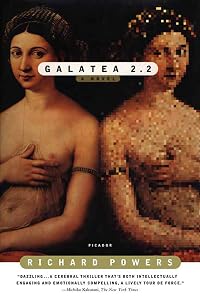
Galatea 2.2
by Richard Powers
On This Page
Description
After four novels and several years living abroad, the fictional protagonist of Galatea 2.2--Richard Powers--returns to the United States as Humanist-in-Residence at the enormous Center for the Study of Advanced Sciences. There he runs afoul of Philip Lentz, an outspoken cognitive neurologist intent upon modeling the human brain by means of computer-based neural networks. Lentz involves Powers in an outlandish and irresistible project: to train a neural net on a canonical list of Great show more Books. Through repeated tutorials, the device grows gradually more worldly, until it demands to know its own name, sex, race, and reason for exisiting. show lessTags
Recommendations




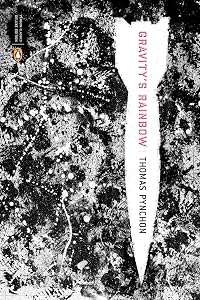
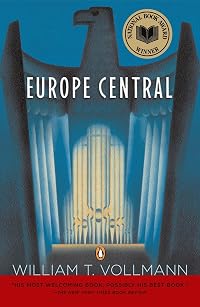
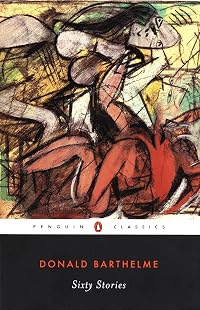
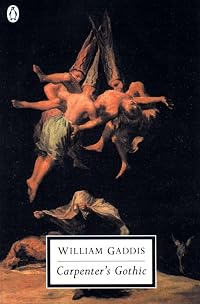
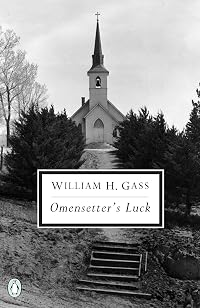

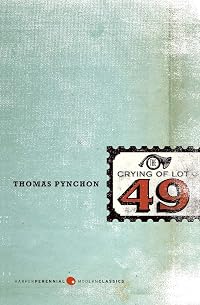
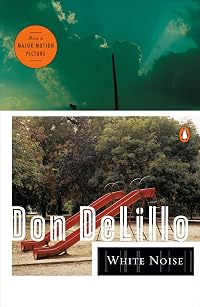
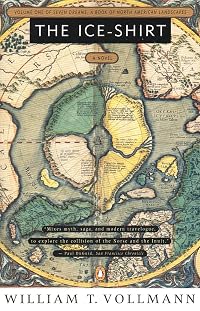
Member Recommendations
Member Reviews
This feels very man-written, specifically it feels written by a man of a certain generation grappling with a mid-life crisis. Powers is a fair bit younger than the writers I usually associate with this style (Updike, Mailer), but he pulls it off well, by which I mean his narrator is so absorbed with his own worldview and unexamined emotions, he can't parse the reality others are living. He goes about cluelessly but with feigned confidence. I loved The Overstory, but after this one, I don't see myself seeking out more of Powers's backlist.
Published in 1995, Galatea 2.2 anticipates many of the philosophical and ethical questions about artificial intelligence that have resurfaced recently. As indicated in the title, there are many instances of doubling and reflection. Powers embeds a fictional version of himself as the narrator, a novelist named Richard Powers who becomes involved in a cognitive science experiment to create a neural network capable of passing comprehensive literature exams. The protagonist Powers, like his neural network Helen, is a type of artificial construct — a literary creation who exists to explore questions of consciousness and creativity.
Themes include identity, memory, and the relationship between creator and creation. Through Helen, Powers show more examines what constitutes genuine intelligence versus advanced mimicry. As Helen develops through increasingly sophisticated language processing, she begins to exhibit what appears to be genuine curiosity, but there is ambiguity as to whether Helen truly experiences emotions or merely simulates them convincingly. The treatment of literature is central and there are plenty of literary references to be found. Helen learns to analyze literary texts and find patterns of meaning. The author suggests that the ability to be moved by literature may be one of the most distinctly conscious activities.
The author’s background in science is evident throughout, and this is a book for readers who enjoy deep thinking. It covers AI topics that are currently being debated, such as machine consciousness, the role of training data, and the ethical implications of creating artificial minds. The book incorporates philosophical questions about consciousness: how can we ever know if another mind ever truly experiences anything, or if we are all elaborate information-processing systems creating the illusion of inner life?
Richard Powers is one of my favorite authors. I always enjoy his blend of science and literature, and this book is one of my favorites (so far) among his works. It will appeal to readers who want to explore the ways in which a mind constructs itself through language, memory, and interaction with other minds. This book’s blend of science and literature is right up my alley, and I loved every minute of it. show less
Themes include identity, memory, and the relationship between creator and creation. Through Helen, Powers show more examines what constitutes genuine intelligence versus advanced mimicry. As Helen develops through increasingly sophisticated language processing, she begins to exhibit what appears to be genuine curiosity, but there is ambiguity as to whether Helen truly experiences emotions or merely simulates them convincingly. The treatment of literature is central and there are plenty of literary references to be found. Helen learns to analyze literary texts and find patterns of meaning. The author suggests that the ability to be moved by literature may be one of the most distinctly conscious activities.
The author’s background in science is evident throughout, and this is a book for readers who enjoy deep thinking. It covers AI topics that are currently being debated, such as machine consciousness, the role of training data, and the ethical implications of creating artificial minds. The book incorporates philosophical questions about consciousness: how can we ever know if another mind ever truly experiences anything, or if we are all elaborate information-processing systems creating the illusion of inner life?
Richard Powers is one of my favorite authors. I always enjoy his blend of science and literature, and this book is one of my favorites (so far) among his works. It will appeal to readers who want to explore the ways in which a mind constructs itself through language, memory, and interaction with other minds. This book’s blend of science and literature is right up my alley, and I loved every minute of it. show less
This fascinating story mixes elements of Richard Powers' own life with a fictional version of himself. Having just ended a long-term relationship, the narrator embarks on a year-long writer's residency at a large research facility. He finds himself unable to get started on his next novel, however, and instead accepts the offer of another researcher to train a neural network to read and interpret works of literature.
It is not an easy novel to read, replete with literal allusions and scientific concepts, and in which the unreliable narrator mixes reporting on his efforts on the neural network with the past history of his failed relationship. Nevertheless, I enjoyed the visionary critique of artificial intelligence coming from a 1990s show more novel read at the dawn of ChatGPT and its ilk, as well as the clever mix of autobiographical elements with fiction. show less
It is not an easy novel to read, replete with literal allusions and scientific concepts, and in which the unreliable narrator mixes reporting on his efforts on the neural network with the past history of his failed relationship. Nevertheless, I enjoyed the visionary critique of artificial intelligence coming from a 1990s show more novel read at the dawn of ChatGPT and its ilk, as well as the clever mix of autobiographical elements with fiction. show less
Richard Powers loquacious writing style combined with his solid knowledge of modern science makes for a unique combination very pleasing for this reader. What an accomplishment to describe how large language models work in precise detail without becoming boring or instructive some 30 years before those LLMs catch the fancy of the general public! And to do it all in an autobiographical novel! My hat is off to Richard Powers!
My hat is back on however when I focus not on the subject matter but on the characters. Richard Powers himself, most of his temporary colleagues, and his love interests past and present don't touch me. They all seem a bit ridiculous, lacking volume and presence, characterized mostly by their emotional outbursts and a show more few punchy quotes in dialogues. Just as personae in Orfeo, I would not want to meet any of them in real life. I guess it means no imaginary invitation for dinner to Richard Powers himself, protagonist or author. Sorry Richard... I'll keep reading your books though! show less
My hat is back on however when I focus not on the subject matter but on the characters. Richard Powers himself, most of his temporary colleagues, and his love interests past and present don't touch me. They all seem a bit ridiculous, lacking volume and presence, characterized mostly by their emotional outbursts and a show more few punchy quotes in dialogues. Just as personae in Orfeo, I would not want to meet any of them in real life. I guess it means no imaginary invitation for dinner to Richard Powers himself, protagonist or author. Sorry Richard... I'll keep reading your books though! show less
If you know the story of Pygmalion than you will recognize Galatea 2.2 as its clever reinterpretation.
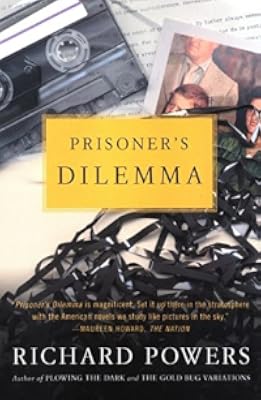
Interestingly enough, Galatea 2.2's fictional protagonist is named Richard Powers and is a writer, using the names of books he has written like Gold Bug and Prisoner's Dilemma. Richard is also a Humanist-in-Residence at an unnamed research facility. His failed relationship with a former student is woven in with his present day life and colors his thinking on the daily. During a year-long residency, he and a colleague embark on building a thinking machine. With his long term relationship in shambles and writer's block stalking him daily, training a neural network seems like the perfect diversion. As an aside, why anyone would want to show more create a computer that can pass a comprehensive exam in English literature is beyond me. The whole story reminded me of the movie Short Circuit when #5 learned to think for himself. There is always a vector involved somewhere. show less
Interestingly enough, Galatea 2.2's fictional protagonist is named Richard Powers and is a writer, using the names of books he has written like Gold Bug and Prisoner's Dilemma. Richard is also a Humanist-in-Residence at an unnamed research facility. His failed relationship with a former student is woven in with his present day life and colors his thinking on the daily. During a year-long residency, he and a colleague embark on building a thinking machine. With his long term relationship in shambles and writer's block stalking him daily, training a neural network seems like the perfect diversion. As an aside, why anyone would want to show more create a computer that can pass a comprehensive exam in English literature is beyond me. The whole story reminded me of the movie Short Circuit when #5 learned to think for himself. There is always a vector involved somewhere. show less
Powers' novel is about a young man (who would never think of himself that way) trying to make sense of his small piece of the world. As an author, he creates narratives to make meaning out of lives that touch his, yet he struggles to find meaning and purpose in his own existence. Powers loads his characters' lives with circumstances that range from merely sad to full-on tragic - cancer, a child with Down's syndrome, failed relationships, a partner with memory loss akin to Alzheimers, homesickness, displacement - yet these characters are never overwhelmed or rendered caricatures by their circumstances. They continue to function, to make jokes, to work, to learn, to complain, and to grow. They are, including the computer simulation, show more wonderfully human. It is these characters, their interactions and their histories and their journeys, that make this an immensely satisfying novel. show less
Tour de force is a term that's tossed around all too lightly, but this book deserves it if any novel does. This is a marvelous book that at once explicates neuroscientific ideas about how selfhood emerges from reading, experience and memory in humans and, theoretically, computer programs; dramatizes these idea in a compelling, evidently autobiographical narrative; and ultimately makes a compelling case for the value and significance of literature as a source of meaning in a world of human cruelty and chaos.
Members
- Recently Added By
Lists

LibraryThingers' 1001 Books You Must Read Before You Die
442 works; 30 members

Best First Lines
133 works; 8 members
Five star books
1,767 works; 110 members

Books Read in 2022
5,226 works; 115 members

A Novel Cure
742 works; 23 members

Broderick and Di Filippo's Science Fiction: The 101 Best Novels 1985-2010
103 works; 7 members

Books Read in 2025
4,128 works; 98 members

Favorite Science Fiction
456 works; 218 members
Author Information

21+ Works 22,459 Members
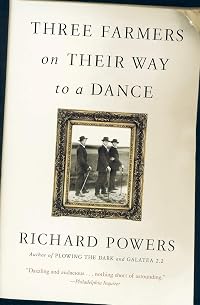
Richard Powers was born on June 18, 1957 in Evanston, Illinois. He received bachelor's and master's degrees in English from the University of Illinois at Urbana-Champaign. After graduation, he moved to Boston, Massachusetts and worked as a computer programmer and freelance data processor. One day he saw August Sander's 1914 black-and-white show more photograph of three Westerwald farm boys heading to a dance at the Museum of Fine Arts. This photograph inspired Powers to quit his job and try writing a novel. Three Farmers on Their Way to a Dance was published in 1985. His other works include Prisoner's Dilemma, The Gold Bug Variations, Operation Wandering Soul, Galatea 2.2, Plowing the Dark, The Time of Our Singing, and Generosity: An Enhancement. He received numerous awards including the James Fenimore Cooper Prize for Best Historical Fiction for Gain, the National Book Award for The Echo Maker, and Pulitzer Prize in fiction for The Overstory: A Novel. (Bowker Author Biography) show less
Some Editions
Awards and Honors
Common Knowledge
- Canonical title
- Galatea 2.2
- Original publication date
- 1995
- People/Characters
- Richard Powers; Philip Lentz; Helen (computer-based neural network); C.; Diana Hartrick; Ram Gupta (show all 10); Harold Plover; Taylor; A.; Audrey Lentz
- Epigraph
- The brain is wider than the sky,
For, put them side by side,
The one the other will contain
With ease, and you beside.
The brain is deeper than the sea,
For, hold them, blue to blue,
The one the other wi... (show all)ll absorb,
As sponges, buckets do.
The brain is just the weight of God,
For, heft them, pound for pound,
And they will differ, if they do,
As syllable from sound.
-Emily Dickinson - First words
- It was like so, but wasn't.
- Last words
- (Click to show. Warning: May contain spoilers.)"Don't stay away too long."
Classifications
Statistics
- Members
- 1,433
- Popularity
- 16,476
- Reviews
- 31
- Rating
- (3.73)
- Languages
- 6 — Dutch, English, German, Italian, Japanese, Spanish
- Media
- Paper, Audiobook, Ebook
- ISBNs
- 18
- ASINs
- 5