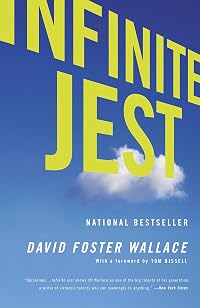
Infinite Jest
by David Foster Wallace 
On This Page
Description
A spoof on our culture featuring a drug-and-alcohol rehabilitation house near Boston. The center becomes a hotbed of revolutionary activity by Quebec separatists in revolt against the Organization of North American Nations which now rules the continent.Tags
Recommendations


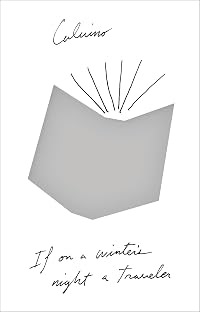
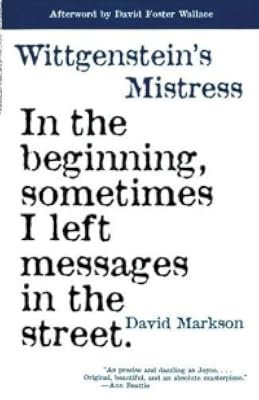
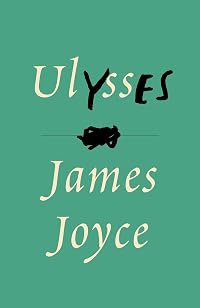
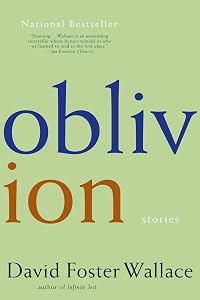



Member Recommendations
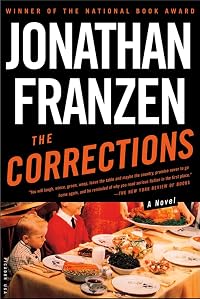
browner56 You will either love them both or hate them both, but you will probably need a reader's guide to get through either one--I know I did.
91
owenkeegan Set at an Irish boarding school, this book shares a sense of humor with and has a narrative disjunction similar to Infinite Jest.
50
anonymous user It's all about what people do for entertainment, status, and sport. Along the way, the entire spectrum of society is satirized.
42
hairball If you liked Infinite Jest, you will like The Instructions, but even if you didn't like IJ, you should try it.
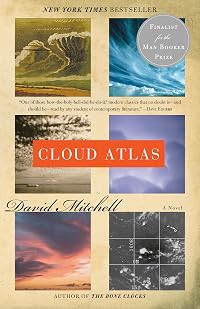
owenkeegan David Foster Wallace based the structure of Infinite Jest on a fractal. Cloud Atlas similarly transitions from one story to the next as though zooming in on a corner of one world to reveal a whole new universe, related but unique.
65
The Man Without Qualities: A Sort of Introduction; Pseudo Reality Prevails {Vol. 1 of 2} by Robert Musil
JuliaMaria Die Frankfurter Allgemeine Zeitung meint, dass 'Unendlicher Spass' von Foster Wallace für den Beginn des einundzwanzigsten Jahrhunderts das sei, was Musils 'Mann ohne Eigenschaften' für das vergangene Jahrhundert war.
21
Cecrow Infinite Jest wields several references/allusions to Shakespeare's play.

DLSmithies I know that Infinite Jest isn't "about drugs" - to reduce it to that would be insulting - but nevertheless, I read these books around the same time, and found they both have really interesting things to say about drugs and addiction in modern society - so if you liked IJ, Tome Felling's book might be worth a look.
RidgewayGirl Books share a hectic, erudite wordplay and sense of the outrageous.
Member Reviews
My first read in about fourteen years. There were times in the first half where I found all the "likes" and comically long acronyms very annoying, but once everything started clicking, I was as blown away as I was the first time. This book's online reputation among people who almost definitely haven't read it should just be ignored. It's funny, sad, and insightful and all the rest, but the real achievement here has to be in its structure. Michael Silverblatt famously identified the novel's form as being derived from fractals, and though I have pretty much zero understanding of fractals, this time I could finally see what he meant by this. The first three hundred pages or so are highly fragmented, with very short chapters often composed show more of discrete monologues or set-pieces. But as the text develops, the chapters begin to stretch out, and little bits of information from those initial fragments start to pop up, just like the leitmotif phrases in Gaddis's JR (by which I remember Wallace saying somewhere he was very influenced). Then, that ending—a kind of mobiüs-strip, Wakean loop so beautifully and seamlessly executed it really defies belief.
It would take me more time and ability than I possess to conduct the kind of formalist analysis this book deserves, so I will go and read Carlisle's book instead. show less
It would take me more time and ability than I possess to conduct the kind of formalist analysis this book deserves, so I will go and read Carlisle's book instead. show less
I love things that force me to puzzle my way through them and then reward me for doing so. I love a book that is complicated in both plot and structure. I love a book I can read over and over and find new things within. Infinite Jest is maybe my favorite book.
It has four major plot lines: Hal is a high schooler at a tennis school addicted to marijuana (and he barely does anything in the book, as he is a man of inaction); Don is 30 and a recovering AA member at the house down the hill from the tennis school; there are Quebec terrorists looking for the film that Hal’s late father created that causes anyone who watches it become blissfully catatonic; and the lead actress of this film is entering the recovery house Don is in after an show more attempted suicide by cocaine.
There are also half a hundred other ongoing plots.
The name of the video that makes the viewer blissfully catatonic is Infinite Jest. Those who see it want to only watch the video for the rest of their lives. This is the main thesis and debate within the book: Is it good to withhold something that seems to make someone happy and is yet damaging to them? The answer is, obviously, yes, and within the book this is the answer. Wallace is railing against a self-medicating society, wherein the medication is both literal (there are MANY references to the precise pharmaceutical names of drugs) and metaphorical. The refusal to take the easy way out is always a choice for these characters, but so often an insurmountable mountain.
Often this results in a deep sadness in the book. It’s so often deeply and sometimes quietly funny, but the darkest and most depressing parts are rendered in painfully sharp detail and wink in and out without warning. Is Infinite Jest a tragedy? No. Maybe. Partially. That may be an answerable question.
But there are glimmers of love and hope. Mario Incandenza, Hal’s brother, unfairly twisted in the womb into a caricature of a human, is, in fact, the most deeply unbiased human in the whole story. He loves everyone, but he loves Hal and his mom (Mrs. Avril Incandenza) the most and totally unconditionally. For a character that doesn’t quite understand people and emotions, Wallace twice puts Mario into a critical position of giving sane advice to two broken characters.
I haven’t even mentioned the prose. Wallace’s language is so distinctly his voice in the combination of obscure vocabulary (I don’t think I've ever seen the word quincunx in another book) and emotional commonplace vernacular that it just about messes up your head in good way and everything like that. Many of the third-person narrative elements are actually “told” in the voice of whatever character is being focused on. Educated characters have a wide-ranging lexicon while characters that have lived their life on the streets casually use racial slurs. In this way, Wallace places the reader’s subconscious into the mind of the character, forcing an empathy that I didn’t even becomes aware of until this, my third read-through.
This time around, I read it in chronological order. I underlined, I flipped around and wrote page numbers in the margins that explain oblique passages, I defined words and translated languages, and I felt like a student again. It opened up so many connections that I hadn’t before put together. Or maybe I was critically looking for new things. Either way, it’s the third time I've read this 1079-page book, and it was a hundred hours well spent. If that’s not enough of a ringing endorsement, I don’t know what can be. If you want my marked-up copy, let me know. I will do whatever I can help people read this, one of my favorite books. “Are we not all of us fanatics?” show less
It has four major plot lines: Hal is a high schooler at a tennis school addicted to marijuana (and he barely does anything in the book, as he is a man of inaction); Don is 30 and a recovering AA member at the house down the hill from the tennis school; there are Quebec terrorists looking for the film that Hal’s late father created that causes anyone who watches it become blissfully catatonic; and the lead actress of this film is entering the recovery house Don is in after an show more attempted suicide by cocaine.
There are also half a hundred other ongoing plots.
The name of the video that makes the viewer blissfully catatonic is Infinite Jest. Those who see it want to only watch the video for the rest of their lives. This is the main thesis and debate within the book: Is it good to withhold something that seems to make someone happy and is yet damaging to them? The answer is, obviously, yes, and within the book this is the answer. Wallace is railing against a self-medicating society, wherein the medication is both literal (there are MANY references to the precise pharmaceutical names of drugs) and metaphorical. The refusal to take the easy way out is always a choice for these characters, but so often an insurmountable mountain.
Often this results in a deep sadness in the book. It’s so often deeply and sometimes quietly funny, but the darkest and most depressing parts are rendered in painfully sharp detail and wink in and out without warning. Is Infinite Jest a tragedy? No. Maybe. Partially. That may be an answerable question.
But there are glimmers of love and hope. Mario Incandenza, Hal’s brother, unfairly twisted in the womb into a caricature of a human, is, in fact, the most deeply unbiased human in the whole story. He loves everyone, but he loves Hal and his mom (Mrs. Avril Incandenza) the most and totally unconditionally. For a character that doesn’t quite understand people and emotions, Wallace twice puts Mario into a critical position of giving sane advice to two broken characters.
I haven’t even mentioned the prose. Wallace’s language is so distinctly his voice in the combination of obscure vocabulary (I don’t think I've ever seen the word quincunx in another book) and emotional commonplace vernacular that it just about messes up your head in good way and everything like that. Many of the third-person narrative elements are actually “told” in the voice of whatever character is being focused on. Educated characters have a wide-ranging lexicon while characters that have lived their life on the streets casually use racial slurs. In this way, Wallace places the reader’s subconscious into the mind of the character, forcing an empathy that I didn’t even becomes aware of until this, my third read-through.
This time around, I read it in chronological order. I underlined, I flipped around and wrote page numbers in the margins that explain oblique passages, I defined words and translated languages, and I felt like a student again. It opened up so many connections that I hadn’t before put together. Or maybe I was critically looking for new things. Either way, it’s the third time I've read this 1079-page book, and it was a hundred hours well spent. If that’s not enough of a ringing endorsement, I don’t know what can be. If you want my marked-up copy, let me know. I will do whatever I can help people read this, one of my favorite books. “Are we not all of us fanatics?” show less
David Foster Wallace’s novel Infinite Jest has three main narrative strands. In the first, we follow the life of Hal Incandenza, academic and tennis prodigy and student at a large tennis academy run by his family. In the second, we follow the life of Don Gately, recovering narcotics addict and live-in staffer at a halfway house for addicts. And in the third, we follow the lives of U.S. secret agent Hugh Steeply and Canadian terrorist Remy Marathe, on opposing sides after a darkly comical alternate history sees the U.S. cleansing itself by dumping all its pollution into northern New England and then (in an act of “experialism”) coercing Canada into accepting ownership of the contaminated territory. These strands are never quite show more brought together in the novel, though the very attentive reader will be able to infer how it is that Don Gately must end up sharing a hospital room with Remy Marathe’s wife, and so be able to make use of the information provided to him by the ghost of Hal Incandenza’s father, at the same time as Hal is brought to the same hospital and can thus join the caper. But none of these scenes or their consequences are actually narrated in the novel. Wallace has other ambitions, some of which make it obligatory for him to deny readers, as much as he thinks he can get away with it, conventional narrative pleasures.
Wallace uses Infinite Jest to ask the question, “what is it good for a person to love?” He does quite a bit more than this, but the question of what to love, what to live for, what to give oneself away to, is the question that drives the novel.
The question has not always been worth asking. For most of human history, most people had little choice as to how to live. Everyone, or nearly everyone, struggled to find or produce clean water, food, and shelter, to keep their children alive and healthy, to avoid being devoured, murdered, or maimed.
In a modern, wealthy society the old problems are trivially overcome, and so the question arises: what to choose next? People can dedicate their lives to high levels of accomplishment in sports, the arts, or science. They can dedicate their lives to sex or romance. Food, drink, cocaine, heroin, spending lazy afternoons in front of the TV, raising wonderful children, defending the nation, redressing injustices...all are pursuits to which most citizens of the first world can, if they so choose, dedicate their lives, and in Wallace’s novel there are characters dedicated to all of these and more.
In the U.S. of Infinite Jest, the demands that life and society make on people are as modest and so, in a sense, as freeing, as one could wish. A large percentage of people stay at home, working and amusing themselves via their homes’ ultra-high resolution computer screens, ordering movies and groceries online, even attending conferences online. Energy is cheap and abundant. The availability of legal and illegal psychotropic drugs is, if anything, greater than in the actual world; the proportion of characters not just enamored with but (at least at some point) dependent on, or devoted to, such drugs is certainly striking. The world of the novel is one in which the U.S. has nothing but wealth and free time and an infinite variety of choices of how to use it. The world also contains an underground film, itself called Infinite Jest, that offers a viewing experience so compelling that rewatching the film is all anyone wants to do once exposed to it, even to the exclusion of eating. Whether or not the U.S. citizens of the novel will have the choice to give their lives to this film, seemingly the ultimate pleasure, is what drives the plot insofar as there is a plot to be driven.
Infinite Jest has no easy answer to offer to its own question, but it directly rejects some possible answers. The life devoted to one’s personal pleasure – sought through alcohol or illegal drugs or sex or food or the passive entertainment of TV and film – is narrowing and destructive. The life devoted to one’s nation – exemplified mainly by Steeply and Marathe – is better for a person, in that it demands sacrifice, demands living for something outside of the self, and this appears to make a person stronger, healthier. But it does not seem to really nourish the soul on its own. The life of Hal Incandenza, devoted to excellence at tennis – and, by extension, a life devoted to any sporting, artistic, or scientific pursuit – is treated similarly. And while perhaps devotion to family is a way of being whole and healthy if done well, no one in the novel seems to have achieved that sort of a relationship to their parents or children.
So how should one live? The answer Infinite Jest ultimately pieces together is seen mainly in the characters who are in 12-Step programs (met in Don Gately’s strand of the narrative). Though not all of these characters are succeeding in sobriety, much less in dedicating their lives to something that gives them meaning and genuine happiness, some of them are. The successful ones exemplify some very specific virtues: they try to pay attention to the world in front of them, and the people in front of them. They “identify,” in recovery jargon, with the people they encounter, rather than “compare,” i.e., work to create human connection rather than disconnection. They do their best to face what lies within themselves and what lies out in the world without hiding, being quick to acknowledge their own faults and slow to find fault with others. When living this way is painful they do their best to abide with the pain, a day at a time (even, a second at a time), until the pain subsides by the mysterious workings of the body, the brain, or higher powers, i.e., God.
The role of God in a healthy, functional, genuinely happy life is one the novel takes very seriously. Don Gately and a number of other recovering-addict characters comment on the seeming ridiculousness of prayer as a way of living a better life, expressing a point of view Wallace assumes the reader is likely to share. But the addicted characters who actually recover are nonetheless the ones who pray. Mario Incandenza, Hal’s brother and a physically deformed but spiritually enlightened character, prays sincerely, believes in God, and struggles with the prevalence of non-belief at the tennis academy. He is also the only character in the novel (setting aside perhaps the minor figure of a weight-training guru) who is fundamentally psychologically whole.
This, then, is the whole of the Law and the Prophets, in Wallace’s novel: love the Lord your God with all your heart, and love your neighbor as you love yourself.
Wallace seems terribly afraid of coming across as naive or overly earnest. Perhaps that is partly because he has his pride as an intellectual, and in intellectual circles naiveté and earnestness do not go far. But it also seems that it is partly because Wallace’s ambition for Infinite Jest is not just that he does his best, in a piece of literary fiction, to ask and answer the question of what we should love. His ambition is that, in writing about this question and his answer to it, he will actually change the reader. Change the reader deeply: not just in the head, as she comprehends the ideas of the novel, but in the heart, where it counts. And to come across to the reader as a naive and earnest proselytizer for Jesus’s most famous message is a sure way to not leave much of an effect on the reader Wallace imagines picking up Infinite Jest.
So, rather than to instruct the reader, Wallace uses Infinite Jest to give the reader the experiences that, he believes, conduce to spiritual growth: to loving one’s fellow people, and God. These are experiences of attention, identification, and communication.
The first feature of Wallace’s enlightened characters is that they pay close attention to the world; they display a sort of mindfulness associated with Zen Buddhism. Hal Incandenza and other tennis academy students experience this sort of total attention only occasionally, mostly when “in the zone” on court. Mario Incandenza, on the other hand, is forced by his physical disabilities to move very slowly, and so pay great attention to everything around him and everything that he does: his approximation to enlightenment in the novel is commensurately greater. Similarly, Don Gately spends his meetings at Alcoholics Anonymous sitting up in “nose-pore range,” so that he can devote his full attention to each person who comes up to speak, and in the world of the novel (and perhaps in the actual world) this is the sort of behavior that distinguishes those who will remain sober from those who will return to active addiction.
The more successful the reader of Infinite Jest, the more she is like Mario Incandenza: always reading slowly, paying enormous attention as she goes. Wallace breaks up the temporal sequence of the novel and makes it difficult to identify when different events take place (not least by having the U.S. sell the naming rights to years, so that most of the narrative takes place in the Year of the Depends Adult Undergarment, for instance). He also breaks up the reading process by sending the reader frequently to endnotes (there are 388 of them), some of which function like minor academic endnotes while others break off from the narrative of the main text to tell their own stories, or provide other forms of information, that are often crucial for understanding narrative and plot, and that also sometimes contain important thematic material as well. These disruptions put a heavy burden on the reader’s attention. So too with the many small concordances between different parts of the novel: minor characters are often met on multiple occasions separated by scores or hundreds of pages, and it is down to the reader’s memory and attention to detail to mark these happenings, to say nothing of the relation of the novel to Hamlet or other literary works, and other purely literary features revealed only to close inspection. And again, the resolution of the novel’s plot requires the reader’s attention, since it is not itself spelled out. Finally, a number of passages in the novel are very long and likely to try the patience of the reader of more conventional novels; the dense and repetitious thought processes of a man waiting for a delivery of marijuana is one example early on. In return for the reader’s attention, however, Wallace offers payoffs. Not the easy payoffs of reading funny dialogue or a thrilling chase scene, but payoffs that match the sort of work that went into attaining them: comprehension of the big picture, of who people are and why they act as they do, of allusion and structure and other artistic properties of the work. The novel is hard to read exactly because its goal is to teach the reader to pay closer attention to everything; its promise is that this close attention will be rewarded by seeing deeper into what is in front of one’s nose. And seeing deeper brings us closer to each other and God.
Identification is the second feature of Wallace’s enlightened characters. Striving to understand what it is like to be someone else, to empathize with how another person felt or feels, to see what is in common rather than what distinguishes, is a central part of addiction recovery in Infinite Jest. But it also appears to be what is absent from unhappy people more generally, and present in happier people more generally, within the novel. Hal Incandenza cannot remember any moment of real emotional connection with either his father or mother, something that contributes to his profound loneliness as a late teenager. His brother Mario, on the other hand, is empathetically gifted; it is a genuine surprise and cause of concern for him when he is not able to intuit how Hal feels. Not coincidentally, Hal has a serious problem with marijuana, using it to escape until it seems to become his reason for going through a day, while Mario is a happy person.
To promote the reader’s efforts to identify with other people, to empathically engage them, Wallace does not just rely on the description of the virtues of identification in addiction recovery. He also gives extremely detailed, empathy-supporting psychological portraits of a huge range of characters, most of them very unlike the expected readers of the novel. Using familiar modernist techniques, he encourages the reader to try to identify with poor black girls, rich white boys, male prostitutes, drug addicts, enforcers for bookies, depressed women, and many more. Characters who perform horrifying acts are presented both from the outside and from the inside, making it harder not to empathize with some aspect of the worst, harder not to recognize some part of oneself in a person one would reject all comparisons to, ordinarily: the ruthless Tony Krause, who allows a companion to die a horrible death in a scene early on, is also the pitiable Tony Krause, who cannot control his bowels in withdrawal and must nonetheless ride public transportation; and so on for many others. Sustained for over a thousand pages, the cumulative effect is to encourage the reader to take her strengthened empathic muscles out into the world beyond the written page, and to try to identify with homeless beggars, difficult people in supermarket checkout lines, academic blowhards.
Finally, Wallace’s idea of the happy person is of one with certain kinds of supernatural communicative experiences. Experiences of communication with God in Infinite Jest are not uncommon, but they are unilateral. Mario Incandenza prays for about an hour each day, but he does not hear anything in response. Don Gately goes so far as to complain, at an Alcoholics Anonymous meeting, that he prefers to think of his prayers as directed at the ceiling; thinking of them as directed at something more spiritual leaves him envisioning nothing but his thoughts expanding unheeded into the infinity of outer space. But in the novel, God in some form is the only explanation for how it is that an addict can go from desperately longing for the addictive substance practically every hour of every day, only to find that somehow, through AA’s program of daily prayers to a higher power and group support and simple abstinence, the desperate longing vanishes. The idea that a God capable of saving someone from addictive longing should be beyond comprehension, should not be a communicative fellow with a big beard, is presented as to be expected.
But in addition to the God of Infinite Jest there is another realm of the supernatural, or more properly the paranormal. In the novel, upon death the soul is released from the body, but the soul is a quantum mechanical phenomenon, a sort of disturbance in the ether that is too rarified to readily have any effect on the ordinary world. But a soul with sufficient patience (human bodies move at the speed of a clock’s hour hand, from a disembodied soul’s perspective) can interact with the rest of us, speaking with living people through their inner voices and appearing to them as ghosts. It is as such a ghost that the late Jim Incandenza (Hal and Mario’s father) speaks to Don Gately, late in the novel. He introduces Gately to the idea that, when you are thinking to yourself and you use a word that you don’t actually know, this is a ghost is speaking to you, through your own inner voice (this is a “ghostword”); also, to the idea that the “patient and abiding dead” are responsible for some of our wisest thoughts: sometimes a determined soul slows down enough to pass on some advice, not quite grasped as such but perhaps still acted upon, to a living person.
While Wallace does not invite the reader to pray to God, he does engineer the experience of ghostwords for the reader. While reading Infinite Jest, even very knowledgeable readers will sometimes find themselves hearing words in their inner voices that they do not actually know: obscure bits of English, technical jargon from chemistry, neuroscience, mathematics, or linguistics, or little bits of slang borrowed from Wallace’s own family life (“greebles” for tiny bits of rolled-up shredded materials like facial tissues, for instance). Though Wallace survived the writing of Infinite Jest, it was inevitable that he would die at some point (sooner rather than later, as it sadly turned out). And now, deceased, he is the ghost who puts ghostwords into the reader’s mind, words the reader does not know but hears in her inner voice nonetheless, as she reads Wallace’s novel. These words are an opportunity for the reader to experience a communication from Wallace as one of the patient and abiding dead, and perhaps to see all literature as capable of playing this role for us. This gesture, more “spiritual” than religious, is Wallace’s effort to teach the reader to extend her attention and identification beyond the realm that lies visible before her.
Infinite Jest is a wonderful and challenging novel regardless of whether God exists, whether quantum mechanics has anything to do with the “soul,” whether or not reading a novel can make one a better, healthier, happier human being. Wallace’s command of distinct narrative voices and the density of narrative and thematic interconnections, his senses of humor and tragedy, his sharp observational powers, and his rich characterizations are all excellent reasons to read Infinite Jest. But it is not surprising if a novel that explicitly invites comparisons to Shakespeare’s greatest play has even larger ambitions than just being a good novel. In Infinite Jest, Wallace seeks to understand, and to teach, how to live. show less
Wallace uses Infinite Jest to ask the question, “what is it good for a person to love?” He does quite a bit more than this, but the question of what to love, what to live for, what to give oneself away to, is the question that drives the novel.
The question has not always been worth asking. For most of human history, most people had little choice as to how to live. Everyone, or nearly everyone, struggled to find or produce clean water, food, and shelter, to keep their children alive and healthy, to avoid being devoured, murdered, or maimed.
In a modern, wealthy society the old problems are trivially overcome, and so the question arises: what to choose next? People can dedicate their lives to high levels of accomplishment in sports, the arts, or science. They can dedicate their lives to sex or romance. Food, drink, cocaine, heroin, spending lazy afternoons in front of the TV, raising wonderful children, defending the nation, redressing injustices...all are pursuits to which most citizens of the first world can, if they so choose, dedicate their lives, and in Wallace’s novel there are characters dedicated to all of these and more.
In the U.S. of Infinite Jest, the demands that life and society make on people are as modest and so, in a sense, as freeing, as one could wish. A large percentage of people stay at home, working and amusing themselves via their homes’ ultra-high resolution computer screens, ordering movies and groceries online, even attending conferences online. Energy is cheap and abundant. The availability of legal and illegal psychotropic drugs is, if anything, greater than in the actual world; the proportion of characters not just enamored with but (at least at some point) dependent on, or devoted to, such drugs is certainly striking. The world of the novel is one in which the U.S. has nothing but wealth and free time and an infinite variety of choices of how to use it. The world also contains an underground film, itself called Infinite Jest, that offers a viewing experience so compelling that rewatching the film is all anyone wants to do once exposed to it, even to the exclusion of eating. Whether or not the U.S. citizens of the novel will have the choice to give their lives to this film, seemingly the ultimate pleasure, is what drives the plot insofar as there is a plot to be driven.
Infinite Jest has no easy answer to offer to its own question, but it directly rejects some possible answers. The life devoted to one’s personal pleasure – sought through alcohol or illegal drugs or sex or food or the passive entertainment of TV and film – is narrowing and destructive. The life devoted to one’s nation – exemplified mainly by Steeply and Marathe – is better for a person, in that it demands sacrifice, demands living for something outside of the self, and this appears to make a person stronger, healthier. But it does not seem to really nourish the soul on its own. The life of Hal Incandenza, devoted to excellence at tennis – and, by extension, a life devoted to any sporting, artistic, or scientific pursuit – is treated similarly. And while perhaps devotion to family is a way of being whole and healthy if done well, no one in the novel seems to have achieved that sort of a relationship to their parents or children.
So how should one live? The answer Infinite Jest ultimately pieces together is seen mainly in the characters who are in 12-Step programs (met in Don Gately’s strand of the narrative). Though not all of these characters are succeeding in sobriety, much less in dedicating their lives to something that gives them meaning and genuine happiness, some of them are. The successful ones exemplify some very specific virtues: they try to pay attention to the world in front of them, and the people in front of them. They “identify,” in recovery jargon, with the people they encounter, rather than “compare,” i.e., work to create human connection rather than disconnection. They do their best to face what lies within themselves and what lies out in the world without hiding, being quick to acknowledge their own faults and slow to find fault with others. When living this way is painful they do their best to abide with the pain, a day at a time (even, a second at a time), until the pain subsides by the mysterious workings of the body, the brain, or higher powers, i.e., God.
The role of God in a healthy, functional, genuinely happy life is one the novel takes very seriously. Don Gately and a number of other recovering-addict characters comment on the seeming ridiculousness of prayer as a way of living a better life, expressing a point of view Wallace assumes the reader is likely to share. But the addicted characters who actually recover are nonetheless the ones who pray. Mario Incandenza, Hal’s brother and a physically deformed but spiritually enlightened character, prays sincerely, believes in God, and struggles with the prevalence of non-belief at the tennis academy. He is also the only character in the novel (setting aside perhaps the minor figure of a weight-training guru) who is fundamentally psychologically whole.
This, then, is the whole of the Law and the Prophets, in Wallace’s novel: love the Lord your God with all your heart, and love your neighbor as you love yourself.
Wallace seems terribly afraid of coming across as naive or overly earnest. Perhaps that is partly because he has his pride as an intellectual, and in intellectual circles naiveté and earnestness do not go far. But it also seems that it is partly because Wallace’s ambition for Infinite Jest is not just that he does his best, in a piece of literary fiction, to ask and answer the question of what we should love. His ambition is that, in writing about this question and his answer to it, he will actually change the reader. Change the reader deeply: not just in the head, as she comprehends the ideas of the novel, but in the heart, where it counts. And to come across to the reader as a naive and earnest proselytizer for Jesus’s most famous message is a sure way to not leave much of an effect on the reader Wallace imagines picking up Infinite Jest.
So, rather than to instruct the reader, Wallace uses Infinite Jest to give the reader the experiences that, he believes, conduce to spiritual growth: to loving one’s fellow people, and God. These are experiences of attention, identification, and communication.
The first feature of Wallace’s enlightened characters is that they pay close attention to the world; they display a sort of mindfulness associated with Zen Buddhism. Hal Incandenza and other tennis academy students experience this sort of total attention only occasionally, mostly when “in the zone” on court. Mario Incandenza, on the other hand, is forced by his physical disabilities to move very slowly, and so pay great attention to everything around him and everything that he does: his approximation to enlightenment in the novel is commensurately greater. Similarly, Don Gately spends his meetings at Alcoholics Anonymous sitting up in “nose-pore range,” so that he can devote his full attention to each person who comes up to speak, and in the world of the novel (and perhaps in the actual world) this is the sort of behavior that distinguishes those who will remain sober from those who will return to active addiction.
The more successful the reader of Infinite Jest, the more she is like Mario Incandenza: always reading slowly, paying enormous attention as she goes. Wallace breaks up the temporal sequence of the novel and makes it difficult to identify when different events take place (not least by having the U.S. sell the naming rights to years, so that most of the narrative takes place in the Year of the Depends Adult Undergarment, for instance). He also breaks up the reading process by sending the reader frequently to endnotes (there are 388 of them), some of which function like minor academic endnotes while others break off from the narrative of the main text to tell their own stories, or provide other forms of information, that are often crucial for understanding narrative and plot, and that also sometimes contain important thematic material as well. These disruptions put a heavy burden on the reader’s attention. So too with the many small concordances between different parts of the novel: minor characters are often met on multiple occasions separated by scores or hundreds of pages, and it is down to the reader’s memory and attention to detail to mark these happenings, to say nothing of the relation of the novel to Hamlet or other literary works, and other purely literary features revealed only to close inspection. And again, the resolution of the novel’s plot requires the reader’s attention, since it is not itself spelled out. Finally, a number of passages in the novel are very long and likely to try the patience of the reader of more conventional novels; the dense and repetitious thought processes of a man waiting for a delivery of marijuana is one example early on. In return for the reader’s attention, however, Wallace offers payoffs. Not the easy payoffs of reading funny dialogue or a thrilling chase scene, but payoffs that match the sort of work that went into attaining them: comprehension of the big picture, of who people are and why they act as they do, of allusion and structure and other artistic properties of the work. The novel is hard to read exactly because its goal is to teach the reader to pay closer attention to everything; its promise is that this close attention will be rewarded by seeing deeper into what is in front of one’s nose. And seeing deeper brings us closer to each other and God.
Identification is the second feature of Wallace’s enlightened characters. Striving to understand what it is like to be someone else, to empathize with how another person felt or feels, to see what is in common rather than what distinguishes, is a central part of addiction recovery in Infinite Jest. But it also appears to be what is absent from unhappy people more generally, and present in happier people more generally, within the novel. Hal Incandenza cannot remember any moment of real emotional connection with either his father or mother, something that contributes to his profound loneliness as a late teenager. His brother Mario, on the other hand, is empathetically gifted; it is a genuine surprise and cause of concern for him when he is not able to intuit how Hal feels. Not coincidentally, Hal has a serious problem with marijuana, using it to escape until it seems to become his reason for going through a day, while Mario is a happy person.
To promote the reader’s efforts to identify with other people, to empathically engage them, Wallace does not just rely on the description of the virtues of identification in addiction recovery. He also gives extremely detailed, empathy-supporting psychological portraits of a huge range of characters, most of them very unlike the expected readers of the novel. Using familiar modernist techniques, he encourages the reader to try to identify with poor black girls, rich white boys, male prostitutes, drug addicts, enforcers for bookies, depressed women, and many more. Characters who perform horrifying acts are presented both from the outside and from the inside, making it harder not to empathize with some aspect of the worst, harder not to recognize some part of oneself in a person one would reject all comparisons to, ordinarily: the ruthless Tony Krause, who allows a companion to die a horrible death in a scene early on, is also the pitiable Tony Krause, who cannot control his bowels in withdrawal and must nonetheless ride public transportation; and so on for many others. Sustained for over a thousand pages, the cumulative effect is to encourage the reader to take her strengthened empathic muscles out into the world beyond the written page, and to try to identify with homeless beggars, difficult people in supermarket checkout lines, academic blowhards.
Finally, Wallace’s idea of the happy person is of one with certain kinds of supernatural communicative experiences. Experiences of communication with God in Infinite Jest are not uncommon, but they are unilateral. Mario Incandenza prays for about an hour each day, but he does not hear anything in response. Don Gately goes so far as to complain, at an Alcoholics Anonymous meeting, that he prefers to think of his prayers as directed at the ceiling; thinking of them as directed at something more spiritual leaves him envisioning nothing but his thoughts expanding unheeded into the infinity of outer space. But in the novel, God in some form is the only explanation for how it is that an addict can go from desperately longing for the addictive substance practically every hour of every day, only to find that somehow, through AA’s program of daily prayers to a higher power and group support and simple abstinence, the desperate longing vanishes. The idea that a God capable of saving someone from addictive longing should be beyond comprehension, should not be a communicative fellow with a big beard, is presented as to be expected.
But in addition to the God of Infinite Jest there is another realm of the supernatural, or more properly the paranormal. In the novel, upon death the soul is released from the body, but the soul is a quantum mechanical phenomenon, a sort of disturbance in the ether that is too rarified to readily have any effect on the ordinary world. But a soul with sufficient patience (human bodies move at the speed of a clock’s hour hand, from a disembodied soul’s perspective) can interact with the rest of us, speaking with living people through their inner voices and appearing to them as ghosts. It is as such a ghost that the late Jim Incandenza (Hal and Mario’s father) speaks to Don Gately, late in the novel. He introduces Gately to the idea that, when you are thinking to yourself and you use a word that you don’t actually know, this is a ghost is speaking to you, through your own inner voice (this is a “ghostword”); also, to the idea that the “patient and abiding dead” are responsible for some of our wisest thoughts: sometimes a determined soul slows down enough to pass on some advice, not quite grasped as such but perhaps still acted upon, to a living person.
While Wallace does not invite the reader to pray to God, he does engineer the experience of ghostwords for the reader. While reading Infinite Jest, even very knowledgeable readers will sometimes find themselves hearing words in their inner voices that they do not actually know: obscure bits of English, technical jargon from chemistry, neuroscience, mathematics, or linguistics, or little bits of slang borrowed from Wallace’s own family life (“greebles” for tiny bits of rolled-up shredded materials like facial tissues, for instance). Though Wallace survived the writing of Infinite Jest, it was inevitable that he would die at some point (sooner rather than later, as it sadly turned out). And now, deceased, he is the ghost who puts ghostwords into the reader’s mind, words the reader does not know but hears in her inner voice nonetheless, as she reads Wallace’s novel. These words are an opportunity for the reader to experience a communication from Wallace as one of the patient and abiding dead, and perhaps to see all literature as capable of playing this role for us. This gesture, more “spiritual” than religious, is Wallace’s effort to teach the reader to extend her attention and identification beyond the realm that lies visible before her.
Infinite Jest is a wonderful and challenging novel regardless of whether God exists, whether quantum mechanics has anything to do with the “soul,” whether or not reading a novel can make one a better, healthier, happier human being. Wallace’s command of distinct narrative voices and the density of narrative and thematic interconnections, his senses of humor and tragedy, his sharp observational powers, and his rich characterizations are all excellent reasons to read Infinite Jest. But it is not surprising if a novel that explicitly invites comparisons to Shakespeare’s greatest play has even larger ambitions than just being a good novel. In Infinite Jest, Wallace seeks to understand, and to teach, how to live. show less
Stick with it!
The ecstatic reviews of Infinite Jest on this site are not overblown. It’s as good as everybody says. There are so many enjoyable characters and quirky storylines, I couldn’t put the book down for the last three hundred pages. That said, I should warn prospective readers that it is a slow start. David Foster Wallace (DFW) dives in, and doesn’t initially tell you how everything is interrelated. Discovering those relationships is one of the many pleasures of this novel.
The basics
The story occurs in the near future (1), shortly after the US-Canadian border has been altered, and the North American nations have politically merged. Technology is mostly the same as we know it except popular media has moved beyond the DVD show more format to something called “cartridges“. Wallace introduces you to the following story threads, which he gradually weaves together:
-the Incandenza family (2) and the tennis academy they founded
-a group of drug addicts, struggling towards recovery in a half-way house
-a mellow-voiced late-night female radio announcer, and
-a sleeper cell of wheelchair-bound Québécoise separatists operating outside of Tucson, AZ
Themes
I loved the part about the tennis academy. Wallace has a fondness for super-specialized niches of society, and he delves into all sorts of technical tangents in his plentiful endnotes. In this regard, as other reviewers have noted, IJ is a lot like [book:Gravity’s Rainbow|415]. The tennis players are intensively specialized on their game, and the narration goes into lengthy digressions about tennis strategy and training regimens. Likewise the drug addicts possess extensive specialized knowledge about how to obtain, prepare, and administer their substances of choice. DFW goes into considerable detail describing the techniques, paraphernalia, and chemistry of street drugs. Later, he explores the subculture of drug rehabilitation groups in the same manner. Apparently, Alcoholics Anonymous and its sister organizations are rife with their own jargon, inside jokes, and self-referential philosophies. The voluminous cataloging of these had me wondering what research or life experiences Wallace drew from to write this.
Each of these little specialized worlds, turned more inward than out, spin on their own axies- not quite independent but not entirely moored to metropolitan Boston, where "mainstream" citizens go about their business(3), ignorant of the drug, assassin, and tennis worlds. When Boston is mentioned at all, it serves as a reminder that the IJ characters are all outliers from the norm. Infinite Jest is more or less obsessive (and I don’t say that in a negative way) in its perpetual examination and reexamination of ideas about belonging vs. not belonging, of isolation vs. congregation, of membership vs. exclusion:
Humanity comprises a million, maybe a billion, of these scattered, occasionally overlapping mini-worlds. By another name, that’s tribalism. Divisions and alliances predicated on our differences have always existed. One of the great challenges of our splintered existence is that the modern face of tribalism isn’t much defined by geography or heredity.(5) It is much more based on interests, behaviors and socioeconomic standing. It doesn’t just come down to what village you were born into anymore. To an unprecedented extent, these days we choose our social circles. (I am a member of the Hipster Booknerd tribe) That’s great, but choosing wisely is important, and requires reflection and insight that not everyone possesses. As any nervous parent knows, falling in with the “wrong crowd” can fuck up your life, or even end it, as nearly happened to Joelle van Dyne, whose choice of boyfriend got her a disfigured face and a near-death experience with cocaine. Or take the Mad Stork, James Incandenza, whose unresolved hostility towards his father caused him marry an unfaithful wife who fucked up their children, indirectly leading him to create a weapon of mass destruction, before ultimately taking his own life.(6,7) It seems the freedom and opportunity we have to define ourselves may also cloud our ability to really know ourselves and our needs. That in turn confounds our ability to forge healthy interpersonal connections. As a result, many of us live remote from the rest of society, at the distal tips of our own personal peninsulas. In the post-modern world, no man is an island, but no man is quite completely connected either. More people are walking on the Earth right now than in any other time in history, yet isolation and disconnectivity are pandemic. DFW plays this fugue over and over again, examining every scale of society, like one of those fractals which looks the same no matter how far in our out you zoom: (8)
Wait, there’s more?
So far, Infinite Jest has explored the nature of happiness, and why it eludes so many of us, while developing interesting characters and telling an engaging story. That already places it in the running to be considered great literature. What really knocked my socks off, though, is where it went from there. If each of us enjoys unprecedented freedom to define ourselves and choose our social circles, and if our happiness is contingent on forging meaningful interpersonal bonds in a healthy community, then what’s standing between us and happiness? Why aren’t we the happiest society ever? The answer, if I interpret DFW correctly, lies in the very abundance of choice and information that makes us so free to begin with. There are too many distractions to navigate around. This is the book’s other big theme: entertainment, and its extreme manifestation: escapism.
The elder Incandenza was an avante guarde director with both comical and disturbing approaches to filmmaking. Wallace goes into a lot of detail describing some of Himself‘s films, and while some of it seems diversionary and senseless, it eventually gets to feeling kind of desperate, which I think was the desired effect. Infinite Jest is not so much about how we entertain ourselves as it is how we destroy ourselves with entertainment. I haven’t read [book:Amusing Ourselves to Death|74034], but I suspect that book is along the lines of IJ. Escapism and a preoccupation with trivialities distract us from true happiness. (10) It’s easy to see how recreational drug use ties into this theme. Likewise for James Incandenza’s deadly-addictive movie, “Infinite Jest” (V or VI), which serves as the title for the book. The deadly “samizdat” is so captivating that a single view leaves its victims willing to sever their own digits for a chance to see the cartage just one more time. Less clear-cut is the role that tennis plays for the kids at ETA. On one hand, for most students there, the game started off as entertainment. Some kids still love playing it, but the endless wheel of drills and competitions will change that. Just like the street drugs which ensnared Don Gately, tennis will morph for them from being a diversion to become their master. The true purpose of ETA is not to develop a love of the game, but to turn out the next generation of professional sports entertainers. Top-ranked players like John “No Relation” Wayne have been isolated, not enriched, by the game; his friends and colleagues have become competitive obstacles in his path to glory. Meanwhile, Hal Incandenza continues to abuse the ripped tendon in his left ankle because he believes he has a shot at the pro tour. It is a wicked and ingenious tidbit of humor that ETA students amuse themselves with the game “Eschaton”, where tennis serves as a metaphor for global thermonuclear war. Why shouldn’t they see tennis as a menacing and destructive force? Even the Québécoise separatists engage the theme of entertainment-as-a-weapon, when their government conducts experiments on the brain’s pleasure center. They reduce human subjects to the state of rats -you know the ones- who keep pressing a stimulating button, to the exclusion of all other needs, until they ultimately die of dehydration.
If this all seems very heavy handed… well, it is. But Infinite Jest was also great fun to read. It entertained (!) me in so many ways that I don’t have the time or room to write about here. (12) I’ve barely mentioned Mario Incandenza, who I’d love to read an entire separate book about. Or Joelle van Dyne, and her fucked up family. Or the residents of Ennet House, and what becomes of them. I’d love to read yet another book about ONAN, and the history of DFW’s imagined future in the era of subsidized time. You could say this book is overwritten (13), but I’d rather compare the experience of reading it to wandering through a museum, or a bookstore, where new and diverse curiosities lay almost anywhere my eyes wander. And like a good museum, I left Infinite Jest wanting more, and looking forward to a future return.
============================================
ENDNOTES
(1) Exactly when is a subject of some debate, as the advent of subsidized time tends to confuse things! That is one of the odd, imaginative curveballs DFW throws us early on, and I have to admit I didn’t know what he was talking about at first! (Reference)
(2) The dynamics of this family could alone fill a novel. On one hand, they reminded me of the Glass family of [book:Franny and Zooey|5113], because they were such high-functioning individuals. On the other hand, their foibles and scandals were more reminiscent of the 1970’s sitcom “Soap“.
(3) Of course, the idea of a “mainstream” core of society is largely illusory, and I’m sure DFW is making that point on some level.
(4) Perhaps too broad to be meaningful? Was that the point?
(5) No wonder it is so easy to feel alone in a crowd. Most of us depend for survival more on colleagues sprinkled across the globe than on our next door neighbors. That’s great, but the downside is that you may frequently find yourself without the companionship or support of your fellow tribesmen around you. Another modern tripup of tribalism is that loyalties are more tenuous than they used to be. A tribe used to be a social affiliation founded on survival needs, and as such, were infused with a powerful immediacy which is lacking in the post-industrial world. Most work and play in 2010 feel only indirectly or artificially connected to fulfilling our basic survival needs. Sure, work in a cubicle gets you the money you need to buy food, but cubicle work lacks the direct and visceral connection to survival that hunting and farming had. I’m sorry to say it, but that makes a difference. Business partners who hang out at the country club are just never going to experience the same bond that a clan of Neanderthals felt for one another when they worked as a team to bring down a mastodon to feed their village.
(6) The many ways parents and children can fuck each other up is another ongoing theme in this tome.
(7) On the other hand, some characters manage to know themselves and make healthy social choices accordingly. My favorite of these are the “crocodile” old-timers at the Allston/Brighton Alcoholics Anonymous, who have overcome their addictions by investing themselves in the fellowship of mutual support at the nightly meetings.
(8) (Reference)
(9) Map
(10) I’m typing this alone on GoodReads at 1 am, as my wife, exhausted, has given up on an evening together with me and gone to bed, so you tell me who deserves the lecture I'm dishing out here.
(11) Operant Conditioning reference
(12) The story is set in Boston, with one story line playing out in Tucson, AZ. I’ve lived in both of those towns, and it tickled a nostalgic nerve of mine to read about old stomping grounds.
(13) To give you an idea of its complexity, take a look at this character map! (link courtesy of brian) show less
The ecstatic reviews of Infinite Jest on this site are not overblown. It’s as good as everybody says. There are so many enjoyable characters and quirky storylines, I couldn’t put the book down for the last three hundred pages. That said, I should warn prospective readers that it is a slow start. David Foster Wallace (DFW) dives in, and doesn’t initially tell you how everything is interrelated. Discovering those relationships is one of the many pleasures of this novel.
The basics
The story occurs in the near future (1), shortly after the US-Canadian border has been altered, and the North American nations have politically merged. Technology is mostly the same as we know it except popular media has moved beyond the DVD show more format to something called “cartridges“. Wallace introduces you to the following story threads, which he gradually weaves together:
-the Incandenza family (2) and the tennis academy they founded
-a group of drug addicts, struggling towards recovery in a half-way house
-a mellow-voiced late-night female radio announcer, and
-a sleeper cell of wheelchair-bound Québécoise separatists operating outside of Tucson, AZ
Themes
I loved the part about the tennis academy. Wallace has a fondness for super-specialized niches of society, and he delves into all sorts of technical tangents in his plentiful endnotes. In this regard, as other reviewers have noted, IJ is a lot like [book:Gravity’s Rainbow|415]. The tennis players are intensively specialized on their game, and the narration goes into lengthy digressions about tennis strategy and training regimens. Likewise the drug addicts possess extensive specialized knowledge about how to obtain, prepare, and administer their substances of choice. DFW goes into considerable detail describing the techniques, paraphernalia, and chemistry of street drugs. Later, he explores the subculture of drug rehabilitation groups in the same manner. Apparently, Alcoholics Anonymous and its sister organizations are rife with their own jargon, inside jokes, and self-referential philosophies. The voluminous cataloging of these had me wondering what research or life experiences Wallace drew from to write this.
Each of these little specialized worlds, turned more inward than out, spin on their own axies- not quite independent but not entirely moored to metropolitan Boston, where "mainstream" citizens go about their business(3), ignorant of the drug, assassin, and tennis worlds. When Boston is mentioned at all, it serves as a reminder that the IJ characters are all outliers from the norm. Infinite Jest is more or less obsessive (and I don’t say that in a negative way) in its perpetual examination and reexamination of ideas about belonging vs. not belonging, of isolation vs. congregation, of membership vs. exclusion:
What I got out of this is that while a few broad (4) commonalities unite all people (e.g. most of us are not cannibals), it is the ways we differ from the “core” which is the basis of our identities. In a world of choices, there are plenty of differences for us to construct identities on.
✓applicants to the tennis academy and the half-way house both worry about getting into those institutions
✓current students and residents worry about staying in
✓the wives of the Saudi diplomats are their own little social island, with its own unique rules of engagement
✓the many cliques of ETA represent a careful balance of personalities, socioeconomic standing, and (importantly) tennis ranking
✓the "Mad Stork" is not accepted by other film makers as "one of them", until he becomes commercially successful, at which point he does not wish to be accepted, as his whole identity depends on being a "maverick" from the Hollywood establishment
✓Alcoholics Anonymous divides addicts into those on the "inside" (i.e. the recovering, in the ranks of A.A.) and those on "The Outside" (i.e. those hopelessly trying to make their way in the world, without A.A.)
✓the Québécoise are an unwilling subset of Canada, who wish to break off and declare their own identity
✓ETA's directors worry that if its students pop positive for drugs, it will threaten the academy's membership in the ONANTA league
✓the various ethnic neighborhoods in Cambridge are culturally distinct, and socially isolated from one another
✓young rural Canadians form bonds and gain social recognition by playing chicken with oncoming trains
✓America has coerced an unwilling Canada and Mexico into joining an "Organization of North American Nations"
etc, etc, etc
Humanity comprises a million, maybe a billion, of these scattered, occasionally overlapping mini-worlds. By another name, that’s tribalism. Divisions and alliances predicated on our differences have always existed. One of the great challenges of our splintered existence is that the modern face of tribalism isn’t much defined by geography or heredity.(5) It is much more based on interests, behaviors and socioeconomic standing. It doesn’t just come down to what village you were born into anymore. To an unprecedented extent, these days we choose our social circles. (I am a member of the Hipster Booknerd tribe) That’s great, but choosing wisely is important, and requires reflection and insight that not everyone possesses. As any nervous parent knows, falling in with the “wrong crowd” can fuck up your life, or even end it, as nearly happened to Joelle van Dyne, whose choice of boyfriend got her a disfigured face and a near-death experience with cocaine. Or take the Mad Stork, James Incandenza, whose unresolved hostility towards his father caused him marry an unfaithful wife who fucked up their children, indirectly leading him to create a weapon of mass destruction, before ultimately taking his own life.(6,7) It seems the freedom and opportunity we have to define ourselves may also cloud our ability to really know ourselves and our needs. That in turn confounds our ability to forge healthy interpersonal connections. As a result, many of us live remote from the rest of society, at the distal tips of our own personal peninsulas. In the post-modern world, no man is an island, but no man is quite completely connected either. More people are walking on the Earth right now than in any other time in history, yet isolation and disconnectivity are pandemic. DFW plays this fugue over and over again, examining every scale of society, like one of those fractals which looks the same no matter how far in our out you zoom: (8)
Personal- The Incandenza family, while so successful in so many ways, are hopelessly fractionated. The Mad Stork, aloof and distant, haunted by memories of his father, suffers misunderstood and eventually takes his own life. Avril wears a mask of respectability which her own sons never question, but which hides a catalogue of sexual secrets, which may possibly include several cringeworthy flavors of incest. Orin is a pathological liar, and another closet sexual deviant; and Hal is gradually separating himself from the family with his secretive drug use. These people are loosely cohesive at best, and are drifting apart as the story progresses. The only well-grounded one among them is outwardly deformed and inwardly beautiful Mario, who is the most lovable literary character I've encountered in recent memory.
Local- The Enfield Tennis Academy (ETA) is nearly a self-contained world. Ennet House addicts traverse an entire social world each morning when they climb the hill to work the ETA kitchens. When Orin leaves ETA for Boston University, only ten miles away, he finds a place so different, he redefines his entire person, shedding seventeen years of intensive tennis grooming to become a football player. Across the Charles River, a Portuguese neighborhood harbors hostile Canadians and a street gang of kids with no communal ties to the likes of Hal Incandenza. These micro-cultures cohabitate in a small geographic area, yet exist completely independent of one other. Conventional ideas of a “community” (Boston) as a local area with shared values and standards is practically nonexistent here.
Global- Relations between the United States and Canada in DFW’s world are much tenser and more adversarial than our America in 2010. Wallace’s America simultaneously put a five-hundred mile long chemical waste dump along the Canadian border, while forcing them into a political alliance called the Organization of North American Nations -”ONAN“. (9) The countries celebrate “interdependence day”, but each harbors a simmering hostility towards the other.
Wait, there’s more?
So far, Infinite Jest has explored the nature of happiness, and why it eludes so many of us, while developing interesting characters and telling an engaging story. That already places it in the running to be considered great literature. What really knocked my socks off, though, is where it went from there. If each of us enjoys unprecedented freedom to define ourselves and choose our social circles, and if our happiness is contingent on forging meaningful interpersonal bonds in a healthy community, then what’s standing between us and happiness? Why aren’t we the happiest society ever? The answer, if I interpret DFW correctly, lies in the very abundance of choice and information that makes us so free to begin with. There are too many distractions to navigate around. This is the book’s other big theme: entertainment, and its extreme manifestation: escapism.
The elder Incandenza was an avante guarde director with both comical and disturbing approaches to filmmaking. Wallace goes into a lot of detail describing some of Himself‘s films, and while some of it seems diversionary and senseless, it eventually gets to feeling kind of desperate, which I think was the desired effect. Infinite Jest is not so much about how we entertain ourselves as it is how we destroy ourselves with entertainment. I haven’t read [book:Amusing Ourselves to Death|74034], but I suspect that book is along the lines of IJ. Escapism and a preoccupation with trivialities distract us from true happiness. (10) It’s easy to see how recreational drug use ties into this theme. Likewise for James Incandenza’s deadly-addictive movie, “Infinite Jest” (V or VI), which serves as the title for the book. The deadly “samizdat” is so captivating that a single view leaves its victims willing to sever their own digits for a chance to see the cartage just one more time. Less clear-cut is the role that tennis plays for the kids at ETA. On one hand, for most students there, the game started off as entertainment. Some kids still love playing it, but the endless wheel of drills and competitions will change that. Just like the street drugs which ensnared Don Gately, tennis will morph for them from being a diversion to become their master. The true purpose of ETA is not to develop a love of the game, but to turn out the next generation of professional sports entertainers. Top-ranked players like John “No Relation” Wayne have been isolated, not enriched, by the game; his friends and colleagues have become competitive obstacles in his path to glory. Meanwhile, Hal Incandenza continues to abuse the ripped tendon in his left ankle because he believes he has a shot at the pro tour. It is a wicked and ingenious tidbit of humor that ETA students amuse themselves with the game “Eschaton”, where tennis serves as a metaphor for global thermonuclear war. Why shouldn’t they see tennis as a menacing and destructive force? Even the Québécoise separatists engage the theme of entertainment-as-a-weapon, when their government conducts experiments on the brain’s pleasure center. They reduce human subjects to the state of rats -you know the ones- who keep pressing a stimulating button, to the exclusion of all other needs, until they ultimately die of dehydration.
If this all seems very heavy handed… well, it is. But Infinite Jest was also great fun to read. It entertained (!) me in so many ways that I don’t have the time or room to write about here. (12) I’ve barely mentioned Mario Incandenza, who I’d love to read an entire separate book about. Or Joelle van Dyne, and her fucked up family. Or the residents of Ennet House, and what becomes of them. I’d love to read yet another book about ONAN, and the history of DFW’s imagined future in the era of subsidized time. You could say this book is overwritten (13), but I’d rather compare the experience of reading it to wandering through a museum, or a bookstore, where new and diverse curiosities lay almost anywhere my eyes wander. And like a good museum, I left Infinite Jest wanting more, and looking forward to a future return.
============================================
ENDNOTES
(1) Exactly when is a subject of some debate, as the advent of subsidized time tends to confuse things! That is one of the odd, imaginative curveballs DFW throws us early on, and I have to admit I didn’t know what he was talking about at first! (Reference)
(2) The dynamics of this family could alone fill a novel. On one hand, they reminded me of the Glass family of [book:Franny and Zooey|5113], because they were such high-functioning individuals. On the other hand, their foibles and scandals were more reminiscent of the 1970’s sitcom “Soap“.
(3) Of course, the idea of a “mainstream” core of society is largely illusory, and I’m sure DFW is making that point on some level.
(4) Perhaps too broad to be meaningful? Was that the point?
(5) No wonder it is so easy to feel alone in a crowd. Most of us depend for survival more on colleagues sprinkled across the globe than on our next door neighbors. That’s great, but the downside is that you may frequently find yourself without the companionship or support of your fellow tribesmen around you. Another modern tripup of tribalism is that loyalties are more tenuous than they used to be. A tribe used to be a social affiliation founded on survival needs, and as such, were infused with a powerful immediacy which is lacking in the post-industrial world. Most work and play in 2010 feel only indirectly or artificially connected to fulfilling our basic survival needs. Sure, work in a cubicle gets you the money you need to buy food, but cubicle work lacks the direct and visceral connection to survival that hunting and farming had. I’m sorry to say it, but that makes a difference. Business partners who hang out at the country club are just never going to experience the same bond that a clan of Neanderthals felt for one another when they worked as a team to bring down a mastodon to feed their village.
(6) The many ways parents and children can fuck each other up is another ongoing theme in this tome.
(7) On the other hand, some characters manage to know themselves and make healthy social choices accordingly. My favorite of these are the “crocodile” old-timers at the Allston/Brighton Alcoholics Anonymous, who have overcome their addictions by investing themselves in the fellowship of mutual support at the nightly meetings.
(8) (Reference)
(9) Map
(10) I’m typing this alone on GoodReads at 1 am, as my wife, exhausted, has given up on an evening together with me and gone to bed, so you tell me who deserves the lecture I'm dishing out here.
(11) Operant Conditioning reference
(12) The story is set in Boston, with one story line playing out in Tucson, AZ. I’ve lived in both of those towns, and it tickled a nostalgic nerve of mine to read about old stomping grounds.
(13) To give you an idea of its complexity, take a look at this character map! (link courtesy of brian) show less
One of the worst books ever. I read the whole thing, even after I knew I hated it, partly because of my stubborn reluctance to put down a book half-read, partly because I knew I was going to pan it and wanted to do so credibly, and partly because he is not an untalented or boring writing -- just excruciating, amateurish, adolescent, sado-masochistic, sloppy and pointless. The topic of the book is ostensibly a future dystopian fantasy, but it really is a book about, and of, addiction: uncontrolled mental thrall to one's own undisciplined and despairing spirit. The intense, prolix focus on scatology, violence, gore and anxiety made me feel like I was a car-pool mother, trapped into driving a bunch of under-age, over-smart adolescents on a show more lo-o-o-ong car ride and having to listen to their jejune philosophizing from the back seat. As a piece of craftsmanship, it also is terrible: foreshadowings of events that never occur, plot lines developed and never resolved or even addressed, lengthy dramatis personae of undeveloped characters who fill out a roster of grotesques with little differentiation. There are much better ways to fill one's time, and one's mind, than reading this book. If you still want to try it,here is my only suggestion: Read it electronically. Toggling the end-notes works much better that way, and you can at least do word-search to track the bloat of character names and odd tag-references. show less
I started this several years ago ... and then let it go. Now I'm about a quarter of the way through it and I can't imagine HOW I could have left it. It's a real hoot and it's taking me to some very interesting places, in the far corners of my mind. When I pick it up and start to read, it just takes over and I'm rolling along in a special place. I've never experienced any other book quite the same way as this one.
Does every word sing? No. Are there things contained in the book's 1,079 pages of text and footnotes that don't work ... hell, yes. But he took the novel form and stretched it this way, and bent it that way, until it worked on many different levels, and failed on a fe others. A major physical problem I had with the book was its show more heft, it challenged my badly sprained thumb. Holding this book up in bed to read was often a dangerous proposition.
As a tennis junkie and player from way back, reading the tennis players insider stuff about Hal and the family's tennis academy was pure gold for me. All of the up close and personal agony of the drug halfway house's clients was hard to read at times, but certainly interesting. The book takes place sometime in some nonspecific future, after the US, Mexico and Canada have come under one government, and the years are named after their corporate sponsors. Sadly for this Vermont born reader, all of New England was abandoned as a place to live the good life, and is only used for storing hazardous waste in a polluted hell on earth.
The book style of moving from tennis training and competition, to dealing with the problems of addicts, to the North American politics of this futurescape, kept this reader's mind loose. And it is one VERY FUNNY book.
There were nearly 400 footnotes in the back of the book and they served many purposes. Explaining and detailing all the drugs (legal and street), was a common feature — one that seemed simply too clinical and cold after about the twentieth time, but Wallace has his fixations. Another use of the footnotes was to explain all the abbreviations that Wallace created and used throughout the work, which became a little old after a while. He knew we needed to know — and what's better than a fun trip to the back of the book? I ended up using two bookmarks while reading I Jest, one for my place in the text, and one for my latest footnote. Wallace used the footnotes for many other purposes. Moving back and forth, never knowing where any footnote would lead you, kept reading fluid and created many spectacularly humorous moments for him to play out a joke, or just mess with your head.
The word unique could have been created just as a label for this book ... Lord knows that reviewers, and readers of all kinds, have called it many things. But it's been an experience for me that was entirely unique. This is a reading experience that is massively creative and certainly one long strange trip of a book. Hell, I will be thinking and pondering his words for a long time. show less
Does every word sing? No. Are there things contained in the book's 1,079 pages of text and footnotes that don't work ... hell, yes. But he took the novel form and stretched it this way, and bent it that way, until it worked on many different levels, and failed on a fe others. A major physical problem I had with the book was its show more heft, it challenged my badly sprained thumb. Holding this book up in bed to read was often a dangerous proposition.
As a tennis junkie and player from way back, reading the tennis players insider stuff about Hal and the family's tennis academy was pure gold for me. All of the up close and personal agony of the drug halfway house's clients was hard to read at times, but certainly interesting. The book takes place sometime in some nonspecific future, after the US, Mexico and Canada have come under one government, and the years are named after their corporate sponsors. Sadly for this Vermont born reader, all of New England was abandoned as a place to live the good life, and is only used for storing hazardous waste in a polluted hell on earth.
The book style of moving from tennis training and competition, to dealing with the problems of addicts, to the North American politics of this futurescape, kept this reader's mind loose. And it is one VERY FUNNY book.
There were nearly 400 footnotes in the back of the book and they served many purposes. Explaining and detailing all the drugs (legal and street), was a common feature — one that seemed simply too clinical and cold after about the twentieth time, but Wallace has his fixations. Another use of the footnotes was to explain all the abbreviations that Wallace created and used throughout the work, which became a little old after a while. He knew we needed to know — and what's better than a fun trip to the back of the book? I ended up using two bookmarks while reading I Jest, one for my place in the text, and one for my latest footnote. Wallace used the footnotes for many other purposes. Moving back and forth, never knowing where any footnote would lead you, kept reading fluid and created many spectacularly humorous moments for him to play out a joke, or just mess with your head.
The word unique could have been created just as a label for this book ... Lord knows that reviewers, and readers of all kinds, have called it many things. But it's been an experience for me that was entirely unique. This is a reading experience that is massively creative and certainly one long strange trip of a book. Hell, I will be thinking and pondering his words for a long time. show less
In Infinite Jest, David Foster Wallace leaves to us the last great gasp of the post-modern novel. Theories abound, characters proliferate, storylines interweave, elipses elide, and the whole mish-mash is paddywacked into a dogged tome. The work floats out there, severed from reality, in its own terribly clever, terribly self reverential and terribly absorbing universe. A first read shows a world filled with hilarity carefully crafted by a verbal maestro; a second more careful read reveals a dark and disturbing world eating away at and consuming reality, written by the work's own victim and villain.
There is much here to occupy, amuse and challenge the reader. What makes it all hold together and say something at least interesting about show more the world of which it is barely a part? About the world from which the work has become disassociated? Addiction. It is a book about addictions to things which help us to create worlds apart, and an exploration of worlds apart with or without addiction, from Shakespeare to Sports to Canada. These are things that drive us to an early grave. And those addictions tether it to the world it evades, distorts, and rejects.
A sad and awe-filled and wholly unnerving work, filled with Wallace mocking his own grin. Be warned afore. In many ways, this is Dave's suicide poem. RIP DFW. show less
There is much here to occupy, amuse and challenge the reader. What makes it all hold together and say something at least interesting about show more the world of which it is barely a part? About the world from which the work has become disassociated? Addiction. It is a book about addictions to things which help us to create worlds apart, and an exploration of worlds apart with or without addiction, from Shakespeare to Sports to Canada. These are things that drive us to an early grave. And those addictions tether it to the world it evades, distorts, and rejects.
A sad and awe-filled and wholly unnerving work, filled with Wallace mocking his own grin. Be warned afore. In many ways, this is Dave's suicide poem. RIP DFW. show less
Members
- Recently Added By
Lists

The Guardian's 1000 Novels Everyone Must Read
1,005 works; 552 members

1001 Books You Must Read Before You Die
1,448 works; 1,136 members

Best Contemporary Literary Fiction (Around the Last 30 Years)
400 works; 124 members

Great American Novels
158 works; 40 members

Favourite Books
1,820 works; 308 members

Philosophical Fiction
97 works; 26 members

Favorite Long Books
330 works; 42 members

Larry McCaffery's 20th Century Greatest Hits: 100 English-Language Books
103 works; 12 members

50 Tough Books for Extreme Readers
71 works; 38 members

Recommend the 20 best books you've read in the last five years
2,168 works; 608 members

Metafiction
86 works; 22 members

1990s
309 works; 17 members

Significant works of postmodern fiction
86 works; 25 members

Most difficult novels
68 works; 27 members
20th Century Literature
1,161 works; 55 members
The American Experience
173 works; 18 members

Experimental Literature
141 works; 19 members
Time Magazine's "All-Time 100"
113 works; 15 members
LibraryThingers' 1001 Books You Must Read Before You Die
442 works; 30 members

I Can't Finish This Book
189 works; 22 members

Recommended Philosophic Novels
26 works; 1 member

Blue Pyramid 1,276 Best Books of All Time
1,248 works; 32 members
Time's All-Time 100 Novels
100 works; 27 members
Fake Top 100 Fiction
81 works; 4 members
1,001 BYMRBYD Concensus
723 works; 27 members

A Novel Cure
742 works; 23 members
Elegant Prose
80 works; 4 members
The Guardian's best novels in English: Readers' alternative list
15 works; 2 members
My list of 100 books to read next
100 works; 4 members

recalling favorites...
105 works; 2 members

Cooper
79 works; 1 member

Maybe This Year? Books to Look Forward To
413 works; 9 members

The American novels that should have won the Booker prize
16 works; 3 members

Books on my Kindle
162 works; 3 members
American Lit for Eng 11 Research Project
368 works; 6 members

thinking of reading in 2016
99 works; 1 member

Personal 2024 reads
5 works; 1 member

Juggernauts (fiction)
21 works; 3 members

Blindpill
20 works; 2 members

The Atlantic's The Great American Novel
136 works; 12 members

Reading Glasses Podcast
410 works; 3 members

Retrospective of 20th- and 21st-century literature
154 works; 1 member
Canon de la narrativa universal del s. XX (cicutadry)
499 works; 3 members

How to date men when you hate men
12 works; 1 member
DigitalDreamDoor top 300
300 works; 4 members

.
194 works; 2 members
Vlogbrothers Book Recommendations
307 works; 4 members
.
396 works; 1 member
Books We'd Want on a Desert Island
204 works; 133 members

Hulk's Essential Reading List
38 works; 1 member

Recommended Literary Books
111 works; 1 member

To Read
617 works; 7 members
My Favourite Books
86 works; 5 members

Biggest Disappointments
606 works; 168 members

Shakespeare Quote Titles
112 works; 12 members
Read These Too
458 works; 9 members

Books Read in 2018
4,360 works; 110 members

50 Books from the Past 50 Years
50 works; 8 members

Entender el mundo
46 works; 1 member

Alphabetical Books
211 works; 3 members

Allie's Wishlist
217 works; 2 members
Overdue Podcast
808 works; 9 members
Speculative Fiction: Slipstream Literature
166 works; 16 members
Top-Rated Books on LibraryThing
272 works; 117 members

Unread books
1,063 works; 83 members
Talk Discussions
Past Discussions
I Think, Therefore I Jest: EFs recursive IJ reading thread in Infinite Jesters (December 2015)
Into the heart of America, zenomax's IJ thread. in Infinite Jesters (January 2013)
RSVP Thread for Infinite Jest, Opening the First Page on 01.01.2013 in Infinite Jesters (January 2013)
anna reads IJ in Infinite Jesters (January 2013)
Why you shouldn't read Infinite Jest; or, A Thread for Haters in Infinite Jesters (January 2013)
Year of Beelzebubba singing unforgettable Ethel Merman covers and reading Infinite Jest for the seco in Infinite Jesters (December 2012)
When Art and Infinite Jest Collide in Infinite Jesters (December 2012)
Out-of-the-Blue Question Thread: In which Infinite Jest's Themes are mined obliquely in Infinite Jesters (December 2012)
INFINITE JEST: Its Structure in Infinite Jesters (November 2012)
Looking for a prospective Infinite Jest reader willing to take the plunge in Book talk (November 2010)
Requesting the help of some Infinite Jesters in Book talk (November 2010)
Infinite Jest? in 1001 Books to read before you die (November 2007)
Author Information

90+ Works 47,845 Members
Writer David Foster Wallace was born in Ithaca, New York on February 21, 1962. He received a B.A. from Amherst College in Massachusetts. He was working on his master's degree in creative writing at the University of Arizona when he published his debut novel The Broom of the System (1987). Wallace published his second novel Infinite Jest (1996) show more which introduced a cast of characters that included recovering alcoholics, foreign statesmen, residents of a halfway house, and high-school tennis stars. He spent four years researching and writing this novel. His first collection of short stories was Girl with Curious Hair (1989). He also published a nonfiction work titled Signifying Rappers: Rap and Race in the Urban Present. He committed suicide on September 12, 2008 at the age of 46 after suffering with bouts of depression for 20 years. (Bowker Author Biography) show less
David Foster Wallace has a Legacy Library. Legacy libraries are the personal libraries of famous readers, entered by LibraryThing members from the Legacy Libraries group.
Some Editions
Awards and Honors
Awards
Notable Lists
The Great American Novels (1996)
Series
Belongs to Publisher Series
Work Relationships
Contains
Has the adaptation
Has as a reference guide/companion
Has as a study
Has as a teacher's guide
Common Knowledge
- Canonical title*
- Unendlicher Spass
- Original title
- Infinite Jest
- Original publication date
- 1996-01-26
- People/Characters
- Hal Incandenza; Mario Incandenza; Avril "the Moms" Incandenza; James "Himself" Incandenza; Michael Pemulis; Don Gately (show all 14); Joelle Van Dyne; Orin Incandenza; Charles "C.T." Tavis; Randy Lenz; Bruce Green; Rodney "Rod the God" Tine; Hugh Steeply; Remy Marathe
- Important places
- Boston, Massachusetts, USA; Allston, Massachusetts, USA; Cambridge, Massachusetts, USA; Tucson, Arizona, USA; Massachusetts, USA; Arizona, USA (show all 8); Enfield, Massachusetts, USA; Enfield Tennis Academy (Enfield, Massachusetts, USA)
- Dedication
- For F.P. Foster: R.I.P.
- First words
- I am seated in an office, surrounded by heads and bodies.
- Quotations
- "...'Acceptance' is usually more a matter of fatigue than anything else."
"Molly Notkin often confides on the phone to Joelle van Dyne about the one tormented love of Notkin's life thus far, an erotically circumscribed... (show all) G.W. Pabst scholar at New York University tortured by the neurotic conviction that there are only a finite number of erections possible in the world at any one time and that his tumescence means e.g. the detumescence of some perhaps more deserving or tortured Third World sorghum farmer or something, so that whenever he tumefies he 'll suffer the same order of guilt that your less eccentrically tortured Ph.D.-type person will suffer at the idea of, say, wearing baby seal-fur." - Last words
- (Click to show. Warning: May contain spoilers.)And when he came back to, he was flat on his back on the beach in the freezing sand, and it was raining out of a low sky, and the tide was way out.
- Publisher's editor
- Pietsch, Michael
- Original language
- English
- Canonical DDC/MDS
- 813.5
*Some information comes from Common Knowledge in other languages. Click "Edit" for more information.
Classifications
Statistics
- Members
- 15,043
- Popularity
- 480
- Reviews
- 271
- Rating
- (4.22)
- Languages
- 12 — Chinese, Dutch, English, Finnish, French, German, Hungarian, Italian, Polish, Russian, Spanish, Portuguese (Brazil)
- Media
- Paper, Audiobook, Ebook
- ISBNs
- 59
- ASINs
- 44