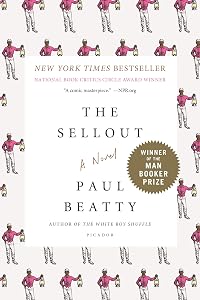
The Sellout
by Paul Beatty
On This Page
Description
"Raised in the "agrarian ghetto" of Dickens--improbably smack in the middle of downtown L.A.--the narrator of The Sellout resigned himself to the fate of all other middle-class Californians: "to die in the same bedroom you'd grown up in, looking up at the crack in the stucco ceiling that had been there since '68 quake." Raised by a single father, a controversial sociologist at Riverside Community College, he spent his childhood as the subject in psychological studies, classic experiments show more revised to include a racially-charged twist. He also grew up believing this pioneering work might result in a memoir that would solve their financial woes. But when his father is killed in a shoot out with the police, he realizes there never was a memoir. All that's left is the bill for a drive-thru funeral and some maudlin what-ifs. Fuelled by this injustice and the general disrepair of his down-trodden hometown, he sets out to right another wrong: Dickens has literally been removed from the map to save California further embarrassment. Enlisting the help of the town's most famous resident--the last surviving Little Rascal, Hominy Jenkins, our narrator initiates a course of action--one that includes reinstating slavery and segregating the local high school--destined to bring national attention. These outrageous events land him with a law suit heard by the Supreme Court, the latest in a series of cases revolving around the thorny issue of race in America. The Sellout showcases a comic genius at the top of his game. It challenges the most sacred tenets of the U.S. Constitution, urban life, the civil rights movement, the father-son relationship, and the holy grail of racial equality--the black Chinese restaurant"-- "A biting satire about a young man's isolated upbringing and the race trial that sends him to the Supreme Court"-- show lessTags
Recommendations




Member Recommendations
Member Reviews
The opening of Paul Beatty's "The Sellout" could be the most shocking beginning for a novel I have ever read, or am likely to read. I started laughing -- out-loud --from the get-go and didn't finish until 288 pages later. He gives me passages as funny as some of the best in John Barth's "The Sot-Weed Factor," Sterne's "Tristram Shandy," "Candide," "The Yawning Heights" by Alexander Zinoviev, even the greatest of them all, Cervantes' "Don Quixote."
It is so shocking partially because of the language, as bald and brash as the toughest rap, and flying across conventions of polite society like black fly season in Northern Ontario. It stings and it really hurts.
Beatty's anti-hero, variously called Bon-Bon, Me, and "The Sellout" is like a show more blackface Thomas Jefferson in modern-day Los Angeles: a farmer, a slave-owner, and an erudite provocateur. A true Californian proud of his sweet fruit. And hilariously proud of his genetically-modified watermellons. I told you it stings!
Angry that the County of Los Angeles has amalgamated his neighbourhood, Dickens, he sets on a path of renewal by reintroducing segregation into the American way of life. Really apartheid. And his plans succeed when poor black youth show growing school test scores and neighbourhood institutions show a revival.
I can tell you from first hand experience that Americans do not like to think of their great political experiment as a failure. Beatty shoves it in their faces.
Given the current turn of events in the US Government, Beatty's contention that integration doesn't work, that white Americans don't like Mexicans, Asians, Aboriginal Americans any more than black Americans rings true. Especially that so many white Americans count themselves at the bottom of the body politic.
Integration never sufficiently answered the biggest questions asked of a contemporary black American: who am I? How do I become myself?
Not just questions for black Americans, or Angelenos. Great questions for us all.
If a certain sadness pervades the novel, it could almost be read as a requiem for the Obama years where so much anticipation was built up only to be deflated by an intransigent Republican Congress. show less
It is so shocking partially because of the language, as bald and brash as the toughest rap, and flying across conventions of polite society like black fly season in Northern Ontario. It stings and it really hurts.
Beatty's anti-hero, variously called Bon-Bon, Me, and "The Sellout" is like a show more blackface Thomas Jefferson in modern-day Los Angeles: a farmer, a slave-owner, and an erudite provocateur. A true Californian proud of his sweet fruit. And hilariously proud of his genetically-modified watermellons. I told you it stings!
Angry that the County of Los Angeles has amalgamated his neighbourhood, Dickens, he sets on a path of renewal by reintroducing segregation into the American way of life. Really apartheid. And his plans succeed when poor black youth show growing school test scores and neighbourhood institutions show a revival.
I can tell you from first hand experience that Americans do not like to think of their great political experiment as a failure. Beatty shoves it in their faces.
Given the current turn of events in the US Government, Beatty's contention that integration doesn't work, that white Americans don't like Mexicans, Asians, Aboriginal Americans any more than black Americans rings true. Especially that so many white Americans count themselves at the bottom of the body politic.
Integration never sufficiently answered the biggest questions asked of a contemporary black American: who am I? How do I become myself?
Not just questions for black Americans, or Angelenos. Great questions for us all.
If a certain sadness pervades the novel, it could almost be read as a requiem for the Obama years where so much anticipation was built up only to be deflated by an intransigent Republican Congress. show less
Reading The Sellout is like taking an extended ride on a tilt-a-whirl.
The Tilt-A-Whirl™: definition: "a large segmented undulating spinning platform with 7 vehicles spread over the surface. Each vehicle spins on its own axis and depending on the weight location of each guest, every thrilling ride is unique."
I, for one, have ever been a fan of the roller coaster and tilt-a-whirl. As you tumble around the air, effortlessly and seemingly without being subjected to the laws of gravity -- and absolutely no point of reference -- you feel like you are spinning through the tunnels of time, as the universe spits you out and you are born anew. You land on Planet Earth still dizzy from the experience, and a little bit wobbly, but glad to be on show more solid ground, finally. Whew!
Beatty's superb novel addressing racism in America is very much like this experience. It is filled with relentless and biting satire that shakes your sense of gravity and leaves you more than a little wobbly as you exit.
It is an amazing knock to America's racial solar plexus, especially given the current events: every time you catch a glimpse of the news, there's another slam to the pscyhe. "Race relations" is just another expression for living in a very ugly, very dysfunctional family, where people don't love you, but damned if they'll let you go and live your own life, on your own terms. I'm amazed, in fact, that the lid hasn't blown off into outer space and that the country continues to function, more or less peacefully.
The one minor difficulty that I see in the work is that it is replete with inside references that the rest of the world just won't understand, and so if it is a mechanism for opening the dialogue between races, as some have suggested, then it has its limitations. (Without a point of reference, there's nowhere to begin.)
On the other hand, as a stand-alone voice that delivers an imaginative poetry of protest; of challenge and of grievance; of confrontation and reproach -- without all the fireworks -- it is superb.
This is a one-man literary peace march delivered in elegiac style, imbued with moments of gut-splitting humour and dirge-like dysphoria: like the spirits of Richard Pryor and Martin Luther King Jr. coming together to deliver a eulogy. show less
The Tilt-A-Whirl™: definition: "a large segmented undulating spinning platform with 7 vehicles spread over the surface. Each vehicle spins on its own axis and depending on the weight location of each guest, every thrilling ride is unique."
I, for one, have ever been a fan of the roller coaster and tilt-a-whirl. As you tumble around the air, effortlessly and seemingly without being subjected to the laws of gravity -- and absolutely no point of reference -- you feel like you are spinning through the tunnels of time, as the universe spits you out and you are born anew. You land on Planet Earth still dizzy from the experience, and a little bit wobbly, but glad to be on show more solid ground, finally. Whew!
Beatty's superb novel addressing racism in America is very much like this experience. It is filled with relentless and biting satire that shakes your sense of gravity and leaves you more than a little wobbly as you exit.
It is an amazing knock to America's racial solar plexus, especially given the current events: every time you catch a glimpse of the news, there's another slam to the pscyhe. "Race relations" is just another expression for living in a very ugly, very dysfunctional family, where people don't love you, but damned if they'll let you go and live your own life, on your own terms. I'm amazed, in fact, that the lid hasn't blown off into outer space and that the country continues to function, more or less peacefully.
The one minor difficulty that I see in the work is that it is replete with inside references that the rest of the world just won't understand, and so if it is a mechanism for opening the dialogue between races, as some have suggested, then it has its limitations. (Without a point of reference, there's nowhere to begin.)
On the other hand, as a stand-alone voice that delivers an imaginative poetry of protest; of challenge and of grievance; of confrontation and reproach -- without all the fireworks -- it is superb.
This is a one-man literary peace march delivered in elegiac style, imbued with moments of gut-splitting humour and dirge-like dysphoria: like the spirits of Richard Pryor and Martin Luther King Jr. coming together to deliver a eulogy. show less
I've finished The Sellout by Paul Beatty, Man Booker winner this year, which is like Dave Chappelle (SNL) on steroids. The story of a "nigger-whisperer" and farmer from a small black enclave in LA called Dickens. As a "crisis negotiator, "I found myself in my pajamas, at least once a week, standing barefoot in an apartment complex courtyard, bullhorn in hand, staring up at some distraught, partially hotcombed-headed mother dangling her baby over a second-floor balcony ledge. When my father did the whispering...every payday he'd be inundated by teeming hordes of the bipolar poor, who having spent it all in one place, and grown tired and unsated from the night's notoriously shitty prime-time television lineup, would unwedge themselves show more from between the couch-bound obese family members and the boxes of unsold Avon beauty products, turn off the kitchen radio pumping song after song extolling the virtues of Friday nights living it up at the club, popping bottles, niggers and cherries in that order, then having canceled the next day's appointment with their mental health care professional, the chatterbox cosmetologist, who after years doing heads, still knows only one hairstyle--fried, dyed and laid to the wide--they'd choose that Friday, 'day of Venus,' goddess of love, beauty and unpaid bills, to commit suicide, murder, or both. But under my watch people tended to snap on Wednesday. Hump day."
This book took me a long time to get into, to get used to his language and craziness and a feeling of not wanting to be there at all, but now I look up at my favorite quotes and marvel at Beatty's creativity and smack-on descriptions and realize he is a winner. At times, I was thinking of Tom Robbins or J. P. Donleavy - you can see I don't keep up with today's comic writers much - because his plots and situations seemed so outlandish and out-of-my-world and they may be, but his is a formidable talent for writing. I am with him. The book club was not, only one other liked it. More favorite quotes:
"Most times there's so much Nina Simone 'Mississippi Goddam' despondency in the night air it becomes hard to focus. The deep purple contusions about the face and arms...And invariably, softly in the background, billowing the curtains through the parted sliding glass doors, there's always Nina Simone. These are the women my father warned me about. The drug-and-asshole-addled women who sit in the dark, hard up and lovesick, chain-smoking cigarettes, phones pressed to their ear, speed-dialing K-Earth 101 FM, the oldies station, so they can request Nina Simone or the Shirelles' 'This is Dedicated to the One I Love' aka 'This is Dedicated to Niggers That Beat Me Senseless and Leave.' Stay away from bitches who love Nina Simone and have faggots for best friends,' he'd say, 'They hate men.' "
"That's the problem with history, we like to think it's a book--that we can turn the page and move the fuck on. But history isn't the paper it's printed on. It's memory, and memory is time, emotions, and song. History is the things that stay with you." p.115
"You never see people in commercials that look 'Jewish,' just as you never see black people that come off as 'urban' and hence 'scary,' or handsome Asian men, or dark-skinned Latinos.. you see more ads featuring unicorns and leprechauns than you do gay men and women...But if you really think about it, the only thing you absolutely never see in car commercials isn't Jewish people, homosexuals or urban Negroes, it's traffic." p. 139
Sister Cities. "Some unions, like that of Tel Aviv and Berlin, Paris and Algiers, Honolulu and Hiroshima, are designed to signal an end to hostilities and the beginning of peace and prosperity. Others are shotgun marriages because one city (e.g.,Atlanta) impregnated another (e.g., Lagos) on a first date...Some cities marry up for money and prestige; others marry down to piss off their mother countries, Guess who's coming for dinner? Kabul! Every now and then, two cities meet and fall in love out of mutual respect and a love for hiking, thunderstorms and classic rock 'n' roll. Think Amsterdam and Istanbul. Buenos Aires and Seoul." p.145
"For the most part in L.A. County you can gauge the threat level of a community by the color of its street signs. In Los Angeles proper the signs are a hollowed-out metallic midnight blue. If a bird's nest constructed of pine needles was tucked inside the sign, it meant evergreen trees and a nearby golf course. Mostly white public-school kids whose parents lived above their means in upper-middle-class neighborhoods like Cheviot Hills, Silver Lake and the Palisades. Bullet holes and a stolen car wrapped around the post signified kids about my hair texture, allowance level, and clothing syle in neighborhoods like Watts, Boyle Heights, and Highland Park. Sky blue signified kick back cool bedroom communities like Santa Monica, Rancho Palos Verdes, and Manhattan Beach. Chill dudes commuting to school by any means necessary from skateboard to hang glider, the good-bye lipstick prints from their trophy-wife mothers still on their cheeks. Carson, Hawthorne, Culver City, South Gate and Torrance are all designated by a working-class cactus green; there the little homies are independent, familiar and multilingual. Fluent in Hispanic, black, and Samoan gang signs. In Hermosa Beach, La Mirada and Duarte the street signs are the bland brown of cheap blended malt whiskey. The boys and girls mope their way to school, depressed and drowsy, past the hacienda-style tract housing. The sparkling white signs denote Beverly Hills, of course. Exceedingly wide hilly streets lined with rich kids unthreatened by my appearance. Assuming that if I was there I belonged. Asking me about the tension of my tennis racquets. Schooling me on the blues, the history of hip-hop, Rastafarianism, the Coptic Church, jazz, gospel, and the myriad of ways in which a sweet potato can be prepared." p. 191
"Daddy never believed in closure. He said it was a false psychological concept. Something invented by therapists to assuage white Western guilt. In all his years of study and practice, he'd never heard a patient of color talk of needing 'closure.' They needed revenge. They needed distance. Forgiveness and a good lawyer, maybe, but never closure. He said people mistake suicide, murder, lap band surgery, interracial marriage, and overtipping for closure, when in reality what they've achieved is erasure." p. 261 show less
This book took me a long time to get into, to get used to his language and craziness and a feeling of not wanting to be there at all, but now I look up at my favorite quotes and marvel at Beatty's creativity and smack-on descriptions and realize he is a winner. At times, I was thinking of Tom Robbins or J. P. Donleavy - you can see I don't keep up with today's comic writers much - because his plots and situations seemed so outlandish and out-of-my-world and they may be, but his is a formidable talent for writing. I am with him. The book club was not, only one other liked it. More favorite quotes:
"Most times there's so much Nina Simone 'Mississippi Goddam' despondency in the night air it becomes hard to focus. The deep purple contusions about the face and arms...And invariably, softly in the background, billowing the curtains through the parted sliding glass doors, there's always Nina Simone. These are the women my father warned me about. The drug-and-asshole-addled women who sit in the dark, hard up and lovesick, chain-smoking cigarettes, phones pressed to their ear, speed-dialing K-Earth 101 FM, the oldies station, so they can request Nina Simone or the Shirelles' 'This is Dedicated to the One I Love' aka 'This is Dedicated to Niggers That Beat Me Senseless and Leave.' Stay away from bitches who love Nina Simone and have faggots for best friends,' he'd say, 'They hate men.' "
"That's the problem with history, we like to think it's a book--that we can turn the page and move the fuck on. But history isn't the paper it's printed on. It's memory, and memory is time, emotions, and song. History is the things that stay with you." p.115
"You never see people in commercials that look 'Jewish,' just as you never see black people that come off as 'urban' and hence 'scary,' or handsome Asian men, or dark-skinned Latinos.. you see more ads featuring unicorns and leprechauns than you do gay men and women...But if you really think about it, the only thing you absolutely never see in car commercials isn't Jewish people, homosexuals or urban Negroes, it's traffic." p. 139
Sister Cities. "Some unions, like that of Tel Aviv and Berlin, Paris and Algiers, Honolulu and Hiroshima, are designed to signal an end to hostilities and the beginning of peace and prosperity. Others are shotgun marriages because one city (e.g.,Atlanta) impregnated another (e.g., Lagos) on a first date...Some cities marry up for money and prestige; others marry down to piss off their mother countries, Guess who's coming for dinner? Kabul! Every now and then, two cities meet and fall in love out of mutual respect and a love for hiking, thunderstorms and classic rock 'n' roll. Think Amsterdam and Istanbul. Buenos Aires and Seoul." p.145
"For the most part in L.A. County you can gauge the threat level of a community by the color of its street signs. In Los Angeles proper the signs are a hollowed-out metallic midnight blue. If a bird's nest constructed of pine needles was tucked inside the sign, it meant evergreen trees and a nearby golf course. Mostly white public-school kids whose parents lived above their means in upper-middle-class neighborhoods like Cheviot Hills, Silver Lake and the Palisades. Bullet holes and a stolen car wrapped around the post signified kids about my hair texture, allowance level, and clothing syle in neighborhoods like Watts, Boyle Heights, and Highland Park. Sky blue signified kick back cool bedroom communities like Santa Monica, Rancho Palos Verdes, and Manhattan Beach. Chill dudes commuting to school by any means necessary from skateboard to hang glider, the good-bye lipstick prints from their trophy-wife mothers still on their cheeks. Carson, Hawthorne, Culver City, South Gate and Torrance are all designated by a working-class cactus green; there the little homies are independent, familiar and multilingual. Fluent in Hispanic, black, and Samoan gang signs. In Hermosa Beach, La Mirada and Duarte the street signs are the bland brown of cheap blended malt whiskey. The boys and girls mope their way to school, depressed and drowsy, past the hacienda-style tract housing. The sparkling white signs denote Beverly Hills, of course. Exceedingly wide hilly streets lined with rich kids unthreatened by my appearance. Assuming that if I was there I belonged. Asking me about the tension of my tennis racquets. Schooling me on the blues, the history of hip-hop, Rastafarianism, the Coptic Church, jazz, gospel, and the myriad of ways in which a sweet potato can be prepared." p. 191
"Daddy never believed in closure. He said it was a false psychological concept. Something invented by therapists to assuage white Western guilt. In all his years of study and practice, he'd never heard a patient of color talk of needing 'closure.' They needed revenge. They needed distance. Forgiveness and a good lawyer, maybe, but never closure. He said people mistake suicide, murder, lap band surgery, interracial marriage, and overtipping for closure, when in reality what they've achieved is erasure." p. 261 show less
The Booker Prize Winning social satire is about a black man in SoCal whose attempts to reinvigorate his community land him in front of the Supreme Court for slaveholding. The whole story is a farcical satire with over the top vocabulary, historical and pop culture references, and racially-charged humor. The only way to not be offended is to admit it's equal-opportunity-offensive, meaning every group and identity gets made fun in turn. The message is loud and clear and I appreciate that the author said it. However, the book is not fun to read. It's too much of a good thing, exhausting even.
A twisted meditation on race and black identity in America, where the subtext is just as strong as the humour. I tried explaining the plot to a friend and failed utterly, for it isn't anchored by the story but by Beatty's incisive wit and courageous, sometimes shocking humour. It's full of sentences that will make you laugh out loud with their wit, and make you feel smart with their subtlety (or outrageousness). It's free-flowing, adventurous, brave and as the good people of Dickens would probably describe it, it's like jazz. By the end, the humour does tire itself out a little, or maybe the first half is just more fun, but it redeems itself with an ending that shows what a powerful tool satire absurdism is in making us think about show more "difficult to discuss" topics. And looking back, it does make the reader think quite deeply about them. I should probably give this a 4/5 but it won't stick with me for long, outside of the way the language and the humour were structured.
Second read: In my previous read, I'd missed the profundity of the final chapters. The book is an even deeper meditation than I'd realized earlier. If it didn't stick with me for long last time, this time it surely will. show less
Second read: In my previous read, I'd missed the profundity of the final chapters. The book is an even deeper meditation than I'd realized earlier. If it didn't stick with me for long last time, this time it surely will. show less
The Sellout opens with Me, a black man who has inherited an urban farm in a southeastern suburb of Los Angeles, sitting before the Supreme Court. He has been prosecuted for being a slave owner and trying to segregate the community schools in an attempt to literally put his hometown of Dickens back on the map. While he waits for his case—Me v. the United States of America, sort of a modern-day contrast to Plessy v. Ferguson—to be called, he passes the time by smoking some of the artisanal marijuana that he and Hominy Jenkins, his self-anointed slave and former Little Rascals sidekick, grow alongside their watermelons. The rest of the novel then provides the backfill story of how Me came to find himself in such a position, beginning show more with his upbringing by a psychologist father with some unusual parenting techniques to his emergence as a reluctant social activist for a largely apathetic population.
Does this sound like the outline of some kind of bizarre update of To Kill a Mockingbird? Well, it is hardly that. Instead, The Sellout is a wildly comical satire on the fractured state of race relations today, one of the most deadly serious topics I can imagine. Paul Beatty does a remarkable job of filling the tale with a dizzying number of historical and cultural references while taking absolutely no prisoners when examining the stereotypes and hypocrisies that exist on all sides of the issue. Along the way, the reader is treated to many laugh-out-loud scenes while being exposed to more creative uses of the n-word (and, trust me, there are a lot of them) than you would think possible. Although its underlying plot is a little thin, this is a book that delivers a powerful message. It is also a novel that really could only have been written by an author who is (1) black, (2) deeply insightful, and (3) hysterically funny. Fortunately, Beatty is all of those things. show less
Does this sound like the outline of some kind of bizarre update of To Kill a Mockingbird? Well, it is hardly that. Instead, The Sellout is a wildly comical satire on the fractured state of race relations today, one of the most deadly serious topics I can imagine. Paul Beatty does a remarkable job of filling the tale with a dizzying number of historical and cultural references while taking absolutely no prisoners when examining the stereotypes and hypocrisies that exist on all sides of the issue. Along the way, the reader is treated to many laugh-out-loud scenes while being exposed to more creative uses of the n-word (and, trust me, there are a lot of them) than you would think possible. Although its underlying plot is a little thin, this is a book that delivers a powerful message. It is also a novel that really could only have been written by an author who is (1) black, (2) deeply insightful, and (3) hysterically funny. Fortunately, Beatty is all of those things. show less
Paul Beatty not only has the unmitigated blackness to write essay disguised as fiction, he even has the unmitigated blackness to indicate he did so in a section entitled Unmitigated Blackness. I had already read other reviews complaining about its not being a real novel, and it certainly isn't when judged by the standards which the literary establishment (which, like all establishments, is unacknowledged invisible White by default) but to level this charge would be like saying Rap isn't music, Ebonics isn't a language, gay marriage isn't marriage, and of course there are those who say all those things.
It is a post-racial novel, not in the sense that racism is over, but in the sense that post-modernism lives alongside of modernism show more lowering the property values. Halfway through reading it, I thought that the author would appreciate it if I rated it with an extra star for Affirmative Action, but then at the end, when the White couple is thrown out of the Black comedy performance, I took it personally even as I understood the point-- that segregation can be a positive value when it creates a more comfortable atmosphere allowing for the non-default group to excel.
I did NOT take it personally when Bonbon's father was shot by the LA police because unarmed Black people being shot is a cliche. Was I supposed to feel something? Is it a failure of the writing to involve me emotionally? Or is what I was supposed to feel exactly what I did feel--that being the lack while noticing it? It explains why we have to be reminded that Black lives matter, not because we've forgotten that it's so but because we've forgotten to feel anything in its everydayness.
I like to think of this as a work of social-science-fiction, with the attendant characterization weaknesses of the sci-fi genre which we overlook because the ideas captivate us.
If sometimes the sadomasochism jokes were too much for me, I suspect this is a matter of taste--I tend to prefer not to use hot sauce as is my cultural proclivity.
The question this book asks is tossed off as a one liner "What is our thing?" "Cosa Nostra" in Italian, so "Gangsta" in Blackitude? Does "post-racialism" mean our thing has been appropriated?
If racism is difficult to talk about this book must have been difficult to write, but it's so easy to read. show less
It is a post-racial novel, not in the sense that racism is over, but in the sense that post-modernism lives alongside of modernism show more lowering the property values. Halfway through reading it, I thought that the author would appreciate it if I rated it with an extra star for Affirmative Action, but then at the end, when the White couple is thrown out of the Black comedy performance, I took it personally even as I understood the point-- that segregation can be a positive value when it creates a more comfortable atmosphere allowing for the non-default group to excel.
I did NOT take it personally when Bonbon's father was shot by the LA police because unarmed Black people being shot is a cliche. Was I supposed to feel something? Is it a failure of the writing to involve me emotionally? Or is what I was supposed to feel exactly what I did feel--that being the lack while noticing it? It explains why we have to be reminded that Black lives matter, not because we've forgotten that it's so but because we've forgotten to feel anything in its everydayness.
I like to think of this as a work of social-science-fiction, with the attendant characterization weaknesses of the sci-fi genre which we overlook because the ideas captivate us.
If sometimes the sadomasochism jokes were too much for me, I suspect this is a matter of taste--I tend to prefer not to use hot sauce as is my cultural proclivity.
The question this book asks is tossed off as a one liner "What is our thing?" "Cosa Nostra" in Italian, so "Gangsta" in Blackitude? Does "post-racialism" mean our thing has been appropriated?
If racism is difficult to talk about this book must have been difficult to write, but it's so easy to read. show less
Members
- Recently Added By
Published Reviews
ThingScore 100
“The book deals with gentrification, police violence, and racism. But Beatty didn’t need a crystal ball for his biting satire.”
added by Lemeritus
added by private library
But somehow, The Sellout isn't just one of the most hilarious American novels in years, it also might be the first truly great satirical novel of the century.
added by Capybara_99
Lists

2016 Tournament of Books
17 works; 20 members

1001 Books You Must Read Before You Die
1,448 works; 1,134 members

Best 21st Century Books (So Far)
670 works; 85 members

Top Five Books of 2020
982 works; 348 members

Booker Prize
491 works; 62 members

Vulture's 100 Best Books of the 21st Century (So Far)
98 works; 9 members

Must-Read Books by Black Authors
114 works; 92 members

2016 Notable Books for Adults
26 works; 7 members

This is the Canon: Decolonize Your Bookshelf in 50 Books
51 works; 5 members

Top Five Books of 2016
795 works; 229 members

Man Booker Prize Longlist 2016
13 works; 2 members

50 Books from the Past 50 Years
50 works; 8 members

Books Read in 2017
4,249 works; 129 members
Contemporary Fiction
109 works; 7 members

Books Read in 2016
4,666 works; 197 members
Kirkus Starred Fiction Reviews of Books Published in 2015
310 works; 6 members
International Dublin Literary Award Longlist 2017
147 works; 3 members

Books Read in 2020
4,379 works; 124 members
Books Read in 2015
3,299 works; 129 members

NYT: Notable Books of 2015 (Fiction & Poetry)
20 works; 1 member

Dublin Literary Award Longlist 2017
147 works; 2 members

Overdue Podcast
806 works; 9 members
wish list
61 works; 3 members

Books Read in 2018
4,360 works; 110 members

NPR Readers Poll: 100 Favorite Funny Books
100 works; 5 members
LitHub's Best Novels of the Decade 2010-2019
39 works; 1 member

The Atlantic's The Great American Novel
136 works; 12 members
NYT 100 best books of 21st C
100 works; 31 members

Retrospective of 20th- and 21st-century literature
154 works; 1 member
Best Books of the 2010s
20 works; 1 member

.
184 works; 1 member

Books Read in 2025
4,091 works; 97 members

To Read
617 works; 7 members

Schomburg Centennial Reading List
100 works; 4 members
Author Information

7+ Works 5,575 Members
Some Editions
Awards and Honors
Awards
Distinctions
Notable Lists
Work Relationships
Is contained in
Common Knowledge
- Canonical title
- The Sellout
- Original title
- The Sellout
- Original publication date
- 2015-03-03
- People/Characters
- "Bonbon" Me; Foy Cheshire; Hominy Jenkins; Hampton Fiske; Murray Flores; Bridget "La Giggles" Sanchez (show all 35); Marpessa Delissa Dawson; Tasha [in The Sellout]; Mistress Dorothy; King Cuz (Curtis Baxter); Officer Mendez; Laura Jane; Susan Silverman; Charisma Molina; Nestor Lopez; Sheila Clark; Clyde; Stevie Dawson; Lori Lopez; Dori Lopez; Jerry Lopez; Charlie Lopez; Billy Lopez; Kristina Davis; Butterfly Davis; Suzy Holland; Hannah Nater; Robby Haley; Keagan Goodrich; Melonie Vanderweghe; Judge Nguyen; Fred Manne; Adam Y; Chantal Mattingly; Me's Father
- Important places
- Dickens, California, USA; Los Angeles, California, USA; California, USA; United States of America; Washington, D.C., USA; Mississippi, USA
- Dedication
- For Althea Amrik Wasow
- First words
- This may be hard to believe, coming from a black man, but I've never stolen anything. Never cheated on my taxes or at cards. Never snuck into the movies or failed to give back the extra change to a drugstore cashier indiffere... (show all)nt to the ways of mercantilism and minimum wage expectations. I've never burgled a house. Held up a liquor store. Never boarded a crowded bus or subway car, sat in the middle seat reserved for the elderly, pulled out my gigantic penis and masturbated to satisfaction with a perverted, yet somehow crestfallen, look on my face. But here I am, in the cavernous chambers of the Supreme Court of the United States of America, my car illegally and somewhat ironically parked on Constitution Avenue, my hands cuffed and crossed behind my back, my right to remain silent long since waived and said goodbye to as I sit in a thickly padded chair that, much like this country isn't quite as comfortable as it looks. -Prologue
I suppose that's exactly the problem - I wasn't raised to know better. My father was (Carl Jung, rest his soul) a social scientist of some renown. As the founder and, to my knowledge, sole practitioner in the field of Liberta... (show all)rian Psychology, he liked to walk around the house, aka "the Skinner box," in a laboratory coat. where I, his gangly, absentminded black lab rat was homeschooled in strict accordance with Piaget's theory of cognitive development, I wasn't fed; I was presented with lukewarm appetitive stimuli. I wasn't punished, but broken of my unconditioned reflexes. I wasn't loved, but brought up in an atmosphere of calculated intimacy and intense levels of commitment. -Chapter 1 - Quotations
- Silence can be either protest or consent, but most times it’s fear.
Foy was no Tree of Knowledge, at most he was a Bush of Opinion. - Last words
- (Click to show. Warning: May contain spoilers.)I never will.
- Blurbers
- Silverman, Sarah; Marcus, Ben; Lipsyte, Sam; Williams, Olivia
- Original language
- English
- Canonical DDC/MDS
- 813.54
- Canonical LCC
- PS3552.E19
Classifications
Statistics
- Members
- 4,064
- Popularity
- 3,820
- Reviews
- 144
- Rating
- (3.77)
- Languages
- 11 — Czech, Dutch, English, French, German, Hebrew, Italian, Polish, Spanish, Swedish, Portuguese (Portugal)
- Media
- Paper, Audiobook, Ebook
- ISBNs
- 38
- UPCs
- 1
- ASINs
- 17