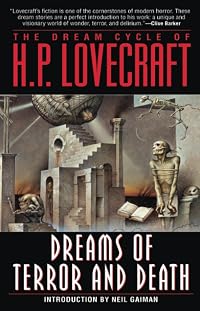
The Dream Cycle of H.P. Lovecraft: Dreams of Terror and Death
by H. P. Lovecraft
On This Page
Description
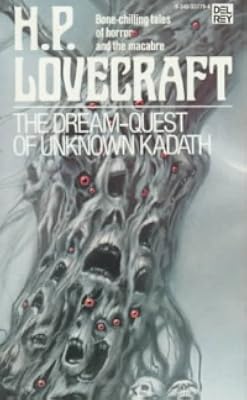
The only audio edition of Dreams of Terror and Death authorized by the H. P. Lovecraft Estate! This volume collects, for the first time, the entire Dream Cycle created by H. P. Lovecraft, the master of twentieth-century horror, including some of his most fantastic tales, such as: The Doom That Came to Sarnath-Hate, genocide, and a deadly curse consume the land of Mnar. The Statement of Randolph Carter-"You fool, Warren is dead!"The Nameless City-Death lies beneath the shifting sands, in a show more story linking the Dream Cycle with the legendary Cthulhu Mythos. The Cats of Ulthar-In Ulthar, no man may kill a cat … and woe unto any who tries. The Dream Quest of Unknown Kadath-The epic nightmare adventure with tendrils stretching throughout the entire Dream Cycle. Plus twenty more tales of surreal terror!. show lessTags
Recommendations
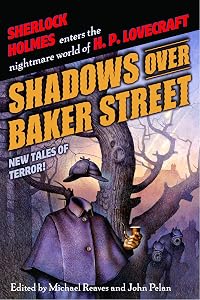
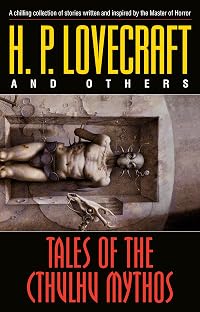

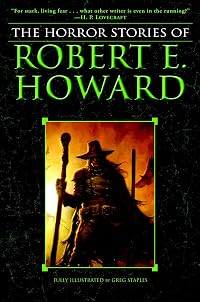


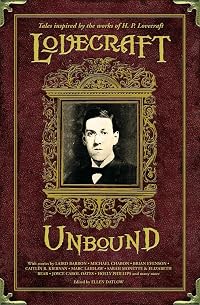









Member Recommendations
Member Reviews
This collection contains many of Lovecraft’s strongest stories, and for the most part it reminds you why his work still matters. At his best, Lovecraft creates a universe that is vast, cold, and fundamentally indifferent to humanity. His protagonists do not triumph. They discover something they were not meant to know, and that knowledge costs them their sanity, their humanity, or their lives. Stories like *Pickman’s Model* and others in this volume work precisely because contact with the unknown has irreversible consequences.
Lovecraft’s worlds are not places you can explore safely. They are traps. Once you see what is really there, you cannot return unchanged.
Because of that, the Randolph Carter stories feel strangely out of place show more in this collection. They read almost like adventure tales rather than horror. Carter travels through strange realms, encounters entities from the mythos, and survives his experiences. The tone shifts from cosmic dread to dreamlike exploration.
That shift weakens the fundamental premise of Lovecraft’s universe. In his most powerful stories, the cosmic forces are unknowable and overwhelming. You cannot bargain with them, map their territories, or walk through their domains and come home again. Knowledge in Lovecraft is corrosive. It erodes the human mind and identity.
The Carter stories soften that rule. The universe becomes something navigable rather than something that destroys those who approach it. Instead of dread, we get a kind of mythic adventure, full of references to other elements of the mythos. While these stories are imaginative, they diminish the cold, incomprehensible scale that makes Lovecraft’s horror so effective.
For readers who come to Lovecraft for cosmic horror, the Carter material feels like a different mode entirely. Well written, certainly, but closer to fantasy than to terror.
Fortunately, the rest of the collection shows Lovecraft operating at full strength. When he keeps the unknown truly unknowable, and when his characters cannot escape what they discover, the stories retain the bleak power that defines his work.
In Lovecraft’s best fiction, the rule is simple: you cannot escape his worlds. At best, you survive long enough to understand what you have lost. show less
Lovecraft’s worlds are not places you can explore safely. They are traps. Once you see what is really there, you cannot return unchanged.
Because of that, the Randolph Carter stories feel strangely out of place show more in this collection. They read almost like adventure tales rather than horror. Carter travels through strange realms, encounters entities from the mythos, and survives his experiences. The tone shifts from cosmic dread to dreamlike exploration.
That shift weakens the fundamental premise of Lovecraft’s universe. In his most powerful stories, the cosmic forces are unknowable and overwhelming. You cannot bargain with them, map their territories, or walk through their domains and come home again. Knowledge in Lovecraft is corrosive. It erodes the human mind and identity.
The Carter stories soften that rule. The universe becomes something navigable rather than something that destroys those who approach it. Instead of dread, we get a kind of mythic adventure, full of references to other elements of the mythos. While these stories are imaginative, they diminish the cold, incomprehensible scale that makes Lovecraft’s horror so effective.
For readers who come to Lovecraft for cosmic horror, the Carter material feels like a different mode entirely. Well written, certainly, but closer to fantasy than to terror.
Fortunately, the rest of the collection shows Lovecraft operating at full strength. When he keeps the unknown truly unknowable, and when his characters cannot escape what they discover, the stories retain the bleak power that defines his work.
In Lovecraft’s best fiction, the rule is simple: you cannot escape his worlds. At best, you survive long enough to understand what you have lost. show less
If you think Lovecraft is all doom and madness, this compilation of stories is here to teach an important lesson: sometimes he's also writing about how cats can save someone from moon monsters. This collection of short stories is a well-selected look into the stories Lovecraft wrote set in and around the world of dreams. Only brushing the Cthulhu mythos, I found these other works to offer a more rounded view of the author and the universe he created. Included among the shorter stories are two novellas, The Case of Charles Dexter Ward and The Dream Quest for Unknown Kadath. Both of these works were rather trying at times - Lovecraft's signature attention to somewhat dry and very minute detail can drag sometimes over a hundred pages - but show more I enjoyed both and they were a refreshing change of pace.
This is a must read for anyone looking for a side of Lovecraft which has been somewhat overlooked in popular culture, and for those who want to know what's up with his love of cats. show less
This is a must read for anyone looking for a side of Lovecraft which has been somewhat overlooked in popular culture, and for those who want to know what's up with his love of cats. show less
My name is Howard Phillips. I live at 66 College Street, in Providence, Rhode Island. On November 24, 1927-for I know not what the year may be now-I fell asleep and dreamed, since when I have been unable to awaken.
Lovecraft becomes one of the Dreamers, and wow is it effective.
Lovecraft becomes one of the Dreamers, and wow is it effective.
I wanted to respond in brief to some few of your own comments. Lovecraft's Antisemitism was directed at the Jewish race as it manifested itself in Urban communities--Lovecraft often complains of the "packs" of non-whites he encountered. But he set this bigotry aside in the cases of individuals whom he met or with whom he corresponded. Sonia was a beautiful, vibrant woman and she swept Lovecraft off his feet. They were deeply in love, but the marriage was destroyed, as Sonia wrote in a letter to Samuel Loveman, by HPL's hatred of the Jewish race, which was manifested in Lovecraft's perpetual harping of to his long-suffering wife. Most of the notorious racists whom I know will have absolutely nothing to do with the racists they show more abhor--nothing; and so in this Lovecraft's racism was singular in nature. He was raised in a racist household, by a mother and aunts who applauded the poem he wrote when he was very young, "On the Creation of Niggers." He wrote that poem to entertain his family and get acceptance from them, and they rewarded him for it. Porius: there is absolutely no indication that HPL ever came to "accept the dreaded asiatic horde"--just the opposite.
NoirSeanF: I doubt that this collection is "most popular for the Randolph Carter pseudo-series," which form a very minor facet of Lovecraft's impressive oeuvre. I would judge "Pickman's Model," "The Case of Charles Dexter Ward," and "The Dreams in the Witch House" as the really well-known and most-referenced tales in the book. "The Statement of Randolph Carter" is indeed very well known, and has the distinction of being one of the most widely filmed of Lovecraft's tales--numerous versions of it have been shewn at the H. P. Lovecraft Film Festival.
I love coming to Library Thing and reading all of your views on Lovecraft. Thanks for all of the activity, and keep reading Lovecraft! show less
NoirSeanF: I doubt that this collection is "most popular for the Randolph Carter pseudo-series," which form a very minor facet of Lovecraft's impressive oeuvre. I would judge "Pickman's Model," "The Case of Charles Dexter Ward," and "The Dreams in the Witch House" as the really well-known and most-referenced tales in the book. "The Statement of Randolph Carter" is indeed very well known, and has the distinction of being one of the most widely filmed of Lovecraft's tales--numerous versions of it have been shewn at the H. P. Lovecraft Film Festival.
I love coming to Library Thing and reading all of your views on Lovecraft. Thanks for all of the activity, and keep reading Lovecraft! show less
The Dream cycle of H.P. Lovecraft is one out of three books containing all of Lovecrafts work. This, i believe, is the second volume in the trilogy. This volume focuses on all of Lovecrafts fantasy or dream based stories or even just his stories that are really surreal. Currently i am in the middle of the novella "The Dream Quest of Unknown Kadath". up until now i have enjoyed all of the stories (although some are hard to understand because they take place in the dream land). i would recommend this to anyone who is a fan of Lovecrafts work or anyone who really cares about horror because Lovecraft was one of the revolutionary horror writers of all time. i wouldn't recommend it, however, as the introductory to Lovecrafts work.
This was my introduction to Lovecraft. There are some very good stories in this book, but unfortunately, some of them were also tedious to me. I will probably read other Lovecraft in the future, but I cannot say that this is a favorite.
lovecraft learned over the years to accept the dreaded asiatic horde.
Members
- Recently Added By
Lists

Weird and Weirder Fiction
270 works; 34 members

eXTREME cOVER art
2 works; 1 member
Author Information

1,940+ Works 74,225 Members
Howard Phillips Lovecraft, 1890 - 1937 H. P. Lovecraft was born on August 20, 1890 in Providence, Rhode Island. His mother was Sarah Susan Phillips Lovecraft and his father was Winfield Scott Lovecraft, a traveling salesman for Gorham & Co. Silversmtihs. Lovecraft was reciting poetry at the age of two and when he was three years old, his father show more suffered a mental breakdown and was admitted to Butler Hospital. He spent five years there before dying on July 19, 1898 of paresis, a form of neurosyphillis. During those five years, Lovecraft was told that his father was paralyzed and in a coma, which was not the case. His mother, two aunts and grandfather were now bringing up Lovecraft. He suffered from frequent illnesses as a boy, many of which were psychological. He began writing between the ages of six and seven and, at about the age of eight, he discovered science. He began to produce the hectographed journals, "The Scientific Gazette" (1899-1907) and "The Rhode Island Journal of Astronomy" (1903-07). His first appearance in print happened, in 1906, when he wrote a letter on an astronomical matter to The Providence Sunday Journal. A short time later, he began writing a monthly astronomy column for The Pawtuxet Valley Gleaner - a rural paper. He also wrote columns for The Providence Tribune (1906-08), The Providence Evening News (1914-18), The Asheville (N.C.) Gazette-News (1915). In 1904, his grandfather died and the family suffered severe financial difficulties, which forced him and his mother to move out of their Victorian home. Devastated by this, he apparently contemplated suicide. In 1908, before graduating from high school, he suffered a nervous breakdown. He didn't receive a diploma and failed to get into Brown University, both of which caused him great shame. Lovecraft was not heard from for five years, re-emerging because of a letter he wrote in protest to Fred Jackson's love story in The Argosy. His letter was published in 1913 and caused great controversy, which was noted by Edward F. Daas, President of the United Amateur Press Association (UAPA). Daas invited Lovecraft to join the UAPA, which he did in early 1914. He eventually became President and Official Editor of the UAPA and served briefly as President of the rival National Amateur Press Association (NAPA). He published thirteen issues of his own paper, The Conservative (1915-23) and contributed poetry and essays to other journals. He also wrote some fiction which titles include "The Beast in the Cave" (1905), "The Alchemist" (1908), "The Tomb" and "Dagon" (1917). In 1919, Lovecraft's mother was deteriorating, mentally and physically, and was admitted to Butler Hospital. On May 24, 1921, his mother died from a gall bladder operation. While attending an amateur journalism convention in Boston, Lovecraft met his future wife Sonia Haft Greene, a Russian Jew. They were married on March 3, 1924 and Lovecraft moved to her apartment in Brooklyn. Sonia had a shop on Fifth Avenue that went bankrupt. In 1925, Sonia went to Cleveland for a job and Lovecraft moved to a smaller apartment in the Red Hook district of Brooklyn. In 1926, he decided to move back to Providence. Lovecraft had his aunts bar his wife, Sonia, from going to Providence to start a business because he couldn't have the stigma of a tradeswoman wife. They were divorced in 1929. After his return to Providence, he wrote his greatest fiction, which included the titles "The Call of Cthulhu" (1926), "At the Mountains of Madness" (1931), and "The Shadow Out of Time" (1934-35). In 1932, his aunt, Mrs. Clark, died; and he moved in with his other aunt, Mrs. Gamwell, in 1933. Suffering from cancer of the intestine, Lovecraft was admitted to Jane Brown Memorial Hospital and on March 15, 1937 he died. (Bowker Author Biography) show less
All Editions
Some Editions
Work Relationships
Contains
Common Knowledge
- Canonical title
- The Dream Cycle of H.P. Lovecraft: Dreams of Terror and Death
- Original publication date
- 1995-10 (compilation) (compilation)
- People/Characters
- Atal; Azathoth (Great Old One); Barzai the Wise; Randolph Carter; Iranon; Kuranes (show all 15); Lord Northam; Nyarlathotep (Great Old One); Howard Phillips; Richard Upton Pickman; Romnod; Joe Slater; Charles Dexter Ward; Harley Warren; Yog-Sothoth (Great Old One)
- Important places
- Aira (city); Celephais, Ooth-Nargai, Dreamlands; Dylath-Leen, Dreamlands; Hatheg; Hatheg-Kla (mountain); Kadath (in the cold waste | mountain) (show all 24); Plateau of Leng; Oonai (the city of lutes and dancing); Baharna, Oriab, Dreamlands; Vale of Pnath, Underworld, Dreamlands; Sarnath, Dreamlands; Teloth; Ulthar, Dreamlands; The Netherlands; Kent, England, UK; London, England, UK; Danvers Asylum; Arkham, Massachusetts, USA; Boston, Massachusetts, USA; Providence, Rhode Island, USA; Arkham Sanatorium, Arkham, Massachusetts, USA; Massachusetts, USA; Rhode Island, USA; USA
- Blurbers
- Barker, Clive; Carpenter, John; Gordon, Stuart; Koenig, Walter
Classifications
Statistics
- Members
- 1,580
- Popularity
- 14,494
- Reviews
- 9
- Rating
- (4.10)
- Languages
- English
- Media
- Paper, Audiobook, Ebook
- ISBNs
- 11
- ASINs
- 3