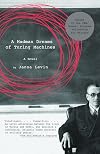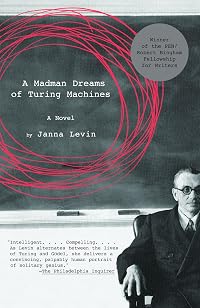
A Madman Dreams of Turing Machines
by Janna Levin
On This Page
Description
Kurt Gödel’s Incompleteness Theorems sent shivers through Vienna’s intellectual circles and directly challenged Ludwig Wittgenstein’s dominant philosophy. Alan Turing’s mathematical genius helped him break the Nazi Enigma Code during WWII. Though they never met, their lives strangely mirrored one another—both were brilliant, and both met with tragic ends. Here, a mysterious narrator intertwines these parallel lives into a double helix of genius and anguish, wonderfully capturing show more not only two radiant, fragile minds but also the zeitgeist of the era.. show less
Tags
Recommendations









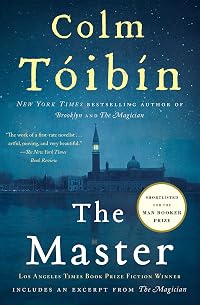
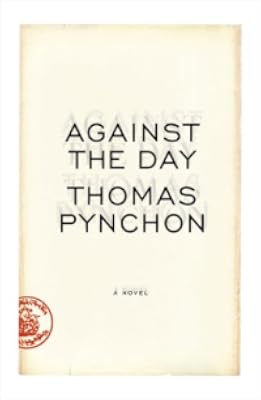
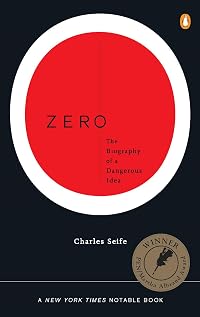
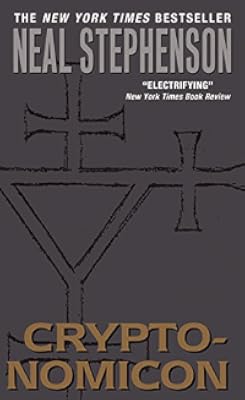
Member Recommendations
Member Reviews
Ah, this book. It's working on two fronts and this leaves gaps on both: it's light on the story to sneak in the philosophy, light on the philosophy to sneak in the story. But I enjoyed it nonetheless - I had never really considered the contemporary enormity of the first of Wittgenstein's claims in the Tractatus, and this it demonstrates, even if we don't get much on Turing's machines and Godel's incompleteness theorums. Much is skipped over or mentioned retrospectively, leaving you wanting more detail, more excitement. But good enough to be an enjoyable and thought-provoking read.
A rather lovely tribute to two fascinating, brilliant, odd, and sad men. I was familiar with the intellectual work of both Gödel and Turing, but didn't know much about their lives (and deaths).
The most interesting aspect of the novel was the way Levin showed the parallels and intersections of the lives of two men who were aware of each other but never met.
One wonders how their respective work would have been different had each of them had different personalities and lives. And what an actual meeting between them would have been like.
The most interesting aspect of the novel was the way Levin showed the parallels and intersections of the lives of two men who were aware of each other but never met.
One wonders how their respective work would have been different had each of them had different personalities and lives. And what an actual meeting between them would have been like.
Here is a most interesting book by the intellegent and imaginative writer, Jenna Levin, a cosmologist. The effect this book had on me was similar to the first book I ever read by Dave Eggers. You realize you are in the presence of someone who can take you soaring on flights of fancy without ever letting you lose sight of the truth. This innovative, compelling story alternates between the lives of Alan Turing and Kurt Gödel, both geniuses, and both leading tragic lives. I couldn't put the book down until I had finished it. And I still don't know where I stand on the central question addressed in the book: “Where is God in 1 + 1 = 2?” But I know I've been thinking about it every second since I put this book down. This is science show more writing at its best. show less
A tricky challenge -- to build a novel around the ideas of the Vienna Circle and Wittgenstein, debating those with related ideas of Alan Turing around free will and artificial intelligence. There is no narrative that easily links these since Turing had no actual contact with Gödel, but the ideas are, of course, central to twentieth-century philosophy.
Out of this unlikely material, Levin has made a thoroughly readable, albeit inconclusive, tale. What keeps it alive are the characterizations, carefully developed from biographies and the characters' own published work, and the prose, which is always graceful and often lyrical.
Out of this unlikely material, Levin has made a thoroughly readable, albeit inconclusive, tale. What keeps it alive are the characterizations, carefully developed from biographies and the characters' own published work, and the prose, which is always graceful and often lyrical.
Agree with the reviewer who wrote that the idea of this book was more interesting than the book turned out to be. I wanted more detail, written for the philosophical/mathematical layman, on Gödel's and Turing's work and discoveries than I got. I wish there had been more scenes in the book like the discussion between Alan Turing and Joan about his opinion on the determinism of the machine-like mind, and less of the scenes that felt sort of irrelevant, like, say, the story of Turing hiding some silver bars in the woods during the war and then failing to find them years later.
But the novel does still present us with two interesting characters, some philosophical nuggets, and not a bad writing style. I'm left with the knowledge that show more Turing and Gödel were mostly miserable geniuses who had great difficulty with human interaction, and perhaps a greater motivation to seek out a well-written biography or two. show less
But the novel does still present us with two interesting characters, some philosophical nuggets, and not a bad writing style. I'm left with the knowledge that show more Turing and Gödel were mostly miserable geniuses who had great difficulty with human interaction, and perhaps a greater motivation to seek out a well-written biography or two. show less
An interesting, if somewhat disjointed, novel based on the lives of Kurt Godel and Alan Turing. Rambling and going essentially nowhere, it is interesting to watch as mathematics seizes center stage from the protagonists, and becomes the invisible but ever present leading character of the book. Philosophy is more imporrtant than character in this particular work, which makes it a bit of an unlikely choice for a general reading audience, but a piece of whimsical esoterica for those who like stories that don't follow the rules of linear storytelling. Well worth a look, though the introduction halfway through the book of a vague character in the form of the narrator that has no motivation for appearance, makes no contribution to the story, show more and makes no sense, is a bit offputting. Fortunately, that character disappears quickly, and only shows up again at the end, and is not missed. show less
The lives of Kurt Gödel (1906" 1978) and Alan Turing (1912" 1954) never crossed physically, but did intellectually: Gödel's incompleteness theorem implies a sort of Platonism, and Turing's mechanical decision theory implies, conversely, hard-nosed materialism. Levin, a mathematician, juxtaposes both lives in her debut novel. She begins with Gödel as a young man in Vienna, his incompleteness theorem destroying the line of inquiry (arguably spearheaded by Wittgenstein, who cameos)that argued math was complete in itself; his courtship with a nightclub dancer, Adele; his misunderstanding of the Nazi takeover of Austria. Alan Turing's not very charmed life is skewed not only by what looks like autism but by being hounded for his show more homosexuality in Britain"after breaking the German Enigma code during WWII. Turing is an innocent in many ways, while Gödel, a greater thinker, is a monster of selfishness; both, however, have a passion for the invisible that is hard to dramatize. Gödel becomes a paranoid old man, living with Adele (who comes alive through Levin's shrewd novelistic guesswork) in solitude in Princeton, and eventually starving himself to death. show less
Members
- Recently Added By
Lists

Stories featuring characters who are mathematicians
42 works; 5 members

Fiction for Readers Who Love Science and Math
57 works; 15 members
Author Information

7+ Works 1,859 Members
Janna Levin is a professor of physics and astronomy at Barnard College of Columbia University.
Some Editions
Awards and Honors
Common Knowledge
- Original title
- A Madman Dreams of Turing Machines
- Original publication date
- 2006
- People/Characters
- Alan Turing; Kurt Gödel
- Dedication
- To my father
- First words
- There is no beginning.
- Last words
- (Click to show. Warning: May contain spoilers.)I can almost see it on the periphery, just where they said it would be, glistening at me from the far edges of every angle I search.
- Blurbers
- Smolin, Lee; Lightman, Alan; Greene, Brian
- Original language
- English
Classifications
Statistics
- Members
- 675
- Popularity
- 42,623
- Reviews
- 20
- Rating
- (3.60)
- Languages
- Dutch, English, Portuguese, Turkish
- Media
- Paper, Ebook
- ISBNs
- 10
- ASINs
- 5