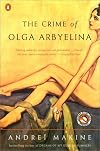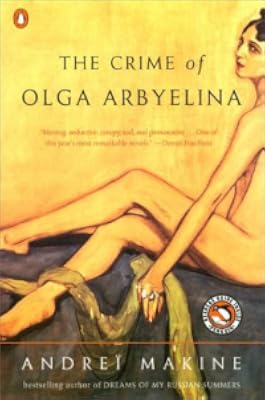
The Crime of Olga Arbyelina
by Andreï Makine
On This Page
Description
The summer of '47. In the sleepy town of Villiers-la-Forêt, roughly an hour from Paris, the peaceful radiance of the day is interrupted by the discovery that, along a nearby riverbank, the body of a man has washed up, a gaping wound in his skull. Beside him rests a beautiful, nearly bare-breasted woman, her dress soaked and in tatters. An accident or foul play? A crime of passion? Soon there are almost as many speculations and theories as there are townspeople. The woman, it turns out, is a show more Russian princess, Olga Arbyelina, a refugee from the Bolshevik revolution who in the 1930s had settled in town along with many of her compatriots. Rumor was that Olga's husband, a dashing prince given to gambling and revels, had deserted her some years after the couple's arrival in France, leaving her alone to care for their young son. About the victim, also a Russian refugee, little is known: many years Olga's elder, he was a taciturn, rather coarse, slightly ridiculous man name Sergei Golets, thought dismissively to be a former horse butcher. What on earth could have brought these two unlikely souls together? Makine meticulously re-creates Olga's past--her enchanted childhood; her pampered youth and fevered, transitory embrace of the revolution; her arduous flight toward freedom; her encounter with the dashing White Army officer who saved her life; her marriage and arrival in France; the birth of her adored son. Love has its limits, its limitations and boundaries. But in a woman of great passion, what do such limits mean when you know that each day may be the last for your son? show lessTags
Recommendations

















Member Reviews
Not many a writer can pull it off - a plot so off-putting and odd, the emotions so raw. To a great extent, Makine managed to do it, though, mainly thanks to his inimitable writing style - lyrical, as usual, only here it's so much darker. And inherent to him, these very skillful repetitions throughout the book, going to the same event in the past again and again - but from a different perspective - not easy to do without boring the reader, but always done uniquely in this writer's case.
There is never any doubt in my mind when I pick up Makine's book - it will never disappoint. (The same I can only say about one more writer, Boris Akunin)... I love Makine's style. As far as his writing, this book didn't disappoint either, and probably if show more one gets into the character of the protagonist more intimately, one can actually get what's going on inside and be less judgmental. I am not at that stage yet. show less
There is never any doubt in my mind when I pick up Makine's book - it will never disappoint. (The same I can only say about one more writer, Boris Akunin)... I love Makine's style. As far as his writing, this book didn't disappoint either, and probably if show more one gets into the character of the protagonist more intimately, one can actually get what's going on inside and be less judgmental. I am not at that stage yet. show less
This would have been my last of the Makine novels that are available in English translation, had it not been for [b:Lieutenant Schreiber's Country|40125197|Lieutenant Schreiber's Country The Story of a Forgotten Hero|Andreï Makine|https://i.gr-assets.com/images/S/compressed.photo.goodreads.com/books/1526382760l/40125197._SY75_.jpg|40004228], which is a rather expensive recent hardback.
This is one of the books that most stands out from his ouevre as different - not least because it is a long way from Makine's personal experience and it is mostly set in a Russian emigre community in France just after the Second World War.
The heroine Olga Arbyelina (a princess by a now failed marriage) works as a librarian in the "Caravanserai", an old show more brewery which is now part old people's home and part cheap flats populated by Russian emigres, situated in a small town a short train trip from Paris. She lives with her son, a haemophiliac. At the start of the book she is suspected of murder after a suspicious death, but most of the book takes place in the previous year and explores the reasons for her involvement.
Much of the plot cannot be described without spoilers -it concerns an incestuous sexual relationship through her son, initiated by him after he has laced her tea with sedatives, but continuing with her growing complicity and eventually leading to her relationship to the victim of the murder/accident . The shadow of haemophilia is never far from the surface, and the morality of the story is very complicated.
As always Makine's writing is very enjoyable to read, if a little more convoluted than in most of his books, perhaps because of the complexity of the plotting. show less
This is one of the books that most stands out from his ouevre as different - not least because it is a long way from Makine's personal experience and it is mostly set in a Russian emigre community in France just after the Second World War.
The heroine Olga Arbyelina (a princess by a now failed marriage) works as a librarian in the "Caravanserai", an old show more brewery which is now part old people's home and part cheap flats populated by Russian emigres, situated in a small town a short train trip from Paris. She lives with her son, a haemophiliac. At the start of the book she is suspected of murder after a suspicious death, but most of the book takes place in the previous year and explores the reasons for her involvement.
Much of the plot cannot be described without spoilers -
As always Makine's writing is very enjoyable to read, if a little more convoluted than in most of his books, perhaps because of the complexity of the plotting. show less
The time is 1947. Olga Arbyelina is a Russian emigre living in a small town outside of Paris. She is reputed to be of royal blood, a rumor supported by the fact that her son is hemopheliac.
Makine's prose is characteristically lyrical--dreamy and repetitious--it reminds me of Debussey's music. But in this case, the lush language is not supported and complemented by the plot and characters. The crux of the novel is Olga's relationship with her son, and her great love for him. However, Olga comes across as passive, apathetic, and unthinking. She and her son are rarely in the same room together (unless one of them is asleep). The disturbing acts of her son and Olga's reaction (or perhaps her nonresponse) to them are unrealistic and show more unbelievable.
2 stars show less
Makine's prose is characteristically lyrical--dreamy and repetitious--it reminds me of Debussey's music. But in this case, the lush language is not supported and complemented by the plot and characters. The crux of the novel is Olga's relationship with her son, and her great love for him. However, Olga comes across as passive, apathetic, and unthinking. She and her son are rarely in the same room together (unless one of them is asleep). The disturbing acts of her son and Olga's reaction (or perhaps her nonresponse) to them are unrealistic and show more unbelievable.
2 stars show less
Haunting detail, but a bit lurid, and somewhat of a disappointment after Dreams of My Russian Summers.
Un frío domingo del año 1947, un crimen estremecedor conmociona al pequeño pueblo de Villiers-la-Fôret, próximo a París: un hombre agoniza a la orilla del río con el cráneo aplastado, y junto a él, aún aturdida y medio desnuda, se encuentra Olga Arbélina, una antigua aristócrata rusa que tuvo que huir de su país durante la Revolución bolchevique. La comunidad de rusos emigrados establecidos en Villiers apenas alcanza a entender qué ha podido conducir a Olga, la apacible bibliotecaria, a una situación tan extraña y comprometida. La investigación que se inicia remueve un doloroso pasado: la precipitada huida de su país, el dolor del exilio, el abandono por parte de un marido mezquino y el nacimiento de un hijo show more hemofílico, que, llegado a la adolescencia, parece reencarnar el destino trágico de los Romanov. Pero la vida de Olga Arbélina todavía oculta un secreto terrible, quién sabe si un segundo «crimen». show less
Mar 7, 2023Spanish
Ratings
Members
- Recently Added By
Published Reviews
ThingScore 25
Diese Perspektive könnte durchaus reizvoll sein. Doch Andrei Makine hat in diesem Roman mit all zu vielen Andeutungen gearbeitet, mögliche Handlungsnebenfährten nur kurz angerissen; letztendlich aber erzählt er brav und bieder eine ziemlich hanebüchene Mutter-Sohn-Geschichte - und dies ausschließlich aus dem Blickwinkel der Mutter Olga.
added by Indy133
Author Information

34+ Works 4,462 Members
Andrei Makine was born in Siberia in 1957. Although raised in the Soviet Union, he learned about France and came to love that country through the stories told by his French grandmother. He now lives in Paris himself, having been granted political asylum by France in 1987, and writes in French. His grandmother figures prominently in the show more autobiographical novel, "Dreams of My Russian Summers," for which Makine received both the Goncourt Prize and the Medicis Prize, becoming the first author to simultaneously receive both of these prestigious French awards. In the U.S., the English translation of "Dreams of My Russian Summers" has also received recognition, including the Boston Book Review Fiction Prize and the Los Angeles Times Best Book of the Year award. Andrei Makine is also the author of "Once Upon the River Love" and "The Crime of Olga Arbelina." (Bowker Author Biography) show less
Some Editions
Awards and Honors
Awards
Series
Belongs to Publisher Series
Gallimard, Folio (3366)
Common Knowledge
- Canonical title
- The Crime of Olga Arbyelina
- Original title
- Le crime d'Olga Arbélina
- Original publication date
- 1998
- Important places
- France; Russia
- First words*
- Sommige mensen wachten zijn woorden af omdat ze er gewoon op uit zijn hem ontboezemingen te ontlokken.
- Original language
- French
*Some information comes from Common Knowledge in other languages. Click "Edit" for more information.
Classifications
- Genres
- Fiction and Literature, General Fiction, Historical Fiction
- DDC/MDS
- 843.914 — Literature & rhetoric French Literature French fiction 1900- 20th Century 1945-1999
- LCC
- PQ2673 .A38416 .C7513 — Language and Literature French, Italian, Spanish and Portuguese literatures French literature Modern literature 1961-2000
- BISAC
Statistics
- Members
- 275
- Popularity
- 117,378
- Reviews
- 5
- Rating
- (3.11)
- Languages
- 10 — Dutch, English, Finnish, French, German, Italian, Norwegian (Bokmål), Romanian, Spanish, Swedish
- Media
- Paper, Ebook
- ISBNs
- 24
- ASINs
- 5