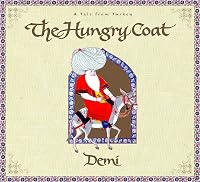
The Hungry Coat: A Tale from Turkey
by Demi
On This Page
Description
After being forced to change to a fancy new coat to attend a party, Nasrettin Hoca tries to feed his dinner to the coat, reasoning that it was the coat that was the invited guest.Tags
Recommendations





Member Recommendations

AbigailAdams26 If you enjoyed this story from the Turkish tradition, you might enjoy a retelling of a variant of the same tale from the Mizrahi Jewish tradition.
Member Reviews
Rushing to attend a dinner given by an old friend of his, that celebrated Turkish wise man the Nasrettin Hoca does not bother to change his coat, old and tattered, and very soiled from his efforts to help out during a crisis at a caravansary he had passed along his ride. When he discovers that his host is not interested in entertaining or feeding him, and that the other guests ignore him, he goes away, making his way home to bathe and to dress in the finest of clothing. Returning to the dinner in his finery, he finds his reception is very different, and determined to teach his friend and the other guests a lesson, begins to feed his coat the food he is given. After all, it seems to be the coat that his host values, so it must be the show more coat which is fed...
Tales of the Nasrettin Hoca (or Nasreddin Hodja) abound in Turkish and Middle Eastern folklore (he's known as Juha in the Arabic world), and I have encountered the figure many times in my folkloric reading over the years. That said, I actually first encountered the specific story to be found in Demi's The Hungry Coat through a Mizrahi Jewish variant of the tale, retold by author Ronit Chacham and illustrator Shirley Waisman in the Israeli children's book Eat, Coat, Eat!. I immediately recognized the tale type when reading this book, which is always a pleasure—I like to compare and contrast similar stories across diverse cultures—and I appreciated author/illustrator Demi's engaging telling, with its humor, heart and insight. I also appreciated her gorgeous artwork, with its ornate decorative style—many of the paintings here look like they come from an illuminated manuscript—and vivid color palette. Recommended to young folklore enthusiasts, to those looking for picture book retellings of Turkish tales, and to fans of the artist. show less
Tales of the Nasrettin Hoca (or Nasreddin Hodja) abound in Turkish and Middle Eastern folklore (he's known as Juha in the Arabic world), and I have encountered the figure many times in my folkloric reading over the years. That said, I actually first encountered the specific story to be found in Demi's The Hungry Coat through a Mizrahi Jewish variant of the tale, retold by author Ronit Chacham and illustrator Shirley Waisman in the Israeli children's book Eat, Coat, Eat!. I immediately recognized the tale type when reading this book, which is always a pleasure—I like to compare and contrast similar stories across diverse cultures—and I appreciated author/illustrator Demi's engaging telling, with its humor, heart and insight. I also appreciated her gorgeous artwork, with its ornate decorative style—many of the paintings here look like they come from an illuminated manuscript—and vivid color palette. Recommended to young folklore enthusiasts, to those looking for picture book retellings of Turkish tales, and to fans of the artist. show less
I absolutely loved The Hungry Coat by Demi. First, the illustrations in this book were fantastic. Demi used paper cuts and fabrics from Turkey to create different patterns and textures on the page. The illustrations added to the authenticity of the story, as they helped the reader gain a better understanding of Turkish art and regional dress. The pictures were also highly detailed. For example, in the middle of the book, Demi depicts the main character, Nasrettin Hoca, chasing a goat. However, Demi creates a two page panerama of the entire room, including small details like smoking pipes, cooking pots, and the fire place.
Second, this book pushes readers to examine how they judge others. This folktale was written to remind readers to show more look beyond a person's physical characteristics and dress. Nasrettin Hocta exemplifies this point when he says, "...if you want to look deeply, look at the man and not at his coat. You can change the coat, but you cannot change the man...many a good man may be found under a shabby coat." show less
Second, this book pushes readers to examine how they judge others. This folktale was written to remind readers to show more look beyond a person's physical characteristics and dress. Nasrettin Hocta exemplifies this point when he says, "...if you want to look deeply, look at the man and not at his coat. You can change the coat, but you cannot change the man...many a good man may be found under a shabby coat." show less
Nasrettin Hoca (or Hodja) is described as a funny little wise man. This is a funny little wise fable about one of his opportunities to impart a lesson on other men. I really enjoyed the illustrations, too; Demi's work seems to have improved over the workmanlike miniature figures in the biographies (that I was not as impressed by).
If this had a bibliography or suggested reading list, I might have rounded up to five stars.
If this had a bibliography or suggested reading list, I might have rounded up to five stars.
Once upon a time in Turkey there lived a funny, little wise man named Nasrettin Hoca. He wore a huge, white turban and a worn-out coat made of patches upon patches. Riding about on his little gray donkey, he liked to help whomever he could. A friend to all, Nasrettin is a popular figure. But when he is suddenly ignored at a friend's banquet, he realizes it is his patchwork coat that is turning people away from him. He leaves the party and returns later, wearing a brand-new coat. Now Nasrettin is warmly welcomed. But instead of eating the delicious foods placed before him, he feeds them to his coat!
How Nasrettin Hoca teaches his friends a lesson about appearances is the heart of this hilarious and clever story. With good humor and show more luminous illustrations inspired by traditional Turkish paintings, Demi brings to life Turkey's most famous folk hero and imparts a timeless tale with a moral that will resonate with readers everywhere. show less
How Nasrettin Hoca teaches his friends a lesson about appearances is the heart of this hilarious and clever story. With good humor and show more luminous illustrations inspired by traditional Turkish paintings, Demi brings to life Turkey's most famous folk hero and imparts a timeless tale with a moral that will resonate with readers everywhere. show less
I was already familiar with this story, one of the better-known of the Turkish stories of Nasreddin Hodja. (It's also one of the more moralistic, reading almost like an Aesop fable where other Hodja stories are whimsical fantasies or even jokes.) What was new to me, though, was Demi's beautiful artwork. Her illustrations are a tribute to the decorative arts of Turkey, from miniature painting to Anatolian rugs and Iznik tiles.
The incorporation of real Turkish art into the illustration shows Demi's respect for the culture that she takes her story from. Unfortunately, the text itself isn't quite so authentic; this version of the story is more moralistic than any other I've encountered. Whether she felt it was necessary for American show more audiences, for her own aesthetic, or to fill out pages 31-32 of the picture-book format, Demi concludes the story with a two-page spread that restates the moral about three more times. Without the last two pages, it's a beautiful book; with them, it's a beautiful book that teaches you a lesson.
Original post on "All The Things I've Lost" show less
The incorporation of real Turkish art into the illustration shows Demi's respect for the culture that she takes her story from. Unfortunately, the text itself isn't quite so authentic; this version of the story is more moralistic than any other I've encountered. Whether she felt it was necessary for American show more audiences, for her own aesthetic, or to fill out pages 31-32 of the picture-book format, Demi concludes the story with a two-page spread that restates the moral about three more times. Without the last two pages, it's a beautiful book; with them, it's a beautiful book that teaches you a lesson.
Original post on "All The Things I've Lost" show less
At first, I was confused (especially when Nasrettin started feeding his clothes), then I was amazed. The lesson of this book cannot be ignored. This is such a great story for teaching children, and adults for that matter, the importance of seeing the person for who they are, not what they do or wear. The story sucks you in to where you litturally have to get the message. I will read this to my daughter for a long time....The art is great too!
I loved the Turkey tale, “The Hungry Coat.” The big idea of this tale is to tell readers that the importance of a person is their heart, not their material possessions. What I appreciated most from this story is the witty decision and wise conclusion of the main character. The character development of the main character shares an important message with readers as well. The main characters friends shun him from a party because his coat and outer appearance is dirty and foul-smelling from helping villagers catch a goat. However, the main character goes back home to wash himself and buy the finest red, gold hemmed coat. The witty writing of the Turkey Tale then has the main character feeling his coat the finest food from the party and show more has the other party members confused. “At last, the alarmed host said, “Tell me, my old friend, why are you feeding your coat?” The author writes intelligently, “When I first arrived in my old coat...there was no food for me. Yet when I came back in this new coat, there was every kind of food for me. This shows it was the coat – and not me – that you invited to your banquet!” I also appreciated how the author clearly states the message of the story near the end. This directly gives the important message to young readers who can not figure out the theme of the book. show less
Members
- Recently Added By
Lists

A Child's Book Tour of Turkey
27 works; 2 members

Children's Picture Books
188 works; 1 member
Author Information

113+ Works 11,660 Members
Awards and Honors
Awards
Common Knowledge
- People/Characters
- Nasreddin
- First words
- Once upon a time in Turkey there lived a funny, little wise man named Nasrettin Hoca.
Classifications
Statistics
- Members
- 285
- Popularity
- 113,512
- Reviews
- 26
- Rating
- (4.07)
- Languages
- English
- Media
- Paper
- ISBNs
- 3
- UPCs
- 1
- ASINs
- 3