
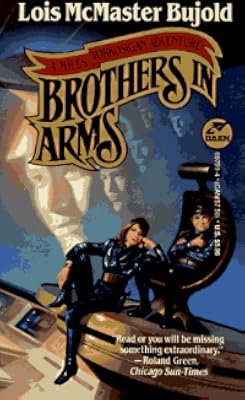
Brothers in Arms
by Lois McMaster Bujold
Vorkosigan: Publication Order (5), Vorkosigan: Chronological Order (8)
On This Page
Description
Lead by Admiral Naismith (a.k.a. Lord Miles Vorkosigan), the Dendarii Mercenaries have pulled off the daring interspace rescue of an entire Cetagandan POW camp. But they have made some deadly enemies. Having finally outrun the infuriated Cetagandans, the Dendarii arrive on Earth for battle, shuttle repair, and a well deserved rest.But Miles realizes he’s in trouble again. First the Mercenaries’ payroll doesn’t arrive on time, and then someone tries to murder him. Now Miles must juggle show more both his identities at once to unravel the complicated plot against him—and to reveal an unexpected ally. Just who is trying to assassinate which of his personas, and why?
. show less
Tags
Recommendations









Member Reviews
In my Vorkosigan reading order, this is the seventh book overall, but the fourth Miles one, though the previous Miles-focused one (Cetaganda) didn't really move the character forward in any kind of way. So here, we have Miles's first progression since what was the second book I read, The Vor Game. However, it's worth pointing out that in publication order, this is the second Miles novel, preceding Vor Game. (Bujold was crazy!)
Perhaps this is why the opening of Brothers in Arms jars a bit. If you left off with Miles in Vor Game or Cetaganda, you left off with him as a member of the Barrayaran military; he has his links to the Dendarii mercenaries, but his focus is on his traditional military career. It's weird, then, when you begin show more Brothers in Arms and find not only that Miles is with the Dendarii mercenaries, but this is apparently what he does on a regular basis, to the point of leading them into major combat actions! My vague understanding is that the book I will read next will actually fill this in somewhat; even if it didn't, though, it's the kind of thing one must get used to when reading a series of books about someone's career published out of chronological order; certainly as a fan of C. S. Forester's Hornblower, I am very familiar with it!
Once you get over that initial discomfort (and this just may be the fault of my reading order, not the book), the beginning of the novel is good fun. Miles has been serving with the Dendarii, who are repairing and resupplying on Earth, but finds himself ordered to join the staff of the Barrayaran embassy on Earth while he's there, so he must simultaneously maintain his Admiral Naismith persona and his Lieutenant Vorkosigan one—all the while the Cetagandans are trying to kill Naismith, but the Dendarii need him, and his Barrayaran superior has ordered him to stay away.
It's a recipe for farce, and of course farce is a thing that Bujold is quite good at. But it's more than that; the book itself points out that Miles is always acting: Admiral Naismith is a persona, Lieutenant Vorkosigan is a persona, and so too is Lord Miles. So who, then, is left? Who is he when he's not fulfilling all these obligations to other people? What is the Venn diagram of those people?
Like any farce, though, things must escalate, but to discuss this, I must get into spoiler territory, so look away if that offends you. (I will say, though, that it's a thing I knew going in, being familiar in a very broad sense with the overall outline of the saga.) In order to explain how Admiral Naismith and Lieutenant Vorkosigan can be in the same place even though they're not the same person, Miles invents the idea that one is a clone of the other created by his father's enemies... and what should happen but who waltzes into the situation: a clone of Miles created by his father's enemies! As complications go, it's honestly a bit contrived even if it is, obviously, fun.
Bujold does her best to justify it, but it's not so much the justification that lets her get away with it as what she does with the conceit. Because who is "Mark" (as Miles dubs him), but the blank space in the middle of that Venn diagram, the person that Miles might be without all those obligations weighing on him? So even though his clone wants to kill and replace him, Miles wants to help his "brother" to be the person he never can be.
But it's not true, of course. Mark is no more free than Miles is; in a sense, he's even more a victim of others' obligations than Miles is. At one point, Miles asks Mark to imagine who he might be if he was free of his creators and their plot... but can Miles imagine who he might be if he were free of all his obligations? No, Miles has no idea at all. In this book, he tries to romance Elli Quinn, but Quinn won't come back to Barrayar with him... and Miles just can't imagine himself without Barrayar, even though in doing so it seems he might actually be able to have Quinn. Who are we, Brothers in Arms seems to say, but all our obligations? Or at least, the ethical ones?* In the end, Miles must try to fulfill all his obligations as ethically as he can, because otherwise, there is no Miles at the core of that Venn diagram. That means saving Mark, but not imposing himself on him. Mark will discover his own obligations for himself.
This sounds very pretentious, perhaps, but it's Bujold, so of course it's not. Like I said, the whole thing is wrapped up in a beautiful veneer of farce, with good comedy, fun character moments, and some genuinely tense action sequences. If I have any criticism, it's that it seems to me there's more thematic depth to be mined from the character of Mark than we actually get here, since Bujold's emphasis is largely on the action and intrigue plot. Like yes, all of the above is definitely going on, but it's more of a background element than a foreground one at times. But my understanding (no spoilers for me, please) is that Mark returns in future books. Bujold has a pattern of introducing an idea and then returning to it years later in a more complicated way (Shards of Honor versus Barrayar, Warrior's Apprentice versus Vor Game), so I have faith that this book isn't just a fun action-adventure romp, but also a set-up for something bigger and better later on. show less
Perhaps this is why the opening of Brothers in Arms jars a bit. If you left off with Miles in Vor Game or Cetaganda, you left off with him as a member of the Barrayaran military; he has his links to the Dendarii mercenaries, but his focus is on his traditional military career. It's weird, then, when you begin show more Brothers in Arms and find not only that Miles is with the Dendarii mercenaries, but this is apparently what he does on a regular basis, to the point of leading them into major combat actions! My vague understanding is that the book I will read next will actually fill this in somewhat; even if it didn't, though, it's the kind of thing one must get used to when reading a series of books about someone's career published out of chronological order; certainly as a fan of C. S. Forester's Hornblower, I am very familiar with it!
Once you get over that initial discomfort (and this just may be the fault of my reading order, not the book), the beginning of the novel is good fun. Miles has been serving with the Dendarii, who are repairing and resupplying on Earth, but finds himself ordered to join the staff of the Barrayaran embassy on Earth while he's there, so he must simultaneously maintain his Admiral Naismith persona and his Lieutenant Vorkosigan one—all the while the Cetagandans are trying to kill Naismith, but the Dendarii need him, and his Barrayaran superior has ordered him to stay away.
It's a recipe for farce, and of course farce is a thing that Bujold is quite good at. But it's more than that; the book itself points out that Miles is always acting: Admiral Naismith is a persona, Lieutenant Vorkosigan is a persona, and so too is Lord Miles. So who, then, is left? Who is he when he's not fulfilling all these obligations to other people? What is the Venn diagram of those people?
Like any farce, though, things must escalate, but to discuss this, I must get into spoiler territory, so look away if that offends you. (I will say, though, that it's a thing I knew going in, being familiar in a very broad sense with the overall outline of the saga.) In order to explain how Admiral Naismith and Lieutenant Vorkosigan can be in the same place even though they're not the same person, Miles invents the idea that one is a clone of the other created by his father's enemies... and what should happen but who waltzes into the situation: a clone of Miles created by his father's enemies! As complications go, it's honestly a bit contrived even if it is, obviously, fun.
Bujold does her best to justify it, but it's not so much the justification that lets her get away with it as what she does with the conceit. Because who is "Mark" (as Miles dubs him), but the blank space in the middle of that Venn diagram, the person that Miles might be without all those obligations weighing on him? So even though his clone wants to kill and replace him, Miles wants to help his "brother" to be the person he never can be.
But it's not true, of course. Mark is no more free than Miles is; in a sense, he's even more a victim of others' obligations than Miles is. At one point, Miles asks Mark to imagine who he might be if he was free of his creators and their plot... but can Miles imagine who he might be if he were free of all his obligations? No, Miles has no idea at all. In this book, he tries to romance Elli Quinn, but Quinn won't come back to Barrayar with him... and Miles just can't imagine himself without Barrayar, even though in doing so it seems he might actually be able to have Quinn. Who are we, Brothers in Arms seems to say, but all our obligations? Or at least, the ethical ones?* In the end, Miles must try to fulfill all his obligations as ethically as he can, because otherwise, there is no Miles at the core of that Venn diagram. That means saving Mark, but not imposing himself on him. Mark will discover his own obligations for himself.
This sounds very pretentious, perhaps, but it's Bujold, so of course it's not. Like I said, the whole thing is wrapped up in a beautiful veneer of farce, with good comedy, fun character moments, and some genuinely tense action sequences. If I have any criticism, it's that it seems to me there's more thematic depth to be mined from the character of Mark than we actually get here, since Bujold's emphasis is largely on the action and intrigue plot. Like yes, all of the above is definitely going on, but it's more of a background element than a foreground one at times. But my understanding (no spoilers for me, please) is that Mark returns in future books. Bujold has a pattern of introducing an idea and then returning to it years later in a more complicated way (Shards of Honor versus Barrayar, Warrior's Apprentice versus Vor Game), so I have faith that this book isn't just a fun action-adventure romp, but also a set-up for something bigger and better later on. show less
After the great prison break in Borders of Infinity, the Dendarii Mercenaries are due a little R&R on Earth, along with 18 million credits in backpay. When that pay doesn't arrive, Miles is thrown into a whirlwind of intrigue, treachery, and old grudges. A passing lie-that Miles Vorkosigan and Miles Naismith are clones, turns out to be more true than anybody might expect. This might be my favorite Vorkosigan book so far, with a practically perfect biotech plot and incredibly compelling characters. If it only had a starship battle, I'd give it six stars.
Miles Vorkosigan and his alter ego, Admiral Naismith, are closely intertwined in this story--sometimes it's as confusing for the reader as it is for Miles, but Bujold certainly handles it deftly. Then she adds to the confusion! It never occurred to me that Miles's comment to the reporter about there being a clone of him would turn out to be true, and a clone planned & paid for by Komarrans--never saw that coming!
Interesting tidbits that stood out for me: Miles's realization that giving Elli such a beautiful face was not necessarily the gift he initially thought it was, but Elli is a stronger and more capable officer because of it. Miles's longing for Elena, so thoroughly buried but so heart-breakingly real, was very touching and deeply show more moving.
As always, the center of each Miles tale seems to be about second chances, about overcoming one's circumstances, about making difficult choices and accepting the consequences, about learning who one really is and what is truly important, which may be different for each character.
So, why 4 stars and not 5? A bit too many identity switches, and some over-stretching of the limits of believability, even for Bujold. show less
Interesting tidbits that stood out for me: Miles's realization that giving Elli such a beautiful face was not necessarily the gift he initially thought it was, but Elli is a stronger and more capable officer because of it. Miles's longing for Elena, so thoroughly buried but so heart-breakingly real, was very touching and deeply show more moving.
As always, the center of each Miles tale seems to be about second chances, about overcoming one's circumstances, about making difficult choices and accepting the consequences, about learning who one really is and what is truly important, which may be different for each character.
So, why 4 stars and not 5? A bit too many identity switches, and some over-stretching of the limits of believability, even for Bujold. show less
Reread for the nth time. The plot is a glorious tangled mess and it all comes together beautifully. If you are into mistaken identity and comedies of errors, this is gold. Also a good precursor to Memory because we start to see how Miles' conflicting identities are affecting him.
The cover is absurd and kitschy, as are most of the covers for this series, and now I'm thinking about how I would design it.
The cover is absurd and kitschy, as are most of the covers for this series, and now I'm thinking about how I would design it.
Summary: Miles Naismith Vorkosigan is used to living a double life. On his home planet of Barrayar, he’s Lord Miles Vorkosigan, a member of the elite ruling and military class, and son to the second-most powerful man on the planet. Off-world, however, he’s Admiral Miles Naismith, commander of the Dendarii Free Mercenary Fleet. Although the Dendarii are secretly funded by Barrayaran intelligence, it’s critical that Miles keep his two identities separate – not always the easiest thing when a prenatal gas attack left him with a crippled physical appearance and brittle bones that are distinctly memorable.
After a nasty run-in with Cetagandan forces, the Dendarii put in at Earth for repairs. This much-needed downtime also gives show more Admiral Naismith the chance to lie low for a bit, considering the Cetagandans have put a substantial price on his head. But Miles isn’t used to switching back and forth between his two personas quite so often, and the strain is starting to show. And to make matters worse, a rumor – started by Miles himself in an attempt to deflect attention from his dual roles – seems to be coming true, with consequences more widespread than even Miles could have imagined.
Review: I’ve already gone on at length elsewhere about how much I enjoy Lois McMaster Bujold’s novels, both in general and the Vorkosigan Saga in particular. She creates marvelous science fiction that focuses on the people, and creates marvelous people to fill her worlds. She’s wickedly funny, with a great ear for dialogue, and can write a tight novel that contains plenty of twists and turns with minimal filler. All of that, it almost goes without saying, remains as true for Brothers in Arms as it is for the series as a whole.
One thing that I thought Brothers in Arms did particularly well, however, was show off Bujold’s skill at character development. She’s not starting from scratch; Miles is already an established character by this point in the series, and Brothers in Arms wouldn’t really work as an entry point. However, in this book, Bujold takes the character of Miles and makes him deeper and rounder, giving him layers to his personality that hadn’t been visible before, but are perfectly in tune with what we had already seen. Watching him try to maintain his multiple identities like shells around himself, while simultaneously trying to crack those shells enough to let the people he loves see the real him, was completely fascinating.
I also really enjoyed the storyline. The Vorkosigan Saga has been called space opera, but there’s really very little space to speak of in Brothers in Arms; almost the entire book is spent planetside on Old Earth. The plot’s got a definite touch of Shakespeare’s Comedy of Errors about it, but it’s tempered with a sizeable dose of pathos, a few helpings of psychology, and some well-done but not overwhelming internal politics. The ethical issues about identity and personhood and individual rights that Bujold addresses in several of her other books are present as well, although they emerge naturally from the premise of the story, rather than being shoehorned in as The Moral.
Grover Gardner did his usual excellent job with the narration, with the slight exception that he’s changed his pronunciation of “Dendarii” since The Warrior’s Apprentice (he’s now pronouncing the second “i"). He’s perfectly consistent within each book, but until I got used to it, I found the switch somewhat distracting. 4 out of 5 stars.
Recommendation: As I said, Brothers in Arms is not a place to start with the series, but it was a great continuation, especially for those who – like me – prefer their science fiction with as few space battles as possible. I’m excited to see what Bujold does next with the possibilities raised in this book. show less
After a nasty run-in with Cetagandan forces, the Dendarii put in at Earth for repairs. This much-needed downtime also gives show more Admiral Naismith the chance to lie low for a bit, considering the Cetagandans have put a substantial price on his head. But Miles isn’t used to switching back and forth between his two personas quite so often, and the strain is starting to show. And to make matters worse, a rumor – started by Miles himself in an attempt to deflect attention from his dual roles – seems to be coming true, with consequences more widespread than even Miles could have imagined.
Review: I’ve already gone on at length elsewhere about how much I enjoy Lois McMaster Bujold’s novels, both in general and the Vorkosigan Saga in particular. She creates marvelous science fiction that focuses on the people, and creates marvelous people to fill her worlds. She’s wickedly funny, with a great ear for dialogue, and can write a tight novel that contains plenty of twists and turns with minimal filler. All of that, it almost goes without saying, remains as true for Brothers in Arms as it is for the series as a whole.
One thing that I thought Brothers in Arms did particularly well, however, was show off Bujold’s skill at character development. She’s not starting from scratch; Miles is already an established character by this point in the series, and Brothers in Arms wouldn’t really work as an entry point. However, in this book, Bujold takes the character of Miles and makes him deeper and rounder, giving him layers to his personality that hadn’t been visible before, but are perfectly in tune with what we had already seen. Watching him try to maintain his multiple identities like shells around himself, while simultaneously trying to crack those shells enough to let the people he loves see the real him, was completely fascinating.
I also really enjoyed the storyline. The Vorkosigan Saga has been called space opera, but there’s really very little space to speak of in Brothers in Arms; almost the entire book is spent planetside on Old Earth. The plot’s got a definite touch of Shakespeare’s Comedy of Errors about it, but it’s tempered with a sizeable dose of pathos, a few helpings of psychology, and some well-done but not overwhelming internal politics. The ethical issues about identity and personhood and individual rights that Bujold addresses in several of her other books are present as well, although they emerge naturally from the premise of the story, rather than being shoehorned in as The Moral.
Grover Gardner did his usual excellent job with the narration, with the slight exception that he’s changed his pronunciation of “Dendarii” since The Warrior’s Apprentice (he’s now pronouncing the second “i"). He’s perfectly consistent within each book, but until I got used to it, I found the switch somewhat distracting. 4 out of 5 stars.
Recommendation: As I said, Brothers in Arms is not a place to start with the series, but it was a great continuation, especially for those who – like me – prefer their science fiction with as few space battles as possible. I’m excited to see what Bujold does next with the possibilities raised in this book. show less
I feel like my recent reviews have tipped mainly into the negative, so to convince myself that I'm not a misandristic, misanthropic malcontent who loves alliteration not wisely but too well, I've decided to introduce a little positivity by going back and reviewing some of my favourite books in the Vorkosigan Saga. My advice regarding the Vorkosigan Saga boils down to this: go read them. All of them. I suggest starting with The Warrior's Apprentice--and no, this isn't one of my usual careless suggestions to jump midway into a series; it's recommended by Bujold herself. And now, onwards to Brothers in Arms!
In Miles Vorkosigan's most recent mission as his alter-ego Admiral Miles Naismith of the Dendarii Free Mercenaries, he was sent show more undercover to rescue one important man from a Cetagandan POW camp. As is typical of Miles' missions, things didn't go as planned, and the 1 prisoner rescue was somehow multiplied into 10,000. Now, with the fleet badly in need of repairs, Miles has stopped at Old Earth to prize payment from the reluctant pockets of the Barrayaran Embassy in London. And, of course, that's when things on Earth start getting, as Miles would say, a little out of hand. While Miles is trying to escort high-faluting London socialites as part of his Barrayaran identity, he is forced to make a daring--and unfortunately visible--rescue as Admiral Naismith. With both of his identities seen on Earth, how long can it be before people connect the glaring fluorescent dots? As Miles points out, "How many four-foot-nine-inch black-haired grey-eyed hunchbacks can there be on this damn planet? D’you think you trip over twitchy dwarfs on every street corner?" Not only is his cover identity at risk, but, with the Cetagandans simultaneously meeting socially with with Lt. Vorkosigan of the Barrayaran Embassy and actively out for the blood of the all-too-similar Admiral Naismith, Miles is doubly in danger. Clearly, Miles decides, the obvious solution is to tell everyone that he has a clone, created in secret as part of a plot against Barrayar. It isn't long before Miles is heading straight into his own unique version of an identity crisis. And since this is Miles Vorkosigan, that's when things start getting complicated.
Brothers in Arms is a genuinely enjoyable and fantastically outrageous farce. I can't discuss much without spoilers, but it suffices to say that it reminds me strongly of the best of P.G. Wodehouse, with everyone bumbling around in an old-fashioned comedy of mistaken identities, impressively convoluted concatenations of circumstance, and thoroughly muddled and bewildering chases. This book contains some absolutely hilarious moments, from Miles Vorkosigan on Fast Penta (holy hyperactive mutants, Batman!), to the continuing litigious nature of Londoners, to a chase scene in the bowels of London with three groups all after one another, to Miles' tumultuous and constantly hilarious flow of inner thoughts. Take, for example, his musings on an ornamental goldfish pond:
One last thing: the Vorkosigan Saga has joined a select set of series that I believe are genuinely better on audio. As I originally encountered most of these books in print form, I can attest that Grover Gardner truly brings an extra dimension to the stories. Gardiner is an amazing narrator; his light tenor and slightly peculiar intonation create a perfect fit for Miles Vorkosigan, yet his wide range and enthusiasm allow him to dip into the a host of different characters, moods, and personalities. Like all the best readers, Gardner seems to genuinely enjoy the story, and he reads the humorous chunks with such glee that his narration imparts an additional flair. The delight he takes in saying "squiiissh" during the goldfish scene quoted above is a gem all on its own. Take my word for it--the Vorkosigan Saga is well worth revisiting on audio.
Although Brothers in Arms doesn't carry the emotional or philosophical weight of Mirror Dance or Memory, it's none the worse for being a thoroughly enjoyable, lighthearted romp. I'm saving up my five star ratings for the next two books in the series, but consider this a very high-4 (for the High Vor?)-star read--call it a 4.3.
What's up next? Well, according to Miles,
In Miles Vorkosigan's most recent mission as his alter-ego Admiral Miles Naismith of the Dendarii Free Mercenaries, he was sent show more undercover to rescue one important man from a Cetagandan POW camp. As is typical of Miles' missions, things didn't go as planned, and the 1 prisoner rescue was somehow multiplied into 10,000. Now, with the fleet badly in need of repairs, Miles has stopped at Old Earth to prize payment from the reluctant pockets of the Barrayaran Embassy in London. And, of course, that's when things on Earth start getting, as Miles would say, a little out of hand. While Miles is trying to escort high-faluting London socialites as part of his Barrayaran identity, he is forced to make a daring--and unfortunately visible--rescue as Admiral Naismith. With both of his identities seen on Earth, how long can it be before people connect the glaring fluorescent dots? As Miles points out, "How many four-foot-nine-inch black-haired grey-eyed hunchbacks can there be on this damn planet? D’you think you trip over twitchy dwarfs on every street corner?" Not only is his cover identity at risk, but, with the Cetagandans simultaneously meeting socially with with Lt. Vorkosigan of the Barrayaran Embassy and actively out for the blood of the all-too-similar Admiral Naismith, Miles is doubly in danger. Clearly, Miles decides, the obvious solution is to tell everyone that he has a clone, created in secret as part of a plot against Barrayar. It isn't long before Miles is heading straight into his own unique version of an identity crisis. And since this is Miles Vorkosigan, that's when things start getting complicated.
Brothers in Arms is a genuinely enjoyable and fantastically outrageous farce. I can't discuss much without spoilers, but it suffices to say that it reminds me strongly of the best of P.G. Wodehouse, with everyone bumbling around in an old-fashioned comedy of mistaken identities, impressively convoluted concatenations of circumstance, and thoroughly muddled and bewildering chases. This book contains some absolutely hilarious moments, from Miles Vorkosigan on Fast Penta (holy hyperactive mutants, Batman!), to the continuing litigious nature of Londoners, to a chase scene in the bowels of London with three groups all after one another, to Miles' tumultuous and constantly hilarious flow of inner thoughts. Take, for example, his musings on an ornamental goldfish pond:
Perhaps the stubborn one was a fiendish Cetagandan construct, whose cold scales glittered like gold because they were. He might pluck it out with a feline pounce, stamping it underfoot with a mechanical crunch and electric sizzle, then hold it up with a triumphal cry—'Ah! Through my quick wits and reflexes, I have discovered the spy among you!' But if his guess were wrong, ah. The squish! under his boot, the dowager’s recoil, and the Barrayaran prime minister’s son would have acquired an instant reputation as a young man with serious emotional difficulties... 'Ah ha!' he pictured himself cackling to the horrified woman as the fish guts slithered underfoot, 'You should see what I do to kittens!' The big goldfish rose lazily at last, and took a crumb with a splash that marred Miles’s polished boots. Thank you, fish, Miles thought to it. You have just saved me from considerable social embarrassment.Bujold still manages to inject a few moments of pathos; Brothers in Arms, is, as one might expect, a story about families; of the ways that fathers shape their sons and siblings hold sway over siblings. hover for spoiler One of the themes of the novel is the contrasting motivations of person and principle. I found it especially interesting in the context of Barrayar; personally, I see Barrayar as the greatest of empty principles, a heartless, grasping, barren homeland that swallows its sons. Because of this, I very much enjoyed the rather frank discussion between Quinn and Miles on the subject of Miles' duty to his homeland. Personally, I'm with Quinn: I just don't get it. Are we, as readers, supposed to understand this stupid nationalism to a "backward dirtball," as Quinn would say? Even so, I think this book shines brightest as a farce. Most of the best moments can't be mentioned without spoilers, but it can be noted that Evil Twin Alternate Universe Facial Hair gets involved. hover for spoiler
One last thing: the Vorkosigan Saga has joined a select set of series that I believe are genuinely better on audio. As I originally encountered most of these books in print form, I can attest that Grover Gardner truly brings an extra dimension to the stories. Gardiner is an amazing narrator; his light tenor and slightly peculiar intonation create a perfect fit for Miles Vorkosigan, yet his wide range and enthusiasm allow him to dip into the a host of different characters, moods, and personalities. Like all the best readers, Gardner seems to genuinely enjoy the story, and he reads the humorous chunks with such glee that his narration imparts an additional flair. The delight he takes in saying "squiiissh" during the goldfish scene quoted above is a gem all on its own. Take my word for it--the Vorkosigan Saga is well worth revisiting on audio.
Although Brothers in Arms doesn't carry the emotional or philosophical weight of Mirror Dance or Memory, it's none the worse for being a thoroughly enjoyable, lighthearted romp. I'm saving up my five star ratings for the next two books in the series, but consider this a very high-4 (for the High Vor?)-star read--call it a 4.3.
What's up next? Well, according to Miles,
"'A purely military operation. No relatives, no politics, no high finance. Straight up good guys and bad guys.'show less
'Great,' said Quinn. 'Which are we?'"
Bujold is an amazing writer. Every time I read (or in this case, listen to) one of her stories, I'm astounded at the end at how she's crafted a story that is complex, and yet easy to follow; surprising, and yet logical. At the end, everything just makes sense. I suspect this is the result of deep, intimate knowledge of your characters, your setting and your plot, something that every writer should aspire to. Bujold excels at the aphorism, and her characters and their dialogue are, although distinct from each other, just so damn funny sometimes.
For myself this is seventh Vorkosigan book I've read. Miles Vorkosigan is a young man leading a double life: He is a member of the Vor of Barrayar, a class of nobility on his home planet, and a show more low-ranking military officer; but he is also Admiral Naismith, leader of the Dendarii mercenaries, and only his closest associates know that the fleet is secretly under the pay of the Barrayarans. How did Miles acquire this fleet? Though fast talking, a keen mind and sheer luck. In a previous book he essentially talked an entire mercenary fleet into his own power.
In this installment, Miles and the Dendarii are stopped at Earth after the mercenaries' last engagement, and when Miles checks in with the Barrayaran embassy (because hey, they need to get paid!) he gets caught up in a Komarran revenge plot against his famous father. Miles tries to pass off the appearance of both Vorkosigan and Naismith in the same place with a story about a clone, but as it turns out, the Komarrans really do have a clone, and Miles discovers his new 'brother', who he christens Mark. Deep down this is a story about loyalties: Miles to his planet, his fleet, his family; Mark's to the Komarrans; Galeni's to Komarr, his father, and Barrayar. Which of these loyalties are worthy? Which are not?
I feel like this summary is only scratching the surface of what Bujold is setting down. Her stories are just so deliciously complicated, and I don't want to ruin the flavor by boiling it down to its separate parts here. Suffice to say it's a great story; though, perhaps, not the best one to start the series with. It feels so rich to me because I know the history that has led up to this point, and someone entering the series here might not catch quite as much. In a sense I appreciate that Bujold hasn't spoon-fed us recaps with every book, or worked in extraneous information in artificial ways, in the way that some authors do when trying to make a series book stand alone. I don't think the story here suffers without that context, but is certainly enriched by having it.
http://tealeafbooks.blogspot.com/ show less
For myself this is seventh Vorkosigan book I've read. Miles Vorkosigan is a young man leading a double life: He is a member of the Vor of Barrayar, a class of nobility on his home planet, and a show more low-ranking military officer; but he is also Admiral Naismith, leader of the Dendarii mercenaries, and only his closest associates know that the fleet is secretly under the pay of the Barrayarans. How did Miles acquire this fleet? Though fast talking, a keen mind and sheer luck. In a previous book he essentially talked an entire mercenary fleet into his own power.
In this installment, Miles and the Dendarii are stopped at Earth after the mercenaries' last engagement, and when Miles checks in with the Barrayaran embassy (because hey, they need to get paid!) he gets caught up in a Komarran revenge plot against his famous father. Miles tries to pass off the appearance of both Vorkosigan and Naismith in the same place with a story about a clone, but as it turns out, the Komarrans really do have a clone, and Miles discovers his new 'brother', who he christens Mark. Deep down this is a story about loyalties: Miles to his planet, his fleet, his family; Mark's to the Komarrans; Galeni's to Komarr, his father, and Barrayar. Which of these loyalties are worthy? Which are not?
I feel like this summary is only scratching the surface of what Bujold is setting down. Her stories are just so deliciously complicated, and I don't want to ruin the flavor by boiling it down to its separate parts here. Suffice to say it's a great story; though, perhaps, not the best one to start the series with. It feels so rich to me because I know the history that has led up to this point, and someone entering the series here might not catch quite as much. In a sense I appreciate that Bujold hasn't spoon-fed us recaps with every book, or worked in extraneous information in artificial ways, in the way that some authors do when trying to make a series book stand alone. I don't think the story here suffers without that context, but is certainly enriched by having it.
http://tealeafbooks.blogspot.com/ show less
Members
- Recently Added By
Lists

Best Science Fiction Novels
816 works; 430 members

NPRs your picks: top 100 Sci-Fi/Fantasy books
297 works; 80 members

What Makes This Book So Great
102 works; 16 members

Top Five Books of 2019
387 works; 107 members

Best Feminist Science Fiction
188 works; 35 members

Books Read in 2017
4,249 works; 130 members

Books Read in 2018
4,360 works; 110 members

Top Five Books of 2023
767 works; 317 members

Books Read in 2013
1,630 works; 51 members

Our Favorite Comfort Reads
334 works; 200 members

Books We Couldn't Put Down
443 works; 197 members
Author Information

104+ Works 85,797 Members
Science fiction and fantasy author Lois McMaster Bujold was born in Columbus, Ohio in 1949. After graduating from Ohio State University, she worked as a pharmacy technician at Ohio State University Hospitals. Her first short story was published in Twilight Zone Magazine in 1984 and her first three novels were published in 1986. She received the show more Nebula Award for Falling Free and The Mountains of Mourning and the Hugo Award for The Vor Game, Barrayar, Mirror Dance, The Mountains of Mourning, and Paladin of Souls. She also received the Locus award for Mirror Dance and Paladin of Souls, the Minnesota Book Award for Komarr, the Mythopoeic Award for The Curse of Chalion, and a Romantic Times 2003 Reviewers' Choice Award for Paladin of Souls. She is best known for her series featuring Miles Vorkosigan. She currently lives in Minneapolis, Minnesota. (Bowker Author Biography) show less
Some Editions
Series


Belongs to Publisher Series
Work Relationships
Common Knowledge
- Canonical title*
- Un clone encombrant
- Original title
- Brother in Arms
- Alternate titles*
- Frères d’armes
- Original publication date
- 1989-01
- People/Characters
- Miles Vorkosigan; Elli Quinn; Ivan Vorpatril; Mark Vorkosigan; Duv Galeni; Bel Thorne (show all 10); Ky Tung; Ser Galen; Sgt Barth; Elena Bothari-Jesek
- Important places
- London, England, UK; Earth
- Dedication
- For Martha and Andy
- First words
- His combat-drop shuttle crouched still and silent in the repairs docking bay - malevolent, to Miles's jaundiced eye.
- Quotations
- “Who were those guys?” asked the Dendarii guard, glancing in the direction the black air at had gone.
“Never mind,” said Miles. “They weren't here, you never saw them.”
“Yes, sir.”
He lov... (show all)ed the Dendarii. They didn't argue with him.
In another moment he could see the river mouth, with its great dikes and locks running for forty kilometers, defining the coastline to human design, shutting out the sea and protecting the historical treasures and several mil... (show all)lion souls of the lower Thames watershed. One of the huge channel-spanning bridges gleamed against the the leaden dawn water beyond. And so men organized themselves for the sake of their technology as they never had for their principles. The sea's politics were inarguable. - Last words
- (Click to show. Warning: May contain spoilers.)Miles was still thinking about the answer to that one when the fleet broke orbit.
- Blurbers
- Green, Roland; Coulson, Robert
- Original language
- English
- Canonical DDC/MDS
- 813.087623
*Some information comes from Common Knowledge in other languages. Click "Edit" for more information.
Classifications
- Genres
- Science Fiction, Fiction and Literature
- DDC/MDS
- 813.087623 — Literature & rhetoric American literature in English American fiction in English By type Genre fiction Adventure fiction Speculative fiction Science fiction Military science fiction
- LCC
- PS3552 .U385 .B76 — Language and Literature American literature American literature Individual authors 1961-
- BISAC
Statistics
- Members
- 2,786
- Popularity
- 6,543
- Reviews
- 54
- Rating
- (4.10)
- Languages
- 10 — English, Estonian, French, German, Italian, Japanese, Lithuanian, Polish, Russian, Spanish
- Media
- Paper, Audiobook, Ebook
- ISBNs
- 31
- ASINs
- 11