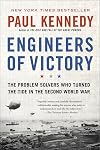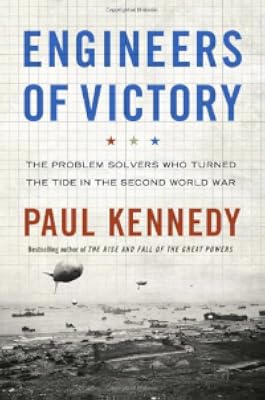
Engineers of Victory: The Problem Solvers Who Turned The Tide in the Second World War
by Paul Kennedy
On This Page
Description
"Engineers of Victory" is a new account of how the tide was turned against the Nazis by the Allies in the Second World War, the focus being on the problem-solvers: Major-General Perry Hobart, who invented the "funny tanks" which flattened the curve on the D-Day beaches; Flight Lieutenant Ronnie Harker "the man who put the Merlin in the Mustang"; and Captain "Johnny" Walker, the convoy captain who worked out how to sink U-boats with a "creeping barrage".Tags
Recommendations












Member Recommendations
Member Reviews
Engineers of Victory is an immensely frustrating book. Brilliantly conceived and written by an author who is obviously a talent, it nonetheless fails to address to its thesis or contribute to scholarship.
Kennedy's thesis is that WW2 was won in those critical months between the Casablanca Conference in January 1943 and early 1944. More specifically, it was won by "Organizers", men at the middle levels of the military, government, and vital industries who invented new weapons systems, sent them into the field, and used them to defeat the Nazis and Imperial Japan. He takes as his case studies the Battle of the Atlantic, strategic bombing in Europe, the rollback of Blitzkrieg on the Eastern Front, the amphibious assaults in the show more Mediterranean and at Normandy, and the logistical and naval victory in the Pacific. There's nothing to argue with there: Clearly something did happen between the dark days of the early war and the triumphant conquests of 1945, and looking at the causal factors as a matter of organization, rather than the psychology of great men (FDR, Eisenhower, and Churchill. Always Churchill) or the superiority of a certain weapon over a comparable model (M4 Sherman vs Panther vs T-34, Go!) is an neat take. After all, it's like Napoleon (supposedly) said: "Amateurs study strategy. Professionals study logistics" (and procurement, and maintenance, and training...).
All the pieces of a really interesting story are there, but Kennedy fails to connect them, or even bring in his anonymous organizers. For a book that alleges to valorize the unsung heroes in the middle, it mentions shockingly few of them. For example, the Battle of the Atlantic would be a great place to talk about Alfred Loomis of the MIT Radiation Laboratory and centimeter radar, or Patrick Blackett's work on operational research in anti-air and anti-sub warfare, along with strategic bombing. Blackett gets one mention in the context of the Casablanca Conference (Roosevelt and Churchill again), and the MIT Radiation Lab isn't mentioned at all.
Omission of vital details are constant. It seems like wherever there's a chance to dive deeply into a topic, and the men and women who organized the Allied victory, the book bounces off and away into a digression of something that we've heard 100 times before on a History Channel documentary. This is a popular book and I don't expect heavy theory, but a passing mention of the literature on organization or innovation would be nice, or perhaps positing this book as a vindication of Robert Merton's sociology of science, and its position that only liberal democracies could take full advantage of science and technology. I'm not even an expert on WW2, and I feel like I could put together a more insightful book on the subject talking about radar-assisted naval gunfire, logistics in distant theaters, and special operations missions as starting points, and then blending in some STS and strategic theory. I expect a history of this caliber to offer a deep dive into new material, or a broad synthesis of exist evidence in favor of some novel insight, or at least to satisfactorily meet its thesis, and Engineers of Victory does none of that. It's downright embarrassing. show less
Kennedy's thesis is that WW2 was won in those critical months between the Casablanca Conference in January 1943 and early 1944. More specifically, it was won by "Organizers", men at the middle levels of the military, government, and vital industries who invented new weapons systems, sent them into the field, and used them to defeat the Nazis and Imperial Japan. He takes as his case studies the Battle of the Atlantic, strategic bombing in Europe, the rollback of Blitzkrieg on the Eastern Front, the amphibious assaults in the show more Mediterranean and at Normandy, and the logistical and naval victory in the Pacific. There's nothing to argue with there: Clearly something did happen between the dark days of the early war and the triumphant conquests of 1945, and looking at the causal factors as a matter of organization, rather than the psychology of great men (FDR, Eisenhower, and Churchill. Always Churchill) or the superiority of a certain weapon over a comparable model (M4 Sherman vs Panther vs T-34, Go!) is an neat take. After all, it's like Napoleon (supposedly) said: "Amateurs study strategy. Professionals study logistics" (and procurement, and maintenance, and training...).
All the pieces of a really interesting story are there, but Kennedy fails to connect them, or even bring in his anonymous organizers. For a book that alleges to valorize the unsung heroes in the middle, it mentions shockingly few of them. For example, the Battle of the Atlantic would be a great place to talk about Alfred Loomis of the MIT Radiation Laboratory and centimeter radar, or Patrick Blackett's work on operational research in anti-air and anti-sub warfare, along with strategic bombing. Blackett gets one mention in the context of the Casablanca Conference (Roosevelt and Churchill again), and the MIT Radiation Lab isn't mentioned at all.
Omission of vital details are constant. It seems like wherever there's a chance to dive deeply into a topic, and the men and women who organized the Allied victory, the book bounces off and away into a digression of something that we've heard 100 times before on a History Channel documentary. This is a popular book and I don't expect heavy theory, but a passing mention of the literature on organization or innovation would be nice, or perhaps positing this book as a vindication of Robert Merton's sociology of science, and its position that only liberal democracies could take full advantage of science and technology. I'm not even an expert on WW2, and I feel like I could put together a more insightful book on the subject talking about radar-assisted naval gunfire, logistics in distant theaters, and special operations missions as starting points, and then blending in some STS and strategic theory. I expect a history of this caliber to offer a deep dive into new material, or a broad synthesis of exist evidence in favor of some novel insight, or at least to satisfactorily meet its thesis, and Engineers of Victory does none of that. It's downright embarrassing. show less
"Engineers of victory" is Ancient Aliens WWII edition, an abysmal effort that is not worthy of the author nor his employer. That Random House shows no editorial control is unfortunately not news. Those who expect to read about actual engineers will be disappointed. The engineers are only mentioned in the final third of a chapter. The meat of the book is devoted to a condensed "USA wins WWII for the world" version to which are added battle vignettes for the imagined ADD readership.
The five parts of the book deal with convoys (air cover, hedgehog mortars, radar), air superiority/strategic bombing (Spitfire, P-51 Mustang), tanks (T34/85), landing craft, long-range naval capacity (carriers, seabees, submarines). The cases include a lot of show more poor quality research. What is correct, usually isn't new. Some that is original is solely because it is wrong and some claims are mostly based on ignorance. Readers without prior knowledge will be in the Fox News watcher situation: They will be dumber than before they started reading the book. Let me explain this on the first example, the convoy system.
First of all, the convoy system is not chiefly an engineering solution. The inventions and innovations listed were only marginally responsible for defeating the German submarines. Secondly, convoys were not an innovation. They were already in heavy use during the First World War (and the Spanish long ago used convoys to ship the gold back to the Old World). This was an all too typical case of the men in authority having forgotten the lessons learned of their predecessors. A recent example of this is the re-discovery of counter-insurgency which was practiced abundantly but futilely in Vietnam. When Petraeus and his merry men presented the old stale ideas as a rediscovery, Washington was amazed and full of praise. During WWII, it took all too long to adapt the convoy system to a WWII environment. When they did, success was immediate (as the chart presented by Kennedy shows). The change was organizational not technical: Add enough protection and keep close to the land (air cover!). Just like Donald Rumsfeld's unwillingness to adapt to the circumstances in Iraq ("You go to war with the army you have ..."), the early losses incurred in the convoy system were a total failure in leadership, because the admirals were not bearing the costs of their faulty thinking.
Secondly, the book is filled with a jingoistic message of Americans winning the war with its strange base line of 1943. Admittedly, it would be hard to uphold the idea of the war being won by US participation with few to none US troops in actual contact with the enemy. Where the book differs from the standard patriotic messaging present in most books authored by Americans is its unnecessary marginalization and disdain for non-Americans: After a battle vignette recalling the brave action of a French frigate sinking two German submarines while a torpedoed Dutch merchant ships is going under, it is truly atrocious of thanking only the Americans, the Canadians and the British for their service in the lines that follow that paragraph. Was it too hard to add the Free French, the Dutch and others who contributed to the Allied victory to the list? In order to sustain the jingoistic USA won WWII, the people that are shortchanged by the author are the Soviets who paid so dear in lives and suffering. Based solely on the fact that the Americans wrote a memo how to improve the Soviet T34 tank, the book naturally considers improvements to the later versions of the tank as US achievements (probably an early version of patent trolling).
The third and major flaw is the mistaken message of the book that innovations can be achieved quickly. It regularly misses to mention the decade-long prior work that was necessary to unlock those innovations. America benefited greatly from the knowledge of European emigrants and also the wealth of knowledge in British institutions.
If it is true that the author started teaching a course ""Military History of the West Since 1500" at Yale, it is sad for the future George W. Bushes that his understanding of military history is atrocious at times: "Unlike a classic land battle (between Greeks and Spartans, or Wellington and Napoleon), where each opponent was roughly similar in composition, the two sides’ forces in the Atlantic struggle were very different." First, the Spartans considered themselves Greek too. Secondly, it is completely wrong that opponents have similarly composed armies. Even in special cases such as the American Civil War where both sides were basically equipped with the same weapons, they started specializing: The Union in artillery, the Confederates in mobility. Napoleon's and Wellington's armies were very different in structure. It was the very genius of Wellington that made him negate the French advantages in both artillery and cavalry by the judicious use of terrain and his superior riflemen. There are multiple other howlers but that seems to be only fitting for a truly terribly awful book that should never have been printed. show less
The five parts of the book deal with convoys (air cover, hedgehog mortars, radar), air superiority/strategic bombing (Spitfire, P-51 Mustang), tanks (T34/85), landing craft, long-range naval capacity (carriers, seabees, submarines). The cases include a lot of show more poor quality research. What is correct, usually isn't new. Some that is original is solely because it is wrong and some claims are mostly based on ignorance. Readers without prior knowledge will be in the Fox News watcher situation: They will be dumber than before they started reading the book. Let me explain this on the first example, the convoy system.
First of all, the convoy system is not chiefly an engineering solution. The inventions and innovations listed were only marginally responsible for defeating the German submarines. Secondly, convoys were not an innovation. They were already in heavy use during the First World War (and the Spanish long ago used convoys to ship the gold back to the Old World). This was an all too typical case of the men in authority having forgotten the lessons learned of their predecessors. A recent example of this is the re-discovery of counter-insurgency which was practiced abundantly but futilely in Vietnam. When Petraeus and his merry men presented the old stale ideas as a rediscovery, Washington was amazed and full of praise. During WWII, it took all too long to adapt the convoy system to a WWII environment. When they did, success was immediate (as the chart presented by Kennedy shows). The change was organizational not technical: Add enough protection and keep close to the land (air cover!). Just like Donald Rumsfeld's unwillingness to adapt to the circumstances in Iraq ("You go to war with the army you have ..."), the early losses incurred in the convoy system were a total failure in leadership, because the admirals were not bearing the costs of their faulty thinking.
Secondly, the book is filled with a jingoistic message of Americans winning the war with its strange base line of 1943. Admittedly, it would be hard to uphold the idea of the war being won by US participation with few to none US troops in actual contact with the enemy. Where the book differs from the standard patriotic messaging present in most books authored by Americans is its unnecessary marginalization and disdain for non-Americans: After a battle vignette recalling the brave action of a French frigate sinking two German submarines while a torpedoed Dutch merchant ships is going under, it is truly atrocious of thanking only the Americans, the Canadians and the British for their service in the lines that follow that paragraph. Was it too hard to add the Free French, the Dutch and others who contributed to the Allied victory to the list? In order to sustain the jingoistic USA won WWII, the people that are shortchanged by the author are the Soviets who paid so dear in lives and suffering. Based solely on the fact that the Americans wrote a memo how to improve the Soviet T34 tank, the book naturally considers improvements to the later versions of the tank as US achievements (probably an early version of patent trolling).
The third and major flaw is the mistaken message of the book that innovations can be achieved quickly. It regularly misses to mention the decade-long prior work that was necessary to unlock those innovations. America benefited greatly from the knowledge of European emigrants and also the wealth of knowledge in British institutions.
If it is true that the author started teaching a course ""Military History of the West Since 1500" at Yale, it is sad for the future George W. Bushes that his understanding of military history is atrocious at times: "Unlike a classic land battle (between Greeks and Spartans, or Wellington and Napoleon), where each opponent was roughly similar in composition, the two sides’ forces in the Atlantic struggle were very different." First, the Spartans considered themselves Greek too. Secondly, it is completely wrong that opponents have similarly composed armies. Even in special cases such as the American Civil War where both sides were basically equipped with the same weapons, they started specializing: The Union in artillery, the Confederates in mobility. Napoleon's and Wellington's armies were very different in structure. It was the very genius of Wellington that made him negate the French advantages in both artillery and cavalry by the judicious use of terrain and his superior riflemen. There are multiple other howlers but that seems to be only fitting for a truly terribly awful book that should never have been printed. show less
This is a management book, sort of. Don't let that scare you away, though. Kennedy has written about what he considers a neglected topic in World War II histories: How middle managers took the material preponderance of the Allies and found ways to organize it to actually produce victory against the Axis. So, while some degreed engineer types play a prominent role in the story, it really is a book about engineering[i], that is, [i]devising victory, rather than about military engineering per se.
The table of contents is unusually helpful at outlining the book, so I'll reproduce it here:
1. How to Get Convoys Safely Across the Atlantic
2. How to Win Command of the Air
3. How to Stop a Blitzkrieg
4. How to Sieze an Enemy-Held Shore
5. How to show more Defeat the "Tyrrany of Distance"
Conclusion: Problem Solving in History
Perhaps only Chapter 5 is not self-explanatory. This chapter largely deals with the Central Pacific campaign.
Kennedy is strong on the interconnectedness of these problems. For example, you can't possibly be serious about a major amphibious assault until you have command of the seas; thus Roundup (an invasion of France in 1942) was not a serious proposition because the U-boats were not defeated until mid-1943. You can't possibly be serious about a major amphibious assault until you have command of the air; hence, a 1943 invasion of France was equally out of the question, because the Allies did not have air supremacy over Europe until early 1944. You can't stop a blitzkrieg without command of the air, either; hence, the Soviets benefited a lot more from the strategic bombing campaign than their Cold War propaganda would admit, because the strategic bombing campaign drew off most of the Luftwaffe and more or less defaulted air superiority in the East to the Soviets.
So how do you get convoys safely across the Atlantic? Well, first, it will be convoys, the larger the better. This bit of wisdom came from the operational researchers, who then had to convince the British Admiralty, who then had to convince the Americans. The operational researchers are thus the first group of "engineers of victory" at the middle level who made things work. But you also had to have sufficient escorts (whose construction required a lot of middle-level organizing) and, very importantly, air support for the convoys (more middle-level organizing, though there also had to be some kicking of derriers at the top to pry the long-range aircraft away from the strategic bombing cult.) One the pieces were in place, the U-boat offensive collapsed with remarkable speed. But, and this is one of Kennedy's points, mere material preponderance on the part of the Allies wasn't enough and the war could have been lost, or at least not won, right here. The right weapons (such as Hedgehog and long-range bombers) had to be constructed and made available to trained sailors and airmen, who also had to work out the best tactics.
Command of the air? Hopeless until you can escort bombers deep into Germany, thereby forcing the Luftwaffe to rise to the defence so it can be shot down. Unescorted bombers failed miserably. So did the P-51 win the war? Too simplistic, Kennedy tells us. There is a might good engineering story around the P-51, which was originally a mediocre fighter powered by the mediocre Allison engine, but a middle-level wonk somewhere in Britain was intrigued enough by it to find a middle-level test pilot to confirm his intuition, which prompted other middle-level geeks to try fitting a (coincidentally almost identical in size to the Allison) not-mediocre Merlin into the aircraft, at which point the P-51 was transformed into probably the best fighter of the war. With a huge range due to its huge fuel capacity, it could escort bombers deep into Europe, then match or exceed the perfomance of the FW-109s. Then other middle-level wonks had to go palaver with the corresponding American middle-level wonks, who persuaded the high-level muckety-mucks to actually mass produce the thing. Which led to Goering seeing the first P-51s over Berlin and, according to legend, declaring that the war was lost.
How to stop a blitzkrieg? This chapter is full of surprises, which I hesitate to spoil. So I'll just drop a hint: The Russian answer to the German blitzkrieg was almost certainly not what you think, unless you've already read this book. Kennedy is disappointed that the Russian archives are so unrevealing on just who the middle-level Russian wonks were and how they organized Russia's considerable resources to drive back the Germans.
How to seize an enemy-held shore? Part of the answer I already gave, but there is also the matter of Hobart's "Funnies." Hobart was an eccentric retired general who Churchill insisted be brought out of retirement to try out some of his innovative ideas on specialized armor. Hobart was given an entire division of tanks to fix up for the Normandy invasion, and his subordinates (more middle-level geeks) devised minesweeper tanks, bridging tanks, bulldozer tanks, and so on. These helped quite a lot at the British and Canadian beaches. However, Bradly was unimpressed, and the troops at Omaha may have suffered for it.
Defeating the tyrrany of distance? Kennedy is much taken with the Hellcat fighter and the Essex-class carrier -- and, weirdly, he is not shy about praising the Wikipedia articles on these topics. Well, whatever. He actually gets some details wrong here: Guam was not the first American territory recaptured during the war (that would be Attu); resistance in the Aleutians was not negligible except at Kiska (that would, again, be Attu); and a few other nits. But the basic story seems plausible enough.
The final chapter talks about the importance of having a culture of problem-solving. The Axis lacked this; for all their skill at tactics and operations, their grand strategy was boneheaded and their ability to turn resources and ideas into victory very limited. The Messerschmidt jet fighter is an interesting contrast with the P-51 in this respect.
Surprises? Aside from how to stop a blitzkrieg, Kennedy was most surprised at the chapter in his original outline that he felt compelled to drop after doing his research: Intelligence. Alied intelligence had some spectacular successes, but Kennedy offers a corresponding long list of spectacular failures, and argues that intelligence was useful and pervasive but simply not decisive. The Battle of the Atlantic was won when the Allies decided they could drive right through the German U-boat lines and destroy the boats in their path, ignoring the intelligence on where those lines were.
Two thumbs up. show less
The table of contents is unusually helpful at outlining the book, so I'll reproduce it here:
1. How to Get Convoys Safely Across the Atlantic
2. How to Win Command of the Air
3. How to Stop a Blitzkrieg
4. How to Sieze an Enemy-Held Shore
5. How to show more Defeat the "Tyrrany of Distance"
Conclusion: Problem Solving in History
Perhaps only Chapter 5 is not self-explanatory. This chapter largely deals with the Central Pacific campaign.
Kennedy is strong on the interconnectedness of these problems. For example, you can't possibly be serious about a major amphibious assault until you have command of the seas; thus Roundup (an invasion of France in 1942) was not a serious proposition because the U-boats were not defeated until mid-1943. You can't possibly be serious about a major amphibious assault until you have command of the air; hence, a 1943 invasion of France was equally out of the question, because the Allies did not have air supremacy over Europe until early 1944. You can't stop a blitzkrieg without command of the air, either; hence, the Soviets benefited a lot more from the strategic bombing campaign than their Cold War propaganda would admit, because the strategic bombing campaign drew off most of the Luftwaffe and more or less defaulted air superiority in the East to the Soviets.
So how do you get convoys safely across the Atlantic? Well, first, it will be convoys, the larger the better. This bit of wisdom came from the operational researchers, who then had to convince the British Admiralty, who then had to convince the Americans. The operational researchers are thus the first group of "engineers of victory" at the middle level who made things work. But you also had to have sufficient escorts (whose construction required a lot of middle-level organizing) and, very importantly, air support for the convoys (more middle-level organizing, though there also had to be some kicking of derriers at the top to pry the long-range aircraft away from the strategic bombing cult.) One the pieces were in place, the U-boat offensive collapsed with remarkable speed. But, and this is one of Kennedy's points, mere material preponderance on the part of the Allies wasn't enough and the war could have been lost, or at least not won, right here. The right weapons (such as Hedgehog and long-range bombers) had to be constructed and made available to trained sailors and airmen, who also had to work out the best tactics.
Command of the air? Hopeless until you can escort bombers deep into Germany, thereby forcing the Luftwaffe to rise to the defence so it can be shot down. Unescorted bombers failed miserably. So did the P-51 win the war? Too simplistic, Kennedy tells us. There is a might good engineering story around the P-51, which was originally a mediocre fighter powered by the mediocre Allison engine, but a middle-level wonk somewhere in Britain was intrigued enough by it to find a middle-level test pilot to confirm his intuition, which prompted other middle-level geeks to try fitting a (coincidentally almost identical in size to the Allison) not-mediocre Merlin into the aircraft, at which point the P-51 was transformed into probably the best fighter of the war. With a huge range due to its huge fuel capacity, it could escort bombers deep into Europe, then match or exceed the perfomance of the FW-109s. Then other middle-level wonks had to go palaver with the corresponding American middle-level wonks, who persuaded the high-level muckety-mucks to actually mass produce the thing. Which led to Goering seeing the first P-51s over Berlin and, according to legend, declaring that the war was lost.
How to stop a blitzkrieg? This chapter is full of surprises, which I hesitate to spoil. So I'll just drop a hint: The Russian answer to the German blitzkrieg was almost certainly not what you think, unless you've already read this book. Kennedy is disappointed that the Russian archives are so unrevealing on just who the middle-level Russian wonks were and how they organized Russia's considerable resources to drive back the Germans.
How to seize an enemy-held shore? Part of the answer I already gave, but there is also the matter of Hobart's "Funnies." Hobart was an eccentric retired general who Churchill insisted be brought out of retirement to try out some of his innovative ideas on specialized armor. Hobart was given an entire division of tanks to fix up for the Normandy invasion, and his subordinates (more middle-level geeks) devised minesweeper tanks, bridging tanks, bulldozer tanks, and so on. These helped quite a lot at the British and Canadian beaches. However, Bradly was unimpressed, and the troops at Omaha may have suffered for it.
Defeating the tyrrany of distance? Kennedy is much taken with the Hellcat fighter and the Essex-class carrier -- and, weirdly, he is not shy about praising the Wikipedia articles on these topics. Well, whatever. He actually gets some details wrong here: Guam was not the first American territory recaptured during the war (that would be Attu); resistance in the Aleutians was not negligible except at Kiska (that would, again, be Attu); and a few other nits. But the basic story seems plausible enough.
The final chapter talks about the importance of having a culture of problem-solving. The Axis lacked this; for all their skill at tactics and operations, their grand strategy was boneheaded and their ability to turn resources and ideas into victory very limited. The Messerschmidt jet fighter is an interesting contrast with the P-51 in this respect.
Surprises? Aside from how to stop a blitzkrieg, Kennedy was most surprised at the chapter in his original outline that he felt compelled to drop after doing his research: Intelligence. Alied intelligence had some spectacular successes, but Kennedy offers a corresponding long list of spectacular failures, and argues that intelligence was useful and pervasive but simply not decisive. The Battle of the Atlantic was won when the Allies decided they could drive right through the German U-boat lines and destroy the boats in their path, ignoring the intelligence on where those lines were.
Two thumbs up. show less
This is a historian's history of a segment of World War Two, written for historians but marketed at a more general audience. It therefore comes over at the same time as both a detailed history and a book that goes off at a tangent.
Kennedy's thesis is that Allied victory was made possible by "problem-solvers", who provided solutions (usually, but not always technological) to the key problems inherent in the conduct of global total war. The author defines these problems as: how to get convoys safely across the Atlantic, how to win command of the air, how to stop a Blitzkrieg, how to seize an enemy-held shore, and how to defeat the "tyranny of distance". The time-frame Kennedy chooses to work within is roughly some eighteen months, from show more the end of 1942 to the summer of 1944, or the Casablanca conference to the Normandy landings.
The problem with this approach is that in order to tell the story of each of the innovations involved, it is necessary to give background, and in a lot of instances to extend the story beyond the nominal cut-off date to give a rounded account. And in doing this, Kennedy loses the focus on his "problem solvers" and has to deal with matters of geography, and production, and personalities, despite having told us at the outset that these things are not what the book is going to be about.
It is a perfectly good, if US-centric, account of the events of the campaigns he describes. And he does focus, from time to time, on technological advances that made victory possible (even if it didn't seem so at the time). In doing that, he does sometimes focus on matters that other historians have dismissed as "only being of interest to military history buffs" (more specifically, on those who study military aircraft, tanks or ships, often with a view to modelling them). This recognition of a body of study which can throw light on broader historical events is welcome, though it might be argued that it doesn't go far enough. For example, my understanding of events in the war in Europe has been changed by recent readings of an account of the invasion of Holland in May 1940. The accepted wisdom, written by the victors, is that Germany rolled over the Dutch forces in five days and once again demonstrated the infallibility and invincibility of Blitzkrieg. But my recent reading has suggested that the Dutch air force, though heavily outnumbered and unlikely to prevail, nonetheless gave a good account of itself, put up unexpected and effective resistance, and indeed destroyed so much of the Luftwaffe's Junkers Ju.52 transport aircraft fleet that German airlift provision never recovered. It might even be argued that von Paulus' defeat at Stalingrad was ordained when Luftwaffe troop transports put their charges down on the North Sea beaches, were unable to get off again, and were subsequently destroyed on the ground.
I detected a few errors and omissions of that nature; they probably would not have undermined Kennedy's thesis too much, but they were there. Because, in this book, he is re-ordering existing arguments, it is derived almost entirely from secondary sources, which in the eyes of many of his fellow historians is a cardinal sin. As Kennedy has spent much of his career teaching in US universities, the America-centric approach shouldn't have come as too much of a surprise, though my defences were alerted at an early stage where he wrote warmly of Admiral Ernest King, a man whose widely-acknowledged Anglophobia is here hidden behind words like "determination". And he cites discredited historian David Irving's biography of Luftwaffe Marshal Erhard Milch with barely a raised eyebrow in the footnotes.
As a part of general reading about World War Two, this book provides interesting background reading, filling in some gaps for the more general reader; my detailed knowledge of the Pacific War is now more complete than it was. But anyone picking up this book attracted by the cover packaging into expecting the stories of middle-ranking engineers, innovators and commanders is going to be disappointed. For instance, the back-cover blurb of the UK Penguin edition promises the story of "little-known men and women at lower levels", including Major-General Percy Hobart (of whom I had heard, and who is misnamed, through a typographical error, as "Perry" Hobart on the cover), who devised the specialised amphibious, mine-clearing and trench-crossing tanks that went ashore on D-Day; but Hobart's story is covered in about five pages in all.
The book the cover promised should have looked at selected technological advances and covered those in detail, eschewing their places in the overall conflict and replacing them with the story of their development from beginning to end. It should have included things such as critical path analysis and other managerial tools and techniques; and it should have included technological advances that the Germans excelled in, such as jet propulsion and rocketry (there is a particular story to be told in rocketry about the imagined rivalry between Wernher von Braun and the Austrian rocket scientist Eugen Sänger - imagined by von Braun, that is - and how Sänger's work on surface-to-air missiles was side-lined by Hitler because defensive technologies didn't fit his particular vision of conflict). But that would not have been such a history book for historians; and although Kennedy acknowledges those authors and researchers who have written about specific weapons of war, his professional pride didn't allow him to write that book. Which is perhaps a shame. The book that the casual reader might have thought they were going to get is probably a book that needs to be written so that historians stop thinking of themselves as the sole arbiters of what makes history. But this book isn't it. show less
Kennedy's thesis is that Allied victory was made possible by "problem-solvers", who provided solutions (usually, but not always technological) to the key problems inherent in the conduct of global total war. The author defines these problems as: how to get convoys safely across the Atlantic, how to win command of the air, how to stop a Blitzkrieg, how to seize an enemy-held shore, and how to defeat the "tyranny of distance". The time-frame Kennedy chooses to work within is roughly some eighteen months, from show more the end of 1942 to the summer of 1944, or the Casablanca conference to the Normandy landings.
The problem with this approach is that in order to tell the story of each of the innovations involved, it is necessary to give background, and in a lot of instances to extend the story beyond the nominal cut-off date to give a rounded account. And in doing this, Kennedy loses the focus on his "problem solvers" and has to deal with matters of geography, and production, and personalities, despite having told us at the outset that these things are not what the book is going to be about.
It is a perfectly good, if US-centric, account of the events of the campaigns he describes. And he does focus, from time to time, on technological advances that made victory possible (even if it didn't seem so at the time). In doing that, he does sometimes focus on matters that other historians have dismissed as "only being of interest to military history buffs" (more specifically, on those who study military aircraft, tanks or ships, often with a view to modelling them). This recognition of a body of study which can throw light on broader historical events is welcome, though it might be argued that it doesn't go far enough. For example, my understanding of events in the war in Europe has been changed by recent readings of an account of the invasion of Holland in May 1940. The accepted wisdom, written by the victors, is that Germany rolled over the Dutch forces in five days and once again demonstrated the infallibility and invincibility of Blitzkrieg. But my recent reading has suggested that the Dutch air force, though heavily outnumbered and unlikely to prevail, nonetheless gave a good account of itself, put up unexpected and effective resistance, and indeed destroyed so much of the Luftwaffe's Junkers Ju.52 transport aircraft fleet that German airlift provision never recovered. It might even be argued that von Paulus' defeat at Stalingrad was ordained when Luftwaffe troop transports put their charges down on the North Sea beaches, were unable to get off again, and were subsequently destroyed on the ground.
I detected a few errors and omissions of that nature; they probably would not have undermined Kennedy's thesis too much, but they were there. Because, in this book, he is re-ordering existing arguments, it is derived almost entirely from secondary sources, which in the eyes of many of his fellow historians is a cardinal sin. As Kennedy has spent much of his career teaching in US universities, the America-centric approach shouldn't have come as too much of a surprise, though my defences were alerted at an early stage where he wrote warmly of Admiral Ernest King, a man whose widely-acknowledged Anglophobia is here hidden behind words like "determination". And he cites discredited historian David Irving's biography of Luftwaffe Marshal Erhard Milch with barely a raised eyebrow in the footnotes.
As a part of general reading about World War Two, this book provides interesting background reading, filling in some gaps for the more general reader; my detailed knowledge of the Pacific War is now more complete than it was. But anyone picking up this book attracted by the cover packaging into expecting the stories of middle-ranking engineers, innovators and commanders is going to be disappointed. For instance, the back-cover blurb of the UK Penguin edition promises the story of "little-known men and women at lower levels", including Major-General Percy Hobart (of whom I had heard, and who is misnamed, through a typographical error, as "Perry" Hobart on the cover), who devised the specialised amphibious, mine-clearing and trench-crossing tanks that went ashore on D-Day; but Hobart's story is covered in about five pages in all.
The book the cover promised should have looked at selected technological advances and covered those in detail, eschewing their places in the overall conflict and replacing them with the story of their development from beginning to end. It should have included things such as critical path analysis and other managerial tools and techniques; and it should have included technological advances that the Germans excelled in, such as jet propulsion and rocketry (there is a particular story to be told in rocketry about the imagined rivalry between Wernher von Braun and the Austrian rocket scientist Eugen Sänger - imagined by von Braun, that is - and how Sänger's work on surface-to-air missiles was side-lined by Hitler because defensive technologies didn't fit his particular vision of conflict). But that would not have been such a history book for historians; and although Kennedy acknowledges those authors and researchers who have written about specific weapons of war, his professional pride didn't allow him to write that book. Which is perhaps a shame. The book that the casual reader might have thought they were going to get is probably a book that needs to be written so that historians stop thinking of themselves as the sole arbiters of what makes history. But this book isn't it. show less
It's hard to disagree with the thrust of jcbrunner's review, even if he errs occasionally in his damnation of this unfortunate book. For example, Kennedy is explicitly using a very broad definition of 'engineer' (see the Introduction, p.XVI). He is not only talking about military engineers - those guys in khaki who go out and blow things up to hinder the enemy or build things to help their own forces. He is also not only talking about civilians with tertiary qualifications in civil, mechanical, chemical or aeronautical engineering, although he does talk about them too. Instead Kennedy is talking about problem solvers in general, from all walks of life and with whatever qualification, to all of whom he applies the sobriquet 'engineer.' show more Which is fine by me, even if it has caused some confusion amongst those who prefer a purer use of the appellation.
But otherwise, yeesh. This book is a mess. Even given his any_problem_solver = engineer definition, there is not very much material about problems being solved - in a lot of cases the problem is identified then, hey-presto, it's solved! with little discussion of the individuals, groups, and processes that led to the solution.
The book is also chock full of - to borrow a phrase - Ancient Aliens type history. We learn, for example, that the British at El Alamein were liberally equipped with Bazookas (p.162) while on p.194 we learn that the Panzerfaust came into service before the Panzerschreck. Meanwhile, apparently the Russians stopped the Germans at Kursk with masses of 'PaK bazookas' (p.195) ... a term so incoherent it makes my head hurt.
Unfortunately, the faulty history is overshadowed by the idiosyncratic analysis. The discussion of warfare, and in particular Blitzkrieg, on pages 150-158 would be good if it were written by a high-schooler, but is less than superficial in this context.
Finally, the book's research rests primarily (exclusively?) on secondary sources, and usually very old ones. There are few references which were written in this century, while references to the Official Histories from the 1960s, and populist and generalist accounts from the 1980s, 1970s and even earlier abound. The mean and median age of books used by Kennedy is 1983/1984. In one section of the book a painter is referred to as "an aviation expert" (p.253), and the execrable Journal of Historical Review gets a positive mention. Kennedy's former mentor, Liddell-Hart, gets lovingly and uncritically referred to again and again and again leaving the impression of a conflict of interest, and even Irving gets a look in in this list of eccentric research. The terrible references Kennedy has used cause me to half suspect that with this book he is just trolling his readership for laughs.
Overall this is an unfortunate book, a poor choice to have purchased, and the time spent reading it wasted. show less
But otherwise, yeesh. This book is a mess. Even given his any_problem_solver = engineer definition, there is not very much material about problems being solved - in a lot of cases the problem is identified then, hey-presto, it's solved! with little discussion of the individuals, groups, and processes that led to the solution.
The book is also chock full of - to borrow a phrase - Ancient Aliens type history. We learn, for example, that the British at El Alamein were liberally equipped with Bazookas (p.162) while on p.194 we learn that the Panzerfaust came into service before the Panzerschreck. Meanwhile, apparently the Russians stopped the Germans at Kursk with masses of 'PaK bazookas' (p.195) ... a term so incoherent it makes my head hurt.
Unfortunately, the faulty history is overshadowed by the idiosyncratic analysis. The discussion of warfare, and in particular Blitzkrieg, on pages 150-158 would be good if it were written by a high-schooler, but is less than superficial in this context.
Finally, the book's research rests primarily (exclusively?) on secondary sources, and usually very old ones. There are few references which were written in this century, while references to the Official Histories from the 1960s, and populist and generalist accounts from the 1980s, 1970s and even earlier abound. The mean and median age of books used by Kennedy is 1983/1984. In one section of the book a painter is referred to as "an aviation expert" (p.253), and the execrable Journal of Historical Review gets a positive mention. Kennedy's former mentor, Liddell-Hart, gets lovingly and uncritically referred to again and again and again leaving the impression of a conflict of interest, and even Irving gets a look in in this list of eccentric research. The terrible references Kennedy has used cause me to half suspect that with this book he is just trolling his readership for laughs.
Overall this is an unfortunate book, a poor choice to have purchased, and the time spent reading it wasted. show less
As someone who works as a computer programmer, I found this book very inspiring. It was good to read about others in the past who've needed to overcome incredible engineering challenges to achieve their goals.
stopped in chapter 3
Members
- Recently Added By
Published Reviews
ThingScore 100
With this fresh and discursive new work, the Yale historian Paul Kennedy, best known for his widely debated “Rise and Fall of the Great Powers,” published in 1987, calls attention to the way “small groups of individuals and institutions” surmounted seemingly insuperable operational obstacles to enable Roosevelt, Truman, Churchill and Stalin ultimately to grasp the laurels for an Allied show more triumph. show less
added by tim.taylor
As he walks the reader through the critical breakthroughs required to achieve such daunting tasks as attacking an enemy shore thousands of miles from home, Kennedy colorfully and convincingly illustrates the ingenuity and persistence of a few men who made all the difference.
added by tim.taylor
Histories of world War II tend to concentrate on the leaders and generals at the top who make the big strategic decisions and on the lowly grunts at the bottom who do the fighting from foxhole to foxhole. There are usually very few pages devoted to the people in the middle, the implementers who turn great decisions into a workable reality. Engineers of Victory, by Paul Kennedy, the Yale show more historian and author of the seminal Rise and Fall of the Great Powers (1987), seeks to fill this gap in the historiography of World War II and does so triumphantly. show less
added by sgump
Lists

History: War & Terrorism
64 works; 1 member
Author Information

14+ Works 5,075 Members
Awards and Honors
Distinctions
Work Relationships
Common Knowledge
- Original title
- The Engineers of Victory. How the Second World War was won, from January 1943 to June 1944
- Original publication date
- 2013
- Important events
- World War II (1939 | 1945); Battle of the Atlantic (1939 | 1945); Operation Torch (1942-11-08 | 1942-11-16); Operation Overlord (1944-06-06 | 1944-08-30)
Classifications
Statistics
- Members
- 527
- Popularity
- 56,690
- Reviews
- 8
- Rating
- (3.73)
- Languages
- Dutch, English, Portuguese, Spanish
- Media
- Paper, Ebook
- ISBNs
- 12
- UPCs
- 1
- ASINs
- 5