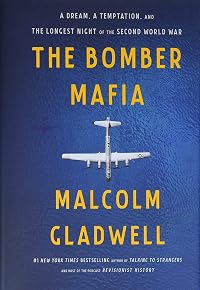
The Bomber Mafia: A Dream, a Temptation, and the Longest Night of the Second World War
by Malcolm Gladwell
On This Page
Description
In The Bomber Mafia: A Dream, a Temptation, and the Longest Night of the Second World War, Malcolm Gladwell, author of New York Times bestsellers including Talking to Strangers and host of the podcast Revisionist History, uses original interviews, archival footage and his trademark insight to weave together the stories of a Dutch genius and his homemade computer, a band of brothers in central Alabama, a British psychopath, and pyromaniacal chemists at Harvard. As listeners hear these stories show more unfurl, Gladwell examines one of the greatest moral challenges in modern American history.Most military thinkers in the years leading up to World War II saw the airplane as an afterthought. But a small band of idealistic strategists had a different view. This "Bomber Mafia" asked: What if precision bombing could, just by taking out critical choke points — industrial or transportation hubs – cripple the enemy and make war far less lethal?
In Revisionist History, Gladwell re-examines moments from the past and asks whether we got it right the first time. In The Bomber Mafia, he employs all the production techniques that make Revisionist History so engaging, stepping back from the bombing of Tokyo, the deadliest night of the war, and asking, "Was it worth it?" The attack was the brainchild of General Curtis LeMay, whose brutal pragmatism and scorched-earth tactics in Japan cost thousands of civilian lives but may have spared more by averting a planned US invasion.
Things might have gone differently had LeMay's predecessor, General Haywood Hansell, remained in charge. As a key member of the Bomber Mafia, Haywood's theories of precision bombing had been foiled by bad weather, enemy jet fighters, and human error. When he and Curtis LeMay squared off for a leadership handover in the jungles of Guam, LeMay emerged victorious, leading to the darkest night of World War II.
. show less
Tags
Recommendations













Member Recommendations
Member Reviews
Typical popular history by a ‘famous’ podcaster – big on sensation, thin on facts, contradictions and doubts that characterize real life and technological innovation. But don’t the captains of industry (readers of the financial times) love this kind of history? Clear heroes and villains, decisive personalities that alter the course of history (something that rarely happens, except in the self-centered life world of CEOs and other over-rated alpha males), convenient, linear time lines and plenty of goal oriented behaviour (and outcomes! Nothing of the messy, fog-of-war type of reality).
The sub-title promises a kind of conceptual approach to technological innovation and war – Yet, what we get is a thin surrogate of a theory of show more change. Strategic change occurs as a result of stubborn, visionary, male super beings, whose ego’s occasionally clash, which can lead to some (temporary) confusion before the great wheel of history receives another swing from a brilliant alpha male in the right direction. Basically, the few facts that Gladwell uses to narrate the story of an American school of precision bombers, could equally be used to construe a recurrent story of failure, right till the present day of drone-driven assassinations. During all this time, the promise of precision bombing remained just that – a promise that was used to perpetrate the most morally despicable acts of mindless carpet bombing that was known to achieve the opposite of what it was meant to achieve (break the spirit of resistance? Duhh, the opposite!).
I would rather have known how it is possible that in the face of overwhelming evidence to the contrary, such ineffectual bombing strategies stay in place (which mechanisms are responsible for this kind of morally doubtful wastage of lives on both ends). What Malcolm does well, is to write in short bursts and sentences, making use of personalized suspense to keep one reading. Chapot for that! show less
The sub-title promises a kind of conceptual approach to technological innovation and war – Yet, what we get is a thin surrogate of a theory of show more change. Strategic change occurs as a result of stubborn, visionary, male super beings, whose ego’s occasionally clash, which can lead to some (temporary) confusion before the great wheel of history receives another swing from a brilliant alpha male in the right direction. Basically, the few facts that Gladwell uses to narrate the story of an American school of precision bombers, could equally be used to construe a recurrent story of failure, right till the present day of drone-driven assassinations. During all this time, the promise of precision bombing remained just that – a promise that was used to perpetrate the most morally despicable acts of mindless carpet bombing that was known to achieve the opposite of what it was meant to achieve (break the spirit of resistance? Duhh, the opposite!).
I would rather have known how it is possible that in the face of overwhelming evidence to the contrary, such ineffectual bombing strategies stay in place (which mechanisms are responsible for this kind of morally doubtful wastage of lives on both ends). What Malcolm does well, is to write in short bursts and sentences, making use of personalized suspense to keep one reading. Chapot for that! show less
"The Bomber Mafia" is a departure from Malcolm Gladwell's previous works of non-fiction. It focuses on how air power changed the way that countries fight wars. To illustrate his central theme, Gladwell contrasts two very different American military leaders, Haywood Hansell, an idealist, and Curtis LeMay, "who was rational and imperturbable, and incapable of self-doubt." Hansell and other like-minded individuals believed that the most humane way to shorten World War II would be to drop bombs on the enemies' most vital manufacturing centers. To accomplish this, Hansell planned to employ an instrument invented by Carl Norden that would enable bombardiers to zero in on their targets in a more precise manner than ever before.
Hansell and his show more group, nicknamed the "Bomber Mafia," attempted to execute a strategy of precision bombing that failed to achieve its goals. Curtis LeMay, who replaced Haywood, employed very different tactics from his predecessor. Most notably, in March of 1945, LeMay oversaw the firebombing of Tokyo, a mission that killed up to 100,000 Japanese citizens. In the months following, LeMay's pilots carried out similar operations that destroyed major portions of more than sixty other Japanese cities. Gladwell provides us with fascinating and disturbing look at the high cost of World War II in terms of lives lost, property destroyed, and the emotional toll taken on the survivors.
Although "The Bomber Mafia" is worth reading, Gladwell made the ill-advised decision to move back and forth in time. Had he presented the events he describes in chronological order, we would have understood their significance more readily. In addition, while it is a given Gladwell's many fans will eagerly read anything that he writes, the topic may not have the universal appeal of his earlier books. Still, the author captivates us with his funny, bizarre, and grim anecdotes, and he conveys an important message that resonates to this day: It is well-nigh impossible to engage in all-out war without inflicting collateral damage, and there is no foolproof way to prevent fierce armed conflicts from descending into chaos. Hansell's quixotic theory that a general can conduct a war humanely was well-intentioned but, in practice, wildly impractical. "Every one of [the Bomber Mafia's] ideas crumbled in the face of reality." show less
Hansell and his show more group, nicknamed the "Bomber Mafia," attempted to execute a strategy of precision bombing that failed to achieve its goals. Curtis LeMay, who replaced Haywood, employed very different tactics from his predecessor. Most notably, in March of 1945, LeMay oversaw the firebombing of Tokyo, a mission that killed up to 100,000 Japanese citizens. In the months following, LeMay's pilots carried out similar operations that destroyed major portions of more than sixty other Japanese cities. Gladwell provides us with fascinating and disturbing look at the high cost of World War II in terms of lives lost, property destroyed, and the emotional toll taken on the survivors.
Although "The Bomber Mafia" is worth reading, Gladwell made the ill-advised decision to move back and forth in time. Had he presented the events he describes in chronological order, we would have understood their significance more readily. In addition, while it is a given Gladwell's many fans will eagerly read anything that he writes, the topic may not have the universal appeal of his earlier books. Still, the author captivates us with his funny, bizarre, and grim anecdotes, and he conveys an important message that resonates to this day: It is well-nigh impossible to engage in all-out war without inflicting collateral damage, and there is no foolproof way to prevent fierce armed conflicts from descending into chaos. Hansell's quixotic theory that a general can conduct a war humanely was well-intentioned but, in practice, wildly impractical. "Every one of [the Bomber Mafia's] ideas crumbled in the face of reality." show less
The Bomber Mafia is Malcolm Gladwell’s 2021 book on the growth of military air power in World War II, and how it was used, particularly by the United States. Gladwell being Gladwell, he has come up with a unique lens through which to view that history.
Gladwell focuses his story on the competing theories for the use of air power in the second world war. Two theories were in play, and both had their proponents. One camp, represented in the book by General Haywood Hansell, believed that air war should be conducted by bombers at high altitudes, using precision instruments to deliver payloads on strategic military targets to weaken the enemy’s ability to fight, thus shortening the overall war.
The other camp, represented by General show more Curtis LeMay, believed that bombers should target the enemy’s population centers, destroying every day life as a means to weakening the enemy’s resolve, thus shortening the overall war. The British were big proponents of this theory of the use of air power as well, leading Churchhill to push Roosevelt in 1943 at the conference in Casablanca to drop attempts at daytime bombing in Europe and join the RAF in nighttime raids on German population centers.
As the war progressed Hansell’s camp soon learned that the key precision instrument they relied on - the Norden bombsight - wasn’t nearly as precise in practice as it was in theory. The bombsight was a mechanical instrument utilizing an analog calculator that required the bombardier to make adjustments through control wheels. The calculator was meant to take into account the plane’s ground speed, direction, strength of wind, etc. But attempts at precision bombing and destruction of Germany’s ball bearing plants (meant to cripple their ability to produce war machinery) failed twice, with large losses of planes and men, and is a key turning point in the book.
Beyond its mechanical nature one key limitation of the Norden bombsight was that it relied, as its name implies, on sight. The bombardier looked through a lens to locate the target - meaning that the instrument could only be used during the day and only on cloudless days. This was a key reason why missions were meant to fly and deliver their payloads from high altitudes, so they could avoid being hit from the ground.
In Japan, Hansell and the US Air Force encountered the jet stream for the first time. Planes flying in the jet stream had airspeeds so great that they rendered the Norden bombsight practically unusable - by the time the target was sighted, the trajectory calculated, and the bomb released the plane had moved too far away to have any chance of hitting the target. This meant that maintaining the altitude required for precision bombing of Japanese strategic military targets was simply impossible.
On the other hand, progress in making indiscriminate bombing of population centeers far more deadly bore fruit as the war progressed. Out of the chemistry labs at Harvard came a fearsome weapon - napalm. Napalm is a highly flammable, sticky gel that burns for an extended period. Napalm bombing of Japanese cities - firebombing - by waves of low flying B29 bombers under General LeMay (who replaced Hansell in the Pacific after the initial attempts to bomb Japanese industrial sites failed) killed anywhere from a quarter of a million up to a million Japanese, and, coupled with the nuclear blasts on Nagasaki and Hiroshima, led the Japanese to surrender.
The question all this raises is which is the more moral use of air power during war? If bombing of population centers kills civilians but ultimately leads to a shorter war, is it more moral than Hansell’s precision bombing approach?
What I appreciated about this book is that Gladwell ruminates on the question, but he doesn’t try to give us the answer, as he might have been tempted to in his earlier books. Even though precision bombing has made tremendous strides since World War II Gladwell points out that both approaches have their strengths and weaknesses - a point he makes in discussion with several retired Air Force generals in the Epilogue of the book.
I listened to the audiobook of The Bomber Mafia, and in it Gladwell says that the project started out as an audiobook and then transitioned into book form. In the audiobook, Gladwell’s podcasting experience shows. There are musical interludes and several audio segments including archival interviews with some of the key players. While it does give the audiobook more of a podcast sensibility, for some reason (maybe because it started out as an audio project) in this case it just feels right.
The Bomber Mafia is unusual in subject matter for a Gladwell book. But as a fan of history I found it to be a great refresher as well as a unique look at the air war. If you’ve been a fan of Gladwell’s and also appreciate history I think you’ll find the audiobook a great listen.
RATING: Five Stars ⭐⭐⭐⭐⭐ show less
Gladwell focuses his story on the competing theories for the use of air power in the second world war. Two theories were in play, and both had their proponents. One camp, represented in the book by General Haywood Hansell, believed that air war should be conducted by bombers at high altitudes, using precision instruments to deliver payloads on strategic military targets to weaken the enemy’s ability to fight, thus shortening the overall war.
The other camp, represented by General show more Curtis LeMay, believed that bombers should target the enemy’s population centers, destroying every day life as a means to weakening the enemy’s resolve, thus shortening the overall war. The British were big proponents of this theory of the use of air power as well, leading Churchhill to push Roosevelt in 1943 at the conference in Casablanca to drop attempts at daytime bombing in Europe and join the RAF in nighttime raids on German population centers.
As the war progressed Hansell’s camp soon learned that the key precision instrument they relied on - the Norden bombsight - wasn’t nearly as precise in practice as it was in theory. The bombsight was a mechanical instrument utilizing an analog calculator that required the bombardier to make adjustments through control wheels. The calculator was meant to take into account the plane’s ground speed, direction, strength of wind, etc. But attempts at precision bombing and destruction of Germany’s ball bearing plants (meant to cripple their ability to produce war machinery) failed twice, with large losses of planes and men, and is a key turning point in the book.
Beyond its mechanical nature one key limitation of the Norden bombsight was that it relied, as its name implies, on sight. The bombardier looked through a lens to locate the target - meaning that the instrument could only be used during the day and only on cloudless days. This was a key reason why missions were meant to fly and deliver their payloads from high altitudes, so they could avoid being hit from the ground.
In Japan, Hansell and the US Air Force encountered the jet stream for the first time. Planes flying in the jet stream had airspeeds so great that they rendered the Norden bombsight practically unusable - by the time the target was sighted, the trajectory calculated, and the bomb released the plane had moved too far away to have any chance of hitting the target. This meant that maintaining the altitude required for precision bombing of Japanese strategic military targets was simply impossible.
On the other hand, progress in making indiscriminate bombing of population centeers far more deadly bore fruit as the war progressed. Out of the chemistry labs at Harvard came a fearsome weapon - napalm. Napalm is a highly flammable, sticky gel that burns for an extended period. Napalm bombing of Japanese cities - firebombing - by waves of low flying B29 bombers under General LeMay (who replaced Hansell in the Pacific after the initial attempts to bomb Japanese industrial sites failed) killed anywhere from a quarter of a million up to a million Japanese, and, coupled with the nuclear blasts on Nagasaki and Hiroshima, led the Japanese to surrender.
The question all this raises is which is the more moral use of air power during war? If bombing of population centers kills civilians but ultimately leads to a shorter war, is it more moral than Hansell’s precision bombing approach?
What I appreciated about this book is that Gladwell ruminates on the question, but he doesn’t try to give us the answer, as he might have been tempted to in his earlier books. Even though precision bombing has made tremendous strides since World War II Gladwell points out that both approaches have their strengths and weaknesses - a point he makes in discussion with several retired Air Force generals in the Epilogue of the book.
I listened to the audiobook of The Bomber Mafia, and in it Gladwell says that the project started out as an audiobook and then transitioned into book form. In the audiobook, Gladwell’s podcasting experience shows. There are musical interludes and several audio segments including archival interviews with some of the key players. While it does give the audiobook more of a podcast sensibility, for some reason (maybe because it started out as an audio project) in this case it just feels right.
The Bomber Mafia is unusual in subject matter for a Gladwell book. But as a fan of history I found it to be a great refresher as well as a unique look at the air war. If you’ve been a fan of Gladwell’s and also appreciate history I think you’ll find the audiobook a great listen.
RATING: Five Stars ⭐⭐⭐⭐⭐ show less
I enjoy Malcolm Gladwell's podcasts and while reading this fascinating history, his voice comes through with that familiar intelligent tone. The Bomber Mafia depicts a group of men who at one time believed that precision bombing was going to be the effective, humane way to win WWII. First was Norden attempting to build the bombsite equipment to enable precision bombing, then Hansen believing it would work on the German Ball bearing factory. These ideals however were failures and it took Curtis Lamay and the invention of the B29 bomber, along with the capture of the maranda islands, to enable the mass incendiary bombing of multiple Tokyo cities with napalm. There is some legitimate criticism in regards to the portrait of Lamay. Was his show more plan solely to help the war end faster and save lives? Or was the intention more of the "bomb them into the Stone Age " quote that he supposedly said about Vietnam. I certainly learned a lot reading this and recommend it. show less
If Malcolm Gladwell wrote a book about cardboard boxes, I would buy it. He could write about paint drying and make it interesting. I think every non-fiction author wants to grow up to be Malcolm Gladwell. This is a man who is a master storyteller — and his latest book is no exception. The Bomber Mafia of the title was a group of men serving in what eventually became the United States Air Force. Following on the First World War, which saw the first use of heavier-than-air craft, the first dogfights, the first aerial bombardment of cities, they had a dream. Their dream was that using new technology like the Norden bombsight, bombs could be dropped precisely where needed. There would be no need to kill civilians, armies would not need to show more clash on the battlefield, and wars would be waged quickly and cleanly with minimal loss of life. Of course it was an absurd idea, but it was tested in practice by the Americans during their air wars in Europe against Nazi Germany and in the Pacific against Imperial Japan. They discovered that their vision was an illusion. It didn’t work. Eventually, the most outspoken of the Bomber Mafia crowd, Haywood Hansell, found himself without a job. His replacement, commanding a fleet of B-29 bombers that could reach Japan, was General Curtis LeMay. LeMay decided to deploy a new technology, napalm, which did the opposite of what the visionaries had in mind. Instead of precision attacks on Japanese war industries — which proved to be nearly impossible — LeMay took advantage of the fact that Japanese civilians lived in densely packed neighbourhoods in houses made of wood. He launched raids that were specifically designed to create firestorms in those cities, causing incredible levels of devastation — and the loss of many thousands of lives. From LeMay’s point of view, the dropping of the atomic bombs on Hiroshima and Nagasaki was the icing on the cake: the war had been won, he believed, by his bombers setting Japanese cities, including Tokyo, ablaze. An incredible story, told brilliantly – highly recommended. show less
History is written by the winners and for a lot of RAF generals and USAF Gen. Curtis LeMay that’s a very good thing because all things being equal, they should have been tried for war crimes in promoting saturation bombing during World War II. Gladwell’s band of flying brothers stationed in central Alabama promoted daytime strategic bombing that concentrated on precisely targeting military and industrial targets with far fewer civilian casualties that the saturation bombing advocated by the RAF. American General Heywood Hansell, a proponent of strategic bombing appeared to be winning the argument, but when he squared off with Curtis LeMay in Guam, he lost both the argument and his command and the rest is history This is a show more fascinating look at what might have been. show less
More of an extended essay than a history book, I found the premise puzzling. By reducing the story to essentially a contest between two rival theories of bombing, represented by two particular American generals, it becomes almost a work of philosophy rather a history. Is it OK to run a war with the aim of killing as few innocent people as possible, or is it better to go all out and kill indiscriminately with the goal of saving more lives in the long run? How did this contest lead to the creation of napalm, which apart from the A-bomb is possibly the most destructive weapon eve developed? And how did the jetstream contribute to the decision to stop precision-bombing Japanese factories and instead use napalm to burn hundreds of thousands show more to death? Its an interesting and thought-provoking book, but left me curiously unsatisfied. Still well worth reading though. show less
Members
- Recently Added By
Lists

Globe and Mail | Canadian Non-Fiction: July 9, 2022
10 works; 1 member

Globe and Mail | Canadian Non-Fiction: July 16, 2022
10 works; 1 member

Globe and Mail | Canadian Non-Fiction: Dec. 18, 2021
10 works; 1 member
Globe and Mail | Canadian Non-Fiction: Dec. 11, 2021
10 works; 1 member

Globe and Mail | Canadian Non-Fiction: Oct. 30, 2021
10 works; 1 member
Globe and Mail | Canadian Non-Fiction: Dec. 4, 2021
10 works; 1 member
Globe and Mail | Canadian Non-Fiction: Dec. 25, 2021
9 works; 1 member
Globe and Mail | Canadian Non-Fiction: Nov. 13, 2021
10 works; 1 member
Globe and Mail | Canadian Non-Fiction: Nov. 27, 2021
10 works; 1 member

Space Force Reading List 2022
9 works; 1 member

History: War & Terrorism
64 works; 1 member
Author Information

In 2005, Time named Malcolm Gladwell one of its 100 most influential people. He is the author of three books, each of which reached number one on the New York Times Best Seller list. They are: The Tipping Point, Blink, and Outliers. His fourth book, What the Dog Saw and Other Adventures was published in 2009. He is a is a British-born Canadian show more journalist and author. Gladwell was a reporter for the Washington Post from 1987 to 1996, working first as a science writer and then as New York City bureau chief. Since 1996, he has been a staff writer for The New Yorker. He graduated with a degree in history from the University of Toronto's Trinity College in 1984. (Publisher Provided) show less
Some Editions
Awards and Honors
Common Knowledge
- Canonical title
- The Bomber Mafia: A Dream, a Temptation, and the Longest Night of the Second World War
- Original title
- The Bomber Mafia : A Dream, a Temptation, and the Longest Night of the Second World War
- Alternate titles
- The Bomber Mafia : A Story Set in War
- Original publication date
- 2021
- People/Characters
- Carl L. Norden; Haywood Hansell Jr., Curtis E. LeMay; Louis Feiser, E. B. Hershberg
- Important places
- Germany; Japan
- Important events
- World War II; Schweinfurt Raids
- Related movies
- The Memphis Belle: A Story of a Flying Fortress (1944 | IMDb)
- Dedication
- To KMO (and BKMO!)
- First words
- There was a time when the world’s largest airport sat in the middle of the western Pacific, around 1,500 miles from the coast of Japan, on one of a cluster of small tropical islands known as the Marianas.
- Last words
- (Click to show. Warning: May contain spoilers.)Haywood Hansell won the war.
- Blurbers
- Finkelstein, Daniel; Spector, Nicole; Smith, Russell; Brandon, John; Remnick, David; Klein, Julia M (show all 7); Ritholtz, Barry
- Original language
- English
- Canonical DDC/MDS
- 940.544973
- Canonical LCC
- D790.G535
Classifications
- Genres
- History, General Nonfiction, Nonfiction
- DDC/MDS
- 940.544973 — History & geography History of Europe History of Europe 1918- Military history of World War II Air operations Operations of specific countries American air operations in WWII
- LCC
- D790 .G535 — History of Europe, Asia, Africa and Oceania History (General) World War II (1939-1945)
- BISAC
Statistics
- Members
- 1,595
- Popularity
- 14,293
- Reviews
- 66
- Rating
- (3.84)
- Languages
- 9 — Chinese, Dutch, English, Finnish, Italian, Spanish, Swedish, Turkish, Portuguese (Portugal)
- Media
- Paper, Audiobook, Ebook
- ISBNs
- 24
- ASINs
- 9