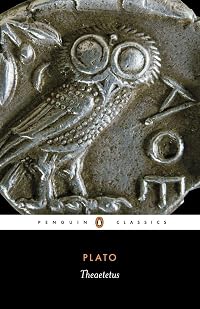
Theaetetus [Greek and translation]
by Plato
On This Page
Description
Some dialogues of Plato are of so various a character that their relation to the other dialogues cannot be determined with any degree of certainty. The Theaetetus, like the Parmenides, has points of similarity both with his earlier and his later writings. The perfection of style, the humour, the dramatic interest, the complexity of structure, the fertility of illustration, the shifting of the points of view, are characteristic of his best period of authorship. The vain search, the negative show more conclusion, the figure of the midwives, the constant profession of ignorance on the part of Socrates, also bear the stamp of the early dialogues, in which the original Socrates is not yet Platonized. show lessTags
Recommendations










Member Reviews
Knowing that Theaetetus is one dialogue in a trilogy with Sophist and Statesman following it, and with Parmenides prior and linked to the trilogy, and having struggled through the almost impenetrable Parmenides, I was apprehensive about Theaetetus but then pleasantly surprised when I read it. After Parmenides, Theaetetus seems like a hybrid of Plato’s early, middle and late periods (assuming this division). It’s a bit more genuine dialogue as opposed to monologue, it has more humor and irony (including several thinly veiled and cutting digs at Protagoras, similar treatment of the Heracliteans, and the familiar but always enjoyable abuse of lawyers, orators and Sophists), and has more of the literary artistry of the early and middle show more works, as well as something more like their topical breadth (and pleasant digressions). Also the metaphors, e.g. of the wax and the aviary, and it touches more on myth (though other late works, e.g. Timaeus and Laws, still deal with myth, sometimes extensively). But then it has the proto-formal logic, more sustained and elaborated arguments, and concerns for precision in use of terms and investigation into language that are characteristically late period. It also doesn’t mention the Theory of Forms, possibly departing from it at least somewhat, and it pretty clearly seems to depart from the earlier conception of learning as recollection of what’s already in the soul.
The primary question is, What is knowledge? and as so often in Plato it ends up inconclusively (“aporia” to ancient Greeks and modern scholars). Of course much is considered, clarified, and much rejected along the way – presumably valuable steps toward a legitimate answer if one’s possible. Plato, in stark contrast to Aristotle, rarely provides a clear and unambiguous doctrine for acceptance or rejection; whether his own beliefs were as qualified and provisional as the dialogues appear to suggest we’ll never know. But he does seem to have believed pretty firmly that a concept given to a mind rather than discovered by it isn’t of much value, either in itself or perhaps more importantly as a way of developing understanding (i.e. of doing philosophy).
This Hackett edition is a nice translation (I’d found Jowett’s unsatisfactory and Cornford’s good, but the constant interruptions of the running commentary unworkable for a first read). It has a good, brief introduction, a useful outline, and few but helpful footnotes. Hackett’s Plato is pretty reliably high quality (Penguin’s is usually good too, and R. E. Allen has been working for years on commentaries and translations of the dialogues which are excellent: he’s done Parmenides; I hope to see Theaetetus and Sophist by him some day. I haven’t used the couple recent single volume modern translation compilations so I can’t comment on them, but I’d also like to get familiar with those). Well, on to Sophist …. show less
The primary question is, What is knowledge? and as so often in Plato it ends up inconclusively (“aporia” to ancient Greeks and modern scholars). Of course much is considered, clarified, and much rejected along the way – presumably valuable steps toward a legitimate answer if one’s possible. Plato, in stark contrast to Aristotle, rarely provides a clear and unambiguous doctrine for acceptance or rejection; whether his own beliefs were as qualified and provisional as the dialogues appear to suggest we’ll never know. But he does seem to have believed pretty firmly that a concept given to a mind rather than discovered by it isn’t of much value, either in itself or perhaps more importantly as a way of developing understanding (i.e. of doing philosophy).
This Hackett edition is a nice translation (I’d found Jowett’s unsatisfactory and Cornford’s good, but the constant interruptions of the running commentary unworkable for a first read). It has a good, brief introduction, a useful outline, and few but helpful footnotes. Hackett’s Plato is pretty reliably high quality (Penguin’s is usually good too, and R. E. Allen has been working for years on commentaries and translations of the dialogues which are excellent: he’s done Parmenides; I hope to see Theaetetus and Sophist by him some day. I haven’t used the couple recent single volume modern translation compilations so I can’t comment on them, but I’d also like to get familiar with those). Well, on to Sophist …. show less
Socrates is usually an entertaining character in most of Plato’s dialogues, and is here as well. I have a vivid picture of him as a scruffy, “snub nosed” guy with “bulging eyes” (209c) that you might try to avoid if you saw him coming down the road. Except that he really is sincere and nice … a bit chatty, but generally a good conversationalist if you have a few hours to spend and don’t mind looking like an ignoramus at times.
This dialogue has Socrates talking with Theaetetus about the nature of knowledge. And in Socrates’ words, he is playing the role of “midwife” helping Theaetetus “give birth” to his notions of knowledge. I’m not making this up. Socrates:
Yes, there’s some questionable stuff there, but the way Socrates envisions the role of midwifery and relates it to an inquiry on the concept of knowledge strikes me as important. However, I’m getting ahead of myself.
Over the course of the dialogue, Theaetetus offers three different definitions of knowledge:
1. “Knowledge is perception”
2. “Knowledge is true belief”
3. “Knowledge is true belief with a rational account”
Through dialogue with Theaetetus, Socrates troubles each these positions in a variety of ways.
Knowledge can’t be perception because, among other things the thing being perceived is continually changing, as is the perceiver (183b). Furthermore the thing is being perceived by different perceivers, all of whom are changing and seeing that thing from different angles. This process cannot yield an object that is commonly perceived in exactly the same way (156d). This position leads to a kind of radical relativism where we cannot know anything about anything except what the thing is to us at any given moment (161d). This position is unfairly (I think) attributed to the sophist Protagoras who famously claimed that “man is the measure of all things.” Socrates takes this sophistic proclamation to mean that “a man” is the measure of all things and so “this man” and “that man” are both equally right about a thing even if their positions differ (171c). I think Protagoras could be read as saying that people (i.e., Man … mankind … humankind) know what they know only insofar as they are capable of knowing at all, through our senses and our ability to make rational sense out of experience (probably a Kantian revision of what Protagoras may have meant).
Neither can knowledge be true belief (187b) if only because we can hold beliefs that are mistaken. I can mistake things that I cannot perceive well enough to distinguish them (194a). I can hold beliefs on the basis of what appears to be true but isn’t. It is also the case that beliefs seem to require separation from knowledge because you cannot hold a belief that is contrary to what one knows (190b). For example, if I know that this medicine will cure what ails me then I cannot simultaneously believe otherwise — it would not be a “true” belief. Someone else could hold that belief as “true” however. Socrates goes on to develop this idea by suggesting that when we know something to be true, the direct encounter with that truth impresses itself like the mark of a signet ring in wax (195a) and beliefs that do not conform will fill that space incompletely. Strangely, though, Socrates insists on extending this analysis to purely conceptual things like number (e.g., 11 and 12) in ways that I don’t get because we can understand those concepts by definition alone. There are no impressions to get wrong.
Finally, it is unclear whether knowledge could be true belief supported by a “rational account” (202c) in which we rationalize our beliefs as being those made understandable through some rational process of justification. This approach ends in indecisiveness because it seems that whatever could be offered as a rational account must come to rest on beliefs and perceptions that can be challenged for all the reasons that Socrates dismantled Theaetetus’s first two definitions of knowledge.
It might seem dissatisfying to end the dialogue here, but I think there is more resolved about knowledge than it might appear, especially if one looks at the very form of this dialogic exchange between Socrates and Theaetetus as reflective of a kind of knowledge that does not rest in definitive statements. Knowledge is a process of knowing and claims deriving from that are provisional. Socrates hints at this version of knowledge early on by defining a “proper inquiry” as “sitting down together in a spirit of goodwill, not with hostile and aggressive intensions” (168b) in order to correct errors in each others’ judgements (168a). Socrates continually encourages Theaetetus to take risks and when he does, Socrates praises him for not holding back and for being willing to have his position picked apart and changed (204b).
Each of the definitions that Socrates engages with, and dismisses, illustrate that it is problematic to treat knowledge as a thing that one has or doesn’t have (197c). If we think about knowledge as something that one believes and offers as true and submits that knowledge as provisional, subject to the test of experience, sensation, and the scrutiny of other knowing and sensing beings then it is not problematic if knowledge is true or false or built on beliefs that are true or false or built from perceptions that are complete or incomplete. Knowledge is something you practice rather than have.
So perhaps there is something to Plato’s odd use of the “midwife” as a metaphor in that it highlights the role of an interlocutor or someone who assists in the creation or bringing forth of knowledge. That is sort of the definition of knowledge that I thought was missing from this formulation and was the role that Socrates was playing from the very start.
This returns us to Socrates’ analogy of the wax tablet in which he cautions that it is better for the wax to be warm and open to change rather than hard and resistant to change (195a). I sure would like to live in a world like this.
P.S. - Also, the concluding essay by Robin Waterfield is really excellent, if a little "in the weeds" at times. show less
This dialogue has Socrates talking with Theaetetus about the nature of knowledge. And in Socrates’ words, he is playing the role of “midwife” helping Theaetetus “give birth” to his notions of knowledge. I’m not making this up. Socrates:
show more
When I ask a question, set about answering it to the
best of your ability. And if, on examination, I find that some thought of yours is illusory and untrue, and if I then draw it out of you and discard it, don’t rant and rave at me, as a first-time mother might if her baby was involved (151c-d)
Yes, there’s some questionable stuff there, but the way Socrates envisions the role of midwifery and relates it to an inquiry on the concept of knowledge strikes me as important. However, I’m getting ahead of myself.
Over the course of the dialogue, Theaetetus offers three different definitions of knowledge:
1. “Knowledge is perception”
2. “Knowledge is true belief”
3. “Knowledge is true belief with a rational account”
Through dialogue with Theaetetus, Socrates troubles each these positions in a variety of ways.
Knowledge can’t be perception because, among other things the thing being perceived is continually changing, as is the perceiver (183b). Furthermore the thing is being perceived by different perceivers, all of whom are changing and seeing that thing from different angles. This process cannot yield an object that is commonly perceived in exactly the same way (156d). This position leads to a kind of radical relativism where we cannot know anything about anything except what the thing is to us at any given moment (161d). This position is unfairly (I think) attributed to the sophist Protagoras who famously claimed that “man is the measure of all things.” Socrates takes this sophistic proclamation to mean that “a man” is the measure of all things and so “this man” and “that man” are both equally right about a thing even if their positions differ (171c). I think Protagoras could be read as saying that people (i.e., Man … mankind … humankind) know what they know only insofar as they are capable of knowing at all, through our senses and our ability to make rational sense out of experience (probably a Kantian revision of what Protagoras may have meant).
Neither can knowledge be true belief (187b) if only because we can hold beliefs that are mistaken. I can mistake things that I cannot perceive well enough to distinguish them (194a). I can hold beliefs on the basis of what appears to be true but isn’t. It is also the case that beliefs seem to require separation from knowledge because you cannot hold a belief that is contrary to what one knows (190b). For example, if I know that this medicine will cure what ails me then I cannot simultaneously believe otherwise — it would not be a “true” belief. Someone else could hold that belief as “true” however. Socrates goes on to develop this idea by suggesting that when we know something to be true, the direct encounter with that truth impresses itself like the mark of a signet ring in wax (195a) and beliefs that do not conform will fill that space incompletely. Strangely, though, Socrates insists on extending this analysis to purely conceptual things like number (e.g., 11 and 12) in ways that I don’t get because we can understand those concepts by definition alone. There are no impressions to get wrong.
Finally, it is unclear whether knowledge could be true belief supported by a “rational account” (202c) in which we rationalize our beliefs as being those made understandable through some rational process of justification. This approach ends in indecisiveness because it seems that whatever could be offered as a rational account must come to rest on beliefs and perceptions that can be challenged for all the reasons that Socrates dismantled Theaetetus’s first two definitions of knowledge.
It might seem dissatisfying to end the dialogue here, but I think there is more resolved about knowledge than it might appear, especially if one looks at the very form of this dialogic exchange between Socrates and Theaetetus as reflective of a kind of knowledge that does not rest in definitive statements. Knowledge is a process of knowing and claims deriving from that are provisional. Socrates hints at this version of knowledge early on by defining a “proper inquiry” as “sitting down together in a spirit of goodwill, not with hostile and aggressive intensions” (168b) in order to correct errors in each others’ judgements (168a). Socrates continually encourages Theaetetus to take risks and when he does, Socrates praises him for not holding back and for being willing to have his position picked apart and changed (204b).
Each of the definitions that Socrates engages with, and dismisses, illustrate that it is problematic to treat knowledge as a thing that one has or doesn’t have (197c). If we think about knowledge as something that one believes and offers as true and submits that knowledge as provisional, subject to the test of experience, sensation, and the scrutiny of other knowing and sensing beings then it is not problematic if knowledge is true or false or built on beliefs that are true or false or built from perceptions that are complete or incomplete. Knowledge is something you practice rather than have.
So perhaps there is something to Plato’s odd use of the “midwife” as a metaphor in that it highlights the role of an interlocutor or someone who assists in the creation or bringing forth of knowledge. That is sort of the definition of knowledge that I thought was missing from this formulation and was the role that Socrates was playing from the very start.
This returns us to Socrates’ analogy of the wax tablet in which he cautions that it is better for the wax to be warm and open to change rather than hard and resistant to change (195a). I sure would like to live in a world like this.
P.S. - Also, the concluding essay by Robin Waterfield is really excellent, if a little "in the weeds" at times. show less
Sócrates, a mais ilustre parteira de ideias da Grécia antiga, conduz o mancebo Teeteto ao conhecimento do que o conhecimento não é, pois nem todo filho do conhecimento o é em verdade - e diferentemente dos legisladores, escravos da pressa e do relógio, agressivos por pressão do meio, os filósofos são amantes da verdade, e podem passar em conversa argumentos que por fim mostram-se insuficientes. Seria errôneo, entretanto, dizer que a tarefa foi em vão. E ademais, Sócrates precisa ir a um julgamento se defender...
***
O que apreendi: Aamaiêutica mostra que o conhecimento (o "saber que") não é a percepção, pois, modus tolens, com Protágoras, o humano não é a medida de todas as coisas - as coisas não são como aparecem; o show more vento sendo frio e quente só o é para duas pessoas, uma sem casaco. E com isso, há quem saiba mais e menos, e o julgamento sobre a percepção falha. E ouvir uma fala não é entendê-la, e lembrar algo não é o perceber. Ademais, com Heráclito, se tudo for fluxo, mas como diferenciar então o as aparências verdadeiras das falsas, intersubjetivamente, e dizer de algo algo sem este significado estar em fluxo? Por fim, a existência, igualdade e diferença não operam pelos sentidos.
A maiêutica também mostra que conhecimento não são julgamentos acertados sobre as experiências. A ideia aqui é mostrar como conhecimentos empíricos poderiam surgir das percepções e mostrar a dificuldade em definir crenças falsas a partir daí, que permitiriam determinar quais são as verdadeiras. Um empirista acredita na existência de proposições? Se uma coisa falsa é julgar o que não é, que é presente imediatamente a nós, é julgar nada, que é um nada julgar. E se tudo for imediato, o que será conhecido será identificado, e o que não não. E se imprimirmos crenças como cera, ainda assim o erro entre a impressão e a indicação do que foi impresso, mas e os erros de aritmética? E se tivermos conhecimentos e ignorâncias dentro da mente, ainda assim, como entender como são confundidos? E conhecimento não é crença verdadeira, porque um advogado pode fazer os júris chegarem a tal estado, sem que eles de fato tenham conhecimento sobre a situação.
Mas e se o conhecimento for a crença verdadeira justificada? Justifiquemos com o sonho de Sócrates, a dizer que é preciso analisar as coisas em seus componentes simples. E temos então conhecimento das coisas complexas, porque analisadas e vistas como combinantes das coisas simples que são dadas. Peguemos a sílaba Só de Sócrates, que nos exige saber S e ó (que não são dados!)' também Só não é meramente esses elementos; e nem a sílaba um primário, que se ainda assim fosse, seria dado e não conhecido. Depois, a razão não é nem a fala, nem enumeração (que não diferencia os que só sabem fazer e não sabem como algo é), nem o diferencial, que qualifica, mas não muda as dificuldades quanto ao conhecimento do algo qualificado.
Então, abandonem o empiricismo, oh, epistemologistas. show less
***
O que apreendi: Aamaiêutica mostra que o conhecimento (o "saber que") não é a percepção, pois, modus tolens, com Protágoras, o humano não é a medida de todas as coisas - as coisas não são como aparecem; o show more vento sendo frio e quente só o é para duas pessoas, uma sem casaco. E com isso, há quem saiba mais e menos, e o julgamento sobre a percepção falha. E ouvir uma fala não é entendê-la, e lembrar algo não é o perceber. Ademais, com Heráclito, se tudo for fluxo, mas como diferenciar então o as aparências verdadeiras das falsas, intersubjetivamente, e dizer de algo algo sem este significado estar em fluxo? Por fim, a existência, igualdade e diferença não operam pelos sentidos.
A maiêutica também mostra que conhecimento não são julgamentos acertados sobre as experiências. A ideia aqui é mostrar como conhecimentos empíricos poderiam surgir das percepções e mostrar a dificuldade em definir crenças falsas a partir daí, que permitiriam determinar quais são as verdadeiras. Um empirista acredita na existência de proposições? Se uma coisa falsa é julgar o que não é, que é presente imediatamente a nós, é julgar nada, que é um nada julgar. E se tudo for imediato, o que será conhecido será identificado, e o que não não. E se imprimirmos crenças como cera, ainda assim o erro entre a impressão e a indicação do que foi impresso, mas e os erros de aritmética? E se tivermos conhecimentos e ignorâncias dentro da mente, ainda assim, como entender como são confundidos? E conhecimento não é crença verdadeira, porque um advogado pode fazer os júris chegarem a tal estado, sem que eles de fato tenham conhecimento sobre a situação.
Mas e se o conhecimento for a crença verdadeira justificada? Justifiquemos com o sonho de Sócrates, a dizer que é preciso analisar as coisas em seus componentes simples. E temos então conhecimento das coisas complexas, porque analisadas e vistas como combinantes das coisas simples que são dadas. Peguemos a sílaba Só de Sócrates, que nos exige saber S e ó (que não são dados!)' também Só não é meramente esses elementos; e nem a sílaba um primário, que se ainda assim fosse, seria dado e não conhecido. Depois, a razão não é nem a fala, nem enumeração (que não diferencia os que só sabem fazer e não sabem como algo é), nem o diferencial, que qualifica, mas não muda as dificuldades quanto ao conhecimento do algo qualificado.
Então, abandonem o empiricismo, oh, epistemologistas. show less
"Oh yes, indeed, Socrates, I often wonder like mad what these things can mean: sometimes when I’m looking at them I begin to feel quite giddy... For this is an experience which is characteristic of a philosopher, this wondering: this is where philosophy begins and nowhere else.” 155c-d
SUMMARY: In Theaetetus, Socrates is introduced to Theaetetus by his friend Theodorus. Almost immediately, Socrates and Theaetetus begin exploring different definitions of knowledge, and taking these definitions as far as possible to see if the logic breaks down, or if the definition of knowledge holds firm, and can be seen as the universal and most true definition of knowledge. James M. Cooper states in the introductory commentary in the volume I am show more reading, says "Socrates now describes his role, however, as he does not in the ‘Socratic’ dialogues, as that of a ‘midwife’: he brings to expression ideas of clever young men like Theaetetus, extensively develops their presuppositions and consequences so as to see clearly what the ideas amount to, and then establishes them as sound or defective by independent arguments of his own." The two major positions argued for is 'knowledge is perception', and 'knowledge is motion'. They explore these positions and find them as not being satisfactory, and propose a third view, that 'knowledge is judgement, when the judgement is paired with an account'. But once again, Socrates eventually rejects this third definition, due to what counts as an account, being unclear. In between these explorations of knowledge, Socrates lectures Theaetetus and Theodorus on how to have a productive dialogue, the state of mind of a philosopher, and the importance of all participating parties maintaining charitability between each other, especially those with differing or opposing views. Socrates instructs that if charitability cannot be maintained, then all parties should disengage from the dialogue.
In the works of Plato I have read so far, I think Theaetetus will stick with me for quite a while. Euthyphro is a great introduction to the types of questions philosophy asks. The Apology and Crito are great introductions to political philosophy. Phaedo captures an important moment of human history, bringing about strong emotions. Cratylus shows the brilliant mind of Socrates in action. But Theaetetus is a work of pure practical philosophy, with plenty of applicable instructions for the reader, and a discussion of knowledge and truth, which has not yet ceased to be universally relevant in our post-modern age, unlike the divinity of words in Cratylus, or the morality of the Gods in Euthyphro. In the introductory commentary of the volume I am reading from, James M. Cooper calls Theaetetus the founding document of epistemology, to which I think similarly in terms of importance, as I truly think this is a landmark document to which I or anyone else can orient ourselves with.
It is utterly fascinating to read an ancient text, and see your exact stream of consciousness and thoughts you have had before. Socrates rejection of perception as being accurate and by itself does not make any judgements is something I think about often. Each of the definitions of knowledge progressively gets closer to my understanding of knowledge, and while Socrates rejects the third definition, it is leagues better of a methodology for knowledge. Where knowledge as perception, and knowledge as motion can seem archaic, knowledge as judgement with an account is an incredibly modern understanding of knowledge. As many of the commentaries take note of, the theory of forms is unusually absent from this dialogue, so I am curious to see if the conclusions from this dialogue become relevant later, as the theory of forms becomes a stronger element in Plato's works.
My own thoughts on what knowledge is, I feel is found more in knowledge's relationships with other knowledge, rather than the basic elements of the knowledge in question. I think that we gain understanding of properties and elements of knowledge by examining the relationship the knowledge in question has with other knowledge. Secondly, I don't necessarily have an understanding of a single methodology for knowledge, but think it is found under a cumulative effort of multiple methodologies that happen to overlap or converge. So my thoughts about knowledge being found when examining knowledge's relationships, is a single methodology, out of many methods, and when combined with other methods for finding knowledge, we can be more confident in our knowledge, when all of our combined methodologies produce a convergence of observed properties. So with the final proposal of Theaetetus saying that 'knowledge is a judgement, when paired with an account', is a great definition, because it defines knowledge as being the result of two methods of observation, that is a judgement, and an account. I must make a note that I do not commit myself to a view that there is an all encompassing hierarchy, where this convergence property stops at the end of reality, and where this convergence stops, is the ultimate and true authority of knowledge. I am not convinced that when we experience knowledge that has a property of convergence among multiple observational methods, that this formula for knowledge unifies into a single all encompassing thing, but you could say I do subscribe to a view of small hierarchies. I more or less subscribe to a module view of knowledge, where there are multiple independent sets of knowledge, with various properties, some of which includes a convergence property. For example, if you go to a lake, and the shore of the lake is made up of multiple small rocks and pebbles. If you were to pick up two rocks, you could say that there is a convergence property due to our definition of a rock, but the rocks are two separate entities because you can hold a rock in each hand, they are not the same thing. The rock is made up of multiple elements, and all these elements converge into one thing inside the rock, but this convergence stops at what we would call the surface area of the rock. If we try to examine the relationship between one rock and the other rock, you can examine similarities, and differences. If you gather a large enough sample of all the rocks in the area, you can then start to discern patterns in each of the individual rocks. You might be able to determine that all the rocks used to be a part of earths crust, and were in some sense one single rock at a previous point in history. You might describe this relationship between the many small rocks that used to be one big rock in Earth's crust as a hierarchal relationship, but I just describe it as a relationship, where I don't place value on where knowledge came from, but value that knowledge itself exists. There is a lot of knowledge to be gained when viewing things through a hierarchy, but I am just not personally convinced that the hierarchy is an inherent trait to natural laws, but view the hierarchal view of relationships between things and knowledge as an aesthetic relationship, that does and can provide knowledge, but do not see a hierarchy as an account for knowledge itself. In trying to bring things to a conclusion, there is probably much to pick apart in my own understandings of my own views. I understand in epistemology that one of the main questions of concern as far as I am aware, is if you can have knowledge be separated from metaphysics, to which I have no clue, as I have yet to encounter this in my studies and personal inquiries into the issue so far.
"THEAETETUS: I can never persuade myself that anything I say will really do; and I never hear anyone else state the matter in the way that you require. And yet, again, you know, I can’t even stop worrying about it. SOCRATES: Yes; those are the pains of labor, dear Theaetetus. It is because you are not barren but pregnant." 148e
"THEAETETUS: Oh yes, indeed, Socrates, I often wonder like mad what these things can mean: sometimes when I'm looking at them I begin to feel quite giddy... For this is an experience which is characteristic of a philosopher, this wondering: this is where philosophy begins and nowhere else." 155c-d
"SOCRATES: You are forgetting, my friend. I don't know anything about this kind of thing myself, and I don't claim any of it as my own. I am barren of theories; my business is to attend you in your labor. So I chant incantations over you an offer you little tidbits from each of the wise till I succeed in assisting you to bring your own belief forth into the light. When it has been born, I shall consider whether it is fertile or a wind-egg. But you must have courage and patience; answer like a man whatever appears to you about the things I ask you." 157c-d
"Only I beg that you will observe this condition: do not be unjust in your questions. It is the height of unreasonableness that a person who professes to care for moral goodness should be consistently unjust in discussion. I mean by injustice, in this connection, the behavior of a man who does not take care to keep controversy distinct from discussion; a man who forgets that in controversy he may play about and trip up his opponent as often as he can, but that in discussion he must be serious, he must keep on helping his opponent to his feet again." 167d-e
"They will seek your company, and think of you as their friend; but they will loathe themselves, and seek refuge from themselves in philosophy, in the hope that they may be thereby become different people and be rid forever of the men that they once were. But if you follow the common practice and do the opposite, you will get the opposite results. Instead of philosophers, you will make your companions grow up to be the enemies of philosophy." 168a-b
"The Spartans tell one either to strip or to go away; but you seem rather to be playing the part of Antaeus. You don't let any comer go till you have stripped him and made him wrestle with you in argument." 169b
"Now there is one kind of mistake I want you to be specially on your guard against, namely, that we do not unconsciously slip into some childish form of argument." 169c-d
"But we have got to take ourselves as we are, I suppose, and go on saying the things which seem to us to be. At the moment, then, mustn’t we maintain that any man would admit at least this, that some men are wiser than their fellows and others more ignorant?" 171d
"The philosopher grows up without knowing the way to the market-place, or the whereabouts of the law courts or the council chambers or any other place of public assembly. Laws and decrees, published orally or in writing, are things he never sees or hears. The scrambling of political cliques for office; social functions, dinners, parties with flute-girls—such doings never enter his head even in a dream. So with questions of birth—he has no more idea whether a fellow citizen is high-born or humble, or whether he has inherited some taint from his forebears, male or female, than he has of the number of pints in the sea, as they say. And in all these matters, he knows not even that he knows not; for he does not hold himself aloof from them in order to get a reputation, but because it is in reality only his body that lives and sleeps in the city. His mind, having come to the conclusion that all these things are of little or no account, spurns them and pursues its wingéd way" 173d-e
"They say Thales was studying the stars, Theodorus, and gazing aloft, when he fell into a well; and a witty and amusing Thracian servant-girl made fun of him because, she said, he was wild to know about what was up in the sky but failed to see what was in front of him and under his feet. The same joke applies to all who spend their lives in philosophy. It really is true that the philosopher fails to see his next-door neighbor; he not only doesn’t notice what he is doing; he scarcely knows whether he is a man or some other kind of creature. The question he asks is, What is Man? What actions and passions properly belong to human nature and distinguish it from all other beings? This is what he wants to know and concerns himself to investigate." 174a-b
"When he hears talk of land—that so-and-so has a property of ten thousand acres or more, and what a vast property that is, it sounds to him like a tiny plot, used as he is to envisage the whole earth. When his companions become lyric on the subject of great families, and exclaim at the noble blood of one who can point to seven wealthy ancestors, he thinks that such praise comes of a dim and limited vision, an inability, through lack of education, to take a steady view of the whole" 174e-175a
"You see, the philosopher is the object of general derision, partly for what men take to be his superior manner, and partly for his constant ignorance and lack of resource in dealing with the obvious." 175b
"Their very ignorance of their true state fixes them the more firmly therein" 176b
"when he dies the place that is pure of all evil will not receive him; that he will forever go on living in this world a life after his own likeness—a bad man tied to bad company: he will but think, ‘This is the way fools talk to a clever rascal like me.' There is one accident to which the unjust man is liable. When it comes to giving and taking an account in a private discussion of the things he disparages; when he is willing to stand his ground like a man for long enough, instead of running away like a coward, then, my friend, an odd thing happens. In the end the things he says do not satisfy even himself; that famous eloquence of his somehow dries up, and he is left looking nothing more than a child." 177b
"It seems to me that the soul when it thinks is simply carrying on a discussion in which it asks itself questions and answers them itself, affirms and denies. And when it arrives at something definite, either by a gradual process or a sudden leap, when it affirms one thing consistently and without divided counsel, we call this its judgment. So, in my view, to judge is to make a statement, and a judgment is a statement which is not addressed to another person or spoken aloud, but silently addressed to oneself." 190a
"If we go on and track this down, perhaps we may stumble on what we are looking for; if we stay where we are, nothing will come clear." 201a
"So, it seems, the answer to the question ‘What is knowledge?’ will be ‘Correct judgment accompanied by knowledge of the differentness’—for this is what we are asked to understand by the ‘addition of an account." 210a
(WHAT) TITLE: Theaetetus
(WHAT) SERIES: Platonic Dialogues
(WHAT) Order:
(WHO) AUTHOR/EDITOR: Plato
RECORDS OF NOTE:
(WHAT) GENRE / SUBJECT: Philosophy, Greek
(HOW) METHODS OF COMPREHENSION: "Primary reading was with Plato: Complete Works, edited by John M. Cooper, and with Theaetetus in this collection being translated by M. J. Levett, and revised by Myles Burnyeat. I read through this translation, highlighting things that I resonated with, or thought was important, to which I have copied my highlights to my reflection and review section. After I read through the first time and capturing my thoughts, I went to supplementary resources, which included Ch. 11 of the Oxford Handbook of Plato on Theaetetus, written by Mi-Kyoung Lee. I read The Wikipedia article on Theaetetus. Then I skimmed through the Stanford Encyclopedia of Philosophy's entry on Theaetetus.
Plato: Complete Works: Edited by John M. Cooper.
https://www.goodreads.com/book/show/9...
The Oxford Handbook of Plato
https://www.goodreads.com/book/show/3...
Wikipedia
https://en.wikipedia.org/wiki/Theaete...
Stanford Encyclopedia of Philosophy
https://plato.stanford.edu/entries/pl...
PAGES: 109
(WHERE) OWNED / PLATFORM: EPUB
EXCITEMENT: 7
RATING: 8
(WHY) HOW DID I HEAR ABOUT IT?: In Plato: Complete works, edited by John M. Cooper
FINISHED: Yes
(WHEN) READ OVER THE COURSE OF?: 2 Weeks
(WHEN) DATE FINISHED: Thu, Nov 13, 2025
(WHY) REASON FINISHED: I am wanting to read through Plato's works. Learn more about the foundations of western philosophy. I want to read through all the major works in Dialectics, Dialectical Materialism, and Dialogic.
(WHY) REASON DROPPED:
EXPECTATIONS: Exceeded
PACING FEEL: Too Long
STYLE: Dialogue
WORTH MY TIME: Yes show less
SUMMARY: In Theaetetus, Socrates is introduced to Theaetetus by his friend Theodorus. Almost immediately, Socrates and Theaetetus begin exploring different definitions of knowledge, and taking these definitions as far as possible to see if the logic breaks down, or if the definition of knowledge holds firm, and can be seen as the universal and most true definition of knowledge. James M. Cooper states in the introductory commentary in the volume I am show more reading, says "Socrates now describes his role, however, as he does not in the ‘Socratic’ dialogues, as that of a ‘midwife’: he brings to expression ideas of clever young men like Theaetetus, extensively develops their presuppositions and consequences so as to see clearly what the ideas amount to, and then establishes them as sound or defective by independent arguments of his own." The two major positions argued for is 'knowledge is perception', and 'knowledge is motion'. They explore these positions and find them as not being satisfactory, and propose a third view, that 'knowledge is judgement, when the judgement is paired with an account'. But once again, Socrates eventually rejects this third definition, due to what counts as an account, being unclear. In between these explorations of knowledge, Socrates lectures Theaetetus and Theodorus on how to have a productive dialogue, the state of mind of a philosopher, and the importance of all participating parties maintaining charitability between each other, especially those with differing or opposing views. Socrates instructs that if charitability cannot be maintained, then all parties should disengage from the dialogue.
In the works of Plato I have read so far, I think Theaetetus will stick with me for quite a while. Euthyphro is a great introduction to the types of questions philosophy asks. The Apology and Crito are great introductions to political philosophy. Phaedo captures an important moment of human history, bringing about strong emotions. Cratylus shows the brilliant mind of Socrates in action. But Theaetetus is a work of pure practical philosophy, with plenty of applicable instructions for the reader, and a discussion of knowledge and truth, which has not yet ceased to be universally relevant in our post-modern age, unlike the divinity of words in Cratylus, or the morality of the Gods in Euthyphro. In the introductory commentary of the volume I am reading from, James M. Cooper calls Theaetetus the founding document of epistemology, to which I think similarly in terms of importance, as I truly think this is a landmark document to which I or anyone else can orient ourselves with.
It is utterly fascinating to read an ancient text, and see your exact stream of consciousness and thoughts you have had before. Socrates rejection of perception as being accurate and by itself does not make any judgements is something I think about often. Each of the definitions of knowledge progressively gets closer to my understanding of knowledge, and while Socrates rejects the third definition, it is leagues better of a methodology for knowledge. Where knowledge as perception, and knowledge as motion can seem archaic, knowledge as judgement with an account is an incredibly modern understanding of knowledge. As many of the commentaries take note of, the theory of forms is unusually absent from this dialogue, so I am curious to see if the conclusions from this dialogue become relevant later, as the theory of forms becomes a stronger element in Plato's works.
My own thoughts on what knowledge is, I feel is found more in knowledge's relationships with other knowledge, rather than the basic elements of the knowledge in question. I think that we gain understanding of properties and elements of knowledge by examining the relationship the knowledge in question has with other knowledge. Secondly, I don't necessarily have an understanding of a single methodology for knowledge, but think it is found under a cumulative effort of multiple methodologies that happen to overlap or converge. So my thoughts about knowledge being found when examining knowledge's relationships, is a single methodology, out of many methods, and when combined with other methods for finding knowledge, we can be more confident in our knowledge, when all of our combined methodologies produce a convergence of observed properties. So with the final proposal of Theaetetus saying that 'knowledge is a judgement, when paired with an account', is a great definition, because it defines knowledge as being the result of two methods of observation, that is a judgement, and an account. I must make a note that I do not commit myself to a view that there is an all encompassing hierarchy, where this convergence property stops at the end of reality, and where this convergence stops, is the ultimate and true authority of knowledge. I am not convinced that when we experience knowledge that has a property of convergence among multiple observational methods, that this formula for knowledge unifies into a single all encompassing thing, but you could say I do subscribe to a view of small hierarchies. I more or less subscribe to a module view of knowledge, where there are multiple independent sets of knowledge, with various properties, some of which includes a convergence property. For example, if you go to a lake, and the shore of the lake is made up of multiple small rocks and pebbles. If you were to pick up two rocks, you could say that there is a convergence property due to our definition of a rock, but the rocks are two separate entities because you can hold a rock in each hand, they are not the same thing. The rock is made up of multiple elements, and all these elements converge into one thing inside the rock, but this convergence stops at what we would call the surface area of the rock. If we try to examine the relationship between one rock and the other rock, you can examine similarities, and differences. If you gather a large enough sample of all the rocks in the area, you can then start to discern patterns in each of the individual rocks. You might be able to determine that all the rocks used to be a part of earths crust, and were in some sense one single rock at a previous point in history. You might describe this relationship between the many small rocks that used to be one big rock in Earth's crust as a hierarchal relationship, but I just describe it as a relationship, where I don't place value on where knowledge came from, but value that knowledge itself exists. There is a lot of knowledge to be gained when viewing things through a hierarchy, but I am just not personally convinced that the hierarchy is an inherent trait to natural laws, but view the hierarchal view of relationships between things and knowledge as an aesthetic relationship, that does and can provide knowledge, but do not see a hierarchy as an account for knowledge itself. In trying to bring things to a conclusion, there is probably much to pick apart in my own understandings of my own views. I understand in epistemology that one of the main questions of concern as far as I am aware, is if you can have knowledge be separated from metaphysics, to which I have no clue, as I have yet to encounter this in my studies and personal inquiries into the issue so far.
"THEAETETUS: I can never persuade myself that anything I say will really do; and I never hear anyone else state the matter in the way that you require. And yet, again, you know, I can’t even stop worrying about it. SOCRATES: Yes; those are the pains of labor, dear Theaetetus. It is because you are not barren but pregnant." 148e
"THEAETETUS: Oh yes, indeed, Socrates, I often wonder like mad what these things can mean: sometimes when I'm looking at them I begin to feel quite giddy... For this is an experience which is characteristic of a philosopher, this wondering: this is where philosophy begins and nowhere else." 155c-d
"SOCRATES: You are forgetting, my friend. I don't know anything about this kind of thing myself, and I don't claim any of it as my own. I am barren of theories; my business is to attend you in your labor. So I chant incantations over you an offer you little tidbits from each of the wise till I succeed in assisting you to bring your own belief forth into the light. When it has been born, I shall consider whether it is fertile or a wind-egg. But you must have courage and patience; answer like a man whatever appears to you about the things I ask you." 157c-d
"Only I beg that you will observe this condition: do not be unjust in your questions. It is the height of unreasonableness that a person who professes to care for moral goodness should be consistently unjust in discussion. I mean by injustice, in this connection, the behavior of a man who does not take care to keep controversy distinct from discussion; a man who forgets that in controversy he may play about and trip up his opponent as often as he can, but that in discussion he must be serious, he must keep on helping his opponent to his feet again." 167d-e
"They will seek your company, and think of you as their friend; but they will loathe themselves, and seek refuge from themselves in philosophy, in the hope that they may be thereby become different people and be rid forever of the men that they once were. But if you follow the common practice and do the opposite, you will get the opposite results. Instead of philosophers, you will make your companions grow up to be the enemies of philosophy." 168a-b
"The Spartans tell one either to strip or to go away; but you seem rather to be playing the part of Antaeus. You don't let any comer go till you have stripped him and made him wrestle with you in argument." 169b
"Now there is one kind of mistake I want you to be specially on your guard against, namely, that we do not unconsciously slip into some childish form of argument." 169c-d
"But we have got to take ourselves as we are, I suppose, and go on saying the things which seem to us to be. At the moment, then, mustn’t we maintain that any man would admit at least this, that some men are wiser than their fellows and others more ignorant?" 171d
"The philosopher grows up without knowing the way to the market-place, or the whereabouts of the law courts or the council chambers or any other place of public assembly. Laws and decrees, published orally or in writing, are things he never sees or hears. The scrambling of political cliques for office; social functions, dinners, parties with flute-girls—such doings never enter his head even in a dream. So with questions of birth—he has no more idea whether a fellow citizen is high-born or humble, or whether he has inherited some taint from his forebears, male or female, than he has of the number of pints in the sea, as they say. And in all these matters, he knows not even that he knows not; for he does not hold himself aloof from them in order to get a reputation, but because it is in reality only his body that lives and sleeps in the city. His mind, having come to the conclusion that all these things are of little or no account, spurns them and pursues its wingéd way" 173d-e
"They say Thales was studying the stars, Theodorus, and gazing aloft, when he fell into a well; and a witty and amusing Thracian servant-girl made fun of him because, she said, he was wild to know about what was up in the sky but failed to see what was in front of him and under his feet. The same joke applies to all who spend their lives in philosophy. It really is true that the philosopher fails to see his next-door neighbor; he not only doesn’t notice what he is doing; he scarcely knows whether he is a man or some other kind of creature. The question he asks is, What is Man? What actions and passions properly belong to human nature and distinguish it from all other beings? This is what he wants to know and concerns himself to investigate." 174a-b
"When he hears talk of land—that so-and-so has a property of ten thousand acres or more, and what a vast property that is, it sounds to him like a tiny plot, used as he is to envisage the whole earth. When his companions become lyric on the subject of great families, and exclaim at the noble blood of one who can point to seven wealthy ancestors, he thinks that such praise comes of a dim and limited vision, an inability, through lack of education, to take a steady view of the whole" 174e-175a
"You see, the philosopher is the object of general derision, partly for what men take to be his superior manner, and partly for his constant ignorance and lack of resource in dealing with the obvious." 175b
"Their very ignorance of their true state fixes them the more firmly therein" 176b
"when he dies the place that is pure of all evil will not receive him; that he will forever go on living in this world a life after his own likeness—a bad man tied to bad company: he will but think, ‘This is the way fools talk to a clever rascal like me.' There is one accident to which the unjust man is liable. When it comes to giving and taking an account in a private discussion of the things he disparages; when he is willing to stand his ground like a man for long enough, instead of running away like a coward, then, my friend, an odd thing happens. In the end the things he says do not satisfy even himself; that famous eloquence of his somehow dries up, and he is left looking nothing more than a child." 177b
"It seems to me that the soul when it thinks is simply carrying on a discussion in which it asks itself questions and answers them itself, affirms and denies. And when it arrives at something definite, either by a gradual process or a sudden leap, when it affirms one thing consistently and without divided counsel, we call this its judgment. So, in my view, to judge is to make a statement, and a judgment is a statement which is not addressed to another person or spoken aloud, but silently addressed to oneself." 190a
"If we go on and track this down, perhaps we may stumble on what we are looking for; if we stay where we are, nothing will come clear." 201a
"So, it seems, the answer to the question ‘What is knowledge?’ will be ‘Correct judgment accompanied by knowledge of the differentness’—for this is what we are asked to understand by the ‘addition of an account." 210a
(WHAT) TITLE: Theaetetus
(WHAT) SERIES: Platonic Dialogues
(WHAT) Order:
(WHO) AUTHOR/EDITOR: Plato
RECORDS OF NOTE:
(WHAT) GENRE / SUBJECT: Philosophy, Greek
(HOW) METHODS OF COMPREHENSION: "Primary reading was with Plato: Complete Works, edited by John M. Cooper, and with Theaetetus in this collection being translated by M. J. Levett, and revised by Myles Burnyeat. I read through this translation, highlighting things that I resonated with, or thought was important, to which I have copied my highlights to my reflection and review section. After I read through the first time and capturing my thoughts, I went to supplementary resources, which included Ch. 11 of the Oxford Handbook of Plato on Theaetetus, written by Mi-Kyoung Lee. I read The Wikipedia article on Theaetetus. Then I skimmed through the Stanford Encyclopedia of Philosophy's entry on Theaetetus.
Plato: Complete Works: Edited by John M. Cooper.
https://www.goodreads.com/book/show/9...
The Oxford Handbook of Plato
https://www.goodreads.com/book/show/3...
Wikipedia
https://en.wikipedia.org/wiki/Theaete...
Stanford Encyclopedia of Philosophy
https://plato.stanford.edu/entries/pl...
PAGES: 109
(WHERE) OWNED / PLATFORM: EPUB
EXCITEMENT: 7
RATING: 8
(WHY) HOW DID I HEAR ABOUT IT?: In Plato: Complete works, edited by John M. Cooper
FINISHED: Yes
(WHEN) READ OVER THE COURSE OF?: 2 Weeks
(WHEN) DATE FINISHED: Thu, Nov 13, 2025
(WHY) REASON FINISHED: I am wanting to read through Plato's works. Learn more about the foundations of western philosophy. I want to read through all the major works in Dialectics, Dialectical Materialism, and Dialogic.
(WHY) REASON DROPPED:
EXPECTATIONS: Exceeded
PACING FEEL: Too Long
STYLE: Dialogue
WORTH MY TIME: Yes show less
Strangely contemporary discussion, dialogue, on the essence of knowledge. What is knowledge? In what ways does knowledge present itself in the world of man? No easy read, more like a really tough workout for your brain. After reading I felt somehow enlightened. But to be honest; I´m not really sure in what way? Maybe just of the recurring insight of the complex ways our human mind works. And that in thinking, and tracing, defining the paths of our knowledge Plato is putting down the groundstone of the mental, philosophical building we in the western world somehow still live in.
Extremely complex and difficult to follow, but still worth the read.
Real philosophers debate what Plato really meant, so I don't feel bad that Theatetus seemed incomplete to me. Still, it was good to read a version of what he taught.
Members
- Recently Added By
Lists

Filosofía - Clásicos
217 works; 1 member

Art of Reading
188 works; 5 members

How to Read a Book's Recommended Reading List
309 works; 10 members
Author Information

Plato was born c. 427 B.C. in Athens, Greece, to an aristocratic family very much involved in political government. Pericles, famous ruler of Athens during its golden age, was Plato's stepfather. Plato was well educated and studied under Socrates, with whom he developed a close friendship. When Socrates was publically executed in 399 B.C., Plato show more finally distanced himself from a career in Athenian politics, instead becoming one of the greatest philosophers of Western civilization. Plato extended Socrates's inquiries to his students, one of the most famous being Aristotle. Plato's The Republic is an enduring work, discussing justice, the importance of education, and the qualities needed for rulers to succeed. Plato felt governors must be philosophers so they may govern wisely and effectively. Plato founded the Academy, an educational institution dedicated to pursuing philosophic truth. The Academy lasted well into the 6th century A.D., and is the model for all western universities. Its formation is along the lines Plato laid out in The Republic. Many of Plato's essays and writings survive to this day. Plato died in 347 B.C. at the age of 80. (Bowker Author Biography) show less
Some Editions
Series
Belongs to Publisher Series
Work Relationships
Common Knowledge
- Canonical title
- Theaetetus; Theaetetus [Greek and translation]
- Original publication date
- c. 360 B.C.
- People/Characters
- Socrates (c.&thinsp | 470&ndash | 399 BC); Theodorus (of Cyrene); Phaenarete (Socrates' mother | mentioned); Theaetetus; Protagoras (mentioned); Plato
- Important places
- Ancient Greece; Athens, Greece; Greece
- Important events
- Classical Antiquity; 4th century BCE
Classifications
Statistics
- Members
- 1,137
- Popularity
- 22,230
- Reviews
- 15
- Rating
- (3.94)
- Languages
- 18 — Catalan, Czech, Danish, Dutch, English, Finnish, French, German, Greek (Ancient), Greek, Hungarian, Italian, Japanese, Portuguese, Russian, Spanish, Swedish, Turkish
- Media
- Paper, Ebook
- ISBNs
- 90
- UPCs
- 1
- ASINs
- 16