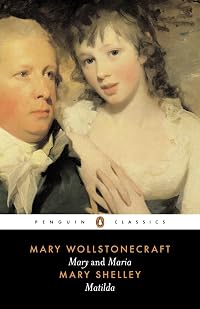
Mary and Maria and Matilda
by Mary Wollstonecraft, Mary Shelley
On This Page
Description
These three works of fiction - two by Mary Wollstonecraft, the radical author of A Vindication of the Rights of Woman, and one by her daughter Mary Shelley, creator of Frankenstein - are powerfully emotive stories that combine passion with forceful feminist argument. In Mary Wollstonecraft's Mary, the heroine flees her young husband in order to nurse her dearest friend, Ann, and finds genuine love, while Maria tells of a desperate young woman who seeks consolation in the arms of another man show more after the loss of her child. And Mary Shelley's Matilda - suppressed for over a century - tells the story of a woman alienated from society by the incestuous passion of her father. Humane, compassionate and highly controversial, these stories demonstrate the strongly original genius of their authors. show lessTags
Recommendations












Member Reviews
"Do all suffer like me; or am I framed so as to be particularly susceptible of misery?"
By sally tarbox on 30 December 2016
Format: Kindle Edition
The introduction to this work notes that 'Mary' "explores the position of an alienated intellectual woman and, in portraying her struggle against the constraints of a claustrophobic feminine world, began a line that would include the more substantial heroines of 'Jane Eyre' and 'Villette'."
I would only give 'Mary' a tentative *2.5, but the reader can certainly see it as a precursor to Bronte's later works of genius. This is a short (60p) story, partly autobiographical, where the independent heroine - after being married off against her will - accompanies her consumptive friend to Portugal. A show more principled, Christian woman, who delights in helping others, Mary observes life and the people around her. And falls in love for the first time... And as she wretchedly sails for England ""the tempest in her soul rendered every other trifling - it was not the contending elements but herself she feared".
I got into this more as I determinedly kept on with it, but I wouldn't call it reading for pleasure.
'Maria' (or 'The Wrongs of Woman'), written ten years later is a much more accomplished work. Very Gothic/ Romantic, the story opens with our eponymous heroine finding herself incarcerated in a lunatic asylum. The reader soon becomes aware that she is quite sane, and as she converses with her wardress, (and later a male inmate - also wrongfully detained - we come to know the stories of all three. Very much a vehicle for the author to continue the theme of her earlier 'Vindication of the Rights of Woman', we read of corrupt husbands having jurisdiction over their wives' money and automatic custody of their children, while the working-class wardress Jemima, tells of abuse by her employers, the plight of unmarried mothers and the way many are forced into prostitution. The opportunities of women as against those of their male counterparts are vastly worse. Although this story stops at a reasonable point, the appendix explains that the author had plans for further chapters, and gives an outline of the intended plot. A fairly interesting read
(Matilda)
"I was a creature cursed and set apart by nature", 18 December 2016
This review is from: Mary Shelley - Mathilda (Paperback)
Although the dark and turbid mindset of the heroine of this tale gives us an impression of the author's own feelings at this time (her son had recently died), as a work of literature I found this terribly over-the-top and melodramatic.
Matilda's mother dies shortly after her birth, and her distraught father goes abroad. For the next sixteen years the girl grows up in the care of a cold-natured aunt until finally, to her joy, her father returns.
(spoiler alert) After a few deliriously happy months in his company, he suddenly and inexplicably changes, becoming harsh and abrupt. When Matilda demands he tell her why, he at last reveals that he is in love with her. And here the whole thing just became ridiculous to me. Both parties decide they must never again meet; her father goes on to commit suicide. Matilda goes off to live in a cottage on a moor, where she adopts a nun's dress and talks interminably about her longing for death, unable to go back into society as "like another Cain, I had a mark set on my forehead to show mankind that there was a barrier between me and them." (Why? She did nothing wrong.)
As a description of profound, illogical depression, it has some merit, but I have to say that I found Matilda an unpleasantly self-obsessed tragedy queen. show less
By sally tarbox on 30 December 2016
Format: Kindle Edition
The introduction to this work notes that 'Mary' "explores the position of an alienated intellectual woman and, in portraying her struggle against the constraints of a claustrophobic feminine world, began a line that would include the more substantial heroines of 'Jane Eyre' and 'Villette'."
I would only give 'Mary' a tentative *2.5, but the reader can certainly see it as a precursor to Bronte's later works of genius. This is a short (60p) story, partly autobiographical, where the independent heroine - after being married off against her will - accompanies her consumptive friend to Portugal. A show more principled, Christian woman, who delights in helping others, Mary observes life and the people around her. And falls in love for the first time... And as she wretchedly sails for England ""the tempest in her soul rendered every other trifling - it was not the contending elements but herself she feared".
I got into this more as I determinedly kept on with it, but I wouldn't call it reading for pleasure.
'Maria' (or 'The Wrongs of Woman'), written ten years later is a much more accomplished work. Very Gothic/ Romantic, the story opens with our eponymous heroine finding herself incarcerated in a lunatic asylum. The reader soon becomes aware that she is quite sane, and as she converses with her wardress, (and later a male inmate - also wrongfully detained - we come to know the stories of all three. Very much a vehicle for the author to continue the theme of her earlier 'Vindication of the Rights of Woman', we read of corrupt husbands having jurisdiction over their wives' money and automatic custody of their children, while the working-class wardress Jemima, tells of abuse by her employers, the plight of unmarried mothers and the way many are forced into prostitution. The opportunities of women as against those of their male counterparts are vastly worse. Although this story stops at a reasonable point, the appendix explains that the author had plans for further chapters, and gives an outline of the intended plot. A fairly interesting read
(Matilda)
"I was a creature cursed and set apart by nature", 18 December 2016
This review is from: Mary Shelley - Mathilda (Paperback)
Although the dark and turbid mindset of the heroine of this tale gives us an impression of the author's own feelings at this time (her son had recently died), as a work of literature I found this terribly over-the-top and melodramatic.
Matilda's mother dies shortly after her birth, and her distraught father goes abroad. For the next sixteen years the girl grows up in the care of a cold-natured aunt until finally, to her joy, her father returns.
(spoiler alert) After a few deliriously happy months in his company, he suddenly and inexplicably changes, becoming harsh and abrupt. When Matilda demands he tell her why, he at last reveals that he is in love with her. And here the whole thing just became ridiculous to me. Both parties decide they must never again meet; her father goes on to commit suicide. Matilda goes off to live in a cottage on a moor, where she adopts a nun's dress and talks interminably about her longing for death, unable to go back into society as "like another Cain, I had a mark set on my forehead to show mankind that there was a barrier between me and them." (Why? She did nothing wrong.)
As a description of profound, illogical depression, it has some merit, but I have to say that I found Matilda an unpleasantly self-obsessed tragedy queen. show less
This volume contains two works by Mary Wollstonecraft, Mary and Maria, the latter unfinished; and a work by her daughter Mary Shelley, Matilda. I found Mary a bit shallow and overemotional, but Maria was pretty compelling—pity there wasn't more of it. Matilda had its moments but the father-daughter incestual feelings theme left me cold—it felt sensationalist for the sake of being sensationalist and obviously could only end in lots and lots of tears and misery.
Ratings
Members
- Recently Added By
Lists

Reading LIst
648 works; 1 member
Author Information

51+ Works 7,910 Members
Mary Wollstonecraft was born in London on April 27, 1759. She opened a school in Newington Green with her sister Eliza and a friend Fanny Blood in 1784. Her experiences lead her to attack traditional teaching methods and suggested new topics of study in Thoughts on the Education of Girls. In 1792, she published A Vindication of the Rights of show more Woman, in which she attacked the educational restrictions that kept women ignorant and dependant on men as well as describing marriage as legal prostitution. In Maria or the Wrongs of Woman, published unfinished in 1798, she asserted that women had strong sexual desires and that it was degrading and immoral to pretend otherwise. In 1793, Wollstonecraft became involved with American writer Gilbert Imlay and had a daughter named Fanny. After this relationship ended, she married William Godwin in March 1797 and had a daughter named Mary in August. Wollstonecraft died from complications following childbirth on September 10, 1797. Her daughter Mary later married Percy Bysshe Shelley and wrote Frankenstein. (Bowker Author Biography) show less

437+ Works 73,542 Members
Mary Wollstonecraft Shelley was born in England on August 30, 1797. Her parents were two celebrated liberal thinkers, William Godwin, a social philosopher, and Mary Wollstonecraft, a women's rights advocate. Eleven days after Mary's birth, her mother died of puerperal fever. Four motherless years later, Godwin married Mary Jane Clairmont, bringing show more her and her two children into the same household with Mary and her half-sister, Fanny. Mary's idolization of her father, his detached and rational treatment of their bond, and her step-mother's preference for her own children created a tense and awkward home. Mary's education and free-thinking were encouraged, so it should not surprise us today that at the age of sixteen she ran off with the brilliant, nineteen-year old and unhappily married Percy Bysshe Shelley. Shelley became her ideal, but their life together was a difficult one. Traumas plagued them: Shelley's wife and Mary's half-sister both committed suicide; Mary and Shelley wed shortly after he was widowed but social disapproval forced them from England; three of their children died in infancy or childhood; and while Shelley was an aristocrat and a genius, he was also moody and had little money. Mary conceived of her magnum opus, Frankenstein, or the Modern Prometheus, when she was only nineteen when Lord Byron suggested they tell ghost stories at a house party. The resulting book took over two years to write and can be seen as the brilliant creation of a powerful but tormented mind. The story of Frankenstein has endured nearly two centuries and countless variations because of its timeless exploration of the tension between our quest for knowledge and our thirst for good. Shelley drowned when Mary was only 24, leaving her with an infant and debts. She died from a brain tumor on February 1, 1851 at the age of 54. (Bowker Author Biography) show less
Some Editions
Series
Belongs to Publisher Series
Work Relationships
Common Knowledge
- Canonical title
- Mary and Maria and Matilda
- Original language
- English
- Disambiguation notice
- This is an omnibus containing works of both Mary Wollstonecraft & Mary Shelley.
Do not combine with "Maria or the Wrongs of Woman" or "Mary and The Wrongs of Women"
Classifications
Statistics
- Members
- 249
- Popularity
- 130,436
- Reviews
- 2
- Rating
- (3.34)
- Languages
- English, German, Spanish, Swedish
- Media
- Paper, Ebook
- ISBNs
- 9
- ASINs
- 6