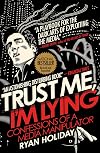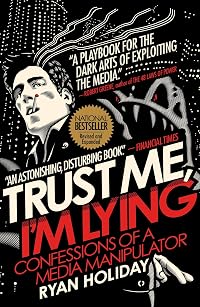
Trust Me, I'm Lying: Confessions of a Media Manipulator
by Ryan Holiday
On This Page
Description
An influential media strategist reveals how blogs are controlling the news in the digital age and exposes the ways in which today's marketers are manufacturing news stories, affecting stock prices, and shaping elections.Tags
Recommendations




Member Recommendations
Member Reviews
This is a seminal work that regrettably, I've waited until now to read. Perhaps if fewer people had done as I did, and instead had absorbed everything this book has to offer before 2016's catastrophic election, we might have avoided our present national nightmare. And yet.
Ryan Holiday's focus is primarily on his work for American Apparel and his friend Tucker Max, and how he was able to plant stories and gin up narratives to further the interests of his clients (higher sales volumes, typically). While some of the end results are innocuous enough, the ease with which he's able to accomplish his goals speak to broader vulnerabilities - terrifying ones, really - through the media we consume, and that, he claims, was the impetus for writing show more this book.
The structure and incentives around which the modern media ecosystem has developed are perverse and actively undermine the mission of reporting anything resembling "objective truth" or "newsworthiness." With the economics of digital media heavily focused on ad click revenue (keeping in mind that this book was written in 2012), Holiday writes about how easy it is to game content producers by helping them generate traffic through patently false and "controversial" non-stories that he plants. Anonymous tips, simple comments, tweets, etc. - all of these tactics work only because media outlets do not, in fact, bother fact-checking or verifying sources. It's an economy built on sand, chasing clicks, reporting abject nonsense, and that's how stories comprising "fake news" are so easily digested and believed - they follow the same superficial patterns as "real news."
Some of this has changed. While the Washington Post may have adopted the Upworthy house style for headline writing, the content is better than that. Consolidation, for all the other ills it causes, have reduced the competition that generated some of the worst offenders. And as paywalls and subscription models continue to replace ad-derived revenues, the trend of chasing clicks only will hopefully dwindle. But digital media (or, collectively, "blogs," as Holiday somewhat fussily insists on calling it) still faces the same challenges of veracity, relevance, judgement, and importance that it did then. Look at the New York Times's unbelievable focus on Hillary Clinton email stories, or the remarkable consistency with which white, right-wing men are the sole guests on Sunday morning talk shows. A cloistered media that self-corrects to the point of overreaction and caricature is how you continue to discredit much of legacy and establishment media, particularly when the credulously repeat claims first lobbed by the nastier of the extreme right websites.
Some of Trust Me, I'm Lying has not aged well, particularly Holiday's continual defense of Max and his lamentations of the "unjust mob condemnations" of Woody Allen and Scott Adams, of all people. In our present moment, figures like these - and their anything-but-exaggerated sins - are hardly the victims of an overzealous auto-da-fe. His grudge towards Gawker, while understandable for the timeframe in which Holiday wrote the book, cannot be seen as anything but petty by today's standards - a plutocrat destroyed Gawker, an independent journalism outfit, for much less.
Furthermore, Holiday's own dismissal of snark as an ineffectual tool of the already powerless rings hollow in this day and age, when a national legislature, operating on behalf of its oligarchic donor class, can completely overwhelm any oppositional tactic (be it street protests or calling one's legislator or other means of direct action) and pass massively unpopular bills into law. In times like these, a cynical attitude towards the policy process is more or less inevitable.
But while these sections make for a somewhat awkward postscript, they don't detract from the ultimate message Holiday has written. Online media is badly, terribly, deeply broken, and it's doing almost anything but informing us. And we're living the consequences of that every day. show less
Ryan Holiday's focus is primarily on his work for American Apparel and his friend Tucker Max, and how he was able to plant stories and gin up narratives to further the interests of his clients (higher sales volumes, typically). While some of the end results are innocuous enough, the ease with which he's able to accomplish his goals speak to broader vulnerabilities - terrifying ones, really - through the media we consume, and that, he claims, was the impetus for writing show more this book.
The structure and incentives around which the modern media ecosystem has developed are perverse and actively undermine the mission of reporting anything resembling "objective truth" or "newsworthiness." With the economics of digital media heavily focused on ad click revenue (keeping in mind that this book was written in 2012), Holiday writes about how easy it is to game content producers by helping them generate traffic through patently false and "controversial" non-stories that he plants. Anonymous tips, simple comments, tweets, etc. - all of these tactics work only because media outlets do not, in fact, bother fact-checking or verifying sources. It's an economy built on sand, chasing clicks, reporting abject nonsense, and that's how stories comprising "fake news" are so easily digested and believed - they follow the same superficial patterns as "real news."
Some of this has changed. While the Washington Post may have adopted the Upworthy house style for headline writing, the content is better than that. Consolidation, for all the other ills it causes, have reduced the competition that generated some of the worst offenders. And as paywalls and subscription models continue to replace ad-derived revenues, the trend of chasing clicks only will hopefully dwindle. But digital media (or, collectively, "blogs," as Holiday somewhat fussily insists on calling it) still faces the same challenges of veracity, relevance, judgement, and importance that it did then. Look at the New York Times's unbelievable focus on Hillary Clinton email stories, or the remarkable consistency with which white, right-wing men are the sole guests on Sunday morning talk shows. A cloistered media that self-corrects to the point of overreaction and caricature is how you continue to discredit much of legacy and establishment media, particularly when the credulously repeat claims first lobbed by the nastier of the extreme right websites.
Some of Trust Me, I'm Lying has not aged well, particularly Holiday's continual defense of Max and his lamentations of the "unjust mob condemnations" of Woody Allen and Scott Adams, of all people. In our present moment, figures like these - and their anything-but-exaggerated sins - are hardly the victims of an overzealous auto-da-fe. His grudge towards Gawker, while understandable for the timeframe in which Holiday wrote the book, cannot be seen as anything but petty by today's standards - a plutocrat destroyed Gawker, an independent journalism outfit, for much less.
Furthermore, Holiday's own dismissal of snark as an ineffectual tool of the already powerless rings hollow in this day and age, when a national legislature, operating on behalf of its oligarchic donor class, can completely overwhelm any oppositional tactic (be it street protests or calling one's legislator or other means of direct action) and pass massively unpopular bills into law. In times like these, a cynical attitude towards the policy process is more or less inevitable.
But while these sections make for a somewhat awkward postscript, they don't detract from the ultimate message Holiday has written. Online media is badly, terribly, deeply broken, and it's doing almost anything but informing us. And we're living the consequences of that every day. show less
This book is Ryan Holiday's mea culpa. He's a media manipulator or was at one time, and after a pang of conscience over the effects of his actions, he's coming clean. As one friend put it when I described the book to him, the techniques Holiday describes and decries in "Trust Me, I'm Lying" feel very black hat, villainous. And often, they are. Even if it were not, the effects are poisonous and occasionally deadly, destructive of reputations and, at times, of companies, cultures, and countries (including, in one anecdote, leading to war).
He feels guilty, and this is his public shower, his cleansing by confession. You, too, can learn what he did to manipulate the media and public opinion.
It makes me feel a little uneasy. On one hand, I'm show more one of the people who might have used or been manipulated by, Ryan Holiday's techniques. For years I have blogged, on politics and on public affairs and on books. Later, I worked for--indeed still I still work for--a public official that might benefit from understanding how to manipulate the media. In reality, though, we play defense against people who use these tools, wittingly or not. Every day we get media requests and inquiries, and I would say that 99 percent of the people who reach out to us in the media do so with good intentions and simply to add to their story.
And yet, the 1 percent (or maybe it's a smaller percent) ends up being the ones that cause the most work. As the saying goes, a lie can travel halfway around the world before the truth even gets its boots on. This has never been truer than the age of the Internet. This is the central argument, or observation, or maybe henchman, of Holiday's book. The combination of the Internet and the advent of the blog reporter, as well as the shortening attention span of readers--that's you and I, my friends--the dissemination of news has become cheap. With cheapness, the incentive to create in-depth pieces evaporates, and readers are drawn to that which angers, or amuses, not to the educational, let alone that which is complex or requires complexity.
Ever heard of clickbait? Or fake news? Or read something salacious? That later proved to be semi-accurate? Or out of context?
This is where it comes from. Media manipulators like Holiday would lie, cheat, leak, allude, self-report, publicize, create controversy, and trick bloggers and reporters to print or publish something that benefits their clients.
So, that's nothing new, right? There have always been publicists, communications directors, public information officers, or spin doctors to put their own angle on the news. True.
But what's different here is the extent to which the modern press has changed because of the dynamics of the Internet. Editors and publishers have long known that readers were more interested in the salacious, and lying or printing inaccurate or false news is nothing new. The "yellow press" was is the great granddaddy of the fake news. But for a brief period of a generation or so, the press has professionalized, created a set of rules and attempted to objectively present and report on the news. But no more. The Internet proliferated with bloggers, resource-poor writers, usually without editors, and always incentivized to publish material that will maximize views, no matter the truth or value of the content. Revenue is earned on ad views or when the site is sold (presumably to someone who can be tricked into believing there is a value where there is none).
To make it worse, reporters, working under barely improved conditions over the bloggers, watch the bloggers for leads and scoops, cribbing what they find, utilizing the "link economy" to hide shoddy research and boost their own numbers.
It's a recipe for disaster, according to Holiday, and the book is replete with examples and anecdotes, both form his own career (remember, this is his mea culpa) and from the public record. It makes for fast and fascinating reading.
It's also a bit depressing. I've often rolled my eyes at accusations of "fake news," especially when tweeted out over President Trump's twitter against the New York Times, CNN, or some other major news agency. And yet, as I've looked closer, as I've read more, I've become more of a skeptic. Then I see shared over social media an "article": the headline reads "President Trump to Resign in 2019,..." with half the headline cut off due to space requirements. I click through and find out that it is actually a reporter that has thrown together a 200-word article that quotes an op-ed by a critic of the president. There's nothing added. No news. Just a misleading, clickbait headline. As I said to the poster, we are all dumber for the article.
Of course, it's great fodder for the critics of the president. But it does nothing more than feeding the echo chamber with empty calories.
Let's end this on an up note. Ryan Holiday has a talent for writing. He's clear, he tells a great story, and he's lived behind the scenes, which is what every American wants to hear about. Is it really as bad as he says? Probably not. But to feed off of what he says, it's in his interest to make things sound worse than they are. No one wants to read a book that says the media is honest, that bloggers and reporters do good research, and that Americans are only interested in reading high minded literature. On the contrary, all that matters is quantity, reporters and bloggers are vain, and Americans want to read the salacious and snarky, what angers or amuses. It is a cynical look, but, I'll be honest, it's not hard to believe.
And, like taking Statistics 101 in college to understand how stats are used (in business, in media, etc), everyone should read it so they understand what's going on behind the news that they are reading. Yes, I believe more reporters are good, well-meaning people. But this is the system we live in, and it is what it is. You might as well educate yourself and become aware.
Or maybe we should just stop reading the news altogether. I'm not sure that we're all that better for the non-stop news cycle, anyway. show less
He feels guilty, and this is his public shower, his cleansing by confession. You, too, can learn what he did to manipulate the media and public opinion.
It makes me feel a little uneasy. On one hand, I'm show more one of the people who might have used or been manipulated by, Ryan Holiday's techniques. For years I have blogged, on politics and on public affairs and on books. Later, I worked for--indeed still I still work for--a public official that might benefit from understanding how to manipulate the media. In reality, though, we play defense against people who use these tools, wittingly or not. Every day we get media requests and inquiries, and I would say that 99 percent of the people who reach out to us in the media do so with good intentions and simply to add to their story.
And yet, the 1 percent (or maybe it's a smaller percent) ends up being the ones that cause the most work. As the saying goes, a lie can travel halfway around the world before the truth even gets its boots on. This has never been truer than the age of the Internet. This is the central argument, or observation, or maybe henchman, of Holiday's book. The combination of the Internet and the advent of the blog reporter, as well as the shortening attention span of readers--that's you and I, my friends--the dissemination of news has become cheap. With cheapness, the incentive to create in-depth pieces evaporates, and readers are drawn to that which angers, or amuses, not to the educational, let alone that which is complex or requires complexity.
Ever heard of clickbait? Or fake news? Or read something salacious? That later proved to be semi-accurate? Or out of context?
This is where it comes from. Media manipulators like Holiday would lie, cheat, leak, allude, self-report, publicize, create controversy, and trick bloggers and reporters to print or publish something that benefits their clients.
So, that's nothing new, right? There have always been publicists, communications directors, public information officers, or spin doctors to put their own angle on the news. True.
But what's different here is the extent to which the modern press has changed because of the dynamics of the Internet. Editors and publishers have long known that readers were more interested in the salacious, and lying or printing inaccurate or false news is nothing new. The "yellow press" was is the great granddaddy of the fake news. But for a brief period of a generation or so, the press has professionalized, created a set of rules and attempted to objectively present and report on the news. But no more. The Internet proliferated with bloggers, resource-poor writers, usually without editors, and always incentivized to publish material that will maximize views, no matter the truth or value of the content. Revenue is earned on ad views or when the site is sold (presumably to someone who can be tricked into believing there is a value where there is none).
To make it worse, reporters, working under barely improved conditions over the bloggers, watch the bloggers for leads and scoops, cribbing what they find, utilizing the "link economy" to hide shoddy research and boost their own numbers.
It's a recipe for disaster, according to Holiday, and the book is replete with examples and anecdotes, both form his own career (remember, this is his mea culpa) and from the public record. It makes for fast and fascinating reading.
It's also a bit depressing. I've often rolled my eyes at accusations of "fake news," especially when tweeted out over President Trump's twitter against the New York Times, CNN, or some other major news agency. And yet, as I've looked closer, as I've read more, I've become more of a skeptic. Then I see shared over social media an "article": the headline reads "President Trump to Resign in 2019,..." with half the headline cut off due to space requirements. I click through and find out that it is actually a reporter that has thrown together a 200-word article that quotes an op-ed by a critic of the president. There's nothing added. No news. Just a misleading, clickbait headline. As I said to the poster, we are all dumber for the article.
Of course, it's great fodder for the critics of the president. But it does nothing more than feeding the echo chamber with empty calories.
Let's end this on an up note. Ryan Holiday has a talent for writing. He's clear, he tells a great story, and he's lived behind the scenes, which is what every American wants to hear about. Is it really as bad as he says? Probably not. But to feed off of what he says, it's in his interest to make things sound worse than they are. No one wants to read a book that says the media is honest, that bloggers and reporters do good research, and that Americans are only interested in reading high minded literature. On the contrary, all that matters is quantity, reporters and bloggers are vain, and Americans want to read the salacious and snarky, what angers or amuses. It is a cynical look, but, I'll be honest, it's not hard to believe.
And, like taking Statistics 101 in college to understand how stats are used (in business, in media, etc), everyone should read it so they understand what's going on behind the news that they are reading. Yes, I believe more reporters are good, well-meaning people. But this is the system we live in, and it is what it is. You might as well educate yourself and become aware.
Or maybe we should just stop reading the news altogether. I'm not sure that we're all that better for the non-stop news cycle, anyway. show less
Ryan Holiday writes just like you would imagine he talks, and he sounds just like the fun but scheming kid that everyone knew in highschool. The one who was smart enough to do his own Geometry homework, but stopped by your house every afternoon to try and talk you into letting him copy yours -- and then got 2 points more than you on the test.
Everyone who is involved with Corporate Communications should read this book. It paints a clear picture of the self-fulfilling circle of deceit that corporations and the media create. And, it illustrates how we as consumers incentivize the behavior we hate, but ultimately reward.
Everyone who is involved with Corporate Communications should read this book. It paints a clear picture of the self-fulfilling circle of deceit that corporations and the media create. And, it illustrates how we as consumers incentivize the behavior we hate, but ultimately reward.
If you want to be freaked about about the current state of news and online culture, then this is the book for you! Holiday, a man who writes this as a sort of confession of sins, freely admits to using and even inventing some of the underhanded ways that bloggers are manipulated, rumors are spread and people made famous or influential. He loved it all, until it turned against him. Until he saw it lead to serious consequences for unsuspecting and innocent people and until it made rather than reported the news. One of those books you can use that old saw, thought provoking, and mean it without hesitation.
Ryan Holiday exposes the ease with which online news organizations and blogs can be easily manipulated, based on his experience using the system to promote his projects, clients, and American Apparel. He provides great insight into the blurring of the lines between blogging and journalism and how the twin factors of add revenue based on screen views and the desire to break a story first create the perfect storm of rumors as news and sensationalist stories appealing to fear, anger, or scandal. When you finish the book you truly will see news and blogging in a different light and how a "follow the money" approach explains so much of what we see. His information on iterative journalism explains how organizations publish rumor but do an show more ineffective job of "getting the story right" but make profit on the incorrect story and the updates to correct it. Not content to just discuss methods and practices, he dissects real news events and promotional efforts to demonstrate how the monster feeds and operates. His insight into the major web hubs for news and individuals, from Huffington to Breitbart, will provide some much needed perspective on how we get our news and whether we really are informed.
He presents the material as exposing media manipulation techniques but one could follow the process and have a good chance at promotional success but at a cost. I was put off on some of his initial YouTube interviews as he seemed like a person confessing sins that he is proud of committing. His later books reveal one who has learned and matured from this dark place to a more settled view of the world and a better ethical approach to life. Finish this book and you'll never view blogs and online news the same again. show less
He presents the material as exposing media manipulation techniques but one could follow the process and have a good chance at promotional success but at a cost. I was put off on some of his initial YouTube interviews as he seemed like a person confessing sins that he is proud of committing. His later books reveal one who has learned and matured from this dark place to a more settled view of the world and a better ethical approach to life. Finish this book and you'll never view blogs and online news the same again. show less
Ryan Holiday exposes the ease with which online news organizations and blogs can be easily manipulated, based on his experience using the system to promote his projects, clients, and American Apparel. He provides great insight into the blurring of the lines between blogging and journalism and how the twin factors of add revenue based on screen views and the desire to break a story first create the perfect storm of rumors as news and sensationalist stories appealing to fear, anger, or scandal. When you finish the book you truly will see news and blogging in a different light and how a "follow the money" approach explains so much of what we see. His information on iterative journalism explains how organizations publish rumor but do an show more ineffective job of "getting the story right" but make profit on the incorrect story and the updates to correct it. Not content to just discuss methods and practices, he dissects real news events and promotional efforts to demonstrate how the monster feeds and operates. His insight into the major web hubs for news and individuals, from Huffington to Breitbart, will provide some much needed perspective on how we get our news and whether we really are informed.
He presents the material as exposing media manipulation techniques but one could follow the process and have a good chance at promotional success but at a cost. I was put off on some of his initial YouTube interviews as he seemed like a person confessing sins that he is proud of committing. His later books reveal one who has learned and matured from this dark place to a more settled view of the world and a better ethical approach to life. Finish this book and you'll never view blogs and online news the same again. show less
He presents the material as exposing media manipulation techniques but one could follow the process and have a good chance at promotional success but at a cost. I was put off on some of his initial YouTube interviews as he seemed like a person confessing sins that he is proud of committing. His later books reveal one who has learned and matured from this dark place to a more settled view of the world and a better ethical approach to life. Finish this book and you'll never view blogs and online news the same again. show less
I'm sure there's not much I can add to what's already been written about this book, so I'll just leave my feelings as I went through it. Part 1, the instruction manual for how to manipulate the media, was eye opening, and hopefully in the future, in my own small little way, I'd like to be able to use bad tools for good purposes. If that's possible. Which it may not be.
Part 2, railing against the system, was a bit of a chore to get through, since it's just Holiday yelling about everything wrong with blogs. It's certainly coherent and flows from idea to idea, but I eventually found myself thinking, "Jesus, another chapter of him yelling at Gawker?" But it's not without utility, I also found myself in the same thought desiring to hold show more myself to a higher standard of readership.
I guess after putting it down, it gets 5 stars for its purpose and usable content (it's rare nowadays to read a takeaway-driven book that hasn't simply repackaged the wheel). It gets -2 stars for indulging too heavily in his gripes, which leaves it with 3 of 5. It has comfortably more going for it than against it, but if I ever pick it up again, there will be a ton to skip over. Kind of like the Slow Sex book. Recommend both. With asterisks. show less
Part 2, railing against the system, was a bit of a chore to get through, since it's just Holiday yelling about everything wrong with blogs. It's certainly coherent and flows from idea to idea, but I eventually found myself thinking, "Jesus, another chapter of him yelling at Gawker?" But it's not without utility, I also found myself in the same thought desiring to hold show more myself to a higher standard of readership.
I guess after putting it down, it gets 5 stars for its purpose and usable content (it's rare nowadays to read a takeaway-driven book that hasn't simply repackaged the wheel). It gets -2 stars for indulging too heavily in his gripes, which leaves it with 3 of 5. It has comfortably more going for it than against it, but if I ever pick it up again, there will be a ton to skip over. Kind of like the Slow Sex book. Recommend both. With asterisks. show less
Members
- Recently Added By
Lists

Ryan Holiday's Books To Base Your Life On
97 works; 2 members
Author Information

70 Works 10,824 Members
Ryan Holiday dropped out of college at the age of 19 to apprentice under author Robert Greene. He went on to advise many bestselling authors and multiplatinum musicians, and served as director of marketing at American Apparel. He is the author of several books including Trust Me I'm Lying, Ego Is the Enemy, The Daily Stoic: 366 Meditations on show more Wisdom, Perseverance, and the Art of Living (co-written with Stephan Hanselman), and Perennial Seller: The Art of Making and Marketing Work That Lasts. (Bowker Author Biography) show less
Common Knowledge
- Canonical title
- Trust Me, I'm Lying: Confessions of a Media Manipulator
- People/Characters
- Ryan Holiday; Scott Adams; Michael Arrington; Julian Assange; Andrew Breitbart; Irin Carmon (show all 17); Dov Charney; Nick Denton; Nikki Finke; Arianna Huffington; Jeff Jarvis; Terry Jones [pastor]; Tucker Max; James O'Keefe; Tim Pawlenty; Rick Santelli; Shirley Sherrod
- First words
- If you were being kind, you would say my job is in marketing and public relations, or online advertising and strategy.
- Quotations
- The news has always been riddled with errors, because it is self-referential instead of self-critical.
Bloggers don't fabricate news, but they do suspend their disbelief, common sense, and responsibility in order to get to big stories first.
[Snark is] a cheap way to write without thinking while still sounding clever.
The central question for the Internet is not, Is this entertaining? but, Will this get attention? Will it spread? - Canonical DDC/MDS
- 659.202856752
- Canonical LCC
- HF5415.H7416
Classifications
Statistics
- Members
- 745
- Popularity
- 37,816
- Reviews
- 27
- Rating
- (3.68)
- Languages
- 8 — Chinese, English, German, Italian, Polish, Portuguese (Portugal), Russian, Spanish
- Media
- Paper, Audiobook, Ebook
- ISBNs
- 17
- ASINs
- 8