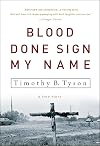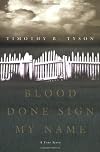
Blood Done Sign My Name
by Timothy B. Tyson
On This Page
Description
The author returns to his hometown of Oxford, North Carolina, to make sense of the thirty-year-old murder of a black man by a Klansman, and the Klansman's subsequent acquittal by an all-white jury.Tags
Recommendations

Member Reviews
In Blood Done Sign My Name, Timothy B. Tyson examines the murder of Henry Marrow, a twenty-three year old black man, in Oxford, South Carolina, on 11 May 1970. The book combines both historical research about race relations during the late 1960s, in which Tyson attempts to dispel popular myths of civil rights, with Tyson’s own memory of growing up in Oxford and the racial caste system in the town. Tyson concludes of the period and its legacy, “Everyone in this struggle, adversaries and advocates alike, grew up steeped in a poisonous white supremacy that distorted their understandings of history and one another. That history is not distant” (pg. 320). He argues that Americans cannot gloss over the more complex parts of this history show more in favor of a simplified narrative as this does an injustice to history and those who lived it.
Marrow, a veteran, demonstrated the betrayal that veterans felt after fighting on behalf of the United States’ ideals. Tyson writes, “Like generations of black veterans before them, who had come home from France or the Philippines insisting that their sacrifices had bought them full citizenship, the Vietnam generation demanded justice. Though they had paid the price, more would be required” (pg. 9). Like Eugene Genovese’s Roll, Jordan, Roll, Tyson uses paternalism to explain the race relations of the mid-twentieth century. He writes, “Paternalism was like a dance whose steps required my grandmother to provide charity to black people, as long as they followed the prescribed routine – that is, coming to the back door, hat in hand; accepting whatever largesse was offered; furnishing effusive expressions of gratitude; and at least pretending to accept their subordinate position in the social hierarchy” (pg. 25). While whites that subscribed to this system believed it represented harmony, it prevented any real connections from forming between Oxford’s white and black residents.
Like Gail Bederman and others, Tyson links race with gender, writing, “Segregation…existed to protect white womanhood from the abomination of contact with uncontrollable black men. Whites who questioned segregation confronted the inevitable and, for most people, conclusive cross-examination: Would you want your daughter to marry one?” (pg. 37). This played a key role in Marrow’s death as his murderers accused him of saying something flirtatious to a white woman. In grounding the civil rights struggle in the backdrop of the Cold War, Tyson writes, “The Cold War competition between the United States and the Soviet Union offered African Americans the unique leverage to redeem or repudiate American democracy in the eyes of the world. The demonstrations in the streets of the civil rights-era South were carefully staged dramas that forced the contradictions of American democracy to the surface” (pg. 67). This forced this issue to a head since it embarrassed the American government on the international stage.
In contradicting the traditional narrative of civil rights, Tyson writes, “Polling data revealed that the majority of white Americans in 1963, prior to the Civil Rights and Voting Rights Acts, believed that the movement for racial equality had already proceeded ‘too far and too fast’” (pg. 106). Rather than accept change, white Americans were compelled by the federal government in 1964 and even then still attempted to avoid government coercion. To this end, Tyson writes, “Those who tell themselves that white people of goodwill voluntarily handed over first-class citizenship to their fellow citizens of color find comfort in selective memory and wishful thinking” (pg. 249). In addition to overturning the popular narrative of civil rights, Tyson works to combat the popular narrative of the Civil War in the South. He writes, “White supremacists and neo-Confederates have made enthusiasm for the Confederacy posthumously unanimous. Some of them will even try to tell you that the slaves loyally supported the Confederacy, which is just a damn lie” (pg. 172). Despite this lie, it demonstrates the lingering need in the South to justify the racial hierarchy established after Reconstruction. show less
Marrow, a veteran, demonstrated the betrayal that veterans felt after fighting on behalf of the United States’ ideals. Tyson writes, “Like generations of black veterans before them, who had come home from France or the Philippines insisting that their sacrifices had bought them full citizenship, the Vietnam generation demanded justice. Though they had paid the price, more would be required” (pg. 9). Like Eugene Genovese’s Roll, Jordan, Roll, Tyson uses paternalism to explain the race relations of the mid-twentieth century. He writes, “Paternalism was like a dance whose steps required my grandmother to provide charity to black people, as long as they followed the prescribed routine – that is, coming to the back door, hat in hand; accepting whatever largesse was offered; furnishing effusive expressions of gratitude; and at least pretending to accept their subordinate position in the social hierarchy” (pg. 25). While whites that subscribed to this system believed it represented harmony, it prevented any real connections from forming between Oxford’s white and black residents.
Like Gail Bederman and others, Tyson links race with gender, writing, “Segregation…existed to protect white womanhood from the abomination of contact with uncontrollable black men. Whites who questioned segregation confronted the inevitable and, for most people, conclusive cross-examination: Would you want your daughter to marry one?” (pg. 37). This played a key role in Marrow’s death as his murderers accused him of saying something flirtatious to a white woman. In grounding the civil rights struggle in the backdrop of the Cold War, Tyson writes, “The Cold War competition between the United States and the Soviet Union offered African Americans the unique leverage to redeem or repudiate American democracy in the eyes of the world. The demonstrations in the streets of the civil rights-era South were carefully staged dramas that forced the contradictions of American democracy to the surface” (pg. 67). This forced this issue to a head since it embarrassed the American government on the international stage.
In contradicting the traditional narrative of civil rights, Tyson writes, “Polling data revealed that the majority of white Americans in 1963, prior to the Civil Rights and Voting Rights Acts, believed that the movement for racial equality had already proceeded ‘too far and too fast’” (pg. 106). Rather than accept change, white Americans were compelled by the federal government in 1964 and even then still attempted to avoid government coercion. To this end, Tyson writes, “Those who tell themselves that white people of goodwill voluntarily handed over first-class citizenship to their fellow citizens of color find comfort in selective memory and wishful thinking” (pg. 249). In addition to overturning the popular narrative of civil rights, Tyson works to combat the popular narrative of the Civil War in the South. He writes, “White supremacists and neo-Confederates have made enthusiasm for the Confederacy posthumously unanimous. Some of them will even try to tell you that the slaves loyally supported the Confederacy, which is just a damn lie” (pg. 172). Despite this lie, it demonstrates the lingering need in the South to justify the racial hierarchy established after Reconstruction. show less
I think I was a bit afraid this book would be too big a downer, and it certainly is not a happy story, but it is very well written and contains enough hope to keep it from being cripplingly sad.
It is amazing that I had never heard this story, and that is part of the problem, I guess. I grew up in the Piedmont of North Carolina and was five years old when the murder depicted in this book happened. Of course, I was too young to hear of it then, but I have not heard of it since either. I know civil rights have been long and hard fought in our country, but have always felt my little corner of the world did okay. I was in the first integrated class in my school and had a black teacher for first grade, and never had a problem or heard any bad show more things about it. (I liked Mrs. Dailey way better than the white teacher next door, who would not believe I had headaches until I threw up on her shoes!)
So this book was a sobering introduction to the state of race relations at that time in our state. But I was also pleased to read some of the history of liberals in the South, because often I've thought I was a rarity. It is nice to see that the world has never been 100% one way or the other, and that, however poorly, there have always been people fighting for good. And shout out to the Methodist ministers for being on the right side of history! show less
It is amazing that I had never heard this story, and that is part of the problem, I guess. I grew up in the Piedmont of North Carolina and was five years old when the murder depicted in this book happened. Of course, I was too young to hear of it then, but I have not heard of it since either. I know civil rights have been long and hard fought in our country, but have always felt my little corner of the world did okay. I was in the first integrated class in my school and had a black teacher for first grade, and never had a problem or heard any bad show more things about it. (I liked Mrs. Dailey way better than the white teacher next door, who would not believe I had headaches until I threw up on her shoes!)
So this book was a sobering introduction to the state of race relations at that time in our state. But I was also pleased to read some of the history of liberals in the South, because often I've thought I was a rarity. It is nice to see that the world has never been 100% one way or the other, and that, however poorly, there have always been people fighting for good. And shout out to the Methodist ministers for being on the right side of history! show less
This is one of those books that will leave you feeling raw and bruised, but also touched and inspired.
In May, 1970, Henry Marrow, a twenty-three-year-old black veteran living in Oxford , North Carolina, was beaten and killed by three white men after he allegedly said something provocative to a white woman. Timothy Tyson, now a white professor of Afro-American studies but then a ten-year-old boy in Oxford, was profoundly affected by this and other racist incidents of his youth. His memoir gets its name from an old Afro-American gospel song avowing that God’s Lamb had died for blacks too, to write their name in the Book of Life: “Ain’t you glad, ain’t you glad, that the blood done sign my name.”
Tyson drew his intellectual and show more emotional inspiration from his father Vernon, one of a long line of Methodist ministers, who had the audacity to claim that all people were God’s children, and that there was no formula for racism in the Bible. The Tysons were kicked out of quite a few parishes for their non-conformity to racist mores.
Tyson makes a number of interesting observations about Southern racism. He contends that the sexual obsessions of white supremacy originated with the practice of white men siring offspring from black female slaves. White men could increase their material worth by this practice. But if white women had offspring from black men, the whole system of bondage would have been threatened. Thus white men played up the sexual threat of black men in order to keep the property system intact. In addition, job scarcity during the Great Depression added another incentive for white males to bruit the threat of black males being around white females.
Tyson’s experiences in the South convinced him that whites would not give up their power and privilege unless forced to do so. He points out many examples of how the Supreme Court’s decision of 1954 and the Civil Rights Act of 1964 did not mean anything on the local level until the advent of widespread violence. White community leaders thought that endless biracial committee meetings and a few basketball nets would appease blacks who still, in the eighties, could still not patronize the same establishments as did whites. But Tyson avers, “the indisputable fact was that whites in Oxford did not even consider altering the racial caste system until rocks began to fly and buildings began to burn.” He challenges “the self-congratulatory popular account” that holds that “Dr. King called on the nation to fully accept its own creed, and the walls came a-tumbling down.” The only disadvantage to this story, he claims, is that it bears no resemblance to what actually happened.
Tyson charges that the legacy of white supremacy remains lethal, from the poverty and deficiencies of infrastructure, education, and health care received by blacks to the images of blacks in the media that negatively affect perceptions of both blacks and whites. With so much history of atrocity simply erased in the south (Tyson found that even his own story of Henry Marrow’s murder had pages torn out from it in the public library), the result is that blacks live with the memories, but whites don’t even know about them. And this history is not distant, he reminds us. The boyhood friend who told him “Daddy and Roger and ‘em shot ‘em a nigger” is barely middle-aged. Tyson feels it is impossible to transcend that history without confronting it. Blacks need to create a new sense of self, and whites need to recognize that, as Dr. King wrote, we are “caught up in an inescapable network of mutuality, tied in a single garment of destiny.”
Tyson’s history of vicious white racism in the South, from beheading blacks who tried to escape slavery, to the killing of a terrified, pleading boy who had the temerity to look at a white woman, will make you weep. And yet, if we are ever to walk a mile in a black man’s shoes, as Tim’s father used to advocate as a mind exercise, we must read such histories, and share them, and struggle to overcome their perfidious repercussions. Or as Robert Kennedy asked, "suppose God is black? What if we go to Heaven and we, all our lives, have treated the Negro as an inferior, and God is there, and we look up and He is not white? What then is our response?" show less
In May, 1970, Henry Marrow, a twenty-three-year-old black veteran living in Oxford , North Carolina, was beaten and killed by three white men after he allegedly said something provocative to a white woman. Timothy Tyson, now a white professor of Afro-American studies but then a ten-year-old boy in Oxford, was profoundly affected by this and other racist incidents of his youth. His memoir gets its name from an old Afro-American gospel song avowing that God’s Lamb had died for blacks too, to write their name in the Book of Life: “Ain’t you glad, ain’t you glad, that the blood done sign my name.”
Tyson drew his intellectual and show more emotional inspiration from his father Vernon, one of a long line of Methodist ministers, who had the audacity to claim that all people were God’s children, and that there was no formula for racism in the Bible. The Tysons were kicked out of quite a few parishes for their non-conformity to racist mores.
Tyson makes a number of interesting observations about Southern racism. He contends that the sexual obsessions of white supremacy originated with the practice of white men siring offspring from black female slaves. White men could increase their material worth by this practice. But if white women had offspring from black men, the whole system of bondage would have been threatened. Thus white men played up the sexual threat of black men in order to keep the property system intact. In addition, job scarcity during the Great Depression added another incentive for white males to bruit the threat of black males being around white females.
Tyson’s experiences in the South convinced him that whites would not give up their power and privilege unless forced to do so. He points out many examples of how the Supreme Court’s decision of 1954 and the Civil Rights Act of 1964 did not mean anything on the local level until the advent of widespread violence. White community leaders thought that endless biracial committee meetings and a few basketball nets would appease blacks who still, in the eighties, could still not patronize the same establishments as did whites. But Tyson avers, “the indisputable fact was that whites in Oxford did not even consider altering the racial caste system until rocks began to fly and buildings began to burn.” He challenges “the self-congratulatory popular account” that holds that “Dr. King called on the nation to fully accept its own creed, and the walls came a-tumbling down.” The only disadvantage to this story, he claims, is that it bears no resemblance to what actually happened.
Tyson charges that the legacy of white supremacy remains lethal, from the poverty and deficiencies of infrastructure, education, and health care received by blacks to the images of blacks in the media that negatively affect perceptions of both blacks and whites. With so much history of atrocity simply erased in the south (Tyson found that even his own story of Henry Marrow’s murder had pages torn out from it in the public library), the result is that blacks live with the memories, but whites don’t even know about them. And this history is not distant, he reminds us. The boyhood friend who told him “Daddy and Roger and ‘em shot ‘em a nigger” is barely middle-aged. Tyson feels it is impossible to transcend that history without confronting it. Blacks need to create a new sense of self, and whites need to recognize that, as Dr. King wrote, we are “caught up in an inescapable network of mutuality, tied in a single garment of destiny.”
Tyson’s history of vicious white racism in the South, from beheading blacks who tried to escape slavery, to the killing of a terrified, pleading boy who had the temerity to look at a white woman, will make you weep. And yet, if we are ever to walk a mile in a black man’s shoes, as Tim’s father used to advocate as a mind exercise, we must read such histories, and share them, and struggle to overcome their perfidious repercussions. Or as Robert Kennedy asked, "suppose God is black? What if we go to Heaven and we, all our lives, have treated the Negro as an inferior, and God is there, and we look up and He is not white? What then is our response?" show less
After growing up roughly 70 miles west of Oxford, North Carolina, I understand many of the customs and attitudes Timothy B. Tyson refers to in Blood Done Sign My Name. He is only a couple of years older than I am and our socio-economic backgrounds are fairly similar. It was surprising that Tyson provided so much insight into my childhood background static of racism.
He explains the insidiousness of paternalism, for example, and how people are dehumanized by it. Being nice to people does not make up for treating them as second-class citizens and denying them equal treatment.
Tyson does a great job of interweaving the events of this shocking, largely overlooked story with his own family and how it affected them. When a 23-year-old Black show more Vietnam veteran walked into a store in Oxford, North Carolina, on a May evening in 1970, he was quickly chased out by the store’s owner and two of his sons and was beaten and then shot to death in plain view on the street. Tyson was friends with the youngest son of the store’s owner.
The first line of the book is chilling enough. But the events that followed the murder affected the town and Tyson’s family make for riveting reading. His father was the minister of the town’s all-White Methodist church, and the family was forced to move by his father’s congregation. Many members, wanting to maintain the status quo, were simply unwilling to listen to a minister who believed in equal rights.
The author’s mother was a teacher and in the end, he realizes that by becoming a historian who covers the struggle for civil rights, he has followed in her footsteps as a teacher. But he also comes to embrace the evangelism he shares with his father. He, too, is on a mission to help us all understand the complicated and tragic events in America’s racial history and the fact that there is still a lot to be reckoned with. show less
He explains the insidiousness of paternalism, for example, and how people are dehumanized by it. Being nice to people does not make up for treating them as second-class citizens and denying them equal treatment.
Tyson does a great job of interweaving the events of this shocking, largely overlooked story with his own family and how it affected them. When a 23-year-old Black show more Vietnam veteran walked into a store in Oxford, North Carolina, on a May evening in 1970, he was quickly chased out by the store’s owner and two of his sons and was beaten and then shot to death in plain view on the street. Tyson was friends with the youngest son of the store’s owner.
The first line of the book is chilling enough. But the events that followed the murder affected the town and Tyson’s family make for riveting reading. His father was the minister of the town’s all-White Methodist church, and the family was forced to move by his father’s congregation. Many members, wanting to maintain the status quo, were simply unwilling to listen to a minister who believed in equal rights.
The author’s mother was a teacher and in the end, he realizes that by becoming a historian who covers the struggle for civil rights, he has followed in her footsteps as a teacher. But he also comes to embrace the evangelism he shares with his father. He, too, is on a mission to help us all understand the complicated and tragic events in America’s racial history and the fact that there is still a lot to be reckoned with. show less
"Daddy and Roger and 'em shot 'em a nigger" With that announcement from a childhood friend, a white preacher's son begins recounting that moment in 1970 (he was 10) and all that followed from the murder of Henry Morrow in Oxford, North Carolina. This is a startling, sad, and passionate book on American racism, and a warning to heed the events of history and remember. When the author presented his library with a copy of his dissertation on the subject, the pages recounting the killing were torn out, and the state archives & local archives are missing the newspapers that recounted events during that time. Essential reading. You will learn.
This book doesn't hide the truth about what happened after integration in North Carolina and around the south, it shares the actual truth with the world, something that desperately needs doing in a time when people have forgotten just how long it takes to make changes to the background of hate. I got this book because it is local history for me, I couldn't put it down because it was so captivating and honest. I found the historical slavery connection to the more recent racism a fascinating insight to exactly why it was that so many people I have known in my life had been unable to let go of their various prejudices in the past. It has made me a little more forgiving of their situation, if not their reasoning and has helped me to see so show more much of history in a totally different light. Connecting the past to the future isn't new, but hearing it here made it seem remarkable.
The author's writing style is captivating and has found a way to bring such deep emotion into history that it would seem a miracle itself. So often we read about what was and nod our heads, file the information away as sad and move on, but rarely do we find ourselves experiencing the anguish that happened in another time right where we were sitting, reading about it. Even the most logical notion hits home in the heart when reading Tyson's account of what went on around him when he was young and how it created what he is today. People of every color are tied together in this earth and in this story, which is equally about freedom and the unjust death of a local man as it is about the author's life and family history.
I simply can't say enough about this book or how it is written. If I were able, I would pass out copies to everyone I know. show less
The author's writing style is captivating and has found a way to bring such deep emotion into history that it would seem a miracle itself. So often we read about what was and nod our heads, file the information away as sad and move on, but rarely do we find ourselves experiencing the anguish that happened in another time right where we were sitting, reading about it. Even the most logical notion hits home in the heart when reading Tyson's account of what went on around him when he was young and how it created what he is today. People of every color are tied together in this earth and in this story, which is equally about freedom and the unjust death of a local man as it is about the author's life and family history.
I simply can't say enough about this book or how it is written. If I were able, I would pass out copies to everyone I know. show less
This book is very interesting in what it is. I can’t say that it is… or will...or ever would be one of my favorites…or that I would want to read it again...but it IS honest and brutal about the nature of the historical interactions between black and white races. I grew up in the deep south in the 50’s and 60’s and can sadly say that it is indeed honest in the author’s assessment of the racial situation. Be aware that some of the content is extremely graphic and the story will not be suitable for everyone by any stretch of the imagination. The story is Tim Tyson’s account of going back and confronting many of his memories of this event and looking at them through the eyes of an adult instead of those of a child. It's a well show more written account and good as far as the writing is concerned but sad and tragic beyond measure in the reality. As I said it will NOT be for everyone. show less
Members
- Recently Added By
Talk Discussions
Past Discussions
Blood Done Sign My Name, Timothy B. Tyson in World Reading Circle (July 2013)
Author Information

5+ Works 1,803 Members
Timothy B. Tyson is a professor of Afro-American studies at the University of Wisconsin-Madison
Awards and Honors
Awards
Notable Lists
Work Relationships
Has the adaptation
Common Knowledge
- Canonical title
- Blood Done Sign My Name
- Original publication date
- 2004-05-18
- People/Characters
- Timothy B. Tyson; Henry "Dickie" Marrow; Robert G. Teel; Benjamin Chavis
- Important places
- Oxford, North Carolina, USA; Granville County, North Carolina, USA; North Carolina, USA; Wilmington, North Carolina, USA; New Hanover County, North Carolina, USA
- Related movies
- Blood Done Sign My Name (2010 | IMDb)
- First words
- "Daddy and Roger and 'em shot 'em a nigger."
- Last words
- (Click to show. Warning: May contain spoilers.)I am standing here until the Lord takes me somewhere else, because the blood done sign my name.
- Blurbers
- Kotlowitz, Alex; Maraniss, David; McWhorter, Diane; Painter, Nell Irvin
Classifications
- Genres
- Nonfiction, History, General Nonfiction, Biography & Memoir, Politics and Government
- DDC/MDS
- 975.653500496073 — History & geography History of North America Southeastern United States (South Atlantic states) North Carolina
- LCC
- F264 .O95 .T97 — Local History of the United States, Canada and Latin America United States local history North Carolina
- BISAC
Statistics
- Members
- 834
- Popularity
- 32,855
- Reviews
- 19
- Rating
- (4.27)
- Languages
- English, French
- Media
- Paper, Audiobook, Ebook
- ISBNs
- 11
- ASINs
- 6