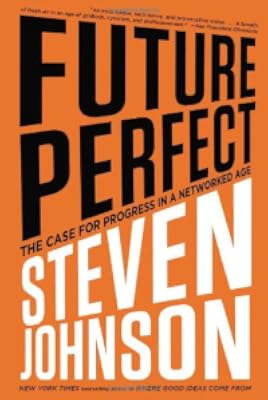
Future Perfect: The Case For Progress In A Networked Age
by Steven Johnson
On This Page
Description
Presents an optimistic assessment of how a technologically connected world can enable a better if different future, outlining a rising model of political change that breaks traditional categories of thinking and enables positive solutions.Tags
Recommendations



































Member Reviews
Future Perfect is an optimistic book about technology, society, and the future. That’s remarkable in itself, since pessimistic (or at least cautionary) books tend to outnumber optimistic ones, but what’s even more remarkable is the care and precision with which Johnson makes his case. The new communications technologies, he argues, are significant less for what they do than for what their capabilities enable us to do, if we choose to do it.
The first of the book’s two sections lays out its central premise: that distributed “peer networks” allowing the free flow of information between diverse individuals are a powerful force for social progress. decentralized networks are a powerful tool for facilitating interaction between show more individuals, and thus for social progress. It concludes: “We have a theory of peer networks. We have the practice of building them. And we have results. We know that peer networks can work in the real world. The task now is to discover how far they can take us.” The second, longer section – a series of thematic chapters on subjects like journalism, technology, and government – makes good on that promise. It presents case studies that show what peer networks have already accomplished, and contemplates what they might accomplish in the future.
Johnson’s goal, in Future Perfect is not to write a primer on the theory of networks, an analysis of how distributed networks function, or a history of distributed networks (though he touches, expertly but wearing his expertise lightly, on all those subjects). Nor is his goal to predict the future: The potential applications he describes for peer networks are presented as possibilities, not certainties. His evident goal is, rather, to encourage readers raised in a world (largely) defined by centralized networks to think seriously about one (more) defined by peer networks. It is a manifesto, but an intellectual rather than a political one. In the spirit of Apple Computer (the subject of one of Johnson’s case studies), it urges: “Think different.”
Future Perfect is, in this sense, a spiritual sequel to Johnson’s Everything Bad is Good for You. Like the earlier work, it takes a proposition that, at first glance, seems completely absurd -- the height of fuzzy headed wishful thinking -- and patiently shows that the “absurd” idea is a more useful tool than the received wisdom that “everybody knows.” Future Perfect improves on Everything Bad, however, by its carefully delineated internal structure and its layering of case study on case study, thematic chapter on thematic chapter. Johnson’s central idea is breathtakingly simple. His development of it, at length and in detail, is what gives the book its power.
Steven Johnson is both an insightful thinker and an exceptionally graceful writer. If you haven’t encountered his work before, this is an excellent place to begin. show less
The first of the book’s two sections lays out its central premise: that distributed “peer networks” allowing the free flow of information between diverse individuals are a powerful force for social progress. decentralized networks are a powerful tool for facilitating interaction between show more individuals, and thus for social progress. It concludes: “We have a theory of peer networks. We have the practice of building them. And we have results. We know that peer networks can work in the real world. The task now is to discover how far they can take us.” The second, longer section – a series of thematic chapters on subjects like journalism, technology, and government – makes good on that promise. It presents case studies that show what peer networks have already accomplished, and contemplates what they might accomplish in the future.
Johnson’s goal, in Future Perfect is not to write a primer on the theory of networks, an analysis of how distributed networks function, or a history of distributed networks (though he touches, expertly but wearing his expertise lightly, on all those subjects). Nor is his goal to predict the future: The potential applications he describes for peer networks are presented as possibilities, not certainties. His evident goal is, rather, to encourage readers raised in a world (largely) defined by centralized networks to think seriously about one (more) defined by peer networks. It is a manifesto, but an intellectual rather than a political one. In the spirit of Apple Computer (the subject of one of Johnson’s case studies), it urges: “Think different.”
Future Perfect is, in this sense, a spiritual sequel to Johnson’s Everything Bad is Good for You. Like the earlier work, it takes a proposition that, at first glance, seems completely absurd -- the height of fuzzy headed wishful thinking -- and patiently shows that the “absurd” idea is a more useful tool than the received wisdom that “everybody knows.” Future Perfect improves on Everything Bad, however, by its carefully delineated internal structure and its layering of case study on case study, thematic chapter on thematic chapter. Johnson’s central idea is breathtakingly simple. His development of it, at length and in detail, is what gives the book its power.
Steven Johnson is both an insightful thinker and an exceptionally graceful writer. If you haven’t encountered his work before, this is an excellent place to begin. show less
 This review was written for LibraryThing Early Reviewers.
Steven Johnson outlines an idea of social and political organization he refers to a the "peer progressive" philosophy. There are two main components to this concept: 1) a belief in the possibility and reality of social progress, and 2) a principle of organization based on a decentralized network through which information can flow freely and problems can be solved in a distributed way. This second point, of course, describes how the internet works on a technical basis, and also how such internet-based projects as Wikipedia function, but it need not necessarily be technological. For instance, some corporations function along these lines, to varying degrees.
Johnson believes this can also be a valuable strategy to use in government, and, show more indeed, views it as a new political movement. It's one that he sees as unaligned with either the traditional Left or Right, but rather as a completely different way of conceptualizing things, one that believes that neither government nor corporations should exert the powerful top-down control they are currently wrestling with each other over, but that sees an essential role for both free market competition and government oversight.
It took me a little while to really click with what Johnson is saying here. For a good chunk of the book, I found myself, somewhat paradoxically, alternating between thinking that he was talking about things that were trivially obvious and thinking that the ideas he was discussing were so nascent that there really was not very much to be said about them yet. But somewhere in there, I started to find myself nodding a lot and saying, "Hey, that's actually a really good idea!" Prizes instead of patents as a means of incentivizing pharmaceutical companies to develop new drugs? Damn, that's a good idea! A strategy of campaign finance reform that allows taxpayers to designate some portion of their tax money to fund the campaign of the candidate or party of their choice, and forbids candidates who accept that money from taking donations from elsewhere? Hey, that's got to be better than what we have now!
Other proposals, such as the "liquid democracy" scheme in which voters can essentially transfer their votes to people they believe know more about the issues than they do, strike me as considerably more dubious. Still. the ideas here are very much worth giving some thought to, and they're presented in Johnson's usual lucid, engaging, and extremely readable style. show less
Johnson believes this can also be a valuable strategy to use in government, and, show more indeed, views it as a new political movement. It's one that he sees as unaligned with either the traditional Left or Right, but rather as a completely different way of conceptualizing things, one that believes that neither government nor corporations should exert the powerful top-down control they are currently wrestling with each other over, but that sees an essential role for both free market competition and government oversight.
It took me a little while to really click with what Johnson is saying here. For a good chunk of the book, I found myself, somewhat paradoxically, alternating between thinking that he was talking about things that were trivially obvious and thinking that the ideas he was discussing were so nascent that there really was not very much to be said about them yet. But somewhere in there, I started to find myself nodding a lot and saying, "Hey, that's actually a really good idea!" Prizes instead of patents as a means of incentivizing pharmaceutical companies to develop new drugs? Damn, that's a good idea! A strategy of campaign finance reform that allows taxpayers to designate some portion of their tax money to fund the campaign of the candidate or party of their choice, and forbids candidates who accept that money from taking donations from elsewhere? Hey, that's got to be better than what we have now!
Other proposals, such as the "liquid democracy" scheme in which voters can essentially transfer their votes to people they believe know more about the issues than they do, strike me as considerably more dubious. Still. the ideas here are very much worth giving some thought to, and they're presented in Johnson's usual lucid, engaging, and extremely readable style. show less
I'm a fan of Steven Johnson's work. I think in interdisciplinary webs and networks rather than silos, and his work reflects that approach. This book is no exception.
Future Perfect is Johnson's look at networking - through the internet, sure, but in other, lower tech ways as well - as infrastructure for effecting change and building communities. The book is essentially a series of case studies in which he examines networking. The cases are interesting, especially if, like myself, one is interested in movements within a political context.
This book is grounded in a substantial literature (though if offers a much easier read!), especially Manuel Castells "The Rise of the Network Society." In fact, this book caused me to go back and read show more Castells again; I found that Johnson helped me take Castells out of a solely theoretical framework and understand better how his concept of "flows" is enacted on the ground.
Less flatteringly, this book is also the predecessor for such books as Gavin Newsom's "Citizenville," in which the concept of the power of networks for political change is reduced to replacing human interaction with computer networks.
And herein lies the one difficulty with a smart book like Johnson's work. Humans tend to be reductionist, and Johnson's elegant understanding of the subtleties of utilizing the power of networks for progress is likely to be misunderstood by others. It is one of the perils of being an intelligent thinker in a time and place that devalues deep thought. I, for one, believe this book will survive the era of oversimplification and will be seen for the useful work it is. show less
Future Perfect is Johnson's look at networking - through the internet, sure, but in other, lower tech ways as well - as infrastructure for effecting change and building communities. The book is essentially a series of case studies in which he examines networking. The cases are interesting, especially if, like myself, one is interested in movements within a political context.
This book is grounded in a substantial literature (though if offers a much easier read!), especially Manuel Castells "The Rise of the Network Society." In fact, this book caused me to go back and read show more Castells again; I found that Johnson helped me take Castells out of a solely theoretical framework and understand better how his concept of "flows" is enacted on the ground.
Less flatteringly, this book is also the predecessor for such books as Gavin Newsom's "Citizenville," in which the concept of the power of networks for political change is reduced to replacing human interaction with computer networks.
And herein lies the one difficulty with a smart book like Johnson's work. Humans tend to be reductionist, and Johnson's elegant understanding of the subtleties of utilizing the power of networks for progress is likely to be misunderstood by others. It is one of the perils of being an intelligent thinker in a time and place that devalues deep thought. I, for one, believe this book will survive the era of oversimplification and will be seen for the useful work it is. show less
This review was written for LibraryThing Early Reviewers.Optimistic Observations from a Reluctant Quasi-Utopian
Steven Johnson is no starry-eyed idealist, but one could be forgiven for thinking so after hearing the premise for his latest tome: That peer progressive groups (i.e. networks where information and ideas progress in a near-limitless fashion from one person to the next) are crowd-sourcing a better tomorrow.
The science historian who brought us 'The Invention of Air' and 'The Ghost Map' takes thre reader through a number of cases where this idea has gone from attravtive-if-theoretical to fact. Thankfully, he does not limit his research to the internet. He also goes into things like the 311 phone service in NYC and how that not only provides its users with info, but also provides the show more government with valuable info from its users as to things like broken lights and, in one facinating case, an on-going city-wide mystery involving maple syrup.
The story-teller you may have loved from reading the aforementioned science histories is present here, but, alas, on a leash. While each chapter startes with a tale of some kind, it is then expounded on to support his thesis. This could not be avoided in any reasonable way, but if you were looking for a cast of characters and incidents similar to The Ghost Map, you may be let down.
Tl;dr: This is a series of well-thought arguments for, gasp, optimism regarding our future. But the full skills of a master story-teller are not on display here. Know what kind of Steven Johnson book you are looking for before taking the plunge. show less
Steven Johnson is no starry-eyed idealist, but one could be forgiven for thinking so after hearing the premise for his latest tome: That peer progressive groups (i.e. networks where information and ideas progress in a near-limitless fashion from one person to the next) are crowd-sourcing a better tomorrow.
The science historian who brought us 'The Invention of Air' and 'The Ghost Map' takes thre reader through a number of cases where this idea has gone from attravtive-if-theoretical to fact. Thankfully, he does not limit his research to the internet. He also goes into things like the 311 phone service in NYC and how that not only provides its users with info, but also provides the show more government with valuable info from its users as to things like broken lights and, in one facinating case, an on-going city-wide mystery involving maple syrup.
The story-teller you may have loved from reading the aforementioned science histories is present here, but, alas, on a leash. While each chapter startes with a tale of some kind, it is then expounded on to support his thesis. This could not be avoided in any reasonable way, but if you were looking for a cast of characters and incidents similar to The Ghost Map, you may be let down.
Tl;dr: This is a series of well-thought arguments for, gasp, optimism regarding our future. But the full skills of a master story-teller are not on display here. Know what kind of Steven Johnson book you are looking for before taking the plunge. show less
This review was written for LibraryThing Early Reviewers.FYI: This review is based upon a uncorrected proof provided to me by the publisher.
Johnson's book is overtly political and progressive, but his arguments don't fit neatly into the standard left/right model. He is arguing for a new kind of politics - one he bases on the Internet. He uses fascinating examples - for example, how New York City solved the mystery of a faint maple syrup odor that showed up on several occasions - to argue for political solutions not coming from a hierarchical order, but from the collective wisdom of citizens themselves. Color me skeptical, but his arguments are earnest and worthy of discussion and consideration. His ideas are a future worth exploring.
Johnson's book is overtly political and progressive, but his arguments don't fit neatly into the standard left/right model. He is arguing for a new kind of politics - one he bases on the Internet. He uses fascinating examples - for example, how New York City solved the mystery of a faint maple syrup odor that showed up on several occasions - to argue for political solutions not coming from a hierarchical order, but from the collective wisdom of citizens themselves. Color me skeptical, but his arguments are earnest and worthy of discussion and consideration. His ideas are a future worth exploring.
This review was written for LibraryThing Early Reviewers.Where does progress come from, and how can we create more of it? The book begins with the Miracle on the Hudson, the safe landing of US Airways Flight 1549 by Chesley Sullenberger, and without diminishing heroism, credits a series of incremental safety improvements, beginning with the chicken gun, which simulates the collision of birds with aircraft.
We tend to think that progress comes from the market, but it also comes from the public sector and social forces. It may involve technology, but even more it involves organizing information and resources. The internet is a role model rather than a solution. An emerging movement of “peer progressives” seeks distributed contributions rather than a centralized plan from the hierarchical show more structures of big business or big government. This has implications for the future of both capitalism and democracy.
Examples:
* Save the Children staff who sought “positive deviants” in a Vietnamese village to understand the behavior patterns that allowed some families to thrive despite the norm of malnutrition, and encouraged amplification through existing communication channels.
* Kickstarter crowdfunding of projects and causes, an example of the “gift economy”.
* X Prize Foundation, which sponsors prize-backed challenges whose goals emerge from a multilayered process.
* 311 system of New York, where citizens can call to request information or report problems, which are tagged and categorized and mapped so the city can set priorities and allocate resources effectively.
This is a short, breezy, optimistic book describing a single idea, well illustrated with examples. It could probably have been consolidated into a magazine essay, but the extra is pleasant reading.
(read 1 Dec 2012) show less
We tend to think that progress comes from the market, but it also comes from the public sector and social forces. It may involve technology, but even more it involves organizing information and resources. The internet is a role model rather than a solution. An emerging movement of “peer progressives” seeks distributed contributions rather than a centralized plan from the hierarchical show more structures of big business or big government. This has implications for the future of both capitalism and democracy.
Examples:
* Save the Children staff who sought “positive deviants” in a Vietnamese village to understand the behavior patterns that allowed some families to thrive despite the norm of malnutrition, and encouraged amplification through existing communication channels.
* Kickstarter crowdfunding of projects and causes, an example of the “gift economy”.
* X Prize Foundation, which sponsors prize-backed challenges whose goals emerge from a multilayered process.
* 311 system of New York, where citizens can call to request information or report problems, which are tagged and categorized and mapped so the city can set priorities and allocate resources effectively.
This is a short, breezy, optimistic book describing a single idea, well illustrated with examples. It could probably have been consolidated into a magazine essay, but the extra is pleasant reading.
(read 1 Dec 2012) show less
This review was written for LibraryThing Early Reviewers.Steven Johnson's latest is Future Perfect: The Case for Progress in a Networked Age (Riverhead, 2012). It's an optimistic meditation on how "peer progressive" values (as Johnson coins them) might be able to transform everything from government to medicine to the mass media. While I confess I'm not entirely as convinced as Johnson that this method will solve all the problems he thinks it could, it's certainly nice to read a positive essay which offers a reasonable way forward.
Johnson, as he typically does in his books, examines historical precedents (for things like prize-backed challenges) and profiles case studies where he sees peer progressive-style initiatives as having been successful in the past (Kickstarter, New York's 311 system show more and more). If you're a fan of Johnson's earlier works I can certainly recommend this one. show less
Johnson, as he typically does in his books, examines historical precedents (for things like prize-backed challenges) and profiles case studies where he sees peer progressive-style initiatives as having been successful in the past (Kickstarter, New York's 311 system show more and more). If you're a fan of Johnson's earlier works I can certainly recommend this one. show less
Members
- Recently Added By
Published Reviews
ThingScore 100
A thought-provoking, hope-inspiring manifesto.
added by waitingtoderail
As journalist Johnson points out in this fascinating and compelling book, as the character of our society changes and embraces social networking to a greater degree, the ways that we foster and measure progress are beginning to change dramatically . . . Stimulating and challenging, Johnson’s thought-provoking ideas steer us steadily into the future.
added by waitingtoderail
Author Information

19+ Works 16,019 Members
Common Knowledge
- Canonical title*
- Un futuro perfetto: il progresso ai tempi di Internet
- Original title
- Future Perfect: The Case For Progress In A Networked Age
*Some information comes from Common Knowledge in other languages. Click "Edit" for more information.
Classifications
- Genres
- Technology, Sociology, Nonfiction, General Nonfiction, Business, Science & Nature
- DDC/MDS
- 303.48 — Society, government, & culture Social sciences, sociology & anthropology Social processes Social change Causes of change
- LCC
- HM851 .J63 — Social sciences Sociology (General) Sociology Social change
- BISAC
Statistics
- Members
- 261
- Popularity
- 123,775
- Reviews
- 24
- Rating
- (3.63)
- Languages
- English, Italian, Spanish
- Media
- Paper, Audiobook, Ebook
- ISBNs
- 12
- ASINs
- 3