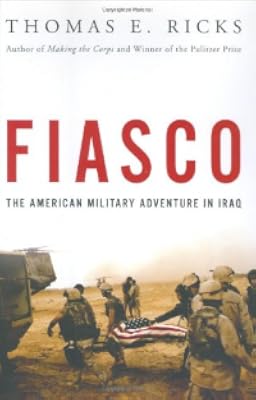
Fiasco: The American Military Adventure in Iraq
by Thomas E. Ricks
The American Military Adventure in Iraq (1)
On This Page
Description
[In this book, the author offers an] account - explosive, shocking, and authoritative - of the American military's tragic experience in Iraq. [The book also offers] accounts of battles such as 2nd Fallujah and Tall Afar, whose names should take their place alongside two Jima and Porkchop Hill on a select list of honor.... Too many American and Iraqi lives have been lost, and too much of America's might and influence has been squandered, for these individuals to escape a fair reckoning. [This show more book] is that reckoning. -Dust jacket. show lessTags
Recommendations
Member Reviews
Journalism is history's first draft , and Thomas Ricks explores in exacting detail the errors in planning, judgement, and strategy that lead to America's misadventure in Iraq. From the beginning, the war was hampered by poor analogies, cherry-picked intelligence, and an division at the highest levels of the Pentagon. There is more than enough blame to go around; Bush, Cheney, Wolfowitz, Franks, Powell, etc, but if any person is truly to blame, it's Rumsfeld, who sabotaged effective planning for the occupation, failed the military, and failed the American people. L Paul Bremer, as head of the Coalition Provisional Authority, deserves another large helping of blame, but an effective plan would have never put him and the CPA's unending show more stream of short-term contractors in charge to begin with.
The most killing indictment of the Bush administration's plan for war is that there was a very real chance that the war could have been won in 2004 or 2005. Saddam was crushed, the insurgency weak, the Iraqi people desperate for real change. But because the Bush administration was focused on non-existent WMDs, and didn't provide a real strategy for reconstruction, they gave the insurgency time to organize and to fight. The bloody peak of the conflict in 2005-2007 is entirely due to failures in the opening days of the war. Military boldness is often to be commended, but with the Bush team, lead instead to a quagmire, and an expanded civil war which has cost millions of lives, incited hatred for Americans, and trained our enemies in the hard school of insurgency.
If there's any weakness to this book, it's that it was published in 2006, and so doesn't cover the surge and General Petraeus's successful counter-insurgency strategy. But you can't fairly blame a book for not being prescient. "The Gamble" is Ricks' sequel, and has been added to the pile. show less
The most killing indictment of the Bush administration's plan for war is that there was a very real chance that the war could have been won in 2004 or 2005. Saddam was crushed, the insurgency weak, the Iraqi people desperate for real change. But because the Bush administration was focused on non-existent WMDs, and didn't provide a real strategy for reconstruction, they gave the insurgency time to organize and to fight. The bloody peak of the conflict in 2005-2007 is entirely due to failures in the opening days of the war. Military boldness is often to be commended, but with the Bush team, lead instead to a quagmire, and an expanded civil war which has cost millions of lives, incited hatred for Americans, and trained our enemies in the hard school of insurgency.
If there's any weakness to this book, it's that it was published in 2006, and so doesn't cover the surge and General Petraeus's successful counter-insurgency strategy. But you can't fairly blame a book for not being prescient. "The Gamble" is Ricks' sequel, and has been added to the pile. show less
Fiasco is not a bad book, it is a dangerous book. Its excellent readability sucks an unsuspecting reader into accepting extremely questionable and biased assessments of the past, of politicians, military institutions and soldiers. The Iraq War was a fiasco but Ricks' analysis stops at the surface.
First, the book is highly biased. Ricks only quotes people to the right of the conservative-in-the-orginal-meaning Andrew Bacevich (the only exception is Juan Cole who is allowed to offer two factual inputs.). Much of the original controversies are simply air-brushed out of the picture. Ricks' primary mission is to shield his friends from criticism. There are various circles of friends, starting with the Washington Post and other print titles, show more the US Marines, the US army, the US army reserves, the United States of America, allies of the United States of America and the rest of the world. If the story absolutely, positively requires Ricks to point fingers at some of his friends, the circle concept comes into play, e.g. the New York Times' Judith Miller is offered as a scapegoat, nicely diluting the equally unprofessional cheer-leading of Ricks' own paper.
Secondly, the book assumes readers with ADD both in regard to external facts and to the text itself. An example of a non-mentioned fact: "This new emphasis (on the operational level) also was meant to address what the Army had decided was a major failing during the Vietnam War" (p. 131). It is beside the point that I do not agree with this analysis that Vietnam was an operational failure, the important fact is that this analysis leaves out what came to be known as the Powell Doctrine ("Do we have a clear attainable objective? Is there a plausible exit strategy?"), which itself was based on the Weinberger Doctrine compiling the lessons of the Vietnam War. If the US had made sure to answer the questions of either doctrine, the quagmire might never have happened.
"Petraeus, now at Fort Leavenworth, ... made the thousands of Army officers who were students there also begin to study this peculiar way of war (ie COIN), so unlike what the U.S. Army had studied for the previous three decades" (p. 414), conveniently ignoring all the published lessons of Somalia, Kosovo, ... (such as the vulnerability of helicopters in close terrain). Ricks' faulty memory approach lets the US military off the hook far too easily.
Thirdly, this book, like so many others, plays down US war crimes. While Ricks presents many clear cases of war crimes, he hardly ever comments or discusses these cases. He simply notes that the US military justices sends the criminals home (fining them all of USD 5.000 for murder, if they prosecute at all) where they live happy lives as high school teachers. Remedial lessons about the Geneva conventions and the laws of war should be a high priority for any US unit. Can it really be a lessons learned that treating civilians with dignity is good?
Fourth, the book establishes easy scapegoats in Rumsfeld, Chalabi and those Neo-Cons. The failure and incompetence of the military-industrial complex runs much deeper. Within Ricks' cherished Marine Corps, the Warrior ethos is to blame with its COIN-unsuitable world-view. Generals such as James "It's fun to shoot some people" Mattis are part of the problem and the destruction of Fallujah the consequence of their actions.
If the book's purpose is to have the military-industrial complex rethink and refine its approach, it has failed. If entertainment and glorification of Ricks' circle of friends is its purpose, it succeeds. show less
First, the book is highly biased. Ricks only quotes people to the right of the conservative-in-the-orginal-meaning Andrew Bacevich (the only exception is Juan Cole who is allowed to offer two factual inputs.). Much of the original controversies are simply air-brushed out of the picture. Ricks' primary mission is to shield his friends from criticism. There are various circles of friends, starting with the Washington Post and other print titles, show more the US Marines, the US army, the US army reserves, the United States of America, allies of the United States of America and the rest of the world. If the story absolutely, positively requires Ricks to point fingers at some of his friends, the circle concept comes into play, e.g. the New York Times' Judith Miller is offered as a scapegoat, nicely diluting the equally unprofessional cheer-leading of Ricks' own paper.
Secondly, the book assumes readers with ADD both in regard to external facts and to the text itself. An example of a non-mentioned fact: "This new emphasis (on the operational level) also was meant to address what the Army had decided was a major failing during the Vietnam War" (p. 131). It is beside the point that I do not agree with this analysis that Vietnam was an operational failure, the important fact is that this analysis leaves out what came to be known as the Powell Doctrine ("Do we have a clear attainable objective? Is there a plausible exit strategy?"), which itself was based on the Weinberger Doctrine compiling the lessons of the Vietnam War. If the US had made sure to answer the questions of either doctrine, the quagmire might never have happened.
"Petraeus, now at Fort Leavenworth, ... made the thousands of Army officers who were students there also begin to study this peculiar way of war (ie COIN), so unlike what the U.S. Army had studied for the previous three decades" (p. 414), conveniently ignoring all the published lessons of Somalia, Kosovo, ... (such as the vulnerability of helicopters in close terrain). Ricks' faulty memory approach lets the US military off the hook far too easily.
Thirdly, this book, like so many others, plays down US war crimes. While Ricks presents many clear cases of war crimes, he hardly ever comments or discusses these cases. He simply notes that the US military justices sends the criminals home (fining them all of USD 5.000 for murder, if they prosecute at all) where they live happy lives as high school teachers. Remedial lessons about the Geneva conventions and the laws of war should be a high priority for any US unit. Can it really be a lessons learned that treating civilians with dignity is good?
Fourth, the book establishes easy scapegoats in Rumsfeld, Chalabi and those Neo-Cons. The failure and incompetence of the military-industrial complex runs much deeper. Within Ricks' cherished Marine Corps, the Warrior ethos is to blame with its COIN-unsuitable world-view. Generals such as James "It's fun to shoot some people" Mattis are part of the problem and the destruction of Fallujah the consequence of their actions.
If the book's purpose is to have the military-industrial complex rethink and refine its approach, it has failed. If entertainment and glorification of Ricks' circle of friends is its purpose, it succeeds. show less
This book should be required reading for everyone. "Fiasco" is a phenomenal look at the Iraq War: what led up to it; who deceived and manipulated us into it and how; who tried to stop it; and most importantly, the thoughts and insights of the people who are fighting the war, from the highest-ranking commanders to the youngest kids on the ground. Ricks' scope is awesome, but he manages it intelligently and eloquently. Best of all, he shows the multiple facets of the war from all angles, making this much more than a mere polemic and delving far more deeply into the various situations and events than anything else I've encountered. Pair this one with "Imperial Life In The Emerald City" and you'll have a second-to-none understanding of show more exactly what went wrong in Iraq and why. Read this book. show less
The Washington Post's Thomas Ricks has written a dense, readable and highly-detailed account of the first 3 years of the American war in Iraq as seen and experienced from within the US military. It is an outstanding account in many ways and a number of other reviewers have done a good job in explaining many of its good qualities. Ricks has obviously had access to many, many officers who were involved in the invasion and subsequent occupation and he seems to have been provided and extraordinary amount of access, including memos, presentations, papers, emails, communications and other internal documents.
However one would hesitate in calling it the definitive account of this period of the war, though it is undoubtedly one of the most show more important. Firstly, as is immediately noticeable when scanning the dramatis personae provided at the front of the book, there are virtually no Iraqis here, which is unfortunate in a book to do with Iraq. In fact the only Iraqi who makes an appearance is Ahmed Chalabi and he comes across as some kind of evil Machivellian villain manipulating things behind the scenes, blamed by various Coalition Provisional Authority officials for all sorts of bad decisions made by the Bush administration and Bremer in Iraq. He's also blamed for faulty intelligence and the shoddy reporting by the New York Times' Judith Miller. Now, there's no doubt that Chalabi played a major role in feeding people in the administration and in the world of journalism the kinds of stories they wanted to hear in order to further his own agenda. However one suspects there's a great deal of buck-shifting going on here.
Another issue to keep in mind is that Ricks' book seems heavily influenced by the milieu in which it was written. It is an account of how the military operated in the years 2002 to 2006 but it is also a polemic. Ricks is arguing for the adoption of Counter Insurgency strategy (or COIN) by the military in Iraq if it wants to have a hope of success. Now, he makes a very compelling argument, but as a result of this agenda, sometimes it feels as if Ricks is focused on addressing officers within the army. This is not necessarily a bad thing, but it can sometimes feel as if the narrative is kept within a box. Assumptions and attitudes are only questioned so far. So, for example, he looks at the containment vs. elimination debate within the military on the question of how to deal with Saddam Hussein but does not really examine the history of the US-Saddam relationship or question the assumption that he had to be dealt with in one of these two ways.
Now I'm not necessarily saying this is a bad thing. However, it does mean that this is a book with a certain focus, and that is the operations of the U.S. military in the Iraq War, from planning to execution, and the successes and failures thereof. It is in its own way an excellent book and one I would certainly recommend to anyone who wants to understand what the US military encountered and how it adapted during the first few years of the Iraq war. show less
However one would hesitate in calling it the definitive account of this period of the war, though it is undoubtedly one of the most show more important. Firstly, as is immediately noticeable when scanning the dramatis personae provided at the front of the book, there are virtually no Iraqis here, which is unfortunate in a book to do with Iraq. In fact the only Iraqi who makes an appearance is Ahmed Chalabi and he comes across as some kind of evil Machivellian villain manipulating things behind the scenes, blamed by various Coalition Provisional Authority officials for all sorts of bad decisions made by the Bush administration and Bremer in Iraq. He's also blamed for faulty intelligence and the shoddy reporting by the New York Times' Judith Miller. Now, there's no doubt that Chalabi played a major role in feeding people in the administration and in the world of journalism the kinds of stories they wanted to hear in order to further his own agenda. However one suspects there's a great deal of buck-shifting going on here.
Another issue to keep in mind is that Ricks' book seems heavily influenced by the milieu in which it was written. It is an account of how the military operated in the years 2002 to 2006 but it is also a polemic. Ricks is arguing for the adoption of Counter Insurgency strategy (or COIN) by the military in Iraq if it wants to have a hope of success. Now, he makes a very compelling argument, but as a result of this agenda, sometimes it feels as if Ricks is focused on addressing officers within the army. This is not necessarily a bad thing, but it can sometimes feel as if the narrative is kept within a box. Assumptions and attitudes are only questioned so far. So, for example, he looks at the containment vs. elimination debate within the military on the question of how to deal with Saddam Hussein but does not really examine the history of the US-Saddam relationship or question the assumption that he had to be dealt with in one of these two ways.
Now I'm not necessarily saying this is a bad thing. However, it does mean that this is a book with a certain focus, and that is the operations of the U.S. military in the Iraq War, from planning to execution, and the successes and failures thereof. It is in its own way an excellent book and one I would certainly recommend to anyone who wants to understand what the US military encountered and how it adapted during the first few years of the Iraq war. show less
From a war hawk who greatly appreciated the research: I got done reading most of the book `Fiasco' before I went home on leave. It was a pretty good book, really well written, very well researched, and easy to read. The author covers almost all the major points in the war and has clearly interviewed a lot of people and done a lot of research on the war.
The author gets a few things right. He is almost obsessed in his criticism of the Bush administration, to the point where he contradicts his own self in the book. The book reads as an `everything the Bush administration ever did was wrong' critique.
In the book the author:
--Describes flaws in the US Army's warfighting policies. The army proved good at destroying the standing army in show more front of them, but wholly inadequate fighting terrorists. And really inadequate at fighting most of the likely post cold war opponents that they might have to fight. The author mentions the Army policy of running away when attacked in a convoy. Just on the day of Saddam's verdict I was on an army convoy, I asked what the SOP was if we were to be attacked, and the answer was to run away, to disengage. No matter how good armor is, it can be defeated with enough tries.
--See's some but not most flaws of the US State Dept.
--Rightfully points out some of the awesomeness of the US Marine Corps.
--Points out the disastrous results of forcing General Conway's hands in Falluja. The general said that they had a plan, and that they shouldn't be rushed. If done properly the taking of Falluja would only need to be done once. There were established good counterinsurgency tactics and procedures that the Marines were set to follow. But the death of the Blackwater guys caused an outcry for "something to be done" for bombs to be dropping. So Politics, and politicians forced the Marines to act prematurely.
--Points out the disastrous results of tying Conway's hands after forcing the Marines into action prematurely and not according to the plan. After the Marines were ordered to please political pundits by forcing the action in Falluja, imagery of the death and destruction caused an outcry, and then Conway was ordered to cease. This effectively put Falluja and Ramadi in enemy's hands. Even when they were eventually retaken by force the damage was done, and the population, which are the prize of a guerilla war, were lost.
--Accurately points out some of the disastrous results of the Abu Ghraib scandal.
The author really does a swell job of pointing out the mistakes that have been made in the war. And there really have been a lot of mistakes made.
One useful thing the author does do in the book is contradict some of the stupider conspiracy theories about the Bush administration, and about invading Iraq being the policy of the administration before 9/11 ever happened. He accurately and believably describes how the events of 9/11 forced the leaders of the administration to change their policy of non nation building, and of staying out of the affairs of foreign countries.
The author is a big fan of General Anthony Zinny, as am I. And there is much mention of the military not using Zinny's plan to invade Iraq. And perhaps Zinni's plan would have solved many of the problems that there are now. From what the author describes it seems like Zinni's plan was a good one. But maybe if Zinni thought that containment was working, maybe his assessment of an invasion plan was also off.
The author maintains that Bush Sr, and then Clinton had a working policy of containment in Iraq. And the author derides Wolfowitz for maintaining that something different needed to be done.
Contrary to the author's assertions containment did not work. It was working for the Russians, the Germans and the French who were dealing with Saddam, but it was not working so well for hundreds of thousands of Iraqi children that were dieing of starvation. And the Arab world was seeing that, if our own public was not, and the population of the Arab world was not blaming Saddam or the French for the images of starving Arab children, they were blaming us.
The containment policy also brought about the attack on the USS Cole, the attack on the Khobar Towers, the bombing of the American Embassy in Kenya, and several other high profile terrorist attacks.
The containment policy brought us 9/11. The direct result of having troops in Saudi Arabia to contain Saddam Hussein was the planes flying into buildings in NYC.
The containment policy was not a success. Something had to change. Wofowitz was right about that.
Bush's policy of invading Iraq has brought about much crying. I mean, Iraq sucks. It does. Iraqi citizens are being subject to terrorists, criminals, religious militias, and such on a daily basis, and US troops are being killed in the effort to help them out. But we are fighting. Yes we are making mistakes, and we are also making not mistakes.
Our military is learning, and sometimes it isn't. We are putting forth an effort. And we may or may not be successful in creating a free and prosperous Iraq. A free and prosperous oasis in the middle east that is an ocean of genocidal tyrant dictators.
Can it be done? Can we be successful? I think so.
Our bureaucracies might prevent it from working out. The Army the CIA, the State Dept are all bureaucracies that were in no way ready to do the right thing here. But for the millions of taxpayer money spent on those institutions they should have been. If they can't do this, if they can't learn and do what they are supposed to do, they should re-think there reason to exist.
Despite all of this, I think everyone over here in Iraq should read the book. It is well documented, and the book does a very good job of pointing out mistakes made. If we can't learn from our mistakes we will not prevail. show less
The author gets a few things right. He is almost obsessed in his criticism of the Bush administration, to the point where he contradicts his own self in the book. The book reads as an `everything the Bush administration ever did was wrong' critique.
In the book the author:
--Describes flaws in the US Army's warfighting policies. The army proved good at destroying the standing army in show more front of them, but wholly inadequate fighting terrorists. And really inadequate at fighting most of the likely post cold war opponents that they might have to fight. The author mentions the Army policy of running away when attacked in a convoy. Just on the day of Saddam's verdict I was on an army convoy, I asked what the SOP was if we were to be attacked, and the answer was to run away, to disengage. No matter how good armor is, it can be defeated with enough tries.
--See's some but not most flaws of the US State Dept.
--Rightfully points out some of the awesomeness of the US Marine Corps.
--Points out the disastrous results of forcing General Conway's hands in Falluja. The general said that they had a plan, and that they shouldn't be rushed. If done properly the taking of Falluja would only need to be done once. There were established good counterinsurgency tactics and procedures that the Marines were set to follow. But the death of the Blackwater guys caused an outcry for "something to be done" for bombs to be dropping. So Politics, and politicians forced the Marines to act prematurely.
--Points out the disastrous results of tying Conway's hands after forcing the Marines into action prematurely and not according to the plan. After the Marines were ordered to please political pundits by forcing the action in Falluja, imagery of the death and destruction caused an outcry, and then Conway was ordered to cease. This effectively put Falluja and Ramadi in enemy's hands. Even when they were eventually retaken by force the damage was done, and the population, which are the prize of a guerilla war, were lost.
--Accurately points out some of the disastrous results of the Abu Ghraib scandal.
The author really does a swell job of pointing out the mistakes that have been made in the war. And there really have been a lot of mistakes made.
One useful thing the author does do in the book is contradict some of the stupider conspiracy theories about the Bush administration, and about invading Iraq being the policy of the administration before 9/11 ever happened. He accurately and believably describes how the events of 9/11 forced the leaders of the administration to change their policy of non nation building, and of staying out of the affairs of foreign countries.
The author is a big fan of General Anthony Zinny, as am I. And there is much mention of the military not using Zinny's plan to invade Iraq. And perhaps Zinni's plan would have solved many of the problems that there are now. From what the author describes it seems like Zinni's plan was a good one. But maybe if Zinni thought that containment was working, maybe his assessment of an invasion plan was also off.
The author maintains that Bush Sr, and then Clinton had a working policy of containment in Iraq. And the author derides Wolfowitz for maintaining that something different needed to be done.
Contrary to the author's assertions containment did not work. It was working for the Russians, the Germans and the French who were dealing with Saddam, but it was not working so well for hundreds of thousands of Iraqi children that were dieing of starvation. And the Arab world was seeing that, if our own public was not, and the population of the Arab world was not blaming Saddam or the French for the images of starving Arab children, they were blaming us.
The containment policy also brought about the attack on the USS Cole, the attack on the Khobar Towers, the bombing of the American Embassy in Kenya, and several other high profile terrorist attacks.
The containment policy brought us 9/11. The direct result of having troops in Saudi Arabia to contain Saddam Hussein was the planes flying into buildings in NYC.
The containment policy was not a success. Something had to change. Wofowitz was right about that.
Bush's policy of invading Iraq has brought about much crying. I mean, Iraq sucks. It does. Iraqi citizens are being subject to terrorists, criminals, religious militias, and such on a daily basis, and US troops are being killed in the effort to help them out. But we are fighting. Yes we are making mistakes, and we are also making not mistakes.
Our military is learning, and sometimes it isn't. We are putting forth an effort. And we may or may not be successful in creating a free and prosperous Iraq. A free and prosperous oasis in the middle east that is an ocean of genocidal tyrant dictators.
Can it be done? Can we be successful? I think so.
Our bureaucracies might prevent it from working out. The Army the CIA, the State Dept are all bureaucracies that were in no way ready to do the right thing here. But for the millions of taxpayer money spent on those institutions they should have been. If they can't do this, if they can't learn and do what they are supposed to do, they should re-think there reason to exist.
Despite all of this, I think everyone over here in Iraq should read the book. It is well documented, and the book does a very good job of pointing out mistakes made. If we can't learn from our mistakes we will not prevail. show less
I was surprised to find this book quite readable, even though it had a lot of military jargon that I wasn't familiar with. I guess what kept coming up is how totally inept this war has been from the start and never gets better. Fiasco is the appropriate name- but I did keep waiting to see what good or right things the military did and they just keep goofing things up. The minute one battalion would get it right (i.e.: Treating the Iraqi's as friends, not foe) the troops would end their tour and a new group would start. The new battalion would have a bad attitude towards the Iraqis.
Fiasco is an exploration of the decision making behind the plans to invade Iraq and the actions, both on the ground and in Washington, once the invasion had begun. From the first sentence, this book is a denouncement of the whole Iraq ‘adventure’, which the author argues was based on bad premises and deceptions. Such misdirected reasoning led to forces on the ground that were never aware of the real nature of their mission, and muddled strategy that has ultimately led to unnecessary deaths and a country on the brink of civil war. Ricks pulls no punches, attributing praise and blame where he sees fit. This book, dense with information and analysis, will probably become the ‘go-to’ book for future readers looking for information show more about the Iraq conflict, with its ability to lead the reader through the various aspects of a complicated and ill-begotten military fiasco. show less
Members
- Recently Added By
Lists

The Emergence of the Modern Middle East
289 works; 13 members

Best of GWOT
7 works; 1 member

Iraq
14 works; 1 member

Remember Shuffle Podcast| Iraq War Series: Parts I - VI
13 works; 1 member
Author Information

14+ Works 5,538 Members
Thomas E. Ricks lives outside Washington, D.C., with his wife and children. Pulitzer Prize-winning journalist Thomas E. Ricks was born in Massachusetts in 1955, and graduated from Yale University in 1977. Prior to becoming the Washington Post's Pentagon and military correspondent in 2000, he was a Wall Street Journal reporter for 17 years. He has show more written several books and other publications on defense matters, including Making the Corps, which won the Washington Monthly's Political Book of the Year award, the New York Times bestseller Fiasco: The American Military Adventure in Iraq, and The Gamble: General David Petraeus and the American Military Adventure in Iraq, 2006-2008. Ricks lectures frequently to the military and is a senior fellow at the Center for a New American Security. He is also a member of Harvard University's Senior Advisory Council on the Project on U.S. Civil-Military Relations, the Inter-University Seminar on Armed Forces and Society, and the International Institute for Strategic Studies. (Bowker Author Biography) show less
Awards and Honors
Awards
Distinctions
Notable Lists
Series

Common Knowledge
- Canonical title
- Fiasco: The American Military Adventure in Iraq
- Original title
- Fiasco: The American Military Adventure in Iraq
- Original publication date
- 2006-07-25
- People/Characters
- George W. Bush (President)
- Important places
- Baghdad, Iraq; Mosul, Iraq; Sadr City, Iraq; Karbala, Iraq; Fallujah, Iraq; Iraq (show all 7); Afghanistan
- Important events
- Iraq War (2003- )
- Epigraph
- Know your enemy, know yourself,
One hundred battles, one hundred victories.
--Sun Tzo - Dedication
- For the war dead
- First words
- President George W. Bush's decision to invade Iraq in 2003 ultimately may come to be seen as one of the most profligate actions in the history of American foreign policy.
- Last words
- (Click to show. Warning: May contain spoilers.)Before that happened, the West would have to consider a war of preemption--but this time its soldiers might really face nuclear, biological, or chemical weapons.
- Original language
- English
- Disambiguation notice
- Full title (2006): Fiasco : the American military adventure in Iraq
Classifications
Statistics
- Members
- 2,268
- Popularity
- 8,841
- Reviews
- 31
- Rating
- (4.12)
- Languages
- 5 — English, French, Greek, Italian, Korean
- Media
- Paper, Audiobook, Ebook
- ISBNs
- 16
- ASINs
- 10