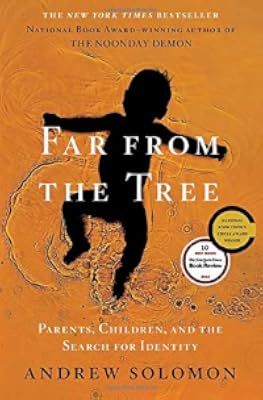
Far From the Tree: Parents, Children and the Search for Identity
by Andrew Solomon
On This Page
Description
Solomon tells the stories of parents who not only learn to deal with their exceptional children but also find profound meaning in doing so.Tags
Recommendations


Member Reviews
Far From the Tree – Andrew Solomon
5 stars
I’m convinced that this is the most important book that I will review this year. I hope I can do it justice.
That familiar old adage, ‘The apple doesn’t fall far from the tree’, turns up usually when a child demonstrates the same undesirable tendencies as the parent. Sometimes it might be used as a compliment if a child shares a notable talent with an ancestor. But what if the apple falls far away from the tree? What if the parent tree is an apple and the child is an orange? Andrew Soloman’s massive book examines ten different populations in which the child’s identity differs widely from the family. He considers the needs of the child to establish a personal, ‘horizontal’ show more identity associated with his difference, within the context of the ‘vertical’ identity of the family. He also considers, with great compassion, the needs of parents who raise such a child. In the first chapter, Soloman speaks of his own experience as a dyslexic, gay child of straight parents. The final chapter, Father, reflects his personal experiences in becoming a parent. The other chapters are titled: Deaf, Dwarf, Down Syndrome, Autism, Schizophrenia, Disability, Prodigies, Rape, Crime, and Transgender.
This is a heavily researched book. There are over 150 pages of footnotes and references. But if it is a textbook, it is the most readable textbook I’ve ever held in my hands. Soloman interviewed, and frequently lived with, hundreds of participants, but at no point does this book become a tabloid ‘tell-it-all’. Even in the chapters which draw primarily on his own experience, he uses each anecdote to illustrate major issues in the development of identity and the treatment of those who differ from ‘us’. Each chapter is comprehensive in providing historical context, current research and public policy issues. Where controversy exists, he has a clearly defined liberal bias, but takes pains to show all sides of an issue. Soloman’s personal comparison between dyslexia, for which intervention is desirable, and homosexuality, as an identity that he embraces, becomes a major theme for discussion throughout the book. What must the hearing parents of a deaf child consider before giving their child a cochlear implant? If your child is a dwarf, should you inflict the pain of limb lengthening surgery for her future benefit? Is genetic testing leading us to ‘laissez- faire’ eugenics? The questions are fascinating. The answers are complex.
I don’t own a copy of this book yet. I’m waiting for the paperback (or a decrease in the kindle price). I checked the book out four times from two different library systems before I was able to finish it. At nearly 1000 pages, it is not a book to read at one sitting. It is not difficult to understand. Soloman’s writing is clear and direct. I found myself rereading because I needed more time to digest the depth of his analysis. I had to resist the urge to underline sentence after sentence that expressed an important fact or a profound truth. Despite dyslexia, this man knows how to write.
“Ability is the tyranny of the majority. If most people could flap their arms and fly, the inability to do so would be a disability.”
“Loving our children is an exercise of the imagination.”
“Though many of us take pride in how different we are from our parents, we are endlessly sad at how different our children are from us”
“While accommodating people with physical disabilities must be undertaken out of moral conviction, adequately treating people with severe psychiatric illness is a win-win situation; if moral conviction fails, economic self-interest should prevail.”
“Perhaps the immutable error of parenthood is that we give our children what we wanted, whether they wanted it or not.”
There is a definite investment of time required to read this book. Certainly, if you or a family member belongs to one of the target groups, you will find something of interest in the relevant chapter. Teachers, social workers, health professionals; of course, this is an important book for anyone working in those fields. Do you vote? Are you a parent? Do you have parents? Soloman has a lot to say to all of us. He’s given me a lot to think about. show less
5 stars
I’m convinced that this is the most important book that I will review this year. I hope I can do it justice.
That familiar old adage, ‘The apple doesn’t fall far from the tree’, turns up usually when a child demonstrates the same undesirable tendencies as the parent. Sometimes it might be used as a compliment if a child shares a notable talent with an ancestor. But what if the apple falls far away from the tree? What if the parent tree is an apple and the child is an orange? Andrew Soloman’s massive book examines ten different populations in which the child’s identity differs widely from the family. He considers the needs of the child to establish a personal, ‘horizontal’ show more identity associated with his difference, within the context of the ‘vertical’ identity of the family. He also considers, with great compassion, the needs of parents who raise such a child. In the first chapter, Soloman speaks of his own experience as a dyslexic, gay child of straight parents. The final chapter, Father, reflects his personal experiences in becoming a parent. The other chapters are titled: Deaf, Dwarf, Down Syndrome, Autism, Schizophrenia, Disability, Prodigies, Rape, Crime, and Transgender.
This is a heavily researched book. There are over 150 pages of footnotes and references. But if it is a textbook, it is the most readable textbook I’ve ever held in my hands. Soloman interviewed, and frequently lived with, hundreds of participants, but at no point does this book become a tabloid ‘tell-it-all’. Even in the chapters which draw primarily on his own experience, he uses each anecdote to illustrate major issues in the development of identity and the treatment of those who differ from ‘us’. Each chapter is comprehensive in providing historical context, current research and public policy issues. Where controversy exists, he has a clearly defined liberal bias, but takes pains to show all sides of an issue. Soloman’s personal comparison between dyslexia, for which intervention is desirable, and homosexuality, as an identity that he embraces, becomes a major theme for discussion throughout the book. What must the hearing parents of a deaf child consider before giving their child a cochlear implant? If your child is a dwarf, should you inflict the pain of limb lengthening surgery for her future benefit? Is genetic testing leading us to ‘laissez- faire’ eugenics? The questions are fascinating. The answers are complex.
I don’t own a copy of this book yet. I’m waiting for the paperback (or a decrease in the kindle price). I checked the book out four times from two different library systems before I was able to finish it. At nearly 1000 pages, it is not a book to read at one sitting. It is not difficult to understand. Soloman’s writing is clear and direct. I found myself rereading because I needed more time to digest the depth of his analysis. I had to resist the urge to underline sentence after sentence that expressed an important fact or a profound truth. Despite dyslexia, this man knows how to write.
“Ability is the tyranny of the majority. If most people could flap their arms and fly, the inability to do so would be a disability.”
“Loving our children is an exercise of the imagination.”
“Though many of us take pride in how different we are from our parents, we are endlessly sad at how different our children are from us”
“While accommodating people with physical disabilities must be undertaken out of moral conviction, adequately treating people with severe psychiatric illness is a win-win situation; if moral conviction fails, economic self-interest should prevail.”
“Perhaps the immutable error of parenthood is that we give our children what we wanted, whether they wanted it or not.”
There is a definite investment of time required to read this book. Certainly, if you or a family member belongs to one of the target groups, you will find something of interest in the relevant chapter. Teachers, social workers, health professionals; of course, this is an important book for anyone working in those fields. Do you vote? Are you a parent? Do you have parents? Soloman has a lot to say to all of us. He’s given me a lot to think about. show less
Solomon looks in incredible detail at what he terms "horizontal identities". Vertical identities are identities that parents share with their children i.e. race would be a vertical identity. Horizontal identities are ones where the characteristics are not necessarily shared with the parents i.e. transgender or autism or sometimes deafness. Solomon writes extensively on each of these various differences.
He writes with incredible empathy, but really tries to show all sides of every issue. There are sides? Yes, there really are. If you are deaf, should you or should you not get a cochlear implant and at what age? What types of interventions are best for a child with autism? Forced medications or not for someone with Schizophrenia? There show more are actually an amazing number of issues and disagreements with how to proceed when a child manifests any of these issues. Limb lengthening for dwarfs? Parents disagree on all of these issues and more, but throughout Solomon shows respect for all the viewpoints while providing medical arguments and whatever evidence is available for the reader. And he also shows how parents often love these children as they are and don't wish them to necessarily be different. Just a very, very compelling read. I think they should excerpt some of this for use in schools to foster better understanding of differences.
The amount of research this guy did was incredible. It is a lot of anecdote, but that is what truly brings the book to life. It was a sociological study, a psychological study, and yet also a true testament to the power of parental love.
One thing I especially enjoyed is that the author didn't totally squelch his own opinions and insight out of the book. If he had some philosophical thoughts or perspective, he wasn't afraid to share those. I think that brought a humanity to the book that you wouldn't usually see in a non-fiction treatise that also has a bit of an academic bent to it.
At any rate, I would highly recommend this book as it fosters humility, empathy, and understanding as well as a deep appreciation for one's children. And gratitude on my part for having such an easy life by comparison. And admiration for those who carry big burdens, often with such love and grace. show less
He writes with incredible empathy, but really tries to show all sides of every issue. There are sides? Yes, there really are. If you are deaf, should you or should you not get a cochlear implant and at what age? What types of interventions are best for a child with autism? Forced medications or not for someone with Schizophrenia? There show more are actually an amazing number of issues and disagreements with how to proceed when a child manifests any of these issues. Limb lengthening for dwarfs? Parents disagree on all of these issues and more, but throughout Solomon shows respect for all the viewpoints while providing medical arguments and whatever evidence is available for the reader. And he also shows how parents often love these children as they are and don't wish them to necessarily be different. Just a very, very compelling read. I think they should excerpt some of this for use in schools to foster better understanding of differences.
The amount of research this guy did was incredible. It is a lot of anecdote, but that is what truly brings the book to life. It was a sociological study, a psychological study, and yet also a true testament to the power of parental love.
One thing I especially enjoyed is that the author didn't totally squelch his own opinions and insight out of the book. If he had some philosophical thoughts or perspective, he wasn't afraid to share those. I think that brought a humanity to the book that you wouldn't usually see in a non-fiction treatise that also has a bit of an academic bent to it.
At any rate, I would highly recommend this book as it fosters humility, empathy, and understanding as well as a deep appreciation for one's children. And gratitude on my part for having such an easy life by comparison. And admiration for those who carry big burdens, often with such love and grace. show less
An exploration of families in which children have "horizontal" identities that distance them from their parents - Deaf, dwarfism, autism, prodigies, Down syndrome, mental illness, conceived in rape, criminal behavior, and more. The author is a gay Jewish man whose parents weren't really comfortable being Jewish and not happy about his gayness. He's trying to cover a lot of ground here - it's a huge book - and not all of it works, but it's thought provoking. For me, who never wanted children, both interesting and off-putting, yet fascinating to see the different choices and outcomes. I think the section on prodigies was the most eye opening for me.
There's a bit too much "I wouldn’t trade my experience because it’s brought me so much show more joy” because to be honest, some of the stories sound really awful and these declarations rarely feel believable to me. Disability porn. Who’s brave enough to say “This isn’t what I hoped for and I can’t take it much longer.”? show less
There's a bit too much "I wouldn’t trade my experience because it’s brought me so much show more joy” because to be honest, some of the stories sound really awful and these declarations rarely feel believable to me. Disability porn. Who’s brave enough to say “This isn’t what I hoped for and I can’t take it much longer.”? show less
My biggest complaint about this book is that it is really long. Otherwise, I really enjoyed it. It really gave me a lot to think about. I think the biggest thing I took away from this is that you really have no idea what another person is going through. I want to try to be less judgmental as a result of reading this book. I also really admired the unbiased way the book was written. It could have been written to further the author's agenda, but I felt like the book was very balanced.
If you have kids or you are going to have kids, I would recommend this book to you.
If you have kids or you are going to have kids, I would recommend this book to you.
Although this book, at 900+ pages (although 200 of those are notes) would make a good doorstopper, it is one of those books that I would recommend to everyone. The wide-ranging topics in the book are all connected by their focus on horizontal identities: children who are different in some way from their parents. (Vertical identities would be something that would be inherited from the parents: black parents with black children, girls all have a woman as a parent.) Many of the horizontal identities would be considered disabilities (although the author discusses the term, meaning, and controversies on definitions at length) – deafness, dwarfism, Down syndrome, autism, schizophrenia, but there is also a chapter on prodigies – children show more highly gifted in the field of classical music in this case. In the case of children born of rape, the child will not necessarily differ from the mother, but the painful conception hangs over the relationship. A child who has committed a crime will also implicate his parents, even if the relationship is loving. Transgender children are at a high risk of rejection from their birth families. Andrew Solomon writes movingly about the parent-child relationship and sympathetically portrays the lives of a number of families. He deftly explains the nuances of the science, general living difficulties, and controversies about the different conditions. While his own opinions are pretty clear, Solomon is remarkably nonjudgmental. The impetus for the book came from his own troubled relationship with his parents, who found it difficult to accept their gay son. Usually, I am a bit wary when an author wants to insert him/herself into a work of nonfiction (that is not explicitly about the author, like a memoir), but in this case it works very well. Solomon is already comparing families dealing with the same condition and compares different groups. His writing about his own experiences is also quite insightful. The first chapter is about his experience growing up and the final chapter about his efforts to start a family with his partner. They end up with a very non-traditional, but seemingly happy and supportive, extended family.
Solomon focuses on horizontal communities – or the lack of community. In the first two chapters, on deaf children and little people (following the more personal one describing his relationship with his parents), the author skillfully captures the strength of the communities that have developed. There is often tension over “losing” a deaf child to the Deaf community, especially because of the communication barrier. There are deaf boarding schools, colleges, and activist groups so some hearing parents often find themselves growing more distant from their deaf children. The little people community has a similarly high level of solidarity, but, with smaller numbers, there is always going to be negotiation with the outside world. Even in those communities, there are conflicts – whether being deaf or dwarf is an identity or disability, whether to date and marry only within the group, whether having children like them should be avoided or is desired – for example, “deaf of deaf” children tend to do better on a number of markers. In the deaf communities, proponents of either American Sign Language or oral communication (lip reading/speech) tend to be fiercely protective of their sides. While Solomon talks to people across the board, he has a clear opinion in favor of ASL, as early as possible. But even with some conflicts, the deaf and dwarf communities are fairly strong and cohesive. Throughout the rest of the book, Solomon contrasts them to other communities.
While there is historical background on how the deaf and little people were treated in the past, movements to recognize and develop communities for other conditions were slow to form. Many of the people Solomon interviews are activists, founders of support groups, or very well-known in the community. While these stories were quite interesting in showing the difficulties and ignorance in the past (although the present is still problematic), this led to my strongest quibble with the book: sometimes it seemed that a high percentage of the people he interviewed were well-off East Coasters. For example, nearly all the families interviewed in the chapter on Down syndrome were New Yorkers, most of them well-off, and some were very prominent and visible DS activists. One story was about an educated, ambitious couple where the wife was a writer for Sesame Street. Her son made an appearance on the show, becoming one of the first public figures with DS.
The autism communities, in contrast, are full of infighting. Although there are opposing views on the surgeries for deaf people and little people, with autism and schizophrenia, the conditions themselves are not fully understood, and indeed the chapters for DS, autism, and schizophrenia movingly relate the perpetual search for treatment or improvement that many parents and children undertake. While hearing parents of deaf children worry about losing them to deaf schools, peers, and partners, the choice to send children with DS, autism or schizophrenia to residential facilities is filled with guilt. Solomon notes that in the past, children deemed developmentally delayed would be shut up and forgotten, but now we have gone in the opposite direction – getting services, treatment, and residential placement is an agonizing bureaucratic struggle and limited services are spread too thin. If sometimes I thought that the chapter on DSfocused on people who were a bit too well-off, the stories in the chapters on autism, schizophrenia, and disability (referring to children with a range of conditions, but who were severely impaired in things like communicating, moving, and eating) were more varied.
The chapter on child classical music prodigies was interesting, but I didn’t think it was quite as well-organized as some of the others. Some of the comparisons to other conditions could be a stretch, but Solomon did convincingly portray the isolation and sometimes difficult parent-child relationships that came along with being a prodigy. Solomon clearly has a love of classical music and opera – references easily slip into the book – which explains his focus on this one area. He talks to some very well-known prodigies such as Leon Fleisher, Lang Lang, Joshua Bell, Nico Muhly. There’s not as much about community here, and Solomon does note the lack of support for families. In several of the other chapters, the author places a lot of emphasis on the importance of early treatment, and here, he describes the worries parents have over pushing their child early to make the most of their gift or trying to give them a normal life as both paths have downsides.
Meaningful communities for women who choose to give birth to a child from rape or parents of criminals are almost nonexistent. Both conditions have some shame and stigma, and unsurprisingly, the sections were sometimes difficult to read. In these chapters, as elsewhere, the author provides many details of his subjects’ lives and he often relates how poverty, mental illness, and other factors exacerbate or contribute to other conditions.
In the chapter focusing on transgender children, Solomon is enormously sympathetic and pretty clearly on the side of supporting transitions. Almost all the families he portrays have parents who were very supportive from the start or eventually came around – while some of the families have difficult lives in general, a lot of the conflict is parents and children vs. a judgmental society. As he uses real, full names for the families (except in a few cases, like the family of one severely disabled girl in the Disability chapter who opted for controversial surgery and had strong reasons to remain anonymous), it makes sense that people who treated their trans children cruelly or disowned them wouldn’t want to talk to him. In all the chapters, however, Solomon does present opposing views, actual cases or anonymous comments about treatment that would incur judgment or is illegal – people giving up different children as soon as possible, parents murdering autistic children or babies born after rape, trans children who committed suicide after familial rejection.
For all this, the book is in no way a parade of misery. Many of the families profiled discussed their strong, loving relationships with their children, or how becoming an activist was intensely rewarding, or, no matter the difficulties, how happy they were with their choices. Solomon gives detailed stories that cover a span of many years, so there is always a sense of life moving and new troubles and happiness arising. In this way, the book provides a hint of how families get used to even very difficult situations. There is some discussion about how people are highly motivated to be satisfied with their choices – they can’t unmake them in most cases – and also how, for example, parents who placed their children in residential facilities or parents who kept them at home may both have been content with their choices, as those inclined to each direction would have done so. Solomon notes “Many of the people I interviewed said they would never exchange their experiences for any other life” even when it came attached with much pain. There is a lengthy description of the Klebolds, whose son, Dylan Klebold, was one of the perpetrators of the Columbine school shooting. Sue Klebold told the author: “I know it would have been better for the world if Dylan had never been born. But I believe it would not have been better for me.”
While overall the book is a hefty read, each section flew by. I could usually read a chapter in one sitting. In addition, the book is very well-written with a number of memorable and insightful sentences. For example, describing some of his own experiences – first with dyslexia, then being gay –
“The standards of perpetual triumph were high in our house, and that early victory over dyslexia was formative: with patience, love, intelligence, and will, we had trounced a neurological abnormality. Unfortunately, it set the stage for our later struggles by making it hard to believe that we couldn’t reverse the creeping evidence of another perceived abnormality – my being gay.”
Or comparing schizophrenia to some of the other conditions –
“The trauma of Down syndrome is that it is present prenatally and can therefore undermine the early stages of bonding. The challenge of autism is that it sets in or is detected in the toddler years, and so transfigures the child to whom parents have already bonded. The shock of schizophrenia is that it manifests in late adolescence or early adulthood, and parents must accept that the child they have known and loved for more than a decade may be irrevocably lost, even as that child looks much the same as ever.”
And he concludes with ideas that have percolated throughout the book –
“Sometimes, I had thought the heroic parents in this book were fools, enslaving themselves to a life’s journey with their alien children, trying to breed identity out of misery. I was startled to learn that my research had built me a plank, and that I was ready to join them on their ship.” show less
Solomon focuses on horizontal communities – or the lack of community. In the first two chapters, on deaf children and little people (following the more personal one describing his relationship with his parents), the author skillfully captures the strength of the communities that have developed. There is often tension over “losing” a deaf child to the Deaf community, especially because of the communication barrier. There are deaf boarding schools, colleges, and activist groups so some hearing parents often find themselves growing more distant from their deaf children. The little people community has a similarly high level of solidarity, but, with smaller numbers, there is always going to be negotiation with the outside world. Even in those communities, there are conflicts – whether being deaf or dwarf is an identity or disability, whether to date and marry only within the group, whether having children like them should be avoided or is desired – for example, “deaf of deaf” children tend to do better on a number of markers. In the deaf communities, proponents of either American Sign Language or oral communication (lip reading/speech) tend to be fiercely protective of their sides. While Solomon talks to people across the board, he has a clear opinion in favor of ASL, as early as possible. But even with some conflicts, the deaf and dwarf communities are fairly strong and cohesive. Throughout the rest of the book, Solomon contrasts them to other communities.
While there is historical background on how the deaf and little people were treated in the past, movements to recognize and develop communities for other conditions were slow to form. Many of the people Solomon interviews are activists, founders of support groups, or very well-known in the community. While these stories were quite interesting in showing the difficulties and ignorance in the past (although the present is still problematic), this led to my strongest quibble with the book: sometimes it seemed that a high percentage of the people he interviewed were well-off East Coasters. For example, nearly all the families interviewed in the chapter on Down syndrome were New Yorkers, most of them well-off, and some were very prominent and visible DS activists. One story was about an educated, ambitious couple where the wife was a writer for Sesame Street. Her son made an appearance on the show, becoming one of the first public figures with DS.
The autism communities, in contrast, are full of infighting. Although there are opposing views on the surgeries for deaf people and little people, with autism and schizophrenia, the conditions themselves are not fully understood, and indeed the chapters for DS, autism, and schizophrenia movingly relate the perpetual search for treatment or improvement that many parents and children undertake. While hearing parents of deaf children worry about losing them to deaf schools, peers, and partners, the choice to send children with DS, autism or schizophrenia to residential facilities is filled with guilt. Solomon notes that in the past, children deemed developmentally delayed would be shut up and forgotten, but now we have gone in the opposite direction – getting services, treatment, and residential placement is an agonizing bureaucratic struggle and limited services are spread too thin. If sometimes I thought that the chapter on DSfocused on people who were a bit too well-off, the stories in the chapters on autism, schizophrenia, and disability (referring to children with a range of conditions, but who were severely impaired in things like communicating, moving, and eating) were more varied.
The chapter on child classical music prodigies was interesting, but I didn’t think it was quite as well-organized as some of the others. Some of the comparisons to other conditions could be a stretch, but Solomon did convincingly portray the isolation and sometimes difficult parent-child relationships that came along with being a prodigy. Solomon clearly has a love of classical music and opera – references easily slip into the book – which explains his focus on this one area. He talks to some very well-known prodigies such as Leon Fleisher, Lang Lang, Joshua Bell, Nico Muhly. There’s not as much about community here, and Solomon does note the lack of support for families. In several of the other chapters, the author places a lot of emphasis on the importance of early treatment, and here, he describes the worries parents have over pushing their child early to make the most of their gift or trying to give them a normal life as both paths have downsides.
Meaningful communities for women who choose to give birth to a child from rape or parents of criminals are almost nonexistent. Both conditions have some shame and stigma, and unsurprisingly, the sections were sometimes difficult to read. In these chapters, as elsewhere, the author provides many details of his subjects’ lives and he often relates how poverty, mental illness, and other factors exacerbate or contribute to other conditions.
In the chapter focusing on transgender children, Solomon is enormously sympathetic and pretty clearly on the side of supporting transitions. Almost all the families he portrays have parents who were very supportive from the start or eventually came around – while some of the families have difficult lives in general, a lot of the conflict is parents and children vs. a judgmental society. As he uses real, full names for the families (except in a few cases, like the family of one severely disabled girl in the Disability chapter who opted for controversial surgery and had strong reasons to remain anonymous), it makes sense that people who treated their trans children cruelly or disowned them wouldn’t want to talk to him. In all the chapters, however, Solomon does present opposing views, actual cases or anonymous comments about treatment that would incur judgment or is illegal – people giving up different children as soon as possible, parents murdering autistic children or babies born after rape, trans children who committed suicide after familial rejection.
For all this, the book is in no way a parade of misery. Many of the families profiled discussed their strong, loving relationships with their children, or how becoming an activist was intensely rewarding, or, no matter the difficulties, how happy they were with their choices. Solomon gives detailed stories that cover a span of many years, so there is always a sense of life moving and new troubles and happiness arising. In this way, the book provides a hint of how families get used to even very difficult situations. There is some discussion about how people are highly motivated to be satisfied with their choices – they can’t unmake them in most cases – and also how, for example, parents who placed their children in residential facilities or parents who kept them at home may both have been content with their choices, as those inclined to each direction would have done so. Solomon notes “Many of the people I interviewed said they would never exchange their experiences for any other life” even when it came attached with much pain. There is a lengthy description of the Klebolds, whose son, Dylan Klebold, was one of the perpetrators of the Columbine school shooting. Sue Klebold told the author: “I know it would have been better for the world if Dylan had never been born. But I believe it would not have been better for me.”
While overall the book is a hefty read, each section flew by. I could usually read a chapter in one sitting. In addition, the book is very well-written with a number of memorable and insightful sentences. For example, describing some of his own experiences – first with dyslexia, then being gay –
“The standards of perpetual triumph were high in our house, and that early victory over dyslexia was formative: with patience, love, intelligence, and will, we had trounced a neurological abnormality. Unfortunately, it set the stage for our later struggles by making it hard to believe that we couldn’t reverse the creeping evidence of another perceived abnormality – my being gay.”
Or comparing schizophrenia to some of the other conditions –
“The trauma of Down syndrome is that it is present prenatally and can therefore undermine the early stages of bonding. The challenge of autism is that it sets in or is detected in the toddler years, and so transfigures the child to whom parents have already bonded. The shock of schizophrenia is that it manifests in late adolescence or early adulthood, and parents must accept that the child they have known and loved for more than a decade may be irrevocably lost, even as that child looks much the same as ever.”
And he concludes with ideas that have percolated throughout the book –
“Sometimes, I had thought the heroic parents in this book were fools, enslaving themselves to a life’s journey with their alien children, trying to breed identity out of misery. I was startled to learn that my research had built me a plank, and that I was ready to join them on their ship.” show less
I found this book absolutely fascinating. So much so, in fact, that I bought a paperback print copy to keep in my library (I listened to the 40 hour audible book) to be used as a reference book.
Towards the end of the book, Solomon uses the following language to describe what I found to be the thesis of the book: "That presumptive caul of negativity [that homosexuality--or any other culturally perceived barrier--is a barrier to parental acceptance and unconditional love] is onerous. Some people trapped by the belief that love comes in finite quantities, and that our kind of love [gay couples' love] exhausts the supply upon which they need to draw. I do not accept competitive models of love, only additive ones" (pp 699-700).
This book show more exposes a myth that the parents of children with physical, mental, emotional, and cultural differences must thereby be considered "saints" rather that simply parents in love with their children. Over and over, Solomon interviews parents and children who say they would not change who they are if they could and who love the members of their families because of (not in spite of) who they are.
The audio book is read by the author, which I found interesting. His pronunciation of certain words was quite different! But just as listening to a singer-songwriter perform their own works, hearing Solomon place the emphasis where, as author, it was written to be made the listening all the more enjoyable.
It is worth the read...or listening! show less
Towards the end of the book, Solomon uses the following language to describe what I found to be the thesis of the book: "That presumptive caul of negativity [that homosexuality--or any other culturally perceived barrier--is a barrier to parental acceptance and unconditional love] is onerous. Some people trapped by the belief that love comes in finite quantities, and that our kind of love [gay couples' love] exhausts the supply upon which they need to draw. I do not accept competitive models of love, only additive ones" (pp 699-700).
This book show more exposes a myth that the parents of children with physical, mental, emotional, and cultural differences must thereby be considered "saints" rather that simply parents in love with their children. Over and over, Solomon interviews parents and children who say they would not change who they are if they could and who love the members of their families because of (not in spite of) who they are.
The audio book is read by the author, which I found interesting. His pronunciation of certain words was quite different! But just as listening to a singer-songwriter perform their own works, hearing Solomon place the emphasis where, as author, it was written to be made the listening all the more enjoyable.
It is worth the read...or listening! show less
The final lines of Solomon’s beautifully-written narrative about families who come to love the exceptional children they didn’t know they wanted, perfectly describes the feelings and moral quandaries I encountered throughout its 702 pages: “Sometimes I had thought the heroic parents in this book were fools, enslaving themselves to a life’s journey with their alien children, trying to breed identity out of misery. I was startled to learn that my research had built me a plank, and that I was ready to join them on their ship.”
In the final chapter, the author becomes a father, creating a family that, he notes, would not have existed 50 years ago. In part because it was considered morally wrong, and also in part because of science. show more Without scientific advancements and societal changes many of the families Solomon writes about wouldn’t exist. But despite many of the advances that have made these exceptional families possible, these families face many hurdles that range from receiving little support for their autistic child to living with the stigma of raising a child conceived in rape.
This plank that the author writes was built for him from his research also becomes a plank for the reader. As I read about parents who came to accept that their children weren’t the ones they imagined themselves having but made it their life’s mission to help these children become the best people they could be, I felt it wrong to wish for a child that wasn’t deaf or autistic or a prodigy. When you read these families’ stories of extreme love and hardship so closely intertwined that the joys and sorrows of parenting are felt so much more intensely, you can’t help but feel that you should be ready to join that ship.
The wide conception of parenting is that parents are responsible for raising children who can one day live independently, contribute to society, and produce children of their own. But parents of children who will never be able to meet these expectations quickly learn to redefine success, focusing on an identity that is more closely an expression of who their children are.
In each chapter, Solomon focuses on a different horizontal identity. He defines horizontal identities as independently divergent; they are inherent or acquired traits that are foreign to a child’s progenitors. These identities are anchored between the chapters titled “Son” and “Father.” In these two chapters, the author writes about himself and the connection he feels with these families’ struggles, being a gay man who suffers from serious clinical depression. Solomon begins the book with the statement, “There is no such thing as reproduction.” While two people who decide to have a baby believe they are “braiding themselves together,” they are actually just producing a “stranger,” and the more “alien” the stranger, the harder it is to accept him. The conception that by having a baby we will live on forever is a comforting prospect for parents-to-be, but all it really does is formulate fantasies that will most likely be shattered.
In “Father,” Solomon connects parenthood to loss because the act of having a child means that a great deal for the parents is lost, mainly the fantasies they might have had for their child. After fathering a son to raise with his partner, Solomon expresses that he felt sorry for what is always lost when a gay couple decides to have children: “I would never see what might come of mixing John’s genes with my own.” Despite believing in “production” as opposed to “reproduction,” the author couldn’t help feeling that two people who love each other should have equal claim to their child.
The ten horizontal identities described in the book make it clear that right and wrong are categories that are just as limiting as pro-choice and pro-life, Liberal and Conservative. The way these parents love their children is situational, because experience is what dictates how they should raise them. Should parents of severely deaf children choose to have them get Cochlear implants or learn to speak instead of learning to sign? Would parents be better off aborting a pregnancy if prenatal diagnosis revealed the child had dwarfism or Down syndrome? How should a family cope with a child who has become a criminal or is transgender? Most of these families stated that they wouldn’t want their children to be any other way, and if they did it was mainly because it would mean an easier life. But in the end, they were happy to have had choices, however limited. show less
In the final chapter, the author becomes a father, creating a family that, he notes, would not have existed 50 years ago. In part because it was considered morally wrong, and also in part because of science. show more Without scientific advancements and societal changes many of the families Solomon writes about wouldn’t exist. But despite many of the advances that have made these exceptional families possible, these families face many hurdles that range from receiving little support for their autistic child to living with the stigma of raising a child conceived in rape.
This plank that the author writes was built for him from his research also becomes a plank for the reader. As I read about parents who came to accept that their children weren’t the ones they imagined themselves having but made it their life’s mission to help these children become the best people they could be, I felt it wrong to wish for a child that wasn’t deaf or autistic or a prodigy. When you read these families’ stories of extreme love and hardship so closely intertwined that the joys and sorrows of parenting are felt so much more intensely, you can’t help but feel that you should be ready to join that ship.
The wide conception of parenting is that parents are responsible for raising children who can one day live independently, contribute to society, and produce children of their own. But parents of children who will never be able to meet these expectations quickly learn to redefine success, focusing on an identity that is more closely an expression of who their children are.
In each chapter, Solomon focuses on a different horizontal identity. He defines horizontal identities as independently divergent; they are inherent or acquired traits that are foreign to a child’s progenitors. These identities are anchored between the chapters titled “Son” and “Father.” In these two chapters, the author writes about himself and the connection he feels with these families’ struggles, being a gay man who suffers from serious clinical depression. Solomon begins the book with the statement, “There is no such thing as reproduction.” While two people who decide to have a baby believe they are “braiding themselves together,” they are actually just producing a “stranger,” and the more “alien” the stranger, the harder it is to accept him. The conception that by having a baby we will live on forever is a comforting prospect for parents-to-be, but all it really does is formulate fantasies that will most likely be shattered.
In “Father,” Solomon connects parenthood to loss because the act of having a child means that a great deal for the parents is lost, mainly the fantasies they might have had for their child. After fathering a son to raise with his partner, Solomon expresses that he felt sorry for what is always lost when a gay couple decides to have children: “I would never see what might come of mixing John’s genes with my own.” Despite believing in “production” as opposed to “reproduction,” the author couldn’t help feeling that two people who love each other should have equal claim to their child.
The ten horizontal identities described in the book make it clear that right and wrong are categories that are just as limiting as pro-choice and pro-life, Liberal and Conservative. The way these parents love their children is situational, because experience is what dictates how they should raise them. Should parents of severely deaf children choose to have them get Cochlear implants or learn to speak instead of learning to sign? Would parents be better off aborting a pregnancy if prenatal diagnosis revealed the child had dwarfism or Down syndrome? How should a family cope with a child who has become a criminal or is transgender? Most of these families stated that they wouldn’t want their children to be any other way, and if they did it was mainly because it would mean an easier life. But in the end, they were happy to have had choices, however limited. show less
Members
- Recently Added By
Published Reviews
ThingScore 80
In Far from the Tree, he [Andrew Solomon] explores the experience of parents having offspring who in one way or another present them with an unexpected set of problems--either neuropsychological impairments from birth or behavioral problems as they grow. This theme drew Mr. Solomon's attention because he is ever aware of how his emergent homosexuality during adolescence represented a serious show more challenge to his parents--a challenge that he believes they didn't handle well. . . . He explicitly relates their [the parents he interviews] responses to what he remembers his parents doing and saying to him when they became aware of his homosexual predilections. This feature gives the book both a personal edge and a less than subtle political subtext. In the end, Far From the Tree is an exercise in identity politics. . . . Despite offering touching stories of parents who face challenges they didn't expect--and deal with them nobly--Far From the Tree ignores, to its detriment, some of the most natural and telling aspects of human beings as they relate to each other across the generations. show less
added by sgump
Part journalist, part psychology researcher, part sympathetic listener, Solomon's true talent is a geographic one: He maps the strange terrain of the human struggle that is parenting. "Far From the Tree" is the product of a decade of research and interviews with 300 families. For each horizontal identity under discussion, Solomon moves easily from often-harrowing individual stories, told show more largely in the subjects' own words, to broader observations informed by his theoretical research, and arrives at a surprising level of synthesis. show less
added by melmore
Narrating the stories of hundreds of families in which children and their parents must struggle with identity — whether due to disability or difference of other kinds — Solomon’s project boils down to this: with stories come understanding, empathy, and respect.
added by melmore
Lists

Top Five Books of 2014
1,064 works; 398 members

Perspectives Book Club Picks
49 works; 3 members

Five star books
1,767 works; 110 members

Family Relationships
68 works; 2 members

Realistic Fiction: Social System
32 works; 1 member

School library books removed after TX state legislator inquiry
429 works; 6 members

Reading Glasses Podcast
410 works; 3 members

NYT 100 best books of 21st C
100 works; 31 members

Books That Changed Our Perspective
423 works; 168 members

.
184 works; 1 member
Author Information

31+ Works 5,172 Members
Andrew Solomon was born in New York City on October 30, 1963. He received a Bachelor of Arts degree in English from Yale University and a Master's degree in English at Jesus College, Cambridge. He has written for numerous publications including The New York Times and The New Yorker. He has written several non-fiction books including The Irony show more Tower, Far from the Tree: Parents, Children, and the Search for Identity, and The Noonday Demon: An Atlas of Depression, which won the 2001 National Book Award. He also wrote the novel A Stone Boat. He is a lecturer in psychiatry at Cornell University and special advisor on LGBT affairs to the Yale School of Medicine's Department of Psychiatry. (Bowker Author Biography) show less
Awards and Honors
Awards
Distinctions
Notable Lists
Work Relationships
Common Knowledge
- Original publication date
- 2012
- Epigraph
- The imperfect is our paradise.
Note that, in this bitterness, delight,
Since the imperfect is so hot in us,
Lies in flawed words and stubborn sounds.
—Wallace Stevens, "The Poem of Our Climate" - Dedication
- for John, for the sake of whose difference I would gladly give up all the sameness in the world
- First words
- There is no such thing as reproduction.
- Quotations
- Having exceptional children exaggerates parental tendencies: those who would be bad parents become awful parents, but those who would be good parents become extraordinary.
- Last words
- (Click to show. Warning: May contain spoilers.)I was startled to learn that my research had built me a plank, and that I was ready to join them on their ship.
Classifications
- Genres
- Sociology, General Nonfiction, Nonfiction
- DDC/MDS
- 362.4083 — Society, government, & culture Social problems and social services Social Welfare People with disabilites
- LCC
- HV888.5 .S65 — Social sciences Social pathology. Social and public welfare. Criminology Social pathology. Social and public welfare. Protection, assistance and relief Special classes Children Children with disabilities
- BISAC
Statistics
- Members
- 1,828
- Popularity
- 11,901
- Reviews
- 45
- Rating
- (4.37)
- Languages
- 7 — Chinese, Dutch, English, German, Norwegian (Bokmål), Portuguese, Spanish
- Media
- Paper, Audiobook, Ebook
- ISBNs
- 25
- ASINs
- 11