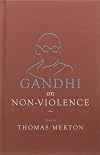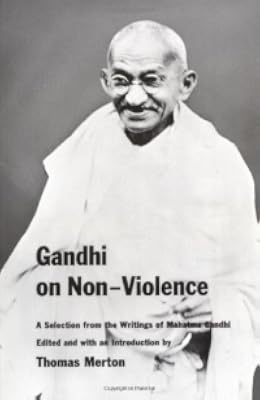
Gandhi on Non-Violence: A Selection From the Writings of Mahatma Gandi
by Mahatma Gandhi
On This Page
Description
"One has to speak out and stand up for one's convictions. Inaction at a time of conflagration is inexcusable."--Mahatma Gandhi The basic principles of Gandhi's philosophy of non-violence (Ahimsa) and non-violent action (Satyagraha) were chosen by Thomas Merton for this volume in 1965. In his challenging Introduction, "Gandhi and the One-Eyed Giant," Merton emphasizes the importance of action rather than mere pacifism as a central component of non-violence, and illustrates how the foundations show more of Gandhi's universal truths are linked to traditional Hindu Dharma, the Greek philosophers, and the teachings of Christ and Thomas Aquinas. Educated as a Westerner in South Africa, it was Gandhi's desire to set aside the caste system as well as his political struggles in India which led him to discover the dynamic power of non-cooperation. But, non-violence for Gandhi "was not simply a political tactic," as Merton observes: "the spirit of non-violence sprang from an inner realization of spiritual unity in himself." Gandhi's politics of spiritual integrity have influenced generations of people around the world, as well as civil rights leaders from Martin Luther King, Jr. and Steve Biko to Václav Havel and Aung San Suu Kyi. Mark Kurlansky has written an insightful preface for this edition that touches upon the history of non-violence and reflects the core of Gandhi's spiritual and ethical doctrine in the context of current global conflicts. show lessTags
Recommendations






























Member Reviews
For this paperback, Thomas Merton selected the basic statements of principle and interpretation which make up Gandhi's philosophy of non-violence (ahimsa) and non-violent action (satyagraha). For many, throughout the world, Mohandas Gandhi stands as the greatest figure of the 20th Century. In his long introduction to this book-and it is one of his most challenging essays-Father Merton shows how Gandhi linked the thought of East and West in his search for universal truth, and how, for him, non-violence sprang from realization of spiritual unity in the individual. Merton relates Gandhi's Ahmisa to tradtional Hindu Dharma, to the Greek and our own concepts of personal freedom, and to the thinking of Thomas Aquinas and later Catholic show more theologians on conscience, good-and -evil, and peace.
The Ghandi text follows that established by the Navajivan Trust. Its sectons deal with 'Principles of non-violence,' 'Non-violence, true and false,' 'Spritual dimensions of non-violence,' 'The political scope on non-violence,' and 'The purity of non-violence.'
Contents
I Introduction: Gandhi and the one-eyed giant by Thomas Merton
II Selections from Gandhi's Non-Violence in Peace and War
Section One Principles of non-violence
Section Two Non-Violence: True and false
Section Three The spiritual dimensions of non-violence
Section Four The political scope of non-violence
Section Five The purity of non-violence
Notes
Index show less
The Ghandi text follows that established by the Navajivan Trust. Its sectons deal with 'Principles of non-violence,' 'Non-violence, true and false,' 'Spritual dimensions of non-violence,' 'The political scope on non-violence,' and 'The purity of non-violence.'
Contents
I Introduction: Gandhi and the one-eyed giant by Thomas Merton
II Selections from Gandhi's Non-Violence in Peace and War
Section One Principles of non-violence
Section Two Non-Violence: True and false
Section Three The spiritual dimensions of non-violence
Section Four The political scope of non-violence
Section Five The purity of non-violence
Notes
Index show less
IB-4
Nov 27, 2020Catalan
Ratings
Members
- Recently Added By
Author Information

624+ Works 9,692 Members
Mohandas Gandhi is well known as a political activist and pacifist who played a key role in achieving India's independence from Great Britain. Although born in Porbandar, India, to parents of the Vaisya (merchant) caste, he was given a modern education and eventually studied law in London. After returning briefly to India, Gandhi went to South show more Africa in 1893, where he spent the next 20 years working to secure Indian rights. It was during this time that he experimented with and developed his basic philosophy of life. Philosophically, Gandhi is best known for his ideas of satyagraha (truth-force) and ahimsa (nonharming). Intrinsic to the idea of truth-force is the correlation between truth and being; truth is not merely a mental correspondence with reality but a mode of existence. Hence, the power of the truth is not what one argues for but what one is. He developed this idea in conjunction with the principle of nonviolence, showing in his nationalist activities that the force of truth, expressed nonviolently, can be an irresistible political weapon against intolerance, racism, and social violence. Although his basic terminology and conceptual context were Hindu, Gandhi was impressed by the universal religious emphasis on the self-transformative power of love, drawing his inspiration from Christianity, Western philosophy, and Islam as well. (Bowker Author Biography) show less
Some Editions
Work Relationships
Is abridged in
Common Knowledge
- People/Characters
- Mohandas Gandhi
Classifications
Statistics
- Members
- 374
- Popularity
- 83,903
- Reviews
- 2
- Rating
- (3.82)
- Languages
- English, Spanish
- Media
- Paper, Ebook
- ISBNs
- 6
- ASINs
- 7