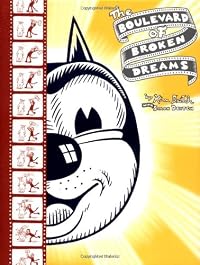
The Boulevard of Broken Dreams
by Kim Deitch (Author), Simon Deitch (Author)
On This Page
Description
The newest addition to Pantheon's growing list of graphic novels: a visually beautiful, narratively intricate, and powerful book by one of the most original, and–until now–least recognized comic artists at work today. The place is New York City in 1933. The setting: the Fontaine Talking Fables animation studio. Teddy Mishkin–definitely alcoholic, possibly insane–is hard at work on the latest cartoon short for Waldo the Cat, the "star" of Fontaine's stable of animated characters. But show more little does anyone (except Teddy) realize that Waldo is real–and that he is Teddy's insidiously helpful assistant. show lessTags
Recommendations





Member Recommendations
stephmo Koslowski takes the aspect of the Toon living amongst people further - it's no longer a fantasy or something to indicate insanity. At the same time, the pressures of the world of Hollywood and cartoons take a darker turn.
Member Reviews
It took me a while to engage the style of this work, which is sort of a more graphically rigorous and less sordid version R. Crumb. It's not nearly as appealing at first glance as Chris Ware, for example. Once you are engaged, though, the visual storytelling is masterful. The story spans the very beginnings of animation in Vaudeville to the present-day world of theme parks and licensed collectibles. Deitch lays out a twisting moral and psychological path largely through the eyes of Ted Mishkin, an alcoholic animator tormented by the mischievous, sometimes demonic, but also pathetic character of Waldo the Cat.
This was kind of a strange book and totally not what I thought it would be about. But the story is very interesting and once you wrap your head around what it's actually about (i.e. not Waldo the cat but his creators and the life and death of their studio) you realize how interesting it really is.
This book is beautifully illustrated with intricate psychadelic splash pages that are dizzying even with their lack of color, if derivative of well-worn artistic territory pioneered by, for example, R. Crumb. The art is the highlight of an otherwise mediocre, sophomoric book. I didn't want the book on my shelf after I finished it, it was so disposeable.
An artist is tortured by a character he supposedly invented, but who is actually channeled from his own repressed desires. The character is marketed for children by a ruthless corporate opportunist, but moonlights in ruining the artists' life, driving him insane. It is Felix the Cat meets Fritz the Cat, replete with cat cartoon character. The female lead character Lillian, is a lone show more beacon of interesting writing in this book. It is too bad the comic was not about her instead. show less
An artist is tortured by a character he supposedly invented, but who is actually channeled from his own repressed desires. The character is marketed for children by a ruthless corporate opportunist, but moonlights in ruining the artists' life, driving him insane. It is Felix the Cat meets Fritz the Cat, replete with cat cartoon character. The female lead character Lillian, is a lone show more beacon of interesting writing in this book. It is too bad the comic was not about her instead. show less
http://nhw.livejournal.com/551536.html
To be honest, after I'd read the first quarter, I thought I was probably going to have to write this up as a dud. Deitch's style is very close to Robert Crumb's; I find it crowded and grotesque, I had difficulty telling the difference between some of the characters, and it all seemed to be about the difficult life of the graphics artist (though specifically here on animated films rather than dead tree comics).
But then I started reading the next section, and suddenly realised that this was a rich, multi-layered narrative, where the same events were told over again from different points of view, and that was in fact saying much more about human relationships than about the comics writer's lonely life. show more I put it down with difficulty last night, half way through; then read it to the end this evening and then went back to the start to pick up things I had missed first time round. I still don't much like the drawing style, but am prepared to put that aside for the story.
What's it about? Well, on one level it's about the Mishkin family, Ted Mishkin being the graphic ilustrator who is the central character, and their various professional acquaintances; but on another, we have the cryptic figure of Waldo The Cat, visible only to Ted (and later to his nephew Nathan) and in a sense his Muse, but also the star of the cartoons that he writes successfully. There's also a certain amount of history of the industry mixed in - I assume that the depiction of vaudeville cinematography in 1910 is more or less accurate, and the skewering of Walt Disney in person is a brief delight. An animated excerpt (with no spoilers for the rest of the plot) can be found here. On balance I would recommend this, but it makes you work harder than I sometimes like to do. show less
To be honest, after I'd read the first quarter, I thought I was probably going to have to write this up as a dud. Deitch's style is very close to Robert Crumb's; I find it crowded and grotesque, I had difficulty telling the difference between some of the characters, and it all seemed to be about the difficult life of the graphics artist (though specifically here on animated films rather than dead tree comics).
But then I started reading the next section, and suddenly realised that this was a rich, multi-layered narrative, where the same events were told over again from different points of view, and that was in fact saying much more about human relationships than about the comics writer's lonely life. show more I put it down with difficulty last night, half way through; then read it to the end this evening and then went back to the start to pick up things I had missed first time round. I still don't much like the drawing style, but am prepared to put that aside for the story.
What's it about? Well, on one level it's about the Mishkin family, Ted Mishkin being the graphic ilustrator who is the central character, and their various professional acquaintances; but on another, we have the cryptic figure of Waldo The Cat, visible only to Ted (and later to his nephew Nathan) and in a sense his Muse, but also the star of the cartoons that he writes successfully. There's also a certain amount of history of the industry mixed in - I assume that the depiction of vaudeville cinematography in 1910 is more or less accurate, and the skewering of Walt Disney in person is a brief delight. An animated excerpt (with no spoilers for the rest of the plot) can be found here. On balance I would recommend this, but it makes you work harder than I sometimes like to do. show less
Deitch's Waldo story follows the rise of Waldo the Cat - first as an idea in Vaudeville and through to a piece of reemergence as a nostalgia and marketing gimmick for a Disney-like company. The story is falls back in on itself, with the time-line crossing back and forth and Kim Dietch inserted briefly at early points in the story with Nathan Mishkin, grandson and keeper of Waldo.
The problem is that Waldo is real. Maybe. If you're insane. Or not. Or are. This becomes a problem in the story - Waldo's ability to influence is at first a great thing, but as Waldo becomes a thing to make money off of, Waldo becomes angry. It is enough to drive a creator mad, right?
Throughout this, Deitch builds a terrific behind-the-scenes story of affairs, show more secret business deals, artistic integrity and even a murder mystery that manages to follow the real-life history of entertainment from Vaudeville through the Golden Age of Disney through the Red Scare and our need to wax nostalgic if we can make a buck from it. The characters are very real and flawed, even if they're not supposed to actually be there.
Detich's drawings are nothing short of amazing. The detail is amazing, and the additional storytelling offered in the detail will have you flipping back through the pages more than once. show less
The problem is that Waldo is real. Maybe. If you're insane. Or not. Or are. This becomes a problem in the story - Waldo's ability to influence is at first a great thing, but as Waldo becomes a thing to make money off of, Waldo becomes angry. It is enough to drive a creator mad, right?
Throughout this, Deitch builds a terrific behind-the-scenes story of affairs, show more secret business deals, artistic integrity and even a murder mystery that manages to follow the real-life history of entertainment from Vaudeville through the Golden Age of Disney through the Red Scare and our need to wax nostalgic if we can make a buck from it. The characters are very real and flawed, even if they're not supposed to actually be there.
Detich's drawings are nothing short of amazing. The detail is amazing, and the additional storytelling offered in the detail will have you flipping back through the pages more than once. show less
This was kind of a strange book and totally not what I thought it would be about. But the story is very interesting and once you wrap your head around what it's actually about (i.e. not Waldo the cat but his creators and the life and death of their studio) you realize how interesting it really is.
This was kind of a strange book and totally not what I thought it would be about. But the story is very interesting and once you wrap your head around what it's actually about (i.e. not Waldo the cat but his creators and the life and death of their studio) you realize how interesting it really is.
Members
- Recently Added By
Lists

Read
293 works; 4 members
Author Information

All Editions
Awards and Honors
Notable Lists
Common Knowledge
- Canonical title
- The Boulevard of Broken Dreams
- Original publication date
- 2002-09-24
- People/Characters
- Waldo; Winsor Newton; Milton the Mastodon; Fred Fontaine; Ted Mishkin; Al Mishkin (show all 10); Reba Fontaine; Lillian Freer; Jack Schick; Nathan Mishkin
- Important places
- New York, New York, USA
- Dedication
- This book is dedicated to my mother, my father, both of my brothers, Art Spiegelman, Chris Ware, Chip Kidd, and most of all, to my lovely wife, Pam.
- First words
- A question I'm often asked is, "where do you get your ideas?"
- Last words
- (Click to show. Warning: May contain spoilers.)No two ways about it...
...they just don't make 'em like they used to. - Blurbers
- Spiegelman, Art
Classifications
- Genre
- Graphic Novels & Comics
- DDC/MDS
- 741.5973 — Arts & recreation Drawing & decorative arts Drawing Comic books, graphic novels, fotonovelas, cartoons, caricatures, comic strips History, geographic treatment, biography North American United States (General)
- LCC
- PN6727 .D383 .B68 — Language and Literature Literature (General) Literature (General) Collections of general literature Comic books, strips, etc.
Statistics
- Members
- 210
- Popularity
- 155,042
- Reviews
- 13
- Rating
- (3.89)
- Languages
- English, French
- Media
- Paper
- ISBNs
- 3