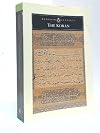
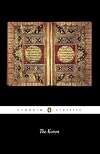
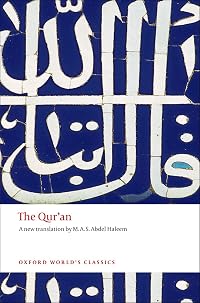
The Koran (Dawood, 1956)
by N. J. Dawood (Translator)
On This Page
Description
The Koran is universally accepted by Muslims to be the infallible Word of God as first revealed to the Prophet Muhammad by the Angel Gabriel nearly fourteen hundred years ago. Its 114 chapters, or surahs, recount the narratives central to Muslim belief, and together they form one of the world's most influential prophetic works and a literary masterpiece in its own right. But above all, the Koran provides the rules of conduct that remain fundamental to the Muslim faith today: prayer, fasting, show more pilgrimage to Mecca and absolute faith in God. show lessTags
Recommendations
















Member Reviews
My reaction to Islam’s holy book is conditioned by my negative opinion of Muḥammad. Of course, even to entertain such thoughts risks hellfire: “You shall not speak ill of God’s apostle…this would surely be a grave offence in the sight of God. Whether you reveal or conceal them, God has knowledge of all things” (33:53). Muslim readers may want to avoid this review for that reason, and because I will assume throughout that Muḥammad (not God) authored the book. That said, let us embark on a journey into the book that guides a quarter of the world’s population.
Right away, I find that the Koran repeats itself a lot. And by a lot, I mean A Lot. Muḥammad’s themes were as sparse as the Arabian desert and he hammered them show more hard. In the beginning, when God created the angels and the jinn and humans, Satan refused the command to bow before us. God condemned him to Hell but granted his request for time to drag as many of us down with him as he can. Satan actively works to turn us from the rightly-guided path, and enjoys quite a bit of success since most of us scorn God’s messengers and fail to comprehend that Hell is real and forever. At the Last Day, all will be resurrected: some to enter a Paradise of shaded gardens, flowing waters, bashful dark-eyed houris, and fruit served by eternally youthful boys; the rest to enter a realm of flame with filth to eat, scalding water to drink, and skin that burns away only to regenerate and burn again.
Everything in the Koran is an expansion or variation on these themes, limiting the book’s appeal to me as a literary work. However, I also recognize that this lent itself to surviving and thriving in an unevenly literate population dependent on oral transmission. When Moses sees the light of the burning bush flickering in the distance, part of his motivation for investigating is to get some news from those who lit the fire (27:7). Word of mouth was the text chain of the time, and the Koran’s repetition of themes is well suited to memorization and recital by believers transiting caravan routes and crossing seas.
That’s not to say the Koran’s message was an easy fit for 7th-century Arabia, despite Muḥammad’s frequent analogy of resurrection with the rains that make the desert bloom, his regulation of ritual camel sacrifice (22:36), and his warning that God could at any time unleash a deadly sandstorm of retribution (67:17). Rather than instant acceptance, Muḥammad ran into a wall of backlash:
• "The unbelievers ask: ‘Why was the Koran not revealed to him entire in a single revelation’" (25:32)?
• "Some say: ‘It is but a medley of dreams.’ Others: ‘He has invented it himself.’ And yet others: ‘He is a poet: let him show us some sign, as did the apostles in days gone by’" (21:5).
• "They replied [to Noah]: ‘Are we to believe in you when your followers are but the lowest of the low’" (26:111)?
• "They also say: ‘Why has this Koran not been revealed to some important man from the two towns’" (43:31)?
• "Never have you read a book before this, nor have you ever transcribed one with your right hand. Had you done either, the unbelievers might have doubted. But to those who are endowed with knowledge it is an undoubted sign. Only the wrongdoers deny Our signs" (29:48).
• "The unbelievers say: ‘Pay no heed to this Koran. Cut short its recital with booing and laughter, so that you may gain the upper hand’" (41:26).
• "The unbelievers are like beasts which, call out to them as one may, can hear nothing but a shout and a cry. Deaf, dumb, and blind, they understand nothing" (2:171).
I attribute Arabian resistance to three things. First is a natural distaste for altering one’s belief system when you’re happy the way you are. Second, Muḥammad demanded radical morality. The closest thing I find to an Islamic Ten Commandments (17:22-38) requires worship of God alone, honor of parents, thriftiness in personal expenses, generosity in support of the destitute, abrogation of the custom of burying unwanted infant daughters alive, flight from adultery, and abstention from killing except in the cause of justice — and then only within reasonable limits. No doubt it was these strictures, attractive even in the modern age, that drew some to Muḥammad even as they generated hostility.
Third, though, I suspect Muḥammad met resistance due to the total war he declared on idolatry. He could be ambivalent toward monotheistic Jews and Christians as wayward cousins who might on occasion offer true worship: “Had God not defended some men by the might of others, monasteries and churches, synagogues and mosques in which His praise is daily celebrated, would have been utterly destroyed” (22:40). No such leniency was possible toward idolaters: “Fight against them until idolatry is no more and God’s religion reigns supreme” (8:39). The only response to idolatry was violence: “Fight for the sake of God those that fight against you, but do not attack them first. God does not love aggressors. Slay them wherever you find them. Drive them out of the places from which they drove you. Idolatry is more grievous than bloodshed” (2:190-191).
If I were a traditional Arabian satisfied with my plural gods, I might not appreciate a self-designated prophet who earmarks me for extermination. And, of course, self-proclaimed prophets never can contain their ambitions. Muḥammad eventually rescinded his protection from Jews and Christians who failed to take him seriously: “Fight against such of those to whom the Scriptures were given as believe in neither God nor the Last Day, who do not forbid what God and His apostle have forbidden, and do not embrace the truth Faith, until they pay tribute out of hand and are utterly subdued” (9:29). All the proof he cared to provide was your crumbling defenses: “Do you not see how We invade their land and diminish its borders? If God decrees a thing, none can reverse it. Swift is His reckoning” (13:41).
And herein lies my beef with Muḥammad. Set aside the fact that his faith reverses so many key tenets of my own; e.g., “God does not love the evil-doers” (3:57) and “Let evil be rewarded with evil” (42:40). Set aside the contrast between Jesus, who said the collapse of the Tower of Siloam was not a sign of unusually great sin, and Muḥammad, who said the collapse of the dam in Sheba was a sign that they got what they had coming (34:16-17). Set aside the gloating Muḥammad imagines for those who can look down on their friends in Hell and tell them how glad they are to be in Paradise instead (37:55-57).
Set aside the message, in other words, and look at Muḥammad the man; and it’s hard not to see a tyrant high on his own supply. When Muḥammad married the ex-wife of his adopted son, he gave himself a divine thumbs-up: “No blame shall be attached to the Prophet for doing what is sanctioned for him by God” (33:38). When two of his wives confronted him over bad behavior, he gave himself a divine hall pass and threatened his wives with replacement: “Prophet, why do you prohibit that which God has made lawful for you, in seeking to please your wives? If you two turn to God in repentance (for your hearts have sinned) you shall be pardoned….It may well be that, if he divorces you, his Lord will give him in your place better wives than yourselves, submissive to God and full of faith, obedient, penitent, devout, and given to fasting; both formerly-wedded and virgins” (66:1-5).
It’s hard for me to take seriously a man who grants himself license to do whatever he wants while threatening everyone else with divorce, domination, death, and Hell. Even disregarding what seems to me deep demerits of the message, I can’t get past the man who brought it. The closest I get to connecting with Muḥammad is when I read Surah 33:53: “Believers, do not enter the houses of the Prophet for a meal without waiting for the proper time….But if you are invited, enter; and when you have eaten, disperse. Do not engage in familiar talk, for this would annoy the Prophet.” I could almost forgive Muḥammad for constructing an entire religion just to ban unwanted guests and avoid small talk. show less
Right away, I find that the Koran repeats itself a lot. And by a lot, I mean A Lot. Muḥammad’s themes were as sparse as the Arabian desert and he hammered them show more hard. In the beginning, when God created the angels and the jinn and humans, Satan refused the command to bow before us. God condemned him to Hell but granted his request for time to drag as many of us down with him as he can. Satan actively works to turn us from the rightly-guided path, and enjoys quite a bit of success since most of us scorn God’s messengers and fail to comprehend that Hell is real and forever. At the Last Day, all will be resurrected: some to enter a Paradise of shaded gardens, flowing waters, bashful dark-eyed houris, and fruit served by eternally youthful boys; the rest to enter a realm of flame with filth to eat, scalding water to drink, and skin that burns away only to regenerate and burn again.
Everything in the Koran is an expansion or variation on these themes, limiting the book’s appeal to me as a literary work. However, I also recognize that this lent itself to surviving and thriving in an unevenly literate population dependent on oral transmission. When Moses sees the light of the burning bush flickering in the distance, part of his motivation for investigating is to get some news from those who lit the fire (27:7). Word of mouth was the text chain of the time, and the Koran’s repetition of themes is well suited to memorization and recital by believers transiting caravan routes and crossing seas.
That’s not to say the Koran’s message was an easy fit for 7th-century Arabia, despite Muḥammad’s frequent analogy of resurrection with the rains that make the desert bloom, his regulation of ritual camel sacrifice (22:36), and his warning that God could at any time unleash a deadly sandstorm of retribution (67:17). Rather than instant acceptance, Muḥammad ran into a wall of backlash:
• "The unbelievers ask: ‘Why was the Koran not revealed to him entire in a single revelation’" (25:32)?
• "Some say: ‘It is but a medley of dreams.’ Others: ‘He has invented it himself.’ And yet others: ‘He is a poet: let him show us some sign, as did the apostles in days gone by’" (21:5).
• "They replied [to Noah]: ‘Are we to believe in you when your followers are but the lowest of the low’" (26:111)?
• "They also say: ‘Why has this Koran not been revealed to some important man from the two towns’" (43:31)?
• "Never have you read a book before this, nor have you ever transcribed one with your right hand. Had you done either, the unbelievers might have doubted. But to those who are endowed with knowledge it is an undoubted sign. Only the wrongdoers deny Our signs" (29:48).
• "The unbelievers say: ‘Pay no heed to this Koran. Cut short its recital with booing and laughter, so that you may gain the upper hand’" (41:26).
• "The unbelievers are like beasts which, call out to them as one may, can hear nothing but a shout and a cry. Deaf, dumb, and blind, they understand nothing" (2:171).
I attribute Arabian resistance to three things. First is a natural distaste for altering one’s belief system when you’re happy the way you are. Second, Muḥammad demanded radical morality. The closest thing I find to an Islamic Ten Commandments (17:22-38) requires worship of God alone, honor of parents, thriftiness in personal expenses, generosity in support of the destitute, abrogation of the custom of burying unwanted infant daughters alive, flight from adultery, and abstention from killing except in the cause of justice — and then only within reasonable limits. No doubt it was these strictures, attractive even in the modern age, that drew some to Muḥammad even as they generated hostility.
Third, though, I suspect Muḥammad met resistance due to the total war he declared on idolatry. He could be ambivalent toward monotheistic Jews and Christians as wayward cousins who might on occasion offer true worship: “Had God not defended some men by the might of others, monasteries and churches, synagogues and mosques in which His praise is daily celebrated, would have been utterly destroyed” (22:40). No such leniency was possible toward idolaters: “Fight against them until idolatry is no more and God’s religion reigns supreme” (8:39). The only response to idolatry was violence: “Fight for the sake of God those that fight against you, but do not attack them first. God does not love aggressors. Slay them wherever you find them. Drive them out of the places from which they drove you. Idolatry is more grievous than bloodshed” (2:190-191).
If I were a traditional Arabian satisfied with my plural gods, I might not appreciate a self-designated prophet who earmarks me for extermination. And, of course, self-proclaimed prophets never can contain their ambitions. Muḥammad eventually rescinded his protection from Jews and Christians who failed to take him seriously: “Fight against such of those to whom the Scriptures were given as believe in neither God nor the Last Day, who do not forbid what God and His apostle have forbidden, and do not embrace the truth Faith, until they pay tribute out of hand and are utterly subdued” (9:29). All the proof he cared to provide was your crumbling defenses: “Do you not see how We invade their land and diminish its borders? If God decrees a thing, none can reverse it. Swift is His reckoning” (13:41).
And herein lies my beef with Muḥammad. Set aside the fact that his faith reverses so many key tenets of my own; e.g., “God does not love the evil-doers” (3:57) and “Let evil be rewarded with evil” (42:40). Set aside the contrast between Jesus, who said the collapse of the Tower of Siloam was not a sign of unusually great sin, and Muḥammad, who said the collapse of the dam in Sheba was a sign that they got what they had coming (34:16-17). Set aside the gloating Muḥammad imagines for those who can look down on their friends in Hell and tell them how glad they are to be in Paradise instead (37:55-57).
Set aside the message, in other words, and look at Muḥammad the man; and it’s hard not to see a tyrant high on his own supply. When Muḥammad married the ex-wife of his adopted son, he gave himself a divine thumbs-up: “No blame shall be attached to the Prophet for doing what is sanctioned for him by God” (33:38). When two of his wives confronted him over bad behavior, he gave himself a divine hall pass and threatened his wives with replacement: “Prophet, why do you prohibit that which God has made lawful for you, in seeking to please your wives? If you two turn to God in repentance (for your hearts have sinned) you shall be pardoned….It may well be that, if he divorces you, his Lord will give him in your place better wives than yourselves, submissive to God and full of faith, obedient, penitent, devout, and given to fasting; both formerly-wedded and virgins” (66:1-5).
It’s hard for me to take seriously a man who grants himself license to do whatever he wants while threatening everyone else with divorce, domination, death, and Hell. Even disregarding what seems to me deep demerits of the message, I can’t get past the man who brought it. The closest I get to connecting with Muḥammad is when I read Surah 33:53: “Believers, do not enter the houses of the Prophet for a meal without waiting for the proper time….But if you are invited, enter; and when you have eaten, disperse. Do not engage in familiar talk, for this would annoy the Prophet.” I could almost forgive Muḥammad for constructing an entire religion just to ban unwanted guests and avoid small talk. show less
This is a must-read whether you’re an atheist, Jew, Christian, Muslim, Buddhist, Pagan--whatever. Followers of Islam number one-and-a-half billion people--they’re the second most populous faith in the world and their impact on history has been profound. I believe that anyone that doesn’t read the Jewish and Christian Bible, the Koran, the Upanishads (sacred to 900 million Hindus and among the oldest written works) and at least try to get their message is going to be handicapped in understanding the world around them. Christians should also be interested in how the Koran incorporates stories from the Bible: Adam, Noah, Jonah, Mary and Jesus--they’re all in there. (Although I prefer the stories in the original source.)
I’m an show more atheist, but I did rate the Bible five stars without reservations and meant it. Not only because it’s essential reading given it’s sacred to 2 billion Christians, the largest world faith, not only because it is one of the oldest writings, giving us an insight into the origins of what it means to be human, but because, in essence, the Bible is not a book--it’s a library--a collection of great poetry and stories.
The Koran is different. Both on Goodreads and Librarything we’re forced to give the authorship of any works held as sacred as “anonymous” but from both a secular and religious point of view that just isn’t accurate. In the case of the Bible, the books in it all have traditional ascriptions. The first five books of the Hebrew Bible are believed by the faithful to have been written by Moses, the other books are usually named after their purported authors. From a secular point of view, although scholars might dispute authorship, it’s like the case with Homer. Many scholars believe that the Iliad and the Odyssey were written 300 years apart, but we give the traditional authorship as Homer for both because it’s convenient and we don’t know better. Jews and Christians alike don’t believe the Bible is written by God--the faithful believe it’s inspired by God, so from both the believing and skeptic point of view the authorship of the Hebrew Bible and the New Testament is “various.” It’s different with the Koran. Mohammed’s claim is that he was reciting the direct word of God as given him by the angel Gabriel. So from the point of view of the believing Muslim, the author of the Koran is God. But for a nonbeliever like me, it’s obviously by one man--Mohammed--who lived from 570 to 632 AD. And judging this book by a secular standard, no I can’t see it as equal to the Bible.
Now, I recognize I do have handicaps evaluating this book. Atheist I might be, but growing up in America I was raised in a Catholic household, educated in Catholic institutions, and surrounded by a dominant Christian culture. I had to take catechism to receive Communion and take classes in Religion to graduate my high school and college. It meant I had a cultural context and familiarity with the Bible well before I ever decided to read it cover to cover. I didn’t and don’t really have that with Islam. For a believing Muslim, reading the Koran in translation as I did means I didn’t really read the Koran. Remember, Mohammed’s claim is that he was reciting the word of God--in Arabic.
But The Koran just didn’t appeal to me, even comparing it to other sacred texts. It’s pretty rambling and unstructured, really a collection of sayings of the Prophet. It’s composed of “suras,” 114 verses on various subjects, and traditionally not ordered thematically, although that’s an order imposed in Dawood’s popular translation, which I own. The longest sura, “The Cow” runs to about 30 pages in my paperback edition but the rest are about ten pages at the longest, and many suras consist of only a few lines. It’s not unlike Confucius’ Analects in that structure. Although while the Analects expressed a philosophy too authoritarian for my tastes, at least it only claimed to simply be derived from his own wisdom and that of previous sages--not the word of God, and it eschewed the supernatural. And goodness knows the God of the Bible can be wrathful and misogynistic, but The Koran? There’s this fairly obscure sura, Number 111, known as “Fibre” cursing Mohammed’s uncle who opposed him:
May the hands of Abu-Lahab perish! May he himself perish! Nothing shall his wealth avail him. He shall be burnt in a flaming fire, and his wife, laden with faggots, shall have a rope of fibre round her neck!
That’s the sura in its entirety. Sounds pretty petty and vindictive for the word of an eternal, just, benevolent God. There’s also the infamous “Verse of the Sword” taken as a justification for Jihad: Slay the idolaters wherever you find them. Arrest them, besiege them, and lie in ambush everywhere for them. (Sura 9:5 “Repentence”) I read things like that and I couldn’t help but think of Jesus urging people to forgive their enemies and turn the other cheek. Or of passages in the Chinese classic Tao Te Ching speaking of the futility of war or that it’s the person without virtue who is consumed with exacting vengeance. There may be countless references in The Koran to God’s mercy and compassion, but that’s not the spirit I read in it reading it cover to cover. Never mind that a man shall inherit twice as much as a female (Sura 4:11 “Women”) and the testimony of a man is worth that of two women. (Sura 2:282 “The Cow”) Given the world we find ourselves in, I actually wanted to find much good in The Koran. But, even knowing the vagaries of translation and interpretation, I can’t read this book and and honestly claim my overall impression was in any way positive. And on Goodreads, at least, one star means "didn't like"--so if I'm going to be honest in my ratings, that's the one that fits. show less
I’m an show more atheist, but I did rate the Bible five stars without reservations and meant it. Not only because it’s essential reading given it’s sacred to 2 billion Christians, the largest world faith, not only because it is one of the oldest writings, giving us an insight into the origins of what it means to be human, but because, in essence, the Bible is not a book--it’s a library--a collection of great poetry and stories.
The Koran is different. Both on Goodreads and Librarything we’re forced to give the authorship of any works held as sacred as “anonymous” but from both a secular and religious point of view that just isn’t accurate. In the case of the Bible, the books in it all have traditional ascriptions. The first five books of the Hebrew Bible are believed by the faithful to have been written by Moses, the other books are usually named after their purported authors. From a secular point of view, although scholars might dispute authorship, it’s like the case with Homer. Many scholars believe that the Iliad and the Odyssey were written 300 years apart, but we give the traditional authorship as Homer for both because it’s convenient and we don’t know better. Jews and Christians alike don’t believe the Bible is written by God--the faithful believe it’s inspired by God, so from both the believing and skeptic point of view the authorship of the Hebrew Bible and the New Testament is “various.” It’s different with the Koran. Mohammed’s claim is that he was reciting the direct word of God as given him by the angel Gabriel. So from the point of view of the believing Muslim, the author of the Koran is God. But for a nonbeliever like me, it’s obviously by one man--Mohammed--who lived from 570 to 632 AD. And judging this book by a secular standard, no I can’t see it as equal to the Bible.
Now, I recognize I do have handicaps evaluating this book. Atheist I might be, but growing up in America I was raised in a Catholic household, educated in Catholic institutions, and surrounded by a dominant Christian culture. I had to take catechism to receive Communion and take classes in Religion to graduate my high school and college. It meant I had a cultural context and familiarity with the Bible well before I ever decided to read it cover to cover. I didn’t and don’t really have that with Islam. For a believing Muslim, reading the Koran in translation as I did means I didn’t really read the Koran. Remember, Mohammed’s claim is that he was reciting the word of God--in Arabic.
But The Koran just didn’t appeal to me, even comparing it to other sacred texts. It’s pretty rambling and unstructured, really a collection of sayings of the Prophet. It’s composed of “suras,” 114 verses on various subjects, and traditionally not ordered thematically, although that’s an order imposed in Dawood’s popular translation, which I own. The longest sura, “The Cow” runs to about 30 pages in my paperback edition but the rest are about ten pages at the longest, and many suras consist of only a few lines. It’s not unlike Confucius’ Analects in that structure. Although while the Analects expressed a philosophy too authoritarian for my tastes, at least it only claimed to simply be derived from his own wisdom and that of previous sages--not the word of God, and it eschewed the supernatural. And goodness knows the God of the Bible can be wrathful and misogynistic, but The Koran? There’s this fairly obscure sura, Number 111, known as “Fibre” cursing Mohammed’s uncle who opposed him:
May the hands of Abu-Lahab perish! May he himself perish! Nothing shall his wealth avail him. He shall be burnt in a flaming fire, and his wife, laden with faggots, shall have a rope of fibre round her neck!
That’s the sura in its entirety. Sounds pretty petty and vindictive for the word of an eternal, just, benevolent God. There’s also the infamous “Verse of the Sword” taken as a justification for Jihad: Slay the idolaters wherever you find them. Arrest them, besiege them, and lie in ambush everywhere for them. (Sura 9:5 “Repentence”) I read things like that and I couldn’t help but think of Jesus urging people to forgive their enemies and turn the other cheek. Or of passages in the Chinese classic Tao Te Ching speaking of the futility of war or that it’s the person without virtue who is consumed with exacting vengeance. There may be countless references in The Koran to God’s mercy and compassion, but that’s not the spirit I read in it reading it cover to cover. Never mind that a man shall inherit twice as much as a female (Sura 4:11 “Women”) and the testimony of a man is worth that of two women. (Sura 2:282 “The Cow”) Given the world we find ourselves in, I actually wanted to find much good in The Koran. But, even knowing the vagaries of translation and interpretation, I can’t read this book and and honestly claim my overall impression was in any way positive. And on Goodreads, at least, one star means "didn't like"--so if I'm going to be honest in my ratings, that's the one that fits. show less
(Disclaimer: I'm a Christian, so I was hardly able to give this an unbiased reading.)
For a number of years now I've had it in my mind to read the Quran, the holy book of Islam. That desire became more of a priority since September 11th and finally at the last Friends of the Library book sale, I searched out and bought my own copy. It's not an "official" copy. Dawood is a scholar who wants to leave the questions "of Mohammed's prophethood and his theological sources" to the reader to decide for him or herself. He even has rearranged the surahs from their classic organization to one that is more thematic. (But he does provide the traditional numbering, so I was able to read the book in the traditional order.) But like some of the show more untraditional translations or paraphrases of the Bible, I think that the main message can still come through. First off, I was slightly surprised that the book wasn't as lame or unreadable as it might have been. There are some beautiful expressions of faith in God, even though they're tarnished by an incomplete understanding of Him. I can see why this book has stood the test of time. Where it fell short--the reason it didn't make me interested in becoming a Muslim--is that there's a subtle focus on Mohammed. Over and over again The Koran reiterates that Allah can and will raise the dead, that those who had scoffed at previous prophets suffered for it, that Allah has no daughters, that those who deny the Quran's message will suffer in hell. These are things that all tie in with Mohammed's problems as he tried to bring his message to the people of Mecca and Medina. In contrast, the Bible talks about people of various stations and in various situations relating to God and each other. We see Moses as an infant, a sinner, a priest and an administrator as well as the prophet who confronted Pharaoh. In The Koran, you only see the latter. Like the Book of Mormon, I found The Koran to be rather lackluster in comparison to the Bible. Unlike the New Testament, I found no continuity between the Old Testament and The Koran. If this is a new revelation from Allah, why doesn't it fit together as well? Anyway, I would recommend that you check it out, if you're so inclined. But you'd be much better off reading the Bible.
--J. show less
For a number of years now I've had it in my mind to read the Quran, the holy book of Islam. That desire became more of a priority since September 11th and finally at the last Friends of the Library book sale, I searched out and bought my own copy. It's not an "official" copy. Dawood is a scholar who wants to leave the questions "of Mohammed's prophethood and his theological sources" to the reader to decide for him or herself. He even has rearranged the surahs from their classic organization to one that is more thematic. (But he does provide the traditional numbering, so I was able to read the book in the traditional order.) But like some of the show more untraditional translations or paraphrases of the Bible, I think that the main message can still come through. First off, I was slightly surprised that the book wasn't as lame or unreadable as it might have been. There are some beautiful expressions of faith in God, even though they're tarnished by an incomplete understanding of Him. I can see why this book has stood the test of time. Where it fell short--the reason it didn't make me interested in becoming a Muslim--is that there's a subtle focus on Mohammed. Over and over again The Koran reiterates that Allah can and will raise the dead, that those who had scoffed at previous prophets suffered for it, that Allah has no daughters, that those who deny the Quran's message will suffer in hell. These are things that all tie in with Mohammed's problems as he tried to bring his message to the people of Mecca and Medina. In contrast, the Bible talks about people of various stations and in various situations relating to God and each other. We see Moses as an infant, a sinner, a priest and an administrator as well as the prophet who confronted Pharaoh. In The Koran, you only see the latter. Like the Book of Mormon, I found The Koran to be rather lackluster in comparison to the Bible. Unlike the New Testament, I found no continuity between the Old Testament and The Koran. If this is a new revelation from Allah, why doesn't it fit together as well? Anyway, I would recommend that you check it out, if you're so inclined. But you'd be much better off reading the Bible.
--J. show less
This is a wilfully bad translation by a Jew (I mean no anti-Semitism - my point is that he is not a Muslim but it's also not unexpected for a Jew in particular to want to misrepresent the Qur'an) of a nevertheless wilfully bad book that is however no worse than any other "revealed" book of religion. Interesting just because one can't know how good or bad something is until one reads it (and Islam has been in the news a lot lately). Islam is doing well to be as peaceful as it is considering the book from which it sprung. There is also much good in there, of course.
Earlier edition from 1974 by N.J.Dawood.
A newly revised edition of N. J. Dawood’this classic translation.
Ratings
Members
- Recently Added By
Author Information

Awards and Honors
Notable Lists
Common Knowledge
- Canonical title
- The Koran (Dawood, 1956) (Dawood, 1956)
- Alternate titles
- Quran, Qur'an
- Original publication date
- 632; 1143 (1st surviving translation into a Western language, Latin, Robert of Ketton) (1st surviving translation into a Western language, Latin, Robert of Ketton); 1543 (1st printed European translation, Latin, Robert of Ketton) (1st printed European translation, Latin, Robert of Ketton); 1616 (1st printed European vernacular translation, German, Salomon Schweigger) (1st printed European vernacular translation, German, Salomon Schweigger); 1641 (1st printed Dutch translation, Barent Adriaensz Berentsma) (1st printed Dutch translation, Barent Adriaensz Berentsma); 1647 (1st printed French translation, André du Ryer) (1st printed French translation, André | du Ryer) (show all 7); 1649 (1st printed English translation, Alexander Ross) (1st printed English translation, Alexander Ross)
- Original language
- Arabic
Classifications
- Genres
- Religion & Spirituality, Nonfiction
- DDC/MDS
- 297.122521 — Religion Other religions Islam Textual Sources Sacred Books and Scriptures Koran Translations Anglo-Saxon English
- LCC
- BP109 .K45 — Philosophy, Psychology and Religion Islam. Bahaism. Theosophy, etc. Islam. Bahai Faith. Theosophy, etc. Sacred books Koran
- BISAC
Statistics
- Members
- 773
- Popularity
- 36,108
- Reviews
- 7
- Rating
- (2.89)
- Languages
- English
- Media
- Paper, Audiobook, Ebook
- ISBNs
- 11
- ASINs
- 22